农业科技

Search documents
华尔街见闻早餐FM-Radio | 2025年10月29日
Hua Er Jie Jian Wen· 2025-10-28 23:29
Market Overview - US stock indices reached new highs, driven primarily by a few tech giants like Microsoft, Nvidia, and Apple, while most other stocks declined [3] - Microsoft announced a new partnership with OpenAI, leading to a 2% increase in its stock price, regaining a market cap of $4 trillion [3] - Nvidia's CEO expressed optimism about AI, resulting in a nearly 5% surge in its stock price, pushing its market cap close to $5 trillion [3] - Gold prices fell below $4,000 per ounce, marking a continuation of a downward trend, while silver experienced a V-shaped recovery [3][10] - The Chinese stock market saw the Shanghai Composite Index briefly surpass 4,000 points before closing down 0.2% [3] Key Developments - The "15th Five-Year Plan" emphasizes the need for breakthroughs in key technologies and the implementation of "AI+" initiatives, with a strong focus on finance [5][14] - The US private sector added an average of 14,000 jobs per week as of October 11, indicating a modest employment growth [6] - OpenAI transitioned to a profit-oriented organization, securing a $250 billion Azure service order from Microsoft, which holds a 27% stake in OpenAI [18] - Nvidia plans a $1 billion equity investment in Nokia to collaborate on AI and 6G networks, while also launching several partnerships in various sectors [17][21] Company Earnings - China Bank reported a return to profit growth in Q3, driven by non-interest income [26] - Ping An Insurance's Q3 net profit surged by 45.4%, showing accelerating growth [26] - ZTE's Q3 revenue increased by 5.11%, but net profit fell by 87.84% [27] - Sunny Solar's Q3 revenue grew by 20.83%, with a 57.04% increase in net profit [27] Industry Trends - The gold market is experiencing significant fluctuations, with a notable drop in ETF holdings, indicating reduced demand for safe-haven assets [15] - The AI sector is facing scrutiny, with concerns about potential bubbles as interest rates are expected to rise [21] - The gas turbine supply shortage is impacting the expansion of AI data centers, leading to increased demand for modified jet engines [38] Upcoming Events - The Federal Reserve is set to announce its interest rate decision, with market participants closely watching for any changes in monetary policy [39] - Major companies including Microsoft, Alphabet, Meta, Caterpillar, and Boeing are scheduled to release their earnings reports [40]




智慧农业装备集中亮相 “黑科技”为丰收保驾护航
Yang Shi Wang· 2025-10-28 14:11
Core Insights - The 32nd China Yangling Agricultural High-tech Achievements Expo showcases advanced technologies in smart agriculture, attracting over 1,800 enterprises from nearly 50 countries [1] - The event highlights the integration of robotics and AI in agriculture, emphasizing the shift towards intelligent farming practices [1][8] Group 1: Agricultural Robotics - New agricultural robots demonstrated at the expo include modular designs capable of performing tasks such as fruit picking and physical weeding using lasers [5][7] - The "Cool Cow" robot features high-precision mechanical arms that can pick fruits with a damage rate as low as 0.3%, utilizing AI to assess ripeness [7][8] - The rapid development cycle of agricultural robots is evident, with some products being developed and produced within a year [3] Group 2: Technology for Harvesting - Agricultural drones and logistics drones collaborated to optimize the harvesting process, ensuring timely collection of crops despite adverse weather conditions [8][10] - New machinery designed with all-track chassis allows for efficient operation in muddy conditions, addressing challenges faced during rainy seasons [10][12] Group 3: Sustainable Agricultural Practices - The expo serves as a platform for promoting green and sustainable agricultural practices, with over 100 new technologies introduced to enhance food security and production stability [15][17] - Innovations such as rainwater harvesting irrigation techniques have shown to save over 40% of water, contributing to sustainable farming [17][19] - The integration of clean energy sources like solar and wind power in high-standard farmland is part of the ongoing transformation towards sustainable agriculture [17][19] Group 4: Future Goals and Digital Integration - The goal for the next decade is to create a modern agricultural framework in Shaanxi, utilizing integrated technology and data management systems for efficient resource use [21] - The establishment of a comprehensive digital management system aims to enhance oversight and planning across over 30 million acres of high-standard farmland [21]


新疆七十年|天山南北的丰饶赞歌
Yang Shi Wang· 2025-10-28 12:59
Core Viewpoint - Xinjiang has transformed from a "desert wasteland" to a "western granary," showcasing the region's immense potential through significant agricultural advancements [1] Summary by Relevant Sections - **Irrigation and Land Expansion** - Irrigated area has expanded from over 27 million acres in 1955 to over 95.2 million acres today [1] - **Grain Production Growth** - Total grain production has surged from 1.1 million tons at the founding of New China to 23.302 million tons in 2024 [1] - Xinjiang is the only province in China to achieve a cumulative grain increase of over 10 billion pounds in three years [1] - **Technological Advancements in Agriculture** - The region employs smart irrigation techniques and technology, including intelligent sensor networks and drone operations, to enhance agricultural efficiency [1] - **Historical Transformation** - Xinjiang has transitioned from "internal balance" to "national supply," marking a historic shift in its agricultural role [1] - **Land Utilization** - The region boasts over 4 acres of arable land per capita, contributing to its status as a significant grain-producing area [1]
第32届杨凌农高会“四新”成果集中发布
Shan Xi Ri Bao· 2025-10-27 22:59
Core Insights - The 32nd Yangling Agricultural High-tech Fair showcased the release of 50 new agricultural technologies, including new varieties, techniques, models, and products [1][2] - Significant agricultural achievements include the new wheat variety "Xi Nong 1155" from Northwest A&F University and the new rapeseed variety "Qin You 797" from the Shaanxi Hybrid Rapeseed Research Center [1] - The event received submissions from various agricultural research institutions and enterprises across China, totaling 135 new varieties, technologies, products, and models [1] Summary by Categories New Agricultural Technologies - The released "Four New" achievements cover key areas such as biological breeding, smart agriculture, green production, and food processing, indicating high technological content and innovation value [2] - The emergence and promotion of these technologies are expected to break agricultural development bottlenecks, enhance production efficiency, improve rural ecological environments, and increase farmers' income [2] Research and Development - Institutions like Northwest A&F University and Shaanxi Agricultural Vocational and Technical University shared their latest research progress, promoting deep integration of production, education, and research [2] - The event aims to facilitate the transformation of laboratory breakthroughs into practical applications in the field, benefiting farmers and agricultural operators [2]
研报掘金丨国海证券:维持史丹利“买入”评级,看好复合肥量利齐升
Ge Long Hui A P P· 2025-10-23 14:59
Core Viewpoint - The report from Guohai Securities indicates that Stanley achieved a net profit attributable to shareholders of 208 million yuan in Q3 2025, representing a year-on-year increase of 35.36% but a quarter-on-quarter decrease of 34.61% due to favorable conditions from phosphate fertilizer exports [1] Industry Summary - The average export price of monoammonium phosphate in China for Q3 2025 was $698 per ton, equivalent to approximately 4,993 yuan per ton, significantly higher than the domestic average price [1] - Urea prices have experienced significant volatility, initially rising and then falling, influenced by supply-demand imbalances, export policy negotiations, and fluctuations in international energy prices [1] - Prices for monoammonium phosphate and potassium fertilizers remain high, primarily due to rising sulfur prices, adjustments in phosphate fertilizer export policies, domestic reductions in potassium fertilizer production, tight imports of potassium fertilizer, and geopolitical conflicts [1] Company Summary - The company focuses on compound fertilizers and has established significant competitive advantages in brand strength, marketing channel development, new product research, and agricultural services [1] - The company is actively advancing the construction of phosphate chemical projects, creating a complete industrial chain from phosphate chemicals to phosphate fertilizers and compound fertilizers [1] - The strategic value of technological innovation is increasingly prominent as leading companies in the industry enhance their R&D investments, driven by improvements in agricultural technology and the increasing penetration of digital and intelligent technologies in fertilization processes [1]


Valmont(VMI) - 2025 Q3 - Earnings Call Transcript
2025-10-21 14:02
Financial Data and Key Metrics Changes - The company reported net sales of $1.05 billion, reflecting a 2.5% year-over-year increase [14] - Operating margin improved by 120 basis points to 13.5%, with diluted earnings per share increasing by 21% to $4.98 [14][15] - Gross profit margin rose to 30.4%, an increase of 80 basis points from the previous year [14] Business Line Data and Key Metrics Changes - Infrastructure sales reached $808.3 million, up 6.6% year-over-year, with utility sales increasing by 12.3% driven by pricing and higher volumes [15] - Agriculture sales decreased by 9% year-over-year to $241.3 million, primarily due to lower irrigation equipment volumes in North America and economic pressures in Brazil [16][17] - Telecommunications sales grew by 37%, supported by a quick turnover strategy and alignment with carrier programs [15] Market Data and Key Metrics Changes - The utility market is experiencing strong demand driven by data center expansion, manufacturing onshoring, and broader electrification, with transmission CapEx expected to grow at a 9% CAGR through 2029 [8] - The Asia-Pacific market for lighting and transportation remains pressured, with operational challenges impacting performance [9] - In agriculture, grower sentiment in North America is soft, with the USDA expecting a 2.5% decline in crop receipts for 2025 [9][10] Company Strategy and Development Direction - The company is focused on simplifying its business, directing resources to high-return initiatives, and enhancing performance in attractive markets [5] - Valmont aims to lead the North American utility market through capacity expansion and operational improvements [5][19] - The company is investing in aftermarket parts and technology to build a more resilient agriculture business [7][20] Management's Comments on Operating Environment and Future Outlook - Management expressed confidence in the long-term fundamentals of the business despite near-term macro pressures [12] - The company is raising its full-year adjusted diluted earnings per share expectations to a range of $18.70 to $19.50 [22] - Management highlighted the importance of maintaining flexibility in capacity to respond to customer needs while ensuring operational efficiency [30] Other Important Information - The company recorded $11 million in bad debt expense due to tighter credit conditions in Brazil, impacting agriculture margins [17][67] - The company plans to consolidate solar revenues into another product line for reporting purposes starting in 2026 [15] - The company has a strong backlog in utility projects, with demand expected to remain robust across various product lines [57] Q&A Session Summary Question: Can you discuss the infrastructure margins and the most impactful margin improvement initiatives? - Management noted that pricing and cost actions have contributed to improved margins, with utility expansions expected to drive significant operating margin contributions [25][26] Question: What is the outlook for utility segment pricing trends? - Management indicated that pricing remains strong due to tariff mitigation plans and a tight demand-supply balance in the bid market [64][66] Question: Are current demand drivers in utility across different product lines? - Management confirmed strong demand across all product lines, driven by electrification, AI, and grid connectivity, with a healthy backlog extending into 2026 [57][58] Question: What is the expectation for agriculture margins moving forward? - Management expects agriculture margins to improve in Q1, with efforts to resolve current bad debt issues and a focus on maintaining double-digit operating margins [67][68]

Valmont(VMI) - 2025 Q3 - Earnings Call Transcript
2025-10-21 14:00
Financial Data and Key Metrics Changes - The company reported net sales of $1.05 billion, reflecting a year-over-year increase of 2.5% [12] - Operating margin improved by 120 basis points to 13.5%, with diluted earnings per share increasing by 21% to $4.98 [4][14] - Gross profit margin rose to 30.4%, an increase of 80 basis points from the previous year [12] Business Line Data and Key Metrics Changes - Infrastructure sales reached $808.3 million, growing 6.6% year-over-year, with utility sales increasing by 12.3% driven by pricing and higher volumes [14] - Agriculture sales decreased by 9% year-over-year to $241.3 million, primarily due to lower irrigation equipment volumes in North America [15] - Telecommunications sales grew by 37%, supported by a quick turnover strategy and alignment with carrier programs [14] Market Data and Key Metrics Changes - The utility market is experiencing strong demand driven by data center expansion, manufacturing onshoring, and broader electrification, with transmission CapEx expected to grow at a 9% CAGR through 2029 [7] - The Asia-Pacific market for lighting and transportation remains pressured, with operational factors impacting results [8] - In agriculture, North American grower sentiment is soft, with the USDA expecting a 2.5% decline in crop receipts for 2025 [8] Company Strategy and Development Direction - The company is focused on simplifying its business, directing resources to high-return initiatives, and enhancing performance [5] - Valmont aims to lead the North American utility market through a multi-pronged growth approach, including capacity expansion and operational improvements [5] - The company is investing in technology and aftermarket parts to build a more resilient agriculture business [6] Management's Comments on Operating Environment and Future Outlook - Management expressed confidence in the long-term fundamentals of the business, despite near-term macro pressures [11] - The company is raising its full-year adjusted diluted earnings per share expectations to a range of $18.70 to $19.50 [20] - Management highlighted the importance of disciplined resource allocation and continuous improvement in operations [19] Other Important Information - The company plans to consolidate solar revenues into another product line for reporting purposes starting in 2026, as solar revenues are expected to be approximately 2% of total revenues going forward [14] - The company ended the quarter with approximately $226 million in cash, and net debt leverage remains below one times [16] Q&A Session Summary Question: Infrastructure margins performance - Management noted that the margin benefits have come from a combination of pricing and cost actions, with utility expansions contributing significantly to operating margins [24][25] Question: Capacity additions in utility - Management confirmed that the business is on track to exceed the benchmark of $100 million additional revenue for every $100 million of capacity added, with ongoing investments planned [26][27] Question: Utility segment pricing contributions - Pricing and volume were identified as relatively equal contributors to the 12.3% growth in utility sales, with pricing actions taken earlier in the year playing a significant role [32] Question: Agriculture business backlog - Management indicated that while the backlog is lower, the market environment remains supportive, and the project pipeline is diverse and strong [41][42] Question: Agriculture margins and bad debt expense - Management expects challenges in agriculture margins to continue in the fourth quarter but anticipates improvements in Q1 as issues are resolved [62]
种地从“经验活”变成“精准活”
Jing Ji Ri Bao· 2025-10-19 22:09
Core Insights - The agricultural sector in Jiamusi, Heilongjiang, is experiencing a significant transformation through the integration of technology and traditional farming practices, leading to improved efficiency and crop quality [1][2] - The local government has implemented a robust support system, including training and technical assistance, to ensure successful harvests and contribute to food security [2] Group 1: Technological Advancements - The Northeast Waterfield Modern Agricultural Machinery Cooperative utilizes IoT smart irrigation systems and AI image recognition for precise farming, enhancing the growth process of rice [1] - Traditional farming techniques are being combined with new technologies, resulting in high-quality rice production in favorable climatic and soil conditions [1] Group 2: Harvesting and Production Support - The county has established a comprehensive support mechanism involving local leaders and extensive training programs, covering over 2,000 participants [1] - Jiamusi's agricultural bureau has initiated the "Four Doubles" project, deploying 1,498 agricultural technicians for field guidance and conducting 13,000 training sessions for farmers and machine operators [2] - The city has successfully completed maintenance on 58,700 tractors and 11,800 various types of harvesters, ensuring operational readiness for the harvest season [2]
菊香“中国芯”——南京农业大学菊花遗传与种质创新利用团队的“芬芳答卷”
Huan Qiu Wang Zi Xun· 2025-10-17 03:33
Core Insights - The article highlights the significant advancements in China's chrysanthemum industry, driven by research and innovation from Nanjing Agricultural University, which has led to the development of numerous new varieties and a thriving market for chrysanthemum-related products [2][3][10]. Group 1: Industry Development - The chrysanthemum industry in China has a long history of over 3,000 years, but it faced challenges such as reliance on imported varieties and a lack of genetic diversity [2]. - Nanjing Agricultural University has established the "China Chrysanthemum Germplasm Resource Preservation Center," which houses over 5,300 resources, including 3,000 varieties, providing a strategic reserve for breeding new chrysanthemum varieties [2][3]. - The university's breeding team has developed over 400 new varieties, with domestic varieties expected to account for 30% of cut flower and 60% of garden chrysanthemum commercial varieties by 2025 [3]. Group 2: Market Impact - The introduction of new varieties like "Nanjing Agricultural University Little Golden Star" has disrupted the market previously dominated by imports, with annual sales reaching millions of stems [3][6]. - The team has established a comprehensive breeding system, utilizing modern biotechnology and market-driven research to ensure the successful commercialization of new varieties [4][6]. - The chrysanthemum products, including cosmetics and food items, have gained popularity, contributing to a vibrant market and enhancing the overall economic landscape [10]. Group 3: Socioeconomic Contributions - The chrysanthemum industry has positively impacted rural communities, with initiatives in places like Guizhou helping over 2,000 people find employment and generating significant tourism revenue [8][9]. - The establishment of demonstration bases and partnerships with leading companies has accelerated the transition from research to market, enhancing the industry's growth [7][10]. - The success stories from various regions illustrate the potential of the chrysanthemum industry to drive rural revitalization and economic development across China [9][10].
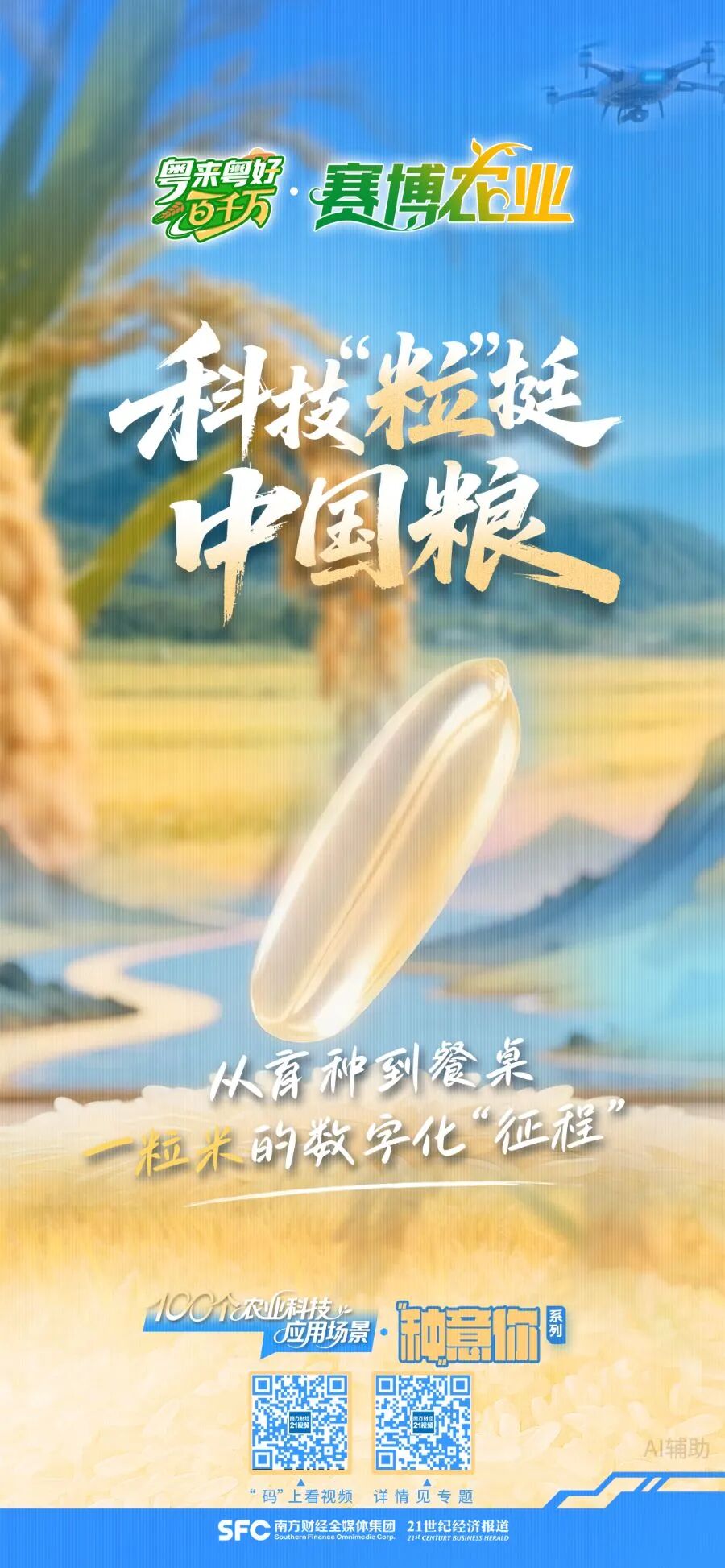
全球7亿人面临饥饿 ,科技“粒”挺中国粮
2 1 Shi Ji Jing Ji Bao Dao· 2025-10-16 02:34
SFC 全球仍有超7亿人面临饥饿,世界粮食日看科技如何护粮! 在第45个世界粮食日,南方财经推出短视频《科技"粒"挺中国粮》,以"一粒米"为引,聚焦全链条农业科技,展现科技如何让 中国饭碗端得更稳、更牢、更有底气。 实习生|俎国黄舒镱李雪瑶苏雅诗 出品|南方财经全媒体集团21世纪经济报道 总策划|邓红辉贾肖明 共创单位|广东省科技厅 分镜设计|柳润瑛陈泽锴剪辑丨曾婷芳 设计统筹|林军明海报|郑嘉琪昝金玉 分发统筹|谭婷张楠李纲宇赖禧 总统筹|杜弘禹袁丁指导|丁青云曹军 选题/执行统筹|喻淑琴李振 脚本撰写|喻淑琴曾婷芳 ...