
增强现实(AR)

Search documents
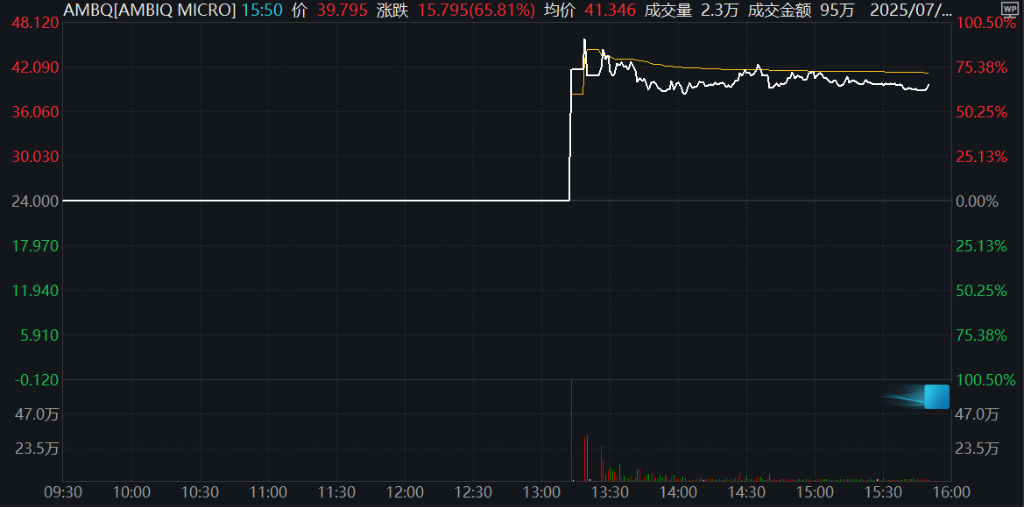
Arm投资的AI芯片公司Ambiq上市首日大涨61%,两度熔断停牌
Hua Er Jie Jian Wen· 2025-07-30 20:28
Core Viewpoint - Ambiq, an AI chip company focused on ultra-low power semiconductor solutions, experienced a significant stock price increase on its first trading day, highlighting strong investor interest and market potential [1][3]. Group 1: IPO and Market Performance - Ambiq went public on the New York Stock Exchange, issuing 4 million shares and raising $96 million [1]. - The stock closed at $38.7, a 61.25% increase from the IPO price of $24, with trading being halted twice due to volatility [1]. Group 2: Technology and Competitive Advantage - Ambiq's core technology is designed for edge AI applications, promising energy consumption five times lower than traditional chips [3]. - This breakthrough allows for the deployment of complex AI functions in power-sensitive wearable devices, such as smartwatches and fitness trackers [3]. - Potential applications of Ambiq's technology include embedding large language models in augmented reality (AR) and virtual reality (VR) devices [3]. Group 3: Financial Performance and Customer Base - Despite promising technology, Ambiq's customer base is relatively concentrated, with its largest customer contributing 38% of revenue in Q1 [4]. - Major clients include Garmin and Google, with a significant drop in revenue contribution from mainland China, from 45.5% last year to 8-9.5% this year [4]. - Ambiq reported a net loss of $8.3 million and revenue of $15.7 million for the three months ending March 31, compared to a net loss of $9.8 million and revenue of $15.2 million in the same period last year [4].

用AI眼镜移动支付、玩黑神话?听听试过的用户怎么说
Guan Cha Zhe Wang· 2025-07-30 00:47
Core Viewpoint - The World Artificial Intelligence Conference (WAIC) showcased a variety of AI glasses from leading companies, highlighting the growing market for smart wearable devices and their innovative features [1][3]. Group 1: Rokid Glasses - Rokid introduced the Rokid Glasses, a lightweight AI+AR smart glasses weighing 49g, featuring AR display, AI visual recognition, and voice interaction for a seamless user experience [3][5]. - The AR display utilizes advanced diffraction waveguide imaging technology to project clear virtual interfaces onto transparent lenses, enabling tasks like object recognition, AI Q&A, real-time translation, and navigation [5][6]. - The glasses also feature a mobile payment function, allowing users to complete transactions using voice commands, making it the world's first smart glasses capable of payment [8][6]. Group 2: Halliday Glasses - Halliday launched its first invisible display smart glasses, Halliday Glasses, which support prescription lenses and utilize a technology called DigiWindow to project images directly onto the retina [9][10]. - The glasses weigh only 28.5g and offer a battery life of up to 12 hours, focusing on information display rather than additional features like cameras [10][13]. - The domestic launch price is set at 2499 yuan, with pre-sales starting in mainland China [10][13]. Group 3: Li Weike Technology - Li Weike showcased three new models of smart glasses, emphasizing lightweight design with the City series starting at 999 yuan and weighing only 23g [15][17]. - The glasses feature AI capabilities such as real-time translation supporting nearly 180 languages and AI note-taking for business users [17][18]. - The company aims to integrate AI deeply into the glasses' functionality, prioritizing AI over hardware in their development strategy [18]. Group 4: XREAL - XREAL presented its flagship AI glasses, XREAL One Pro, which features a wide field of view and high-resolution display, targeting immersive experiences in gaming and entertainment [19][22]. - The glasses utilize self-developed technologies to enhance visual quality and reduce latency, making them suitable for applications like gaming and cinema [22][25]. - The starting price for XREAL One Pro is 4299 yuan, and it supports various AR applications for real-time recognition and interaction [25][22]. Group 5: User Feedback - Users expressed mixed feelings about the functionality of the AI glasses, with some appreciating the convenience of features like real-time translation and voice payment, while others noted areas for improvement [26][27]. - Concerns were raised about the practicality of using the glasses in everyday situations, particularly regarding the need for multiple devices for effective communication [29][30]. - The high price point of these products was a common concern among potential buyers, impacting their willingness to purchase [31][30].
一“镜”搞定这些事!智能眼镜“论剑”功能
Guo Ji Jin Rong Bao· 2025-07-27 16:03
Core Insights - The article highlights the rapid advancement of AI technology, particularly in the realm of smart glasses, showcased at the 2025 World Artificial Intelligence Conference in Shanghai [2][6] - Major companies like XREAL and Rokid are competing in the smart glasses market, presenting innovative products that integrate augmented reality (AR) and artificial intelligence (AI) [2][5] - Alibaba's introduction of its first self-developed AI glasses, Quark AI glasses, marks a significant move in the competitive landscape of smart eyewear [6][8] Company Highlights - XREAL, established in 2017, is a leading company in consumer-grade AR glasses, showcasing its flagship product, One Pro, which features a 57° ultra-wide field of view and advanced optical technology [2][3] - Rokid's smart glasses weigh only 49 grams and incorporate various AI capabilities, including object recognition and real-time translation, appealing to consumers seeking both style and functionality [5] - Alibaba's Quark AI glasses are designed to integrate deeply with its ecosystem, supporting features like navigation and payment through its platforms, although specific pricing and user experience details remain undisclosed [6][8] Industry Trends - The year 2025 is recognized as a pivotal year for innovation in smart glasses, with a competitive "battle of the glasses" emerging among various brands [6] - The integration of AI and AR technologies is becoming increasingly prevalent, as demonstrated by interactive experiences at the conference that blend virtual and real-world elements [3][5] - The collaboration between AI applications and smart hardware is expected to drive further advancements and consumer adoption in the smart glasses market [8]


韩国要投资约25亿发展iLED显示,想摆脱中国对手追赶
Guan Cha Zhe Wang· 2025-07-16 02:46
Core Viewpoint - The South Korean government plans to invest 484 billion KRW (approximately 25.16 billion RMB) in inorganic light-emitting diode (iLED) display technology by 2032 to seek new growth engines for the country's display industry [1] Group 1: Investment and Development Plans - The investment will focus on developing iLED technologies, including Micro LED, quantum dots, and nano LED, while fostering the South Korean industrial ecosystem [1] - The Korean Display Industry Association announced its full support for the R&D projects related to inorganic light-emitting displays and the ultra-differentiated R&D projects for organic light-emitting diodes (OLED) [1][2] - The project will cover various areas, including epitaxial growth technology, chip transfer and bonding technology, and the development of high-resolution devices for augmented reality (AR) and extended reality (XR) [1][2] Group 2: Market Growth and Competitive Landscape - The global iLED market is expected to grow from USD 1 billion in 2026 to USD 32 billion by 2035 [2] - Despite maintaining a leading position in the OLED market, South Korea is significantly lagging in iLED technology, heavily relying on foreign-manufactured LED chips and materials [1][2] - The Korean display industry is facing increasing competition from China, which has made significant advancements in the display sector, particularly in liquid crystal displays (LCD) and OLED technology [2] Group 3: Strategic Initiatives - The OLED ultra-differentiation R&D projects focus on mobile OLED display technology for extreme environments, silicon-based organic light-emitting diode (OLEDoS) technology for XR devices, and ultra-realistic light field display technology [2] - The Korean Display Industry Association aims to develop transformative technologies to maintain competitiveness against rivals like China, including ultra-thin high-reliability component structures and next-generation large-size flexible panels [2][3] - The launch of these R&D projects is seen as a crucial step to enhance core technological competitiveness and maintain sovereignty amid the unstable trade environment, particularly due to the US-China trade war [3]

“数字潮市”带你解锁未来生活
Xin Hua She· 2025-07-04 13:55
Core Viewpoint - The rapid development of digital technology is transforming future lifestyles, as showcased at the 2025 Global Digital Economy Conference with the unveiling of the "Digital Tide City" in Beijing, featuring applications of cutting-edge technologies like AR, MR, and AIGC [1][5]. Group 1: Event Highlights - The "Digital Tide City" in Beijing showcases immersive experiences, allowing visitors to engage with technologies that can instantly create stories, illustrations, and artworks through simple gestures [1][4]. - The Beijing Fang Digital Complex spans 6,000 square meters, featuring over 50 tech companies and 10 immersive exhibition areas, highlighting the deep integration of digital technology and cultural creativity [4][5]. - Daily visitor numbers at the complex reach approximately 2,500 to 2,800, with popular attractions like the XR immersive exhibition and C919 flight simulator often resulting in long queues [4][5]. Group 2: Technological Innovations - Key innovations include a handheld device called the "Digital Elf Guide," which combines AI voice interaction and high-transparency 3D imaging technology for 3D holographic explanations of exhibits [4][5]. - Technologies on display have practical applications in daily life, such as AR smart glasses for facilitating communication for the elderly and hearing-impaired, and a 3D asset encryption system to combat digital piracy [5]. - The immersive projects not only provide entertainment but also demonstrate the empowering effects of digital technology across various sectors, including business, culture, and tourism [5].

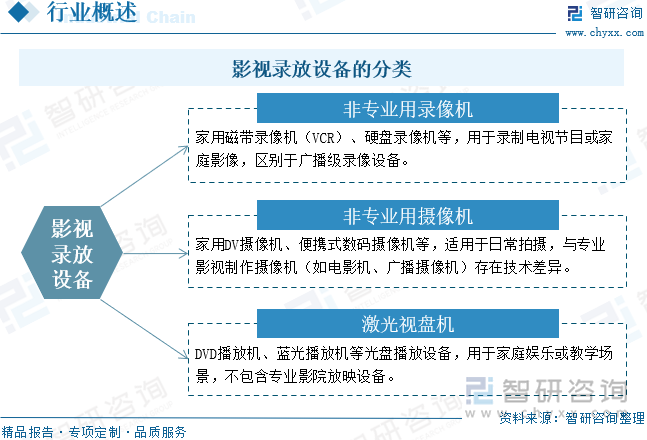
趋势研判!2025年中国影视录放设备行业相关政策、产业链、发展历程、竞争格局及发展前景展望:影视录放设备技术持续升级,市场规模已达千亿元[图]
Chan Ye Xin Xi Wang· 2025-07-02 01:19
Industry Overview - The film and television recording equipment industry has undergone significant transformation, evolving from traditional devices to high-definition Blu-ray players, smart TV boxes, and online streaming devices to meet diverse consumer demands for high-quality audio-visual experiences [1][13] - The market size of China's film and television recording equipment is projected to grow from 337.635 billion yuan in 2015 to 616.448 billion yuan in 2024, with a compound annual growth rate (CAGR) of 6.92% [1][13] - Future developments in the industry are expected to focus on higher resolution, better sound quality, smarter features, and more convenient usage, alongside innovations driven by virtual reality (VR) and augmented reality (AR) technologies [1][13] Industry Policies - The Chinese government has implemented various supportive policies to foster the development of the film and television equipment industry, including financial support for new production bases and technology upgrades [6][8] - Specific measures include a one-time subsidy of up to 20 million yuan for new film production bases and 10 million yuan for technology trials and applications [6][8] Industry Chain - The industry chain consists of upstream raw materials and components supply, midstream production and manufacturing, and downstream applications in film, photography, home entertainment, education, security monitoring, and live streaming [9] Key Enterprises - Major companies in the Chinese film and television recording equipment sector include Woge Optoelectronics, Chunzong Technology, Jiulian Technology, and others, with a focus on niche markets and technological innovation [2][17] - The competitive landscape is characterized by a mix of foreign dominance in high-end markets and the rise of domestic players, with ongoing efforts to close the technology gap [14][17] Development Trends - The industry is moving towards high-performance and intelligent equipment, with innovations in imaging capture and processing capabilities, such as 8K ultra-high definition and AI-enhanced image quality [23] - Emerging application scenarios, including short video creation and live streaming, are driving demand for lightweight and highly mobile equipment [24] - User experience is becoming a core selling point, with simplified interfaces and natural interaction methods like voice control gaining traction [25]



“柔性触手+智能之眼”实现晶圆无损体检
Ke Ji Ri Bao· 2025-06-30 23:48
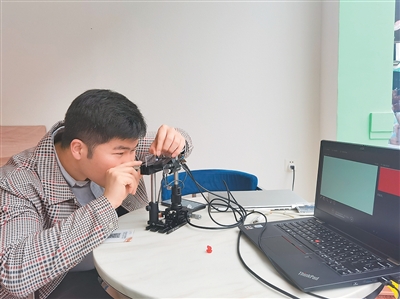
Core Viewpoint - The research team from Tianjin University has developed a groundbreaking method for non-destructive testing of micro-LED wafers, addressing significant challenges in the production and quality assurance of next-generation display technologies [1][2]. Group 1: Technology Development - The team introduced a novel non-destructive testing method using a flexible probe system, which can adapt to the micro-scale variations of the wafer surface with a gentle pressure of only 0.9 MPa [2]. - This flexible probe system, composed of an elastic micro-pillar array and extendable electrodes, demonstrates remarkable durability, maintaining functionality after 1 million contacts, which is ten times longer than traditional rigid probes [2][3]. - The unique three-dimensional pressure-reducing structure of the probe ensures that internal stress remains safe and controllable even under extreme deformation [2]. Group 2: System Integration - An intelligent detection system was developed to complement the flexible probes, ensuring perfect alignment with the wafer and enabling real-time capture of LED activation states while measuring electrical parameters and contact pressure [2][3]. - The system includes a spherical leveling device that guarantees parallelism between the probe and the wafer, enhancing measurement accuracy [2]. Group 3: Industry Impact - The research has led to the creation of a high-density flexible probe array capable of handling ultra-small dimensions of 10×30 micrometers, paving the way for next-generation high-speed wafer testing [3]. - The technology addresses critical pain points in the LED industry and opens new pathways for complex wafer testing, with plans for industrialization to provide cost-effective testing solutions for the domestic LED sector [3]. - Additionally, this advancement lays the groundwork for improving yield rates in high-end display panels used in augmented reality (AR) and virtual reality (VR) applications [3].
帮企业“找地”“找钱”“找伙伴”
Ren Min Ri Bao Hai Wai Ban· 2025-06-25 22:21
Group 1 - The article discusses the revitalization of the Tianjin International Entrepreneurship Center, which has transformed into the China Tianjin Overseas Students Entrepreneurship Park, focusing on enhancing the entrepreneurial environment for returnees [3][4]. - The park has successfully attracted over 300 high-level talents and aims to provide better services for entrepreneurship in the region [3][4]. - The park has experienced a resurgence after a period of stagnation due to reforms and management adjustments [3]. Group 2 - Nika Optics, founded in July 2022, specializes in AR optical display technology and has received an investment of 8 million yuan from Xiaomi [5]. - The company has achieved mass production of its core device, the near-eye optical display module, with a 30° field of view [5][7]. - Nika's technology advantage lies in its self-developed photopolymer, which has led to 100% localization of materials used in its products [7]. Group 3 - The Tianjin Binhai High-tech Zone has implemented various support measures for startups, including financial backing from banks and investment institutions, resulting in 430 million yuan in equity financing and 210 million yuan in debt financing in 2024 [8]. - The park hosts 64 resident companies, primarily in the medical device sector, and offers shared facilities to support these businesses [8][9]. - The park is exploring intellectual property financing services to help startups overcome funding challenges [9]. Group 4 - The article highlights the success of Zhang Jun, a postdoctoral researcher who won a gold medal at the National Postdoctoral Innovation and Entrepreneurship Competition for his project on sodium-ion battery materials [10]. - Zhang's company, Na Kun Carbon Source, focuses on developing high-performance carbon anode materials for sodium-ion batteries, which are seen as a sustainable alternative to lithium-ion batteries [10][11]. - The Tianjin Overseas Students Entrepreneurship Park has facilitated funding and support for Zhang's team, helping them to overcome initial challenges and accelerate their industrialization process [11].
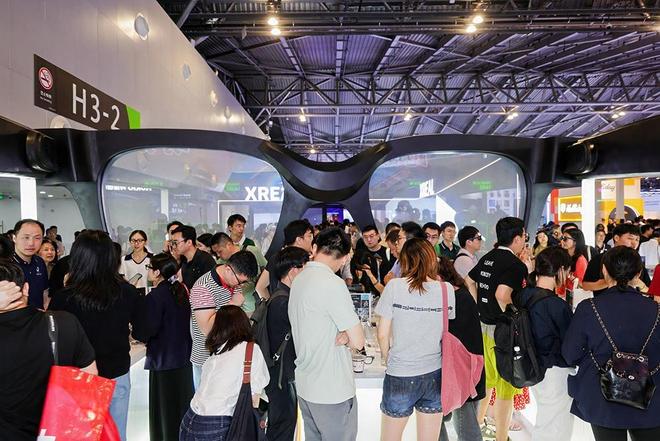
AI闪光芒 “镜”彩纷呈 2025深圳国际眼镜业博览会在深开幕
Shen Zhen Shang Bao· 2025-06-25 16:46
Group 1 - The 2025 Shenzhen International Optical Expo opened on June 25, attracting over 200 exhibitors from more than 20 countries and over 30,000 professional visitors [1] - The exhibition covers an area of 15,000 square meters and is divided into nine themed zones, showcasing the entire industry chain [1] - The event features a special exhibition on the 45-year development history of the Longgang eyewear industry, highlighting its evolution from traditional to smart eyewear [1] Group 2 - Lohas Group showcased its first mass-produced AI smart glasses, "Paipai Mirror A1," which integrates multiple functions such as photography, video recording, and translation [2] - RayNeo, a leading AR brand, presented new AR glasses that achieved a market share of 52% during the recent "618" sales event [2] - The 2025 Shenzhen International Eyewear Design Competition announced its winners, aiming to discover and cultivate outstanding eyewear design talent [2] Group 3 - Shenzhen's eyewear industry has developed a complete industrial chain and rich resources over 40 years, actively embracing technological innovation for smart transformation [3]
AI为何迟迟没出现象级应用?save time 而非 kill time的属性突出
2025-06-24 15:30
Summary of Key Points from the Conference Call Industry Overview - The AI industry is experiencing rapid growth, with global monthly active users nearing 1 billion and over 460 million in China, showing a quarterly growth rate exceeding 100% [4][1] - By the end of 2025, global active users are expected to surpass 2 billion, with notable performance in general AI assistants and educational applications [4][1] Core Insights and Arguments - The commercialization path of AI differs significantly from the internet, focusing more on its tool-like attributes rather than user interaction [5][2] - AI is seen as a time-saving tool, suitable for subscription and paid models, contrasting with the consumption-driven models of the internet [10][2] - The education and finance sectors are identified as the most likely areas to see the emergence of breakthrough AI applications due to their diverse and widespread demand [8][2] - The current state of AI applications is still in the exploratory phase, requiring more time to mature and establish defined business models [2][9] Challenges and Opportunities - The weak software payment habits in China pose challenges for domestic AI companies, making overseas expansion a crucial strategy [6][2][7] - The overseas market offers a more favorable policy environment, stronger subscription habits, and better investment conditions, which are essential for the growth of AI applications [6][2][7] - Structural data is emerging as a potential focal point in the AI landscape, particularly in industries like film, where classic films can be deconstructed into valuable structured data [12][2] Additional Important Insights - AI office software is still in the early stages of acceptance in enterprises, primarily enhancing efficiency but lacking trust and traceability [11][2] - The integration of generative AI with large-scale AI systems is expected to reshape industries, particularly in entertainment and education [19][2][21] - The trend of merging film and gaming (影游合一) is gaining traction, indicating a shift towards interactive experiences that blend storytelling and gameplay [21][2] Conclusion - The AI industry is on the cusp of significant transformation, with various sectors poised for disruption. However, the path to achieving breakthrough applications will require time, innovation, and adaptation to market conditions.