指数增强

Search documents
以量化之力解锁中盘成长股 锻造“稳定超额收益”生命力
Zheng Quan Shi Bao· 2025-10-19 23:05
Core Viewpoint - The market is increasingly favoring index-enhanced products that have clear risk and return characteristics, with the recent launch of the Xingzheng Global CSI 500 Index Enhanced Fund being a notable example [1][2]. Group 1: Product Launch and Management - Xingzheng Global Fund is set to issue the CSI 500 Index Enhanced Fund, managed by experienced quant investor Tian Dawei, aiming for excess returns through multi-factor quantitative stock selection and portfolio optimization [1][2]. - The CSI 500 Index has shown significant investment value, with a cumulative increase of 604.39% from December 31, 2004, to August 31, 2025, and an annualized return of 10.21%, outperforming the CSI 300 Index and the SSE 50 Index [2]. Group 2: Investment Strategy and Process - The investment strategy involves collecting and cleaning various data types, developing alpha factors, optimizing factor quality, and using combination optimization algorithms to maximize alpha scores while controlling for style and sector constraints [3][6]. - The quant team focuses on discovering and validating alpha factors, with over 2,000 factors tracked daily, and employs a standardized process for factor research and application [6]. Group 3: Risk Management - Tian Dawei emphasizes the importance of maintaining industry and style neutrality while controlling tracking error to mitigate risk exposure [5]. - The collaborative approach among various departments, including research, risk management, and trading, enhances the effectiveness of the quant strategy [6]. Group 4: Market Outlook and Trends - The demand for index-enhanced products remains strong, with 295 such products launched by the end of 2024, totaling 212.76 billion yuan, indicating a "blue ocean" market opportunity [2]. - Tian Dawei believes that the current domestic policies and capital market conditions present manageable risks and potential for upward movement in equity markets [7][8].


兴证全球基金田大伟: 以量化之力解锁中盘成长股 锻造“稳定超额收益”生命力
Zheng Quan Shi Bao· 2025-10-19 22:26
Core Insights - The new index-enhanced products with clear risk-return characteristics are gaining popularity in the market [1] - The launch of the CSI 500 Index Enhanced Fund by Xingzheng Global Fund is a response to market demand for such products [2] Group 1: Product Overview - Xingzheng Global Fund plans to issue the CSI 500 Index Enhanced Fund, managed by experienced quant investor Tian Dawei, aiming for excess returns through multi-factor quantitative stock selection and portfolio optimization [1][2] - The CSI 500 Index has shown significant investment value, with a cumulative increase of 604.39% from December 31, 2004, to August 31, 2025, and an annualized return of 10.21%, outperforming the CSI 300 Index and the SSE 50 Index [2] Group 2: Investment Strategy - The investment strategy involves collecting and cleaning various data types, developing alpha factors, optimizing portfolios, and adjusting for special events to form the final investment combination [3] - The focus is on maintaining industry and style neutrality while controlling tracking error to mitigate risk exposure [3] Group 3: Alpha Factor Development - The quant team at Xingzheng Global Fund is dedicated to discovering and validating alpha factors, tracking over 2,000 factors daily [4] - A standardized process for factor research has been established, integrating research, trading, and tracking into a cohesive system [4] Group 4: Market Outlook - Tian Dawei believes that the current domestic policies are supportive, and the equity market has manageable downside risks with potential upside [6] - The company has a well-established matrix of index-enhanced products, having launched multiple products since 2010, and is positioned to capitalize on market trends [7]
反转因子表现出色,沪深300增强组合年内超额 17.58%【国信金工】
量化藏经阁· 2025-10-19 07:08
Performance of Index Enhancement Portfolios - The CSI 300 index enhancement portfolio achieved an excess return of 0.24% this week and 17.58% year-to-date [1][7] - The CSI 500 index enhancement portfolio recorded an excess return of 0.17% this week and 8.16% year-to-date [1][7] - The CSI 1000 index enhancement portfolio had an excess return of 0.39% this week and 17.94% year-to-date [1][7] - The CSI A500 index enhancement portfolio experienced an excess return of -1.77% this week and 8.45% year-to-date [1][7] Stock Selection Factor Performance Tracking - In the CSI 300 component stocks, factors such as one-month reversal, three-month reversal, and EPTTM one-year percentile performed well [1][10] - In the CSI 500 component stocks, factors like three-month volatility, three-month reversal, and EPTTM one-year percentile showed strong performance [1][10] - For the CSI 1000 component stocks, factors including one-month volatility, one-month turnover, and three-month reversal performed well [1][10] - In the CSI A500 index component stocks, factors such as one-month reversal, EPTTM one-year percentile, and one-month volatility were notable [1][10] - Among public fund heavy stocks, factors like dividend yield, three-month reversal, and EPTTM performed well [1][10] Public Fund Index Enhancement Products Performance Tracking - The CSI 300 index enhancement products had a maximum excess return of 0.92%, a minimum of -3.08%, and a median of 0.01% this week [1][23] - The CSI 500 index enhancement products achieved a maximum excess return of 3.20%, a minimum of -0.48%, and a median of 0.49% this week [1][25] - The CSI 1000 index enhancement products recorded a maximum excess return of 1.58%, a minimum of -0.82%, and a median of 0.37% this week [1][28] - The CSI A500 index enhancement products had a maximum excess return of 1.20%, a minimum of -0.84%, and a median of 0.23% this week [1][29]

个人养老金基金名录再扩容,总产品数达302只
Huan Qiu Wang· 2025-10-19 02:10
Core Insights - The China Securities Regulatory Commission has announced an expansion in the number of personal pension fund products, reaching a total of 302 by September 30, 2025, with an addition of 8 new products in the third quarter of this year [1][2]. Group 1: Product Expansion - The newly added 8 products include 5 index-enhanced funds, 2 target date/target risk FOF products, and 1 ETF-linked fund, showcasing a diverse range of investment options [2]. - The expansion emphasizes quantitative enhancement products with a focus on large-cap styles, reflecting regulatory guidance towards stable, long-term, and simplified pension investment strategies [2]. Group 2: Performance and Growth - Personal pension funds have experienced significant performance recovery, with an average net asset value increase of 15.13% year-to-date as of October 17, 2023, with only one product reporting a loss [4]. - The total scale of personal pension Y shares reached 12.405 billion yuan by the end of the second quarter, marking a 35.7% increase from the previous year [4]. - The first batch of personal pension index funds has seen its total scale exceed 1.5 billion yuan within six months of launch, indicating a nearly fourfold increase compared to the end of last year [4]. Group 3: Market Development - The personal pension product offerings have evolved from initial target date FOFs to include index funds, index-enhanced funds, and ETF-linked funds, catering to various risk preferences and investment goals [5]. - As the market matures and investor education improves, personal pensions are increasingly recognized as a core component of the third pillar of retirement for residents [5].

多因子选股周报:反转因子表现出色,沪深300增强组合年内超额17.58%-20251018
Guoxin Securities· 2025-10-18 09:36
- The report tracks the performance of Guosen Financial Engineering's index enhancement portfolios, which are constructed based on multi-factor stock selection models targeting benchmarks such as CSI 300, CSI 500, CSI 1000, and CSI A500 indices. The goal is to consistently outperform the respective benchmarks [11][12][14] - The construction process of the index enhancement portfolios includes three main components: return prediction, risk control, and portfolio optimization. The optimization model maximizes single-factor exposure while controlling for constraints such as industry exposure, style exposure, stock weight deviation, turnover rate, and component stock weight ratio [12][41][42] - The Maximized Factor Exposure (MFE) portfolio is used to test the effectiveness of individual factors under real-world constraints. The optimization model is expressed as follows: $\begin{array}{ll}max&f^{T}\ w\\ s.t.&s_{l}\leq X(w-w_{b})\leq s_{h}\\ &h_{l}\leq H(w-w_{b})\leq h_{h}\\ &w_{l}\leq w-w_{b}\leq w_{h}\\ &b_{l}\leq B_{b}w\leq b_{h}\\ &\mathbf{0}\leq w\leq l\\ &\mathbf{1}^{T}\ w=1\end{array}$ where \(f\) represents factor values, \(w\) is the stock weight vector, and constraints include style exposure (\(X\)), industry exposure (\(H\)), stock weight deviation (\(w_b\)), and component stock weight ratio (\(B_b\)) [41][42][43] - The report monitors the performance of common stock selection factors across different sample spaces, including CSI 300, CSI 500, CSI 1000, CSI A500, and public fund heavy-holding indices. Factors are tested using MFE portfolios to evaluate their excess return relative to benchmarks [11][15][18] - The factor library includes over 30 factors categorized into valuation, reversal, growth, profitability, liquidity, volatility, corporate governance, and analyst-related factors. Examples include BP (Book-to-Price), EPTTM (Earnings-to-Price TTM), one-month reversal, three-month reversal, one-year momentum, and others [16][17] - The report highlights the performance of specific factors in different sample spaces: - **CSI 300**: One-month reversal, three-month reversal, and EPTTM one-year percentile performed well recently, while three-month institutional coverage and standardized unexpected earnings performed poorly [1][18] - **CSI 500**: Three-month volatility, three-month reversal, and EPTTM one-year percentile performed well recently, while one-year momentum and standardized unexpected revenue performed poorly [1][20] - **CSI 1000**: One-month volatility, one-month turnover, and three-month reversal performed well recently, while executive compensation and three-month earnings revisions performed poorly [1][22] - **CSI A500**: One-month reversal, EPTTM one-year percentile, and one-month volatility performed well recently, while three-month institutional coverage and one-year momentum performed poorly [1][24] - **Public fund heavy-holding index**: Dividend yield, three-month reversal, and EPTTM performed well recently, while standardized unexpected revenue and three-month earnings revisions performed poorly [1][26][27] - The report tracks the excess returns of public fund index enhancement products, including CSI 300, CSI 500, CSI 1000, and CSI A500. For CSI 300 products, the highest weekly excess return was 0.92%, while the lowest was -3.08%, with a median of 0.01% [3][32][31] - For CSI 500 products, the highest weekly excess return was 3.20%, while the lowest was -0.48%, with a median of 0.49% [3][35][34] - For CSI 1000 products, the highest weekly excess return was 1.58%, while the lowest was -0.82%, with a median of 0.37% [3][37][36] - For CSI A500 products, the highest weekly excess return was 1.20%, while the lowest was -0.84%, with a median of 0.23% [3][40][39]
主动量化组合跟踪:近期量化指增策略的回调复盘与归因分析
SINOLINK SECURITIES· 2025-10-16 14:58
- The recent phenomenon of "strong index, weak quantitative Alpha" is attributed to style mismatches, with cumulative excess returns driven by small-cap and short-term momentum factors initially, and later by analyst consensus expectations and growth styles[2][3] - The Guozheng 2000 Index enhancement strategy involves factor testing and selection, including technical, reversal, and idiosyncratic volatility factors, which have shown excellent performance in the Guozheng 2000 Index constituents[4] - The machine learning index enhancement strategy based on multiple objectives and models uses GBDT and NN models, trained on different feature datasets and combined to construct a GBDT+NN stock selection factor, which has performed well across various broad-based indices in the A-share market[5] - The dividend style timing + dividend stock selection fixed income+ strategy uses 10 indicators related to economic growth and monetary liquidity to construct a dynamic event factor system for dividend index timing, showing significant stability improvement compared to the CSI Dividend Index total return[6] - The Guozheng 2000 Index enhancement factor's IC mean is 12.54%, with a T-statistic of 12.56, indicating good predictive performance[4] - The GBDT+NN machine learning stock selection factor in the CSI 300 constituents has an IC mean of 11.43% and an annualized excess return of 15.39%[43] - The GBDT+NN machine learning stock selection factor in the CSI 500 constituents has an IC mean of 9.77% and an annualized excess return of 29.48%[48] - The GBDT+NN machine learning stock selection factor in the CSI 1000 constituents has an IC mean of 13.49% and an annualized excess return of 16.10%[53] - The Guozheng 2000 Index enhancement strategy has an annualized excess return of 13.18% and an IR of 1.73[38] - The GBDT+NN CSI 300 Index enhancement strategy has an annualized excess return of 10.86% and an IR of 1.81[47] - The GBDT+NN CSI 500 Index enhancement strategy has an annualized excess return of 10.27% and an IR of 1.71[52] - The GBDT+NN CSI 1000 Index enhancement strategy has an annualized excess return of 15.83% and an IR of 2.34[57] - The dividend stock selection strategy has an annualized return of 18.83% and a Sharpe ratio of 0.89[58] - The dividend timing strategy has an annualized return of 13.58% and a Sharpe ratio of 0.88[58] - The fixed income+ strategy has an annualized return of 7.34% and a Sharpe ratio of 2.17[58]
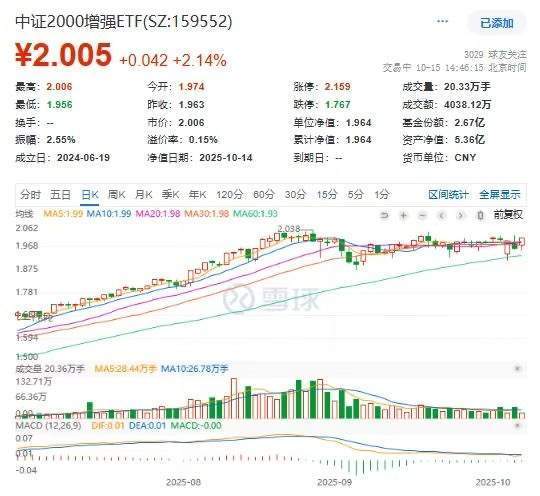
中证2000增强ETF(159552):盘中再登2元大关,年内超额22.45%!
Sou Hu Cai Jing· 2025-10-15 11:02
Core Insights - The stock market has shown a continuous upward trend as of October 15, with significant gains reported for the CSI 2000 Enhanced ETF, which rose by 2.09% [1] - Year-to-date, the CSI 2000 Enhanced ETF has accumulated a total increase of 53.80%, outperforming its benchmark index by 22.45% [1] Summary by Categories - **Market Performance** - The CSI 2000 Enhanced ETF (159552) has experienced a 2.09% increase as of 14:42 on October 15 [1] - The ETF has achieved a year-to-date growth of 53.80%, exceeding the benchmark index by 22.45% [1]
多因子选股周报:超额全线回暖,四大指增组合本周均跑赢基准-20251011
Guoxin Securities· 2025-10-11 09:08
Quantitative Models and Construction Methods 1. Model Name: Maximized Factor Exposure Portfolio (MFE) - **Model Construction Idea**: The MFE portfolio is designed to test the effectiveness of individual factors under real-world constraints, such as controlling for industry exposure, style exposure, stock weight limits, and turnover rates. The goal is to maximize the exposure of a single factor while adhering to these constraints[39][40] - **Model Construction Process**: - The objective function is to maximize single-factor exposure, where $f$ represents the factor values, $f^T w$ is the weighted exposure of the portfolio to the single factor, and $w$ is the vector of stock weights - The optimization model is as follows: $$ \begin{array}{ll} max & f^{T} w \\ s.t. & s_{l} \leq X(w-w_{b}) \leq s_{h} \\ & h_{l} \leq H(w-w_{b}) \leq h_{h} \\ & w_{l} \leq w-w_{b} \leq w_{h} \\ & b_{l} \leq B_{b}w \leq b_{h} \\ & \mathbf{0} \leq w \leq l \\ & \mathbf{1}^{T} w = 1 \end{array} $$ - The first constraint limits the portfolio's style exposure relative to the benchmark index, where $X$ is the factor exposure matrix, $w_b$ is the weight vector of the benchmark index constituents, and $s_l$ and $s_h$ are the lower and upper bounds of style factor exposure, respectively - The second constraint limits the portfolio's industry deviation, where $H$ is the industry exposure matrix, and $h_l$ and $h_h$ are the lower and upper bounds of industry deviation, respectively - The third constraint limits individual stock deviations relative to the benchmark index constituents, where $w_l$ and $w_h$ are the lower and upper bounds of individual stock deviations - The fourth constraint limits the weight proportion of the portfolio within the benchmark index constituents, where $B_b$ is a 0-1 vector indicating whether a stock belongs to the benchmark index, and $b_l$ and $b_h$ are the lower and upper bounds of the weight proportion - The fifth constraint prohibits short selling and limits the upper bound of individual stock weights - The sixth constraint ensures that the portfolio is fully invested, with the sum of weights equal to 1[39][40][41] - The MFE portfolio is constructed for a given benchmark index by applying the above optimization model. To avoid excessive concentration, the deviation of individual stock weights relative to the benchmark is typically set between 0.5% and 1%[41][43] - **Model Evaluation**: The MFE portfolio is used to evaluate the effectiveness of individual factors under realistic constraints, ensuring that the selected factors can contribute to the actual return prediction in the final portfolio[39][40] --- Model Backtesting Results 1. National Trust Quantitative Engineering Index Enhanced Portfolio - **CSI 300 Index Enhanced Portfolio**: - Weekly excess return: 0.63% - Year-to-date excess return: 17.65%[13] - **CSI 500 Index Enhanced Portfolio**: - Weekly excess return: 0.30% - Year-to-date excess return: 8.35%[13] - **CSI 1000 Index Enhanced Portfolio**: - Weekly excess return: 0.77% - Year-to-date excess return: 18.22%[13] - **CSI A500 Index Enhanced Portfolio**: - Weekly excess return: 1.57% - Year-to-date excess return: 11.17%[13] --- Quantitative Factors and Construction Methods 1. Factor Name: BP - **Factor Construction Idea**: Measures valuation by comparing book value to market value[16] - **Factor Construction Process**: - Formula: $BP = \frac{\text{Net Asset}}{\text{Total Market Value}}$[16] 2. Factor Name: Single Quarter EP - **Factor Construction Idea**: Measures profitability by comparing quarterly net profit to market value[16] - **Factor Construction Process**: - Formula: $Single\ Quarter\ EP = \frac{\text{Quarterly Net Profit}}{\text{Total Market Value}}$[16] 3. Factor Name: Single Quarter SP - **Factor Construction Idea**: Measures valuation by comparing quarterly revenue to market value[16] - **Factor Construction Process**: - Formula: $Single\ Quarter\ SP = \frac{\text{Quarterly Revenue}}{\text{Total Market Value}}$[16] 4. Factor Name: EPTTM - **Factor Construction Idea**: Measures profitability by comparing trailing twelve months (TTM) net profit to market value[16] - **Factor Construction Process**: - Formula: $EPTTM = \frac{\text{TTM Net Profit}}{\text{Total Market Value}}$[16] 5. Factor Name: SPTTM - **Factor Construction Idea**: Measures valuation by comparing TTM revenue to market value[16] - **Factor Construction Process**: - Formula: $SPTTM = \frac{\text{TTM Revenue}}{\text{Total Market Value}}$[16] 6. Factor Name: One-Month Volatility - **Factor Construction Idea**: Measures risk by calculating the average intraday true range over the past 20 trading days[16] - **Factor Construction Process**: - Formula: $One\ Month\ Volatility = \text{Average of Intraday True Range over 20 trading days}$[16] 7. Factor Name: Three-Month Volatility - **Factor Construction Idea**: Measures risk by calculating the average intraday true range over the past 60 trading days[16] - **Factor Construction Process**: - Formula: $Three\ Month\ Volatility = \text{Average of Intraday True Range over 60 trading days}$[16] 8. Factor Name: One-Year Momentum - **Factor Construction Idea**: Measures momentum by calculating the return over the past year, excluding the most recent month[16] - **Factor Construction Process**: - Formula: $One\ Year\ Momentum = \text{Return over the past year excluding the most recent month}$[16] 9. Factor Name: Expected EPTTM - **Factor Construction Idea**: Measures profitability based on rolling expected earnings per share (EPS)[16] - **Factor Construction Process**: - Formula: $Expected\ EPTTM = \text{Rolling Expected EPS}$[16] 10. Factor Name: Expected BP - **Factor Construction Idea**: Measures valuation based on rolling expected book-to-price ratio[16] - **Factor Construction Process**: - Formula: $Expected\ BP = \text{Rolling Expected Book-to-Price Ratio}$[16] 11. Factor Name: Expected PEG - **Factor Construction Idea**: Measures valuation by comparing expected price-to-earnings ratio to growth rate[16] - **Factor Construction Process**: - Formula: $Expected\ PEG = \text{Expected PE Ratio / Growth Rate}$[16] 12. Factor Name: Standardized Unexpected Earnings (SUE) - **Factor Construction Idea**: Measures earnings surprise by comparing actual quarterly net profit to expected net profit, normalized by the standard deviation of expected net profit[16] - **Factor Construction Process**: - Formula: $SUE = \frac{\text{Actual Quarterly Net Profit - Expected Net Profit}}{\text{Standard Deviation of Expected Net Profit}}$[16] --- Factor Backtesting Results 1. CSI 300 Index - **Best-performing factors (recent week)**: Expected EPTTM (1.19%), One-Month Volatility (1.17%), BP (1.15%)[18] - **Worst-performing factors (recent week)**: Single Quarter Revenue YoY Growth (-0.61%), Three-Month Institutional Coverage (-0.38%), Three-Month Earnings Revisions (-0.26%)[18] 2. CSI 500 Index - **Best-performing factors (recent week)**: SPTTM (1.69%), Expected BP (1.58%), Single Quarter EP (1.56%)[20] - **Worst-performing factors (recent week)**: One-Year Momentum (-1.01%), Expected PEG (-0.38%), Standardized Unexpected Revenue (-0.29%)[20] 3. CSI 1000 Index - **Best-performing factors (recent week)**: EPTTM (2.36%), SPTTM (2.14%), Expected EPTTM (2.10%)[22] - **Worst-performing factors (recent week)**: Expected Net Profit QoQ (-0.65%), One-Year Momentum (-0.48%), Single Quarter Revenue YoY Growth (-0.39%)[22] 4. CSI A500 Index - **Best-performing factors (recent week)**: Single Quarter SP (1.99%), SPTTM (1.89%), One-Month Volatility (1.69%)[24] - **Worst-performing factors (recent week)**: Single Quarter Revenue YoY Growth (-1.07%), One-Year Momentum (-0.86%), Three-Month Institutional Coverage (-0
资本市场投教“星火计划”9月投教作品热度榜
Zheng Quan Shi Bao Wang· 2025-09-30 09:06
Group 1 - The "Spark Plan" for investor education in the capital market was launched by institutions such as Shenzhen Stock Exchange, Hongde Fund, and Baodao Fund, with various original videos released by Securities Times [1][2] - The top five educational works in September 2025 were identified based on key operational metrics such as reading volume, sharing frequency, likes, favorites, viewing duration, and reading duration [1] - The works included topics such as the record high of margin trading balance in A-shares, future development directions of the food and beverage industry, selection criteria for enhanced index funds, and a series of short dramas aimed at improving investor awareness of illegal securities activities [1] Group 2 - The "Let's Talk About ETF" series by Shenzhen Stock Exchange aims to help investors understand the development history and investment methods of ETFs through easy-to-understand animated videos [2] - The "Spark Plan" is a multi-faceted investor education platform established with the guidance of various regulatory bodies and supported by the Shenzhen Securities Regulatory Bureau and Securities Times [2]
【周周牛事】哪些宽基有指数增强ETF?Go-Goal为你一键找出!
新财富· 2025-09-29 08:03
Core Viewpoint - The article emphasizes the potential of Index Enhanced ETFs, which combine passive tracking with active management strategies to seek excess returns beyond traditional broad-based ETFs [2][5]. Summary by Sections What is Index Enhanced ETF? - Index Enhanced ETFs are designed to closely track broad market indices like the CSI 300 while employing quantitative or stock selection strategies to achieve excess returns. They offer a dual benefit of following the index and aiming for additional profits [5]. How to Find Index Enhanced ETFs? - Investors can easily locate Index Enhanced ETFs using the Go-Goal App or the ETF search mini-program. By selecting the "Index Enhanced" option in the ETF screening feature, users can access a list of 51 Index Enhanced ETFs available in the market, with 50 already listed [6][9]. ETF Screening Features - The Go-Goal platform provides a comprehensive ETF screening tool with eight categories of features, allowing investors to filter based on their specific needs: 1. Asset Class: Domestic stocks, foreign stocks, domestic bonds, commodities, etc. 2. Major Sectors: Public utilities, upstream resources, midstream materials, etc. 3. Style Characteristics: High dividend, growth, value, low valuation, quality, etc. 4. Trading Tags: T+0, Stock Connect, margin trading, etc. 5. Management Method: Full replication, index enhancement. 6. Investment Regions: China, Hong Kong, USA, Japan, Germany, France, etc. 7. Index Type: Core index, secondary core index, other indices. 8. Business Nature: State-owned enterprises, private enterprises [9].