资管新规

Search documents
上半年累计创造收益4172亿元——新型银行理财渐入佳境
Xin Hua Wang· 2025-08-12 06:19
值得注意的是,从投资者结构看,个人投资者仍占绝对比重,但机构投资者的比例也有所上升。截 至2022年6月末,个人投资者数量为9061.68万人,占比99.08%,机构投资者数量为83.72万个,占比 0.92%,较上年末的占比0.77%上升了0.15个百分点。 广受关注的银行理财市场实现了稳步增长、深化改革、服务实体经济发展。 8月19日,银行业理财登记托管中心发布的《中国银行业理财市场半年报告(2022年上)》(以下 简称《报告》)显示,银行理财上半年累计为投资者创造收益4172亿元;截至2022年6月末,理财产品 存续规模达29.15万亿元,同比增长12.98%,投资者数量达9145.40万个,同比增长49%。 "产品更加丰富、服务更加专业,这些因素增加了理财产品对投资者的吸引力。"招联金融首席研究 员董希淼说,预计全年理财市场规模将突破30万亿元,投资者将超过1亿个。 与此同时,理财产品服务实体经济的质效持续提升。根据资管新规要求,目前保本理财产品已清 零,净值型理财产品大幅增加,占比达95.09%;截至2022年6月末,银行理财产品支持实体经济资金规 模约25万亿元,同业理财、多层嵌套大幅减少。 投资 ...
深耕核心竞争力 银行理财公司中报业绩不俗
Xin Hua Wang· 2025-08-12 06:19
Core Insights - The performance of bank wealth management companies has shown significant improvement in the first half of the year, with growth in managed scale, operating income, and net profit [1][2][3] Group 1: Management Scale Growth - As of June 30, 2023, several bank wealth management companies reported growth in managed assets, with 招银理财 managing 2.88 trillion yuan, a 3.60% increase from the end of last year [2] - 中邮理财's net value product scale reached 851.82 billion yuan, up 10.96% year-on-year [2] - 南银理财's total managed wealth products approached 380 billion yuan, reflecting a growth of over 16% [2] - 平安银行 reported a non-principal guaranteed wealth product balance of 947.28 billion yuan, an 8.60% increase [2] Group 2: Operating Performance - 招银理财 achieved operating income of 3.186 billion yuan and net profit of 2.066 billion yuan in the first half of the year, compared to 2.351 billion yuan and 1.557 billion yuan in the same period last year [2] - 杭银理财 reported operating income of 1.044 billion yuan and net profit of 741 million yuan, up from 355 million yuan and 237 million yuan respectively last year [3] Group 3: Product System Enrichment - Wealth management companies have focused on optimizing and enriching their product systems, with 招银理财 developing 70 product lines and launching various themed products [4] - 杭银理财 upgraded its product system, introducing new themes such as "幸福99·六合" and various investment products [4] - 平安理财 made significant advancements in its investment research capabilities, developing a multi-asset allocation system [4] Group 4: Investment Research Capability Enhancement - Wealth management companies are enhancing their investment research and asset management systems, with 杭银理财 establishing a comprehensive asset allocation research framework [5] - 招银理财 reported that as of June 30, 2023, new products compliant with asset management regulations totaled 2.74 trillion yuan, representing 95.14% of its total wealth management products [5] - The transition period for cash management products is expected to conclude by the end of the year, with companies actively working on product transformations [6]
向海外市场展示中国资管力量 信银理财首度上榜全球资管500强
Xin Hua Wang· 2025-08-12 06:15
Group 1 - The core viewpoint of the article highlights that Xinyin Wealth Management has made its debut on the "2023 Global Asset Management Top 500" list, ranking 113th, showcasing its strong comprehensive strength to the global market [1] - The IPE list is particularly focused on serving large overseas pension and institutional investors, with significant attention from European institutions towards the Chinese and Asian markets [1] - Xinyin Wealth Management, a wholly-owned subsidiary of CITIC Bank, has established a leading advantage in product line richness and asset management scale within nearly three years of its establishment [1] Group 2 - As of the end of 2022, the asset management scale of CITIC Bank and its wealth management company reached 1.57 trillion yuan, a year-on-year increase of 173.8 billion yuan, with a growth rate of 12.39% [2] - The net value-based products that comply with the new asset management regulations reached 1.49 trillion yuan, accounting for 94.53% of the total, with a year-on-year increase of 224.1 billion yuan [2] - The article mentions that regulatory changes and the introduction of new asset management regulations have significantly impacted bank-affiliated wealth management subsidiaries, leading to deep adjustments and improvements within Chinese asset management institutions [2]
岁月如歌,信以致远!中原信托四十年风华正茂再启航
Sou Hu Cai Jing· 2025-08-12 03:57
Core Viewpoint - Zhongyuan Trust celebrates its 40th anniversary, highlighting its evolution from a small trust company to a significant player in the financial sector, contributing to the economic development of the region and adapting to industry changes over the decades [1][7]. Group 1: Historical Development - Zhongyuan Trust was established in 1985, marking the revival of the trust industry in China post-reform, and has since been integral to the economic growth of Henan province [2][3]. - The company adopted innovative practices early on, including market-based recruitment and diverse funding methods, which allowed it to support local economic development through loans and investments [3][4]. - Following regulatory reforms in the early 2000s, Zhongyuan Trust expanded its operations significantly, increasing its registered capital from 5.92 billion to 36.5 billion yuan and growing its trust scale from 800 million to 200 billion yuan [4]. Group 2: Recent Developments and Challenges - The introduction of the Asset Management New Regulations in 2018 prompted Zhongyuan Trust to undergo significant organizational adjustments and enhance its business offerings, including the development of a new information system [5][6]. - In 2023, the company completed its largest cash capital increase, raising its registered capital from 4 billion to 4.681 billion yuan, thereby strengthening its financial position [6]. - Zhongyuan Trust has focused on risk management and proactive strategies, enhancing its wealth management and family trust services, while also expanding into digital finance and innovative product offerings [6]. Group 3: Future Outlook - The company has managed over 2 trillion yuan in trust assets and generated significant profits, indicating its robust performance and contribution to the local economy [7]. - As the trust industry undergoes transformation, Zhongyuan Trust aims to enhance its comprehensive strength and maintain its commitment to serving the real economy and improving people's lives [7].
定存利率和保险预定利率「双降」,求稳投资有何新解?
天天基金网· 2025-08-08 12:28
Core Viewpoint - The article discusses the challenges faced by investors in a low-interest-rate environment, highlighting the shift in insurance products and the role of fixed income plus (固收+) funds in alleviating yield anxiety [5][6][12]. Group 1: Insurance Market Dynamics - The core function of insurance is to lock in future risks at a lower cost, evolving from traditional life and health insurance to more complex financial products [7]. - The insurance sector has seen a significant increase in new premium growth since 2022, driven by market conditions and the "theater effect" where companies maintain high rates to attract customers [9][10]. - The sales channels for insurance have shifted, with bank insurance channels becoming increasingly important, as financial advisors take on a larger role in selling insurance products [10]. Group 2: Investment Strategies in Low-Interest Environment - In a low-interest-rate environment, insurance companies are seeking investment opportunities in equity markets, aligning with regulatory long-term assessment mechanisms [12][13]. - Fixed income plus (固收+) funds are recommended for investors seeking stability, as they typically consist of bonds and convertible bonds while using equity positions to enhance flexibility [15][22]. - Investors should consider their risk preferences and review fund reports to select suitable products, focusing on long-term performance metrics such as maximum drawdown and Sharpe ratio [18][21]. Group 3: Asset Allocation and Timing - The long-term return on equity assets is linked to the ROE of listed companies, necessitating careful timing in asset selection to avoid purchasing at inflated prices [19]. - A balanced asset allocation strategy is advised, with part of the portfolio in fixed income assets and the other part in higher-risk assets to achieve diversification [22][23].


专业是信托业的立身之本
Jin Rong Shi Bao· 2025-08-08 07:52
Core Viewpoint - The recent public consultation on the revised "Trust Company Management Measures" is significant as it marks the first revision in 18 years and addresses a market worth 27 trillion yuan, impacting the future development of the trust industry and the public [1] Group 1: Industry Challenges and Regulatory Response - The trust industry has faced risks such as fund pool operations and channel business risks, leading to the need for regulatory intervention to guide the industry towards standardized development [1] - The introduction of a series of policies aims to facilitate the transformation of trust companies as a necessary path for survival in the current regulatory environment [1] Group 2: Service Focus and Social Value - The current focus of the trust industry is on service, with service trust scales accounting for approximately half of the market, highlighting the diverse applications of trust services for various social needs [2] - Examples of innovative trust services include special needs trusts for vulnerable populations, prepaid fund service trusts, property management service trusts, and the first administrative management service trust for water rights in Shanghai [2] Group 3: Regulatory Framework and Future Directions - The revised measures emphasize the "trustee positioning" and include prohibitive lists to reshape business boundaries, addressing key pain points in the industry's transformation [4] - Key prohibitions include the end of rigid repayment, a ban on channel business without substantial services, and the establishment of a firewall against related party transactions to enhance trustee responsibilities [4] - The revision introduces internal governance principles aimed at maximizing beneficiaries' legal interests and fostering a culture of trust, which is expected to accelerate self-reform within trust companies [4] Group 4: Future Outlook - The implementation of the revised measures is anticipated to make trustee capability a benchmark for the industry, with many trust companies already working on their growth trajectories [5] - The future development of the trust industry is expected to focus on depth of professional expertise rather than the speed of scale expansion, indicating a promising outlook for the sector [5]

62家信托公司披露2020年年报 行业进入提质增效重塑阶段
Bei Jing Shang Bao· 2025-08-08 06:59
Core Insights - The trust industry has entered a phase of quality improvement and restructuring after ten years of high growth, with 62 trust companies disclosing their 2020 annual reports [1] - The report from Yunnan Trust indicates that under favorable policies and proactive transformation, the scale of securities investment trusts has increased significantly [1][3] - The industry is facing challenges with a notable decline in net profit, despite 60% of companies reporting an increase in net profit [2] Industry Overview - In 2020, the scale of securities investment trusts reached 2.26 trillion yuan, a year-on-year increase of 15.44%, accounting for 13.87% of the total [1][3] - The total revenue from trust business for 62 companies was 83.283 billion yuan, reflecting a year-on-year growth of 5.76% [1] - The net profit for the industry in 2020 was 47.590 billion yuan, a decrease of 10.11% from 52.945 billion yuan in 2019, marking the end of a growth trend [2] Business Segment Analysis - The scale of industrial and commercial enterprise trusts decreased significantly to 4.96 trillion yuan, a decline of 9.64% compared to 5.49 trillion yuan in 2019 [2] - Financial institution trust investments fell to 1.98 trillion yuan, down 20.76% year-on-year, indicating a tightening regulatory environment [3] - The report highlights a shift towards family trusts, asset securitization, and service trusts as emerging opportunities for growth in the industry [4] Strategic Insights - The report emphasizes the importance of proactive management and strategic clarity for trust companies to navigate the current regulatory landscape [3][4] - Companies that are clear in their development strategies and have strong business layouts are positioned in the leading tiers of the industry, while those lacking innovation face significant challenges [3] - The development of asset securitization is gaining traction, supported by regulatory policies and increasing interest from financing parties and investors [4]
建信理财董事长齐建功:净值化趋势下,银行理财面临挑战和机遇并存
Xin Lang Cai Jing· 2025-08-08 02:23
Core Viewpoint - The forum hosted by China Merchants Bank focuses on the high-quality development of wealth management in the Guangdong-Hong Kong-Macao Greater Bay Area, highlighting both challenges and opportunities in the banking wealth management sector as it transitions to a net worth-based model [1][4]. Group 1: Current Market Situation - The wealth management industry is experiencing a dual challenge of opportunities and risks due to the deepening low-interest rate environment and the transition to net worth-based products [6]. - The shift to a fully net worth-based model is expected to reshape the industry ecosystem significantly, with the need for wealth management companies to align their investment capabilities with client expectations for sustainable returns [5][6]. - The current market shows a trend where most individual investors hold wealth management products for less than one year, indicating a preference for short-term, low-risk products [7]. Group 2: Demand and Client Expectations - There is a growing understanding among clients regarding net worth-based products, but many still hold strong expectations for capital preservation and stable returns, which may not align with the new market realities [7]. - The traditional client base is slow to adapt to the underlying logic of net worth-based products, creating a dependency that could limit future growth for wealth management companies [7]. Group 3: Asset Management and Investment Strategies - The wealth management industry is heavily reliant on fixed-income products, which constitute 97% of the product offerings, but the attractiveness of high-grade bonds is diminishing as yields decline [8][9]. - There is a pressing need for wealth management firms to enhance their research and asset allocation capabilities, particularly in equity assets, to meet the rising demand for stable returns in a volatile market [9]. Group 4: Future Development and Strategic Focus - Wealth management companies, such as Jianxin Wealth Management, are encouraged to adopt a client-centric approach, focusing on understanding and meeting diverse client needs through tailored product offerings [10][11]. - The strategy includes expanding product lines to include multi-asset and multi-strategy offerings, particularly targeting clients in the Greater Bay Area with innovative products like "fixed income plus" strategies [12]. - Emphasis is placed on enhancing IT capabilities and implementing digital transformation to improve client experience and operational efficiency [13]. Group 5: Regional Economic Support and Collaboration - Jianxin Wealth Management aims to leverage its unique position as the only major wealth management firm registered in the Greater Bay Area to support regional economic development and meet local financial needs [14]. - The company plans to explore investment opportunities in innovative industries and green finance, while also facilitating cross-border financial services to meet client demands for international asset allocation [14].
150万亿大资管
2 1 Shi Ji Jing Ji Bao Dao· 2025-07-31 23:52
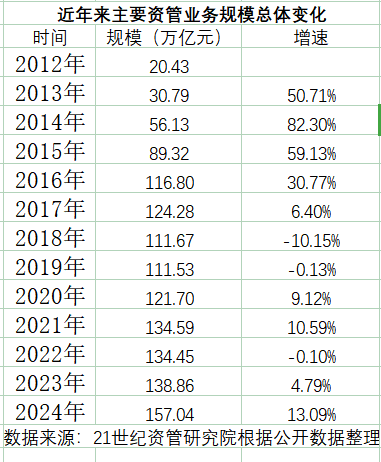
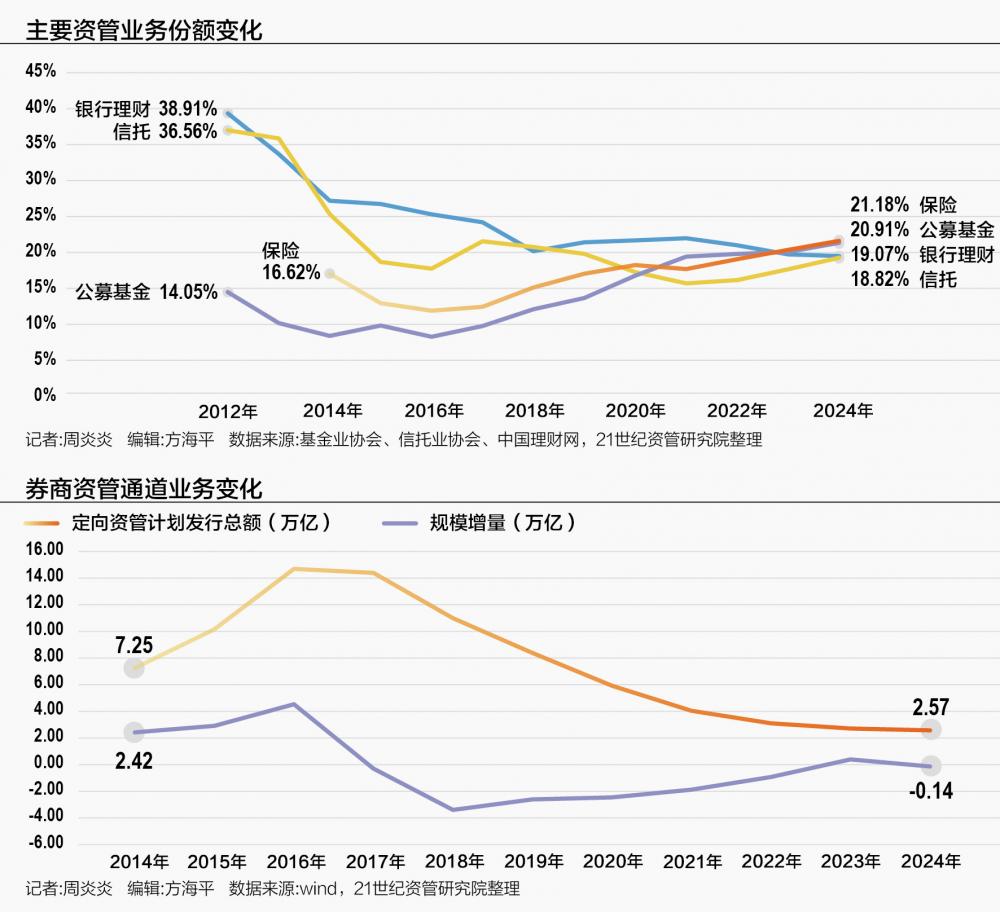
Core Viewpoint - By the end of 2024, China's total asset management scale is expected to reach 150 trillion yuan, indicating significant growth across various asset management sectors despite regulatory challenges and a shift towards financial disintermediation [1][5]. Group 1: Historical Development of Asset Management - The asset management industry in China has evolved significantly since the introduction of bank wealth management products in 2004, with key milestones including the rise of trust companies in 2011 and the implementation of the Asset Management New Regulations in 2018 [2]. - The industry has transitioned from rapid growth to a more regulated and transparent environment, with the establishment of wealth management subsidiaries and a focus on compliance since 2019 [2][5]. Group 2: Current Market Dynamics - As of the end of 2024, the total asset management scale in China is projected to be 157.04 trillion yuan, marking a 13.09% increase from the previous year, the highest growth rate since the introduction of the new regulations [5][6]. - The trust sector has shown the highest growth rate at 23.58%, closely followed by public funds at 20.39% and insurance at 15.08%, while bank wealth management grew by 11.75% [5][6]. Group 3: Sector-Specific Insights Bank Wealth Management - By the end of 2024, bank wealth management is expected to approach 30 trillion yuan, reflecting a recovery from previous declines due to market volatility [9][10]. - The share of bank wealth management in the overall asset management market has decreased from 38.91% in 2012 to 19.07% in 2024, as other sectors like public funds and insurance have gained traction [10]. Trust Sector - The trust industry experienced significant contraction from 2018 to 2020 but has since rebounded, with a notable increase in scale and a shift towards more diversified and professional asset management services [14][15]. Public Funds - Public funds have grown from 846 million yuan in 2000 to 32.83 trillion yuan by the end of 2024, benefiting from favorable market conditions and the shift towards net asset value-based products [16][17]. Insurance Asset Management - Insurance asset management has shown steady growth, reaching over 30 trillion yuan by the end of 2024, with a market share increase from 11.46% in 2016 to 21.18% in 2024 [18][19]. Securities Asset Management - The securities asset management sector has faced significant declines since 2018, with a 7.76% drop in 2024, reflecting the impact of regulatory changes and a shift away from traditional channel-based business models [20][21].
数看150万亿大资管:险资、公募突破30万亿,信托增速最快
2 1 Shi Ji Jing Ji Bao Dao· 2025-07-31 13:51
Core Insights - The asset management industry in China is experiencing significant growth, with a total scale reaching 157.04 trillion yuan by the end of 2024, marking a 13.09% increase from the previous year, the highest since the implementation of the new asset management regulations [6][8][12] - The growth is driven by a shift in investor behavior, as lower bank deposit rates and regulatory changes have led to a "financial disintermediation" effect, with substantial inflows into wealth management products, insurance, and public funds [1][6][9] Group 1: Historical Context and Regulatory Changes - The asset management industry has evolved significantly since the introduction of bank wealth management products in 2004, with key milestones including the rise of trust companies and the implementation of the new asset management regulations in 2018 [2][4] - The new regulations aimed to standardize the industry, eliminate shadow banking, and promote transparency, leading to a more compliant and structured asset management environment [2][4][9] Group 2: Growth by Sector - Trust companies saw the highest growth rate at 23.58%, with their scale approaching that of bank wealth management products, which grew by 11.75% [8][12] - Public funds and insurance asset management also experienced significant growth, with increases of 20.39% and 15.08% respectively, indicating a shift in market dynamics [8][12] - By the end of 2024, the asset management scale for various sectors was as follows: insurance at 33.26 trillion yuan (21.18%), public funds at 32.83 trillion yuan (20.91%), bank wealth management at 29.95 trillion yuan (19.07%), and trust at 29.56 trillion yuan (18.82%) [8][12] Group 3: Market Trends and Investor Behavior - The trend of "deposit migration" is evident, with investors moving funds from traditional bank deposits to higher-yielding wealth management products due to declining interest rates [6][9][16] - The asset allocation preferences of investors have shifted, with a notable increase in the proportion of investments in securities and a decrease in non-standard debt investments, reflecting a more cautious approach to risk [30][33] Group 4: Financial Performance and Revenue Trends - The revenue for trust companies increased to 940.36 billion yuan in 2024, although net profits saw a significant decline of 45.52% compared to the previous year, indicating challenges in profitability despite growth in asset scale [40] - Public funds experienced a decline in management fees due to regulatory changes and market conditions, with a notable shift towards passive investment strategies [41] - Bank wealth management products reported a decrease in annualized returns to 2.65% in 2024, highlighting the impact of the low-interest-rate environment on profitability [43]