
商业航天

Search documents
航空航天ETF天弘(159241)盘中净申购同标的第一,商业航天企业或将在今明两年密集挂牌上市
Mei Ri Jing Ji Xin Wen· 2026-02-04 03:03
Group 1 - The stock market showed a mixed performance with Shanghai outperforming Shenzhen, particularly in the aerospace sector, where the Tianhong Aerospace ETF (159241) rose by 2.20% with a trading volume of 69.5688 million yuan [1] - The Tianhong Aerospace ETF (159241) has seen a net inflow of 386 million yuan over the last 20 trading days, with a net subscription of 7 million units, reaching a new high of 970 million yuan in total assets as of February 3, 2026 [1] - The ETF is well-positioned to capture investment opportunities in themes such as low-altitude economy, large aircraft, satellite internet, and space photovoltaic, benefiting from both policy and market support [1] Group 2 - The political bureau's collective study emphasizes the strategic layout for future industries, marking a new height in the political positioning of commercial aerospace, with ongoing policy support for the construction of a strong aerospace nation [2] - Key support is directed towards low-altitude economy and satellite internet sectors, indicating a favorable environment for growth in these areas [2]
长江通信跌2.08%,成交额4.68亿元,主力资金净流入2057.54万元
Xin Lang Cai Jing· 2026-02-04 02:54
Core Viewpoint - Changjiang Communication's stock price has shown significant volatility and growth in recent months, with a notable increase in trading activity and a mixed financial performance in recent quarters [1][2]. Group 1: Stock Performance - On February 4, Changjiang Communication's stock fell by 2.08%, trading at 36.80 CNY per share, with a total transaction volume of 468 million CNY and a market capitalization of 12.13 billion CNY [1]. - Year-to-date, the stock price has increased by 6.17%, with a 9.39% rise over the last five trading days, a 4.22% increase over the last 20 days, and a substantial 42.03% increase over the last 60 days [1]. - The company has appeared on the "Dragon and Tiger List" once this year, with a net purchase of 152 million CNY on January 30, accounting for 27.15% of total trading volume [1]. Group 2: Financial Performance - For the period from January to September 2025, Changjiang Communication reported a revenue of 413 million CNY, a year-on-year decrease of 6.27%, and a net profit attributable to shareholders of 16.64 million CNY, down 66.59% year-on-year [2]. - The company has distributed a total of 598 million CNY in dividends since its A-share listing, with 60.34 million CNY distributed over the last three years [3]. Group 3: Shareholder Information - As of September 30, 2025, the number of shareholders increased to 23,800, a rise of 12.25%, while the average number of tradable shares per shareholder decreased by 10.91% to 8,879 shares [2]. - Among the top ten circulating shareholders, a new shareholder, Xingquan Commercial Model Mixed (LOF) A, holds 3.62 million shares, while Nuoan Pioneer Mixed A has exited the top ten list [3].

互联网企业增值税无忧:环球市场动态2026年2月4日
citic securities· 2026-02-04 02:41
Market Overview - A-shares experienced a "V-shaped" rebound, with the Shanghai Composite Index rising by 1.29% to 4,067.74 points, and the Shenzhen Component Index increasing by 2.19%[15] - U.S. stocks fell, with the Dow Jones down 0.34% to 49,240 points, and the Nasdaq dropping 1.43% to 23,255 points, driven by a sell-off in tech stocks[8] - European markets saw slight pullbacks, with the FTSE 100 down 0.26% and the CAC 40 down 0.02%[8] Commodity and Forex Trends - International oil prices rebounded by 2%, with WTI crude oil at $63.21 per barrel and Brent crude at $67.89 per barrel[28] - Gold prices surged by 6.08% to $4,903.7 per ounce, while silver rose by 8.17% to $83.3 per ounce[28] - The U.S. dollar index decreased by 0.2% to 97.44, while the dollar to RMB exchange rate was 6.939, reflecting a 0.1% increase[27] Tax Policy and Internet Sector - The new VAT law in China will not affect internet companies' tax rates starting January 1, 2026, but stricter criteria for high-tech enterprise recognition may impact non-leading firms[5] - The government is expected to clarify tax rules for digital products and services, aiming to reduce VAT rates and optimize the tax deduction chain[5] Stock Performance Highlights - Tencent's stock price is projected to grow, with expected revenue growth of 13.5% year-on-year in Q4 2025, driven by strong gaming performance[12] - AMD reported Q4 2025 revenue of $10.3 billion, exceeding guidance, with a year-on-year growth of 34%[7] - The Hang Seng Index rose by 0.22% to 26,834.77 points, despite tech stocks facing pressure from tax rumors[10]
太空能源-砷化镓专家交流
2026-02-04 02:27
Summary of Key Points from the Conference Call on Gallium Arsenide Solar Cells Industry Overview - Gallium arsenide (GaAs) solar cells play a crucial role in the commercial aerospace sector, particularly in high-reliability space environments, outperforming silicon-based and perovskite cells, thus becoming the mainstream choice [1][4] - Major companies in this field include Gan Zhao Company, which previously held an 80% market share in the commercial aerospace sector [2] Core Insights and Arguments - The actual conversion efficiency of GaAs rigid and flexible solar cells can reach over 43.5%, significantly higher than the approximately 38% efficiency for ground applications [1][5] - Future development directions include simulating full-spectrum light and developing corresponding epitaxial structures to enhance absorption range and conversion efficiency, with theoretical efficiency limits potentially reaching 60%-70% [1][9] - Multi-junction GaAs solar cells can achieve around 43% light absorption conversion rate by targeting more wavelengths, with ongoing efforts to expand absorption into blue and infrared regions [1][8] Cost Structure and Reduction Strategies - The cost structure of GaAs solar cells consists mainly of substrates, epitaxial layers, and devices, with substrate costs decreasing due to domestic production of MO sources [2] - Key cost reduction strategies include increasing the domestic production ratio of equipment and materials, enhancing overall technology levels, and improving automation, which could lower graphite component costs by 50%, labor costs by 30%, and material costs by 30% [1][14] - Current chip prices range from 2,000 to 3,000 yuan, with potential reductions to around 1,500 yuan as commercial aerospace develops, indicating a 30%-50% decrease [3][17] Technological Developments and Challenges - The current mature product in the industry is the triple-junction GaAs solar cell, with future iterations focusing on expanding the design to cover more wavelengths for improved performance [7] - The production process from substrate to chip involves complex steps, including the procurement of substrates and the growth of epitaxial structures [6] - Domestic suppliers like Beifang Huachuang and Jing Sheng Jidian are working on MOCVD equipment, but challenges remain in high-end applications requiring rare metals [12] Market Dynamics and Competitive Landscape - The market is characterized by significant competition, with domestic companies like Qian Zhao, Kai Xun, and Dehua leading in GaAs solar cell research and development [27] - The integration of downstream processes poses challenges due to the aging verification cycle of chips, which can take 2-3 years [19] Additional Important Insights - GaAs solar cells exhibit superior radiation resistance compared to silicon-based cells, making them suitable for high-altitude applications [25] - Flexible GaAs solar wings are seen as a necessary trend for future applications requiring high power output, with designs allowing for increased flexibility and power density [26] - The use of X-ray and Vico equipment in production varies significantly, impacting the choice of technology based on the specific requirements of solar cell production [24]
东方钽业20260203
2026-02-04 02:27
Summary of Conference Call on Dongfang Tantalum Industry Company Overview - The conference focused on Dongfang Tantalum Industry, with analysts from Guohai Securities providing insights into the company's recent performance and industry dynamics [1][3]. Key Points and Arguments Industry Dynamics - The tantalum industry has shown strong performance recently, with Dongfang Tantalum's stock price rising significantly [3]. - Tantalum prices have increased, with the current price reported at $120 per pound, up by approximately $20,000 (20%) since early 2025 [3][4]. - Supply constraints are evident due to a natural disaster in the Democratic Republic of Congo (DRC), where a landslide in the Katan mining area has halted production, affecting over 15% of global tantalum supply [4][5]. - The DRC government has implemented restrictive policies on artisanal mining, further impacting supply [5]. Demand Factors - Demand for tantalum is increasing, driven by applications in tantalum capacitors and high-temperature alloy additives, particularly in the AI sector [6][7]. - The rise in AI capital expenditures is leading to higher demand for tantalum capacitors, with a notable increase in the penetration rate of high-temperature tantalum capacitors [6]. - The commercial aerospace sector is also experiencing growth, contributing to the demand for tantalum products [10]. Company-Specific Insights - Dongfang Tantalum has secured a stable supply of tantalum, sourcing primarily from its controlling shareholder, China Nonferrous Metal Mining Group, in Brazil, and other regions outside sensitive areas [7][8]. - The company has a pricing model that allows it to pass on cost increases to customers, maintaining stable gross margins despite rising raw material costs [8][9]. - The company’s product pricing adjusts with tantalum price fluctuations, ensuring profitability remains intact [8]. Financial Performance - Dongfang Tantalum's subsidiary, Dongfang Manufacturing, reported revenues of approximately $12 million and a net profit of around $3.78 million for 2024, indicating strong financial performance [11]. - The company has successfully delivered advanced manufacturing products, filling a technological gap in the domestic market for large-size refractory metal additive manufacturing [11][12]. Future Outlook - The combination of rising tantalum prices and increased demand from the commercial aerospace sector presents significant profit growth potential for Dongfang Tantalum [10][12]. - Analysts believe that the company is well-positioned to benefit from these industry trends, with a strong capacity for supply and responsiveness to market changes [12]. Additional Important Information - The impact of the DRC's political situation on tantalum supply and the company's strategic sourcing decisions are critical factors to monitor [5][7]. - The ongoing developments in the commercial aerospace sector and AI technology will likely continue to influence demand for Dongfang Tantalum's products [10][12].

太空光伏深度报告——冉冉升起的卫星能源市场
2026-02-04 02:27
Summary of the Conference Call on Space Photovoltaics Industry Overview - The conference focused on the space photovoltaics industry, particularly the advancements and investment opportunities related to satellite power systems and commercial space activities [1][2][3]. Key Points and Arguments 1. **Investment Logic in Space Photovoltaics**: The development of space photovoltaics is seen as a core direction for upgrading satellite power systems, driven by the deployment of low Earth orbit (LEO) satellite constellations and emerging applications in space computing [1][2]. 2. **Commercial Space Development**: The potential of space photovoltaics is fundamentally linked to the progress of commercial space activities, which emphasize cost, efficiency, and scalability compared to traditional state-driven space missions [1][2]. 3. **Satellite Functionality and Cost**: Traditional satellites are categorized by their functions (communication, navigation, remote sensing), with costs varying significantly. The cost of early Beidou navigation satellites reached hundreds of millions, while current values range from millions to tens of millions [2]. 4. **Emerging Applications**: Space computing is highlighted as a new application area, driven by the exponential growth in AI and the corresponding demand for computing power, which can be more efficiently managed in space [2][3]. 5. **Growth in Satellite Launches**: The global satellite launch market is experiencing rapid growth, with projections of 4,524 satellites launched by 2025, up from 237 in 2016, indicating a growth rate of over 30% [3][4]. 6. **Competition for Orbital Resources**: The limited availability of orbital resources, particularly in low Earth orbit, is intensifying competition among countries and companies, with significant implications for satellite deployment strategies [4][5]. 7. **Regulatory Framework**: The International Telecommunication Union (ITU) has established a regulatory framework that prioritizes satellite launch applications based on a first-come, first-served principle, impacting the competitive landscape [5][6]. 8. **SpaceX's Dominance**: SpaceX is identified as a leading player in the commercial space sector, with a significant share of satellite launches and a growing number of active satellites in orbit [6][7]. 9. **China's Commercial Space Development**: China's commercial space sector is evolving from a focus on small satellite development by private companies to a more integrated model involving state-owned enterprises, enhancing policy stability and infrastructure support [7][8]. 10. **Satellite Power Systems**: The power system of satellites, particularly solar arrays, is crucial for their operational lifespan and capabilities. Solar photovoltaic technology is the primary energy source, with significant cost implications [8][9]. 11. **Trends in Solar Array Technology**: The solar arrays are evolving towards larger and more flexible designs to meet increasing power demands from satellite constellations [9][10]. 12. **Battery Technology**: The conference discussed three main types of solar cell technologies: crystalline silicon, gallium arsenide, and perovskite, each with distinct advantages and challenges in terms of efficiency, cost, and suitability for space applications [10][11][12]. 13. **Market Potential for Perovskite Technology**: Perovskite technology is viewed as having significant long-term potential, with expectations for increased market penetration and efficiency improvements [15][20]. 14. **Investment Opportunities**: Companies involved in the manufacturing of solar cells and related technologies, such as Junda Co., Oriental Sunrise, and Shanghai Port, are highlighted as key players in the space photovoltaics supply chain [22][23][24][25]. Additional Important Content - The discussion emphasized the importance of the entire supply chain in space photovoltaics, from satellite design to power system delivery, and the need for companies to adapt to the evolving technological landscape [21][22]. - The potential for market growth in space photovoltaics is substantial, with estimates suggesting a market size of hundreds of billions to trillions of yuan by 2030, depending on the deployment of space computing capabilities [20][26]. This summary encapsulates the key insights and discussions from the conference call, providing a comprehensive overview of the space photovoltaics industry and its future prospects.
未知机构:hcdx盟固利基本面拐点确立供货电科蓝天商业航天核心圈-20260204
未知机构· 2026-02-04 02:20
Summary of Conference Call Notes Company and Industry Involved - The company discussed is **HCDX Mengguli**, which is involved in the supply of materials for special power sources in deep-sea and space applications. - The industry focus includes **specialized power sources** for deep-sea, space, and photovoltaic applications, primarily under the umbrella of **China Electronics Technology Group Corporation (CETC)** through its subsidiary **Dian Ke Lantian**. Core Points and Arguments - **Supply Chain Integration**: HCDX Mengguli has successfully integrated into the supply chain of Dian Ke Lantian by supplying **6-series ternary materials** for special power sources used in deep-sea applications [1] - **Projected Supply and Revenue**: In 2025, Dian Ke Lantian is expected to supply approximately **300-400 tons** of materials, translating to an energy output of about **0.1 GWh** and generating a revenue of **50-60 million yuan** [2][3] - **Profitability Turnaround**: HCDX Mengguli anticipates achieving a net profit attributable to shareholders of **18-23 million yuan** in 2025, marking a significant turnaround from previous losses. This shift is attributed to a transition from low-margin traditional power batteries to higher-margin small power applications and high-end consumer electronics [3] - **Sales Volume and Profit Margins**: The company expects to ship **18,000 tons** in total for the year, with a profit of approximately **1,000 yuan per ton**. In Q4 alone, shipments are projected to be **4,000 tons** with a net profit of **2,500 yuan per ton** [3] - **Lithium Cobalt Supply**: In 2025, the company plans to supply **7,000 tons** of lithium cobalt oxide, benefiting from rising cobalt prices and increased processing fees, achieving a gross margin of **13-15%** [3] - **High Voltage Lithium Cobalt Supply**: In 2026, HCDX Mengguli is set to supply **4.5V and 4.53V high voltage lithium cobalt oxide** to major clients like BYD and Zhuhai Guanyu, which is expected to further enhance profit margins [3] - **NCA Business Growth**: The NCA (Nickel Cobalt Aluminum) segment is projected to grow significantly, with shipments expected to reach nearly **3,000 tons** in 2025, a substantial increase from **300-400 tons** in 2024. This growth is primarily driven by orders from **Weilan Lithium Core** and a **500-ton order** from Taiwan's Molicel, with a gross profit of over **20,000 yuan per ton** [3] Other Important Insights - **Market Positioning**: The company is shifting its focus from large power applications to small power applications, targeting sectors such as **electric tools, high-end home appliances, and humanoid robots**, indicating a strategic pivot towards higher value-added markets [3] - **Technological and Customer Endorsements**: The company has established a strong technical foundation and customer endorsements in specialized applications, which may facilitate the extension of its ternary technology into higher-value areas such as space power sources [2][3]
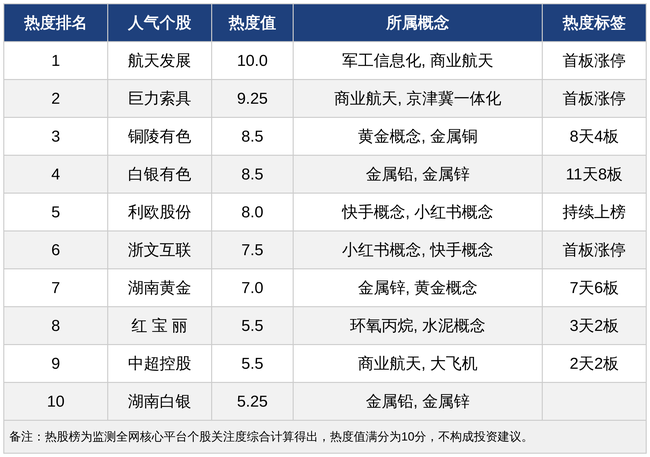
今日十大热股:航天发展、巨力索具领衔商业航天板块,白银有色11天8板、铜陵有色8天4板有色金属持续爆炒
Jin Rong Jie· 2026-02-04 02:17
Market Overview - A-shares experienced a collective rise on February 3, with the Shanghai Composite Index increasing by 1.29% to 4067.74 points, the Shenzhen Component Index rising by 2.19% to 14127.1 points, and the ChiNext Index up by 1.86% to 3324.89 points [1] - The total trading volume in the Shanghai and Shenzhen markets was 2.54 trillion yuan, a decrease of approximately 40.5 billion yuan compared to the previous trading day [1] - A total of 4583 stocks rose while 514 stocks fell, indicating a significant market profit effect [1] Hot Stocks - The top ten popular stocks included Aerospace Development, Jieli Sockets, Tongling Nonferrous Metals, Silver (core stock) Nonferrous Metals, Lioh Co., Zhejiang Wenlian, Hunan Gold, Hongbaoli, Zhongchao Holdings, and Hunan Silver [1][2] Aerospace Development - Aerospace Development benefits from strong policy support in the commercial aerospace sector, having completed the development and launch of multiple commercial satellites and achieved constellation networking operations [3] Jieli Sockets - Jieli Sockets' stock performance is driven by its deep involvement in commercial aerospace and deep-sea mooring sectors, receiving official certification from the Aerospace Science and Technology Institute as the exclusive supplier of key components for the recovery capture system [3] Tongling Nonferrous Metals - Tongling Nonferrous Metals is positively impacted by rising copper prices and a tight supply-demand balance, with LME copper inventories at a low level. The company is one of the largest copper smelting enterprises in China, producing over 400,000 tons annually [3] Silver Nonferrous Metals - The performance of Silver Nonferrous Metals is influenced by international silver price trends, driven by explosive growth in industrial demand, particularly in the photovoltaic and electronics sectors. The company has established a 1.5 billion yuan gold subsidiary, aligning with market interest in precious metals [3] Lioh Co. - Lioh Co. has a solid foundation in its dual business layout of "smart pumps and systems" and "digital marketing," with forward-looking applications in AI marketing and related fields [4][5] Zhejiang Wenlian - Zhejiang Wenlian benefits from optimized governance structure and precise business positioning, having completed rectification of related issues and received legal confirmation of governance compliance [5] Hunan Gold - Hunan Gold's stock performance is supported by improvements in its fundamentals and industry conditions, with recent announcements of major asset restructuring and performance forecasts amid rising international gold prices [5] Hongbaoli - Hongbaoli's core drivers stem from substantial improvements in its main business, focusing on the research and production of epoxy propylene derivatives, with recent projects entering trial production [5]


开盘:三大指数集体低开 半导体板块跌幅居前
Xin Lang Cai Jing· 2026-02-04 02:10
Market Overview - The three major indices opened lower, with the semiconductor sector experiencing significant declines. As of the market opening, the Shanghai Composite Index was at 4064.68, down 0.08%; the Shenzhen Component Index was at 14072.41, down 0.39%; and the ChiNext Index was at 3298.32, down 0.80% [1] Policy and Economic Developments - The Central Government's No. 1 Document for 2026 emphasizes the development of new agricultural productivity, integrating artificial intelligence with agriculture, and accelerating key technological innovations in agricultural bio-manufacturing [2] - The People's Bank of China announced an operation of 800 billion yuan in reverse repos to maintain ample liquidity in the banking system [3] - In January 2026, 4.9158 million new A-share accounts were opened, a month-on-month increase of 89% and a year-on-year increase of 213% compared to January 2025 [3] - The Ministry of Commerce reported that the effects of the old-for-new appliance and digital product subsidy policies are becoming evident, with sales of over 15 million units and nearly 59 billion yuan in sales revenue for six categories of home appliances and four categories of digital products in January [3] - The National Development and Reform Commission announced an increase in retail prices for gasoline and diesel by 205 yuan and 195 yuan per ton, respectively, effective from February 3 [4] Company Announcements - Ningde Times announced a cumulative repurchase of 15.9908 million A-shares as of January 31, while Kweichow Moutai reported a cumulative repurchase of 416,900 shares by the end of January 2026 [5] - Han Jian He Shan announced plans to acquire 99.9978% of Xingfu New Materials, adding a PEEK business line [5] - Wolgok Optoelectronics stated that its aerospace CPI products have not yet achieved mass production, and its microfluidic biochips do not involve chip design and manufacturing [6] - AMD reported fourth-quarter revenue of $10.27 billion, a year-on-year increase of 34%, and a net profit of $2.52 billion, up 42% year-on-year [8] Market Sentiment and Predictions - Zhongyuan Securities noted that the A-share market showed signs of recovery, with sectors like communication equipment, photovoltaic equipment, aerospace, and internet services performing well, while banking, insurance, and agriculture sectors lagged [9] - Dongguan Securities observed that the A-share market rebounded, with commercial aerospace concepts surging and the chemical sector active, while the banking sector showed weakness [9] - There is an expectation of moderate price increases and continued policy and industrial catalysts, with market sentiment likely stabilizing as precious metal prices recover and the Two Sessions policy window approaches after the Spring Festival [10]
未知机构:东财策略每日复盘20260203一市场概况2月3日A股市场-20260204
未知机构· 2026-02-04 02:10
Summary of Key Points from the Conference Call Market Overview - On February 3, the A-share market experienced a rebound, with all three major indices showing strength. The Shanghai Composite Index rose by 1.29% to close at 4067 points, the Shenzhen Component Index increased by 2.19%, and the ChiNext Index gained 1.86%. The total trading volume for the day was 2.54 trillion yuan, slightly down from the previous day. A total of 4856 stocks rose while 532 stocks fell [1][2]. Industry Performance - Among the Shenwan first-level industries, the top five sectors by growth were: - Comprehensive (+5.63%) - Defense and Military Industry (+4.42%) - Machinery Equipment (+3.98%) - Building Materials (+3.52%) - Steel (+3.28%) - The only sector that experienced a decline was Banking, which fell by 0.85% [3]. Thematic Trends - The commercial aerospace sector showed strong upward movement. Other notable themes included controlled nuclear fusion and solid-state batteries, which experienced fluctuations, while humanoid robots were active, and computing power concepts saw a slight recovery [4]. Market News - SpaceX announced the acquisition of xAI, an AI company also owned by Elon Musk, which confirmed its integration into SpaceX. - The China Aerospace Science and Technology Corporation's 11th Academy successfully conducted the first flight of the world's first hybrid unmanned transport aircraft, Rainbow YH-1000S, in Liangping, Chongqing. - Cambrian announced that it has not organized any small-scale communications recently and has not issued any annual or quarterly revenue guidance [5]. Future Outlook and Considerations - The recent rebound may be attributed to a recovery in sentiment following a sharp decline in the previous trading day. However, with trading volume not significantly increasing, there are concerns about short-term market corrections. - If external commodity prices continue to fluctuate, funds may flow back into defensive and low-volatility assets, while caution is advised regarding sectors that were more severely impacted previously. - As announcements and earnings disclosures become more frequent, market focus on earnings realization or potential negative surprises has notably increased. Previous strong sectors may need to navigate through volatility with solid earnings performance [6].