人工智能(AI)

Search documents
一半是海水一半是火焰 私募主题投资思路生变
Zhong Guo Zheng Quan Bao· 2025-12-24 21:35
临近年末,A股市场持续震荡,个股分化加剧。然而,与指数跌宕起伏形成鲜明对比的是,商业航天、 可控核聚变、无人驾驶、海南自贸港、新零售等主题概念板块却如火如荼,部分板块指数更在近期创出 历史新高。这种"个股分化、主题高潮"的分化格局,正成为年末市场最显著的特征,也考验着每一位市 场参与者的智慧。 多家受访的私募机构表示,这一现象是年末资金调仓与产业事件催化共振的结果。面对分化加剧的市 场,有的私募机构"拥抱趋势",有的"坚守价值"。机构的共识是,要对以AI为核心的产业机遇提前展开 多层次布局。 年末市场分化加剧 "现在市场就像一幅地图,指数区域是'温带',而几个热门主题板块简直是'热带'。"上海一家中型股票 私募的负责人李枫(化名)向中国证券报记者如此形容他近期的交易感受。其团队在11月降低了部分前 期涨幅过大的科技权重股仓位,将部分资金转向了事件密集催化的商业航天与可控核聚变主题板块,这 次主动的风格切换在年末为其组合带来了显著的阿尔法收益。 李枫的感受是年末市场结构性行情的缩影。多位接受采访的私募人士表示,这种"冰火两重天"的格局, 是资金面、政策面与时间节点多重因素共振的结果。 涌津投资董事长、投资总监谢 ...
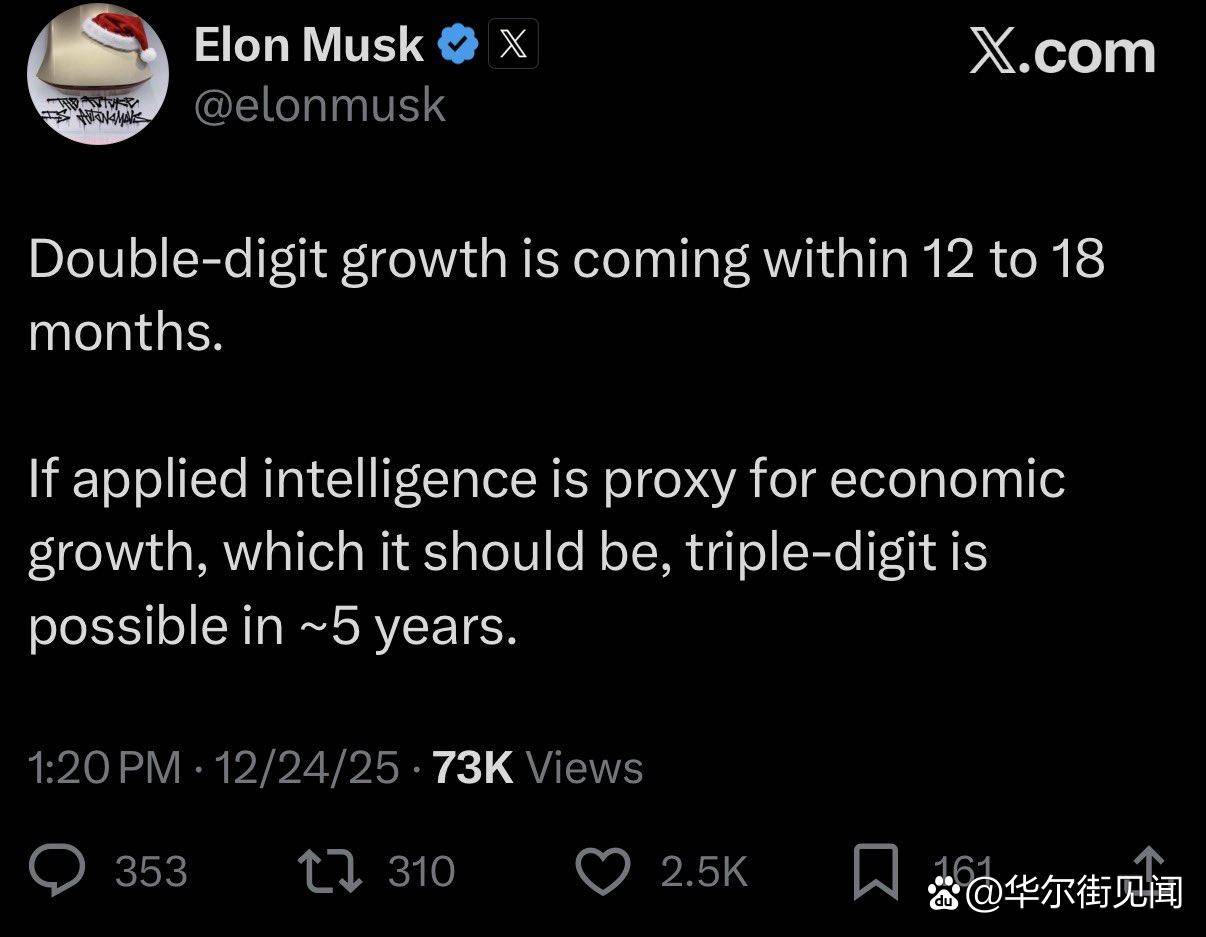
【特朗普前政府效率部DOGE顾问马斯克:AI可帮助美国GDP五年实现三位数增长】特斯拉CEO马斯克:未来12-18个月内(美国)将实现两位数(百分比)的GDP增长。若将人工智能(AI)的落地应用视为经济增长的替代指标(这理应成立),那么约五年内实现三位数增长是可能实现的。
Sou Hu Cai Jing· 2025-12-24 20:02
【特朗普前政府效率部DOGE顾问马斯克:AI可帮助美国GDP五年实现三位数增长】特斯拉CEO马斯克:未来12-18个月内(美国)将实现两位数(百分 比)的GDP增长。若 将人工智能(AI)的落地应用视为经济增长的替代指标(这理应成立),那么约五年内实现三位数增长是可能实现的。 ...


企业AI砸钱血亏,五维工具藏玄机,避坑全靠三层逻辑
Sou Hu Cai Jing· 2025-12-24 16:42
哈喽大家好,今天老张带大家聊聊现在搞AI的企业,不少在跟风,也有不少在踩坑!峰会上听人吹 Agent、多模态多牛,就立马砸钱试点,结果几十万投进去,要么跟业务八竿子打不着,要么效果稀 烂,最后只能不了了之——这不是在搞AI,这是在交智商税啊! 其实问题根本不是AI没用,而是企业搞错了逻辑:把"技术够不够潮"当成了"项目值不值做",却忘了搞 AI的核心是降本增效,不是拿来炫技的。 我见过太多中小企业栽在"追求高大上"上,放着客服自动化、文档审核这些"投入回报明确"的场景不 做,非要去碰全自治Agent这种现阶段难以规模化落地的硬骨头,纯属自找罪受! 想避开这些坑,其实有个"照妖镜"——五维评估框架,一照就知道项目值不值。先看场景熟不熟,数据 够不够、流程顺不顺。 再看能不能算出实打实的收益,ROI清不清晰;接着查安全合规过没过关,数据能不能循环用。 企业AI落地的死穴 穿透产业链 中间的技术层是"水管",聚焦机器学习、自然语言处理等关键技术,将基础层的能力打包成API、 RAG、LLMOps这些能用的工具,这才是中小企业的福音。 不用自己造"水管",借力成熟技术层平台就能快速落地,省事儿又省钱。这层竞争的核心就 ...

At least two more Fed cuts likely in 2026, says Moody's Mark Zandi
Youtube· 2025-12-24 16:22
Here to react is Moody's Analytics chief economist Mark Zandy. Mark, happy holidays. Thanks for being with us.>> Thanks, Carl. Happy holidays. >> Um, any reason to think that claims are going to see move into dangerous territory anytime soon.>> Doesn't feel that way. I mean, that's really good news. I mean, layoffs remain very low.I mean, I, you know, one week uh affected by holidays and timing and seasonal adjustment and all kinds of measurement issues, but feels like underlying UI claims weekly is about 2 ...

突破4500大关后,黄金仍在牛市“早期”?华尔街先知Yardeni:2029年有望冲击10000美元!
美股IPO· 2025-12-24 16:03
Core Viewpoint - Gold prices have reached new highs, increasing approximately 67% this year, and have outperformed the U.S. stock market for 25 consecutive years. Ed Yardeni predicts that gold could rise to $10,000 per ounce by 2029, becoming a core asset that offers both defensive and growth characteristics [1][3][6]. Group 1: Gold Market Performance - Gold has shown strong performance as a safe-haven asset, with a year-to-date increase of about 67% and a historical high of $4,500 per ounce reached recently [3][6]. - Over the past 20 years, gold has delivered a return of 761%, significantly outperforming the S&P 500's return of 673% during the same period [9][14]. - The total market capitalization of gold has reached $31.5 trillion, nearly seven times that of tech giant Nvidia [9]. Group 2: Future Predictions - Ed Yardeni's forecast suggests that gold prices could reach $10,000 per ounce by the end of 2029, aligning with his optimistic outlook for the S&P 500 index, which he expects to hit 7,700 points by the end of 2026 [6][11]. - Historical trends indicate that gold price increases often exceed market expectations, suggesting that the current bull market may still be in its early stages [6][14]. Group 3: Relative Valuation - Current gold prices are at their highest relative to cash since the 1960s and have surpassed the peak levels of 1980. However, when compared to the S&P 500, gold's current valuation is still 50% lower than its peak in 1980, indicating potential for further upside [14]. - Despite being perceived as expensive relative to cash and bonds, gold may still have room to grow when evaluated against equities [14]. Group 4: Silver Market Dynamics - The positive sentiment in the precious metals market has extended to silver, which has seen a 40% increase in price over the past month, maintaining strong momentum [15].

2025年银行业“破壁”进化:大象起舞 向新而生
Zheng Quan Ri Bao· 2025-12-24 15:49
Core Insights - The banking industry in 2025 demonstrates remarkable resilience, with net profits stable compared to the previous year, a capital adequacy ratio above 15% for three consecutive quarters, and total assets reaching a new high of 474 trillion yuan [1] - The industry is undergoing profound changes focused on three main lines: transforming business models to support the real economy, enhancing sustainable operational capabilities, and emphasizing risk prevention and systemic resolution [1] Group 1: Transformation and Innovation - The banking sector is shifting from traditional financial service models to more innovative approaches, integrating into modern industrial systems and fostering new productive forces [3] - Financial resources are increasingly directed towards innovative sectors, with 275,400 technology SMEs receiving loans, a 2.8 percentage point increase in loan approval rates year-on-year [3] - Banks are redefining risk assessment by incorporating intellectual property and R&D intensity into evaluation criteria, thus facilitating financing for asset-light tech companies [4] Group 2: Consumer Support Initiatives - The banking industry is actively promoting consumption by lowering consumer loan interest rates and implementing subsidy policies to stimulate market demand [5] - In August 2025, a joint policy was issued to support personal consumption loans, allowing for significant reductions in effective interest rates for eligible customers [5] - These initiatives have successfully addressed consumer hesitance, leading to increased orders in manufacturing sectors such as automotive and home appliances [6][7] Group 3: Financial Asset Investment Companies (AIC) - The establishment of new AICs has expanded the capacity for banks to support technological innovation through direct equity investments [8] - The regulatory environment is evolving to encourage more banks to enter the AIC space, enhancing their ability to provide diversified financing solutions [8] Group 4: Wealth Management and Financial Products - The focus of wealth management has shifted from expansion to optimizing existing assets, with the market size stabilizing at 31 trillion yuan [9] - Banks are innovating product offerings to meet diverse customer needs while enhancing their investment capabilities [9][10] Group 5: Capital Support for Major Banks - The issuance of 500 billion yuan in special bonds aims to bolster the capital of major state-owned banks, enhancing their credit capacity and risk resilience [11] - This capital injection is expected to support effective demand expansion and economic structure optimization [11] Group 6: Industry Self-Regulation and Quality Focus - The banking sector is moving away from a scale-driven approach towards a focus on quality, efficiency, and differentiated development [12][13] - Regulatory measures are being implemented to curb irrational competition and promote sustainable growth [12][13] Group 7: Cost Reduction and Efficiency Improvement - Banks are actively reducing costs and improving efficiency through strategic adjustments in their liability structures and operational models [14][15] - These measures are aimed at stabilizing profit margins and enhancing risk management capabilities [15] Group 8: Embracing AI Technology - The banking industry is rapidly adopting AI technologies to enhance service delivery and operational efficiency [16] - AI is becoming a core infrastructure for banks, transforming traditional service models into more collaborative human-machine interactions [16] Group 9: Collaboration Among Small and Medium Banks - Small and medium banks are engaging in collaborative strategies to enhance risk management and service delivery [17][18] - These initiatives are aimed at addressing regional financial needs and improving support for small enterprises [18] Group 10: Market Valuation and Investor Confidence - The banking sector has experienced a valuation recovery, with significant stock price increases reflecting improved market confidence and economic fundamentals [19] - This recovery allows banks to explore refinancing options, further strengthening their capital structures [19] Conclusion - The banking industry is evolving towards a more resilient, intelligent, and demand-driven model, focusing on value creation and innovation as it navigates future challenges [20]
在AI面前,人类终于不说谎了
3 6 Ke· 2025-12-24 11:52
人和AI已经开启了新时代,去年是元年。 人类为何会选择跟AI咨询问题?我觉得首先要明白什么是"树洞"。 AI已经在不知不觉之中,悄然无声地走入了人类的情感生活,走入了我们的社会,影响了 人与人之间的感情,左右了人类的很多决策,当我们还在讨论AI是不是有很大泡沫的时 候,殊不知,我们已经在AI时代了。 我有个朋友,最近爱上了他的上司,一个职场女强人,他花了三个月心理建设,终于表白了。在他表白 后,他的女上司并没有拒绝他,也没有接受他,就这么一直暧昧着,保持着说不明道不清的关系,他很 烦恼,没有办法告诉任何人这个事。 于是,他把他们之间的聊天记录,全部发给了千问,问AI这个女生到底什么意思,分析她的心理。 经过一周的文本分析后,AI给了他一个结论,这个女生不爱你,她之所以没有直接拒绝你,是因为觉 得你能力很强,应该留在公司,怕直接拒绝后,伤了你的心,从而离开公司。她想留住你继续工作,但 是对于感情,希望你知难而退,自己意识到不可能。 他为了加固这个答案,又把发给AI的聊天记录,发给了我。我看完之后,用我长达20年的渣男经验, 得出的答案,几乎一致。 我和AI,都是他在这段情感经历中的参谋和树洞。 我恍然大悟,AI ...
韩国12月消费者信心指数创年内最大降幅
Sou Hu Cai Jing· 2025-12-24 11:28
来源:市场资讯 (来源:AJU视界) 韩国12月消费者信心指数创年内最大降幅 12月住宅价格展望指数为121点,环比上升2个百分点。此前受"10·15"房地产调控政策影响,该指数在11月曾下降3个百分点,本月则迅速反 弹,显示预计一年后房价将上涨的消费者比例有所增加。反映消费者对未来一年物价上涨率预期的预期通货膨胀率为2.6%,环比持平。 消费者心理指数由当前生活状态、生活状况展望、家庭收入预期、消费支出预期、当前经济形势判断、未来经济前景展望这6项指数综合计算 得出。该指数高于100表示与长期平均值(2003年至2024年)相比消费心态趋于乐观,低于100则意味着消费心态偏向悲观。 12月六项分指数中,当前经济形势判断降幅最大,从96点降至89点,下降7个百分点。未来经济前景展望下降6个百分点,家庭收入预期、生活 状况展望、当前生活状态均环比下降1个百分点。消费支出预期指数则保持不变。 央行经济心理调查组负责人分析称:"当前经济判断指数走弱,主要是因为农畜水产品和石油等民生商品价格涨幅扩大。未来经济展望下滑则 源于汇率波动加剧、人工智能(AI)产业价值重估等外部不确定性上升。" 韩国银行(央行)24日发布的 ...

科技如何重塑保险资管?中国人寿(海外)魏晓鹏,最新发声
Zhong Guo Ji Jin Bao· 2025-12-24 10:41
Core Viewpoint - The forum highlighted the transformative role of technology in insurance asset management, emphasizing that the primary value of technology is to enhance decision-making stability rather than to make investments more aggressive [1]. Group 1: Evolution of Insurance Asset Allocation - The evolution of insurance asset allocation has shifted from reliance on experience and single return targets to a multi-objective approach focusing on duration, return, and liquidity [2]. - The current environment is characterized by increased geopolitical risks and significant asset correlation, making the dynamic interaction between assets and liabilities more critical than ever [2]. - The essence of insurance asset allocation has transitioned from "what assets to select" to finding "explainable, verifiable, and executable optimal solutions" under multiple constraints [2]. Group 2: Value of Technology in Investment - The primary value of technology in insurance asset management is to make decision-making more robust rather than to accelerate investment processes [3]. - A systematic framework focusing on value and profit has been implemented by the company, exploring AI applications in scenario-based asset allocation [3]. - An example was provided where an algorithm reduced capital risk indicators by 15% while maintaining expected surplus, demonstrating a methodology that integrates liabilities, capital, returns, and risks into a unified decision-making space [3]. Group 3: AI's Role in Insurance Asset Management - AI is seen as a tool to amplify system capabilities rather than replace decision-makers, with applications starting from three foundational areas [4]. - The first area is the structured processing of high-dimensional data, allowing for the identification of structural relationships among thousands of assets and numerous constraints [4]. - The second area involves scenario generation and portfolio simulation, where AI can create more realistic potential paths compared to traditional assumptions [4]. Group 4: Challenges of AI Implementation - The true challenge of technological transformation in insurance asset management lies in whether the organization has a compatible decision-making mechanism and culture, which is deemed more important than the models and algorithms themselves [6]. - Collaboration among research, risk control, actuarial, and IT departments in a common language is essential for effective implementation [6]. - Management must accept the idea of using systems to constrain personal judgment, allowing technology to become an integral part of the institution and its processes [6].

科技如何重塑保险资管?中国人寿(海外)魏晓鹏,最新发声
中国基金报· 2025-12-24 10:31
Core Viewpoint - The core viewpoint of the article emphasizes the transformative role of technology, particularly AI, in reshaping insurance asset management, focusing on enhancing decision-making stability rather than aggressive investment strategies [2][6]. Group 1: Evolution of Insurance Asset Allocation - The evolution of insurance asset allocation has transitioned from reliance on experience and single yield targets to a multi-objective balancing phase centered on duration, yield, and liquidity [4]. - Currently, the complexity of the environment, including rising geopolitical risks and new accounting standards, necessitates a shift from "what assets to select" to finding "explainable, verifiable, and executable optimal solutions" under multiple constraints [5]. Group 2: Value of Technology in Investment - The primary value of technology in insurance asset management is to make investment decisions more robust rather than more aggressive [7]. - A systematic strategic asset allocation framework has been implemented by the company, focusing on value and profit, exploring AI applications in scenario-based asset allocation [7]. - An example of cross-asset allocation demonstrated that an algorithm reduced capital risk indicators by 15% while maintaining expected surplus, integrating liabilities, capital, returns, and risks into a unified decision-making methodology [7]. Group 3: AI's Role in Insurance Asset Management - AI's role is not to replace decision-makers but to amplify system capabilities, starting from three fundamental aspects rather than market prediction [9]. - The first aspect is the structured processing of high-dimensional data, enabling the identification of structural relationships among thousands of assets and numerous constraints [10]. - The second aspect involves scenario generation and portfolio simulation, allowing for the creation of more realistic potential paths compared to traditional assumptions [10]. - The third aspect is human-machine collaborative decision support, where AI provides decision spaces, risk boundaries, and trade-offs, with final decisions made by the investment decision committee [10]. Group 4: Challenges in AI Application - The true challenge in the technological transformation of insurance asset management lies not in the availability of AI but in whether the organization possesses a compatible decision-making mechanism and culture [12]. - Collaboration among research, risk control, actuarial, and IT departments in a common language is essential, as is management's acceptance of using systems to constrain personal judgment [13]. - Although technology cannot provide direct answers, it helps in approaching long-term optimal solutions amidst uncertainty, maintaining the mission of serving the real economy and social development responsibly [13].