现代化产业体系

Search documents
11月24日晚间央视新闻联播要闻集锦
Yang Shi Xin Wen Ke Hu Duan· 2025-11-24 14:01
Group 1 - The modern industrial system is emphasized as the material and technical foundation of a modern country, with a focus on developing the real economy to support the second centenary goal [1][5] - During the "14th Five-Year Plan" period, China aims to accelerate the construction of a modern industrial system, driven by technological innovation and rooted in the real economy [1][5] Group 2 - In October, China's new quality productivity continued to grow, with industrial robot sales revenue increasing by over 40% year-on-year [2][10] - The sales revenue for integrated circuits, industrial robots, and drone manufacturing increased by 32.5%, 41.7%, and 38.4% respectively [10] Group 3 - Green trade is emerging as a new driving force and advantage for China's foreign trade development this year [3][11] - An increasing number of green low-carbon products and services are being showcased in international markets [11]
11月24日《新闻联播》主要内容
Xin Lang Cai Jing· 2025-11-24 12:14
Group 1 - China's modern industrial system construction is accelerating as part of the "14th Five-Year Plan" [1] - In October, the sales revenue of industrial robots increased by over 40% year-on-year, indicating a rapid cultivation of new productivity [7] - By the end of October, the cumulative installed power generation capacity in the country grew by 17.3% year-on-year [12][12] Group 2 - The scale of agricultural social services provided by the national supply and marketing cooperative system reached 320 million acres in the first ten months [12] - The import and export volume of the Shanghai Cooperation Organization demonstration zone to other member countries increased by 27.2% year-on-year in the first ten months [12] - China has initiated an international scientific program in the field of nuclear fusion [12] Group 3 - The implementation of the Space Exploration Scientific Satellite Program marks a new advancement in China's space science [9] - The Shenzhou-22 spacecraft is scheduled for launch on November 25 [10]
【新思想引领新征程·非凡“十四五”】我国加快建设现代化产业体系
Yang Shi Wang· 2025-11-24 12:06
央视网消息(新闻联播):习近平总书记指出,现代化产业体系是现代化国家的物质技术基础,必须把 发展经济的着力点放在实体经济上,为实现第二个百年奋斗目标提供坚强物质支撑。 "十四五"期间,我国以科技创新为引领、以实体经济为根基,加快建设现代化产业体系,为中国式现代 化注入澎湃动力。 广袤大地,中国产业新动能处处涌动着蓬勃生机。 今年前三季度,规模以上高技术制造业增加值同比增长9.6%,工业机器人产量增长近30%,无人机制造 销售收入增长近70%,新兴产业茁壮成长,人工智能、脑机接口等前沿技术加速布局,推动创新"势 能"向经济"动能"不断转化。 当前,各地正紧锣密鼓谋划"十五五"产业发展新图景。湖南省拿出500亿元为全省189万中小企业注入资 金支持,重点聚焦钢铁石化、轨道交通等13条重点产业链。在安徽,正加快布局实施"千家场景"行动, 向量子科技等前沿领域企业主动敞开大门,将释放超过1000个政府机关应用场景,让创新技术加速迭代 落地。 "十五五"规划建议把建设现代化产业体系,巩固壮大实体经济根基放在战略任务的首要位置。锚定这一 方向,不断以创新绘就产业新篇,以实干筑牢强国根基,为全面建设社会主义现代化国家提供坚 ...
工信部启动创建国家新兴产业发展示范基地 2035年将培育“千企百园”标杆
Zheng Quan Shi Bao Wang· 2025-11-24 08:48
Core Viewpoint - The Ministry of Industry and Information Technology has launched the creation of national emerging industry development demonstration bases to support new industrialization and modern industrial system construction [1][2] Group 1: Demonstration Base Creation - The demonstration bases are categorized into park-type and enterprise-type, focusing on industrial cluster development, collaborative innovation, ecological optimization, and management efficiency [1][2] - The goal is to establish around 100 park-type and 1,000 enterprise-type demonstration bases by 2035, enhancing industrial innovation capabilities and competitiveness [1][2] Group 2: Key Industries and Dynamic Adjustment - The initiative targets nine key emerging industries, including new generation information technology, new energy, and high-end equipment, with the ability to adjust based on national policies and industry trends [2] - The creation mechanism includes a "total control, batch creation, and entry-exit" principle, with evaluations every two years to ensure quality [2] Group 3: Support Mechanisms - The Ministry will establish a central-local linkage mechanism for policy support and resource allocation, including specialized financing for demonstration bases [2][3] - Financial institutions will be encouraged to develop tailored financial products to support the construction of these bases [2] Group 4: Talent and Innovation Support - Talent needs for the demonstration bases will be integrated into relevant talent plans, with joint training mechanisms established by affiliated universities [3] - The bases will be supported in applying for projects and building innovation platforms, ensuring a focus on practical outcomes without imposing fees or requiring local matching funds [3]
民营企业“涌现”院士将为科技创新注入强大活力
Di Yi Cai Jing Zi Xun· 2025-11-24 00:51
Core Points - The recent election of three leaders from private enterprises as academicians of the Chinese Academy of Engineering signifies a recognition of the value of private sector innovation in technology [2][3] - The election reflects a shift in the national scientific evaluation system, acknowledging the contributions of private enterprises to technological innovation and breaking the traditional bias towards public institutions [3][4] - The new academicians specialize in key areas such as artificial intelligence, new energy, semiconductors, and biomedicine, which are crucial for high-quality development [3] Group 1: Recognition of Private Sector Innovation - The election of three private enterprise leaders as academicians indicates a significant acknowledgment of the role of private companies in technological innovation, contributing 70% of the nation's technological advancements [2][3] - The recognition of private enterprises is a response to their substantial contributions, with 80% of the national "specialized and innovative" small giants emerging from this sector [2][3] Group 2: Changes in Research Resource Allocation - The recent guidelines for the election of academicians have allocated eight positions specifically for candidates from private technology enterprises, indicating a commitment to reform the scientific evaluation system [3][4] - There is a need for a collaborative research innovation system that includes both public and private sectors, moving away from the historical preference for public institutions [4][5] Group 3: Future Expectations and Support - The implementation of the Private Economy Promotion Law emphasizes the government's encouragement for private enterprises to play a significant role in technological innovation and the development of modern industrial systems [4][5] - To foster more leaders in technology from private enterprises, it is essential to strengthen their role in innovation and industry development, as outlined in the 15th Five-Year Plan [4][5] Group 4: Collaborative Efforts and Challenges - The establishment of "innovation consortia" that include private enterprises is crucial for advancing technological breakthroughs [5] - There is a push for increased collaboration between private enterprises and traditional research institutions, although challenges remain in terms of institutional barriers [5]


湖北发布“十五五”发展新蓝图 12项重点任务推动“基本建成支点”
Chang Jiang Shang Bao· 2025-11-24 00:32
Core Objectives - Hubei has set a strategic goal for the next five years to accelerate the establishment of a significant strategic support point for the rise of the central region [3][4] - The overall target emphasizes the continuity and stability of Hubei's strategic deployment for support point construction [3] Development Strategies - Hubei plans to implement "seven major strategies" and enhance "seven capabilities" to achieve greater results in five key areas [4] - The province aims to solidify its economic foundation, promote technological innovation, and deepen the integration of innovation and industry [7][10] Economic Growth and Achievements - During the "14th Five-Year" period, Hubei's economic total surpassed 5 trillion and 6 trillion yuan, achieving its planning goals a year ahead of schedule [5] - The province has effectively responded to various risks and challenges, making significant progress in support point construction [5][6] Key Tasks and Focus Areas - The provincial government has outlined 12 key tasks, including building a modern industrial system, promoting agricultural modernization, and enhancing infrastructure [7][8] - Specific initiatives include optimizing regional economic layout, expanding high-level openness, and ensuring social welfare improvements [7][9] Regional Collaboration - The plan emphasizes regional collaboration and strategic synergy with other areas to promote balanced and coordinated high-quality development [9] - Hubei will support the development of key cities like Wuhan, Xiangyang, and Yichang as regional centers [9] Agricultural Development - Hubei is hosting the 2025 Agricultural Expo to showcase its advancements in modern agriculture and promote brand awareness [11][12] - The expo will feature a comprehensive display of agricultural innovations and aims to enhance consumer experience and market connections [12][14] Financial Support for Agriculture - Hubei has initiated various financial reforms to activate rural assets and provide diverse financing channels for agricultural entities [15] - The province is focusing on facilitating the listing of agricultural companies to enhance industry upgrades and attract investment [15]

“东绸西固”织就茧丝绸产业新局
Jing Ji Ri Bao· 2025-11-23 23:14
Core Viewpoint - The joint notice issued by the Ministry of Commerce and other departments aims to promote the orderly transfer of the silk industry from the eastern to the western regions of China, enhancing the industry's core competitiveness and establishing a modern industrial system by 2028 [1][2]. Group 1: Industry Development Strategy - The notice outlines a new development pattern for the silk industry, emphasizing innovation in the eastern region and production capacity support in the central and western regions, aiming for a collaborative and complementary growth model [1][2]. - By 2028, the total output value of the silk industry is expected to exceed 300 billion yuan, with breakthroughs in ten key technologies including intelligent silk reeling and green dyeing [1][3]. Group 2: Key Tasks and Objectives - The notice identifies three main areas with nine key tasks to facilitate the transfer of deep processing segments like weaving and dyeing to the central and western regions, while enhancing technological innovation and brand development in the eastern regions [2][3]. - Specific goals include establishing around ten leading enterprises with revenues exceeding 10 billion yuan in the eastern region and developing over 20 well-known brands with independent intellectual property rights by 2028 [3]. Group 3: Coordination and Support Mechanisms - The initiative emphasizes the importance of coordination between eastern and western regions, including the establishment of an information platform and a database for transfer projects and receiving areas [3]. - The notice also highlights the need for ongoing support in terms of land and energy resources to facilitate project construction and ensure the successful transfer of the silk industry [3].
【省财政厅】陕西财政着力支持“专精特新”企业高质量发展
Shan Xi Ri Bao· 2025-11-23 22:55
聚焦关键环节,实施精准财政资金扶持。近年来,陕西省通过中小企业和民营经济发展专项资金, 聚焦企业梯度培育、科技创新等关键环节,持续支持企业高质量发展。2023年以来,累计安排资金2.11 亿元对77家国家级专精特新"小巨人"企业和976家省级"专精特新"中小企业给予认定奖励;累计投入资 金4.9亿元,对中小企业智能化改造和关键核心设备更新、研发投入等项目给予奖补,调动中小企业实 施技术改造和更新设备的积极性、主动性,带动中小企业广泛应用新技术、新材料,不断提高发展质 量。 2024年,该厅联合省发展改革委、省工信厅等部门印发开展中小微企业服务行动的相关通知,指导 全省各级各部门扎实做好中小微企业服务工作;深入推进中小企业数字化转型,组织数字化服务机构深 入企业开展业务培训和数字化诊断,充分利用中央试点资金,支持榆林市、西安市开展中小企业数字化 转型城市试点建设,支持企业集聚创新发展。 "2023年以来,我们累计安排资金8100万元,支持开展省级小微企业创业创新基地建设等项目,形 成人才与资源集聚,助力打造'双创'高地。"省财政厅相关负责人说。(记者:徐颖) 11月20日,记者从省财政厅获悉:近年来,该厅将培育 ...
专访中国社科院经济研究所原所长黄群慧:既要重视AI赋能千行百业,也要考量对就业的替代效应和带来的收入极化
Mei Ri Jing Ji Xin Wen· 2025-11-23 15:49
Core Viewpoint - The "15th Five-Year Plan" emphasizes the construction of a modern industrial system, reflecting a strategic shift in response to current domestic and international conditions, with a focus on both supply-side and demand-side policies [2][3][4]. Group 1: Modern Industrial System - The prioritization of "building a modern industrial system" signifies a need for new growth drivers, as traditional industries currently account for about 80% of the economy, with potential for significant market expansion through transformation [3][4]. - The modern industrial system is crucial for supporting the transformation of traditional industries and fostering new growth dynamics, highlighting the interdependence between technological innovation and industrial development [3][5]. Group 2: Policy Resource Allocation - The government should balance investments in traditional industries with those in strategic emerging and future industries, recognizing that traditional industries are essential for overall economic transformation [6][7]. - Different investment mechanisms are required for traditional, strategic emerging, and future industries, emphasizing the need for tailored policies to avoid pitfalls in resource allocation [8]. Group 3: Future Industries - The selection of six key future industries—quantum technology, biomanufacturing, hydrogen energy, nuclear fusion, brain-computer interfaces, and sixth-generation mobile communications—reflects a strategic focus on original innovation, market potential, and national security [9][10]. - The potential for these industries to achieve commercial viability within five years remains uncertain, with various factors influencing their market readiness and scalability [11][12]. Group 4: High-Tech Industry Growth - The goal of "doubling" the scale of high-tech industries over the next decade indicates a significant push for structural upgrades and the development of new high-tech sectors [14][15]. - Achieving breakthroughs in key areas like integrated circuits and industrial mother machines is critical for overcoming technological bottlenecks and enhancing national competitiveness [16]. Group 5: Artificial Intelligence Integration - The repeated emphasis on "artificial intelligence" in the plan indicates its role as a core driver for modern industrialization, aiming to empower various sectors of the economy [17][18]. - The social implications of AI, including its impact on employment and income distribution, must be considered in policy-making to ensure inclusive growth and address potential ethical concerns [18][19].
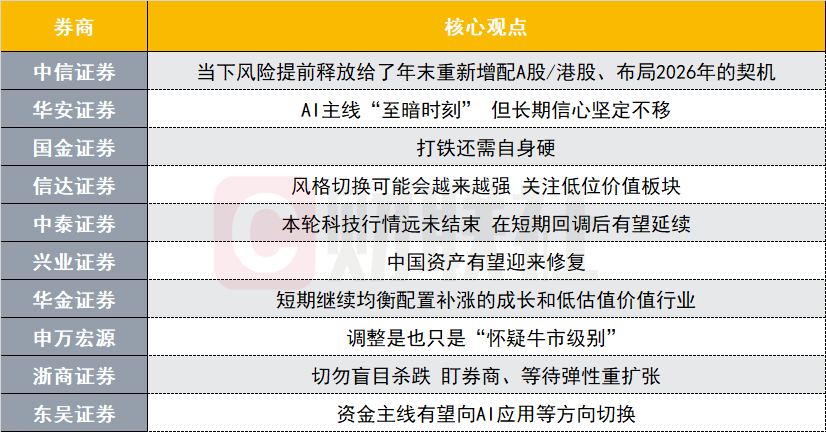
年末重新增配A股迎来契机?投资主线有哪些?十大券商策略来了
Feng Huang Wang· 2025-11-23 13:21
Core Viewpoints - Current risk release provides an opportunity for reallocating A-shares and Hong Kong stocks by year-end and planning for 2026 [2] - The AI sector is experiencing a "darkest hour," but long-term confidence remains unwavering [4] - The adjustment phase is merely a "doubtful bull market level" [11] Industry Insights - Focus on resource and traditional manufacturing opportunities, particularly in chemicals, non-ferrous metals, and new energy [3] - The AI industry is expected to continue its growth trajectory, with significant valuation growth potential for A-share companies [8] - The market is likely to experience a style switch, with increasing attention on low-valued sectors [6] Investment Recommendations - Emphasize sectors benefiting from physical asset consumption, such as upstream resources (copper, aluminum, lithium, oil, coal) and midstream industries [5] - Maintain a balanced allocation between growth sectors and undervalued value industries, particularly in the consumer sector as year-end approaches [10] - Focus on AI applications and sectors closely related to the "14th Five-Year Plan," such as hydrogen energy, nuclear energy, and quantum technology [14]