
普惠金融

Search documents
提升银行业精准对接重点领域 信贷需求能力
Jin Rong Shi Bao· 2025-11-25 02:12
Core Viewpoint - The article emphasizes the importance of the financial sector as a vital component of national competitiveness and economic development, highlighting the need for banks to support the real economy and align with the goals set forth in the 14th Five-Year Plan [1] Group 1: Financial Sector Development - The banking industry is tasked with optimizing credit structures, innovating product services, and improving mechanisms to meet the demands of key areas such as industrial upgrading, technological innovation, and rural revitalization [1][2] - The 14th Five-Year Plan includes the goal of building a modern industrial system, with a focus on intelligent, green, and integrated development [2] Group 2: Industry-Specific Financial Services - Banks should create a differentiated, full-chain industrial financial service system to efficiently allocate financial resources to key industries [2][3] - Emphasis is placed on supporting traditional industries like mining and metallurgy, as well as emerging sectors such as renewable energy and aerospace, through tailored credit policies [2] Group 3: Technology and Innovation Financing - The banking sector is encouraged to develop a comprehensive financial service system that covers the entire lifecycle of technology enterprises, focusing on early-stage investments and support for technology commercialization [4][5] - Establishing a multi-dimensional ecosystem involving government, venture capital, and research institutions is crucial for matching technology, capital, and talent [5] Group 4: Inclusive Finance - The banking industry is urged to enhance inclusive finance to support employment stability and income growth, particularly for small and micro enterprises and rural areas [7][8] - Innovations in financial products and services are necessary to meet the financing needs of small businesses and promote rural revitalization [7] Group 5: Wealth Management and Consumer Finance - Banks should optimize wealth management and consumer finance services to stimulate domestic consumption, which is vital for economic growth [9][10] - The development of personalized financial products and services is essential to meet diverse consumer needs and enhance financial literacy among residents [9][10]
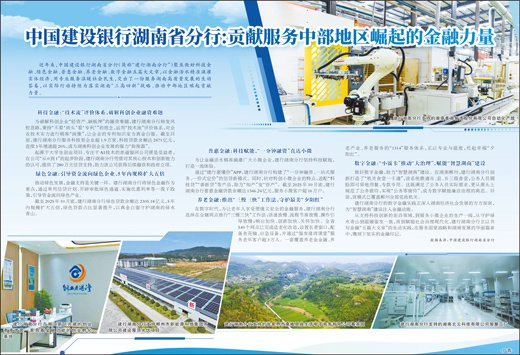
中国建设银行湖南省分行:贡献服务中部地区崛起的金融力量
Ren Min Wang· 2025-11-25 01:32
Core Viewpoint - China Construction Bank Hunan Branch focuses on five key areas: technology finance, green finance, inclusive finance, pension finance, and digital finance, contributing to Hunan's high-quality development and supporting the "Three Highs and Four New" strategy [2][3][4][5][6][7] Group 1: Technology Finance - The bank has developed a "technology flow" evaluation system to address the financing difficulties of technology enterprises, allowing patents to be converted into financial assets [2] - Over 19,000 technology enterprises have been served, with a technology loan balance of 247.1 billion yuan, growing at over 20% for three consecutive years [2] Group 2: Green Finance - Green finance is prioritized, with a loan balance of 230.52 billion yuan expected by October 2025, representing a fivefold increase over five years [3] - The bank implements policies such as separate credit plans and green channels to direct funds towards green industries [3] Group 3: Inclusive Finance - The bank has introduced a new credit model through the "CCB Hui Dong Ni" app, enabling "one-minute financing" for small and micro enterprises [4] - The inclusive finance loan balance reached 134.62 billion yuan, serving over 160,000 small micro customers [4] Group 4: Pension Finance - The bank has implemented a "three slow, three fast" approach to enhance financial services for the elderly, with 540 branches undergoing age-friendly modifications [5] - A comprehensive service system covering pension finance, industry, and services is in place to support the elderly [5] Group 5: Digital Finance - The bank has innovated a "canteen card" system to facilitate digital governance, allowing public officials to use facial recognition for meals across different locations [6] - This initiative promotes clean governance and has been adopted by all party and government agencies [6] Group 6: Overall Impact - The bank's digital finance practices are integrated into various aspects of Hunan's economic and social development, enhancing support for national strategies and local growth [7]


交易商明晰证券业场外业务功能定位
Zheng Quan Ri Bao· 2025-11-24 23:26
Core Viewpoint - The report highlights the proactive role of over-the-counter (OTC) derivatives traders in supporting national strategies and the real economy, showcasing their contributions to the financial sector through various initiatives and case studies [1]. Group 1: OTC Derivatives Empowerment - 44 OTC traders participated in a survey, with 42 providing effective data and case studies, demonstrating the industry's achievements in the financial sector [2]. - In the technology finance sector, 17 traders customized OTC derivatives to meet the complex needs of tech companies and investors, facilitating capital flow into the tech sector through innovative products [2]. - In green finance, 30 traders developed a low-carbon economy service system, utilizing OTC derivatives to support green industries and optimize resource allocation [2]. Group 2: Inclusive Finance and Pension Finance - 30 traders expanded their service coverage in inclusive finance, providing affordable financial services to small and micro enterprises, farmers, and the general public, enhancing economic resilience [3]. - In pension finance, traders are focusing on comprehensive wealth management for residents, offering innovative risk management and personalized solutions through OTC derivatives [3]. Group 3: Digital Finance - 37 traders emphasized the use of financial technology in OTC business development, transitioning risk management from experience-driven to algorithm-driven approaches [4]. Group 4: Consensus on Function Positioning - Traders reached a consensus on the role of OTC derivatives in the high-quality development of the securities industry, recognizing their ability to connect on-market and off-market activities and act as a stabilizing force [5]. - OTC derivatives provide customized, flexible, and refined management tools for professional investors, meeting diverse investment needs [5]. - The business model of OTC derivatives is driving strategic transformation and service upgrades for traders, enhancing their core capabilities in risk management and digital empowerment [5]. Group 5: Challenges and Recommendations - Despite achievements, traders face challenges such as limited business types, disparities in funding and talent, and the need for improved understanding of regulatory guidance [6]. - Recommendations include enhancing top-level design, supporting robust cross-border business systems, strengthening digital investment, and promoting positive industry image [6].
坚守服务小微初心,践行普惠金融使命
Nan Fang Du Shi Bao· 2025-11-24 23:11
Core Insights - The article highlights the successful case of a small business owner, Mr. Chen, who secured a significant municipal project but faced a cash flow gap of 10 million yuan, which was resolved by Ping An Rongyi's rapid financing service [1][2] - Ping An Rongyi's Shenzhen branch has been recognized for its role in promoting inclusive finance, with a focus on small and micro enterprises, achieving a loan balance of 1.90 trillion yuan, leading the nation among major cities for five consecutive years [1][3] Group 1: Service Model and Impact - Ping An Rongyi Shenzhen branch employs a "one-on-one" service model, providing personalized financial consulting to small businesses, which has proven effective in addressing urgent funding needs [2][3] - The company has established a team of approximately 600 offline consultants who actively engage with small business owners in various locations, offering tailored financial solutions and building trust [3][4] - The "宅E贷" product features online approval and rapid disbursement, allowing for quick access to funds, which is crucial for businesses facing immediate financial challenges [2][5] Group 2: Technological Innovation - Ping An Rongyi leverages AI and big data to enhance the efficiency of its financial services, with the AI video loan service "行云" significantly reducing application times and improving user experience [4][5] - The company has developed differentiated financial products such as "宅E贷," "车E贷," and "微营贷-优票方案" to cater to diverse customer needs, while also promoting green finance initiatives [5][6] Group 3: Financial Literacy and Consumer Protection - The Shenzhen branch is committed to enhancing public financial literacy and has initiated over 30 financial consumer protection education activities, reaching more than 200,000 individuals [6]
机制革新破壁垒 产品创新提质效 数字赋能拓边界
Nan Fang Du Shi Bao· 2025-11-24 23:11
Core Insights - The development of inclusive finance is crucial for Shenzhen's goal of becoming a global financial innovation center and serves as a link between finance and people's livelihoods, empowering the real economy [2] Group 1: Financing Solutions for Small and Micro Enterprises - The challenges faced by small and micro enterprises in financing include information asymmetry and lengthy service chains, which the bank addresses by creating a collaborative ecosystem involving government, banks, and enterprises [3] - The bank has implemented a "branch contact person" system to streamline the loan process, enhancing service efficiency and allowing businesses to avoid multiple visits and inquiries [3] Group 2: Supply Chain Financing - The bank focuses on supply chain stability by offering products like "Order e-loan" and "Distributor e-loan," which extend the credit of core enterprises to their upstream and downstream small businesses [4] - A tailored "Order e-loan" solution was developed for a leading LED enterprise, enabling its suppliers to access financing quickly upon receiving orders, thus addressing their long-standing financing difficulties [4] Group 3: Digital Empowerment in Foreign Trade - The bank launched "Cross-border Flash Loan" to support inclusive foreign trade enterprises, utilizing customs data and business registration information to automate credit approval and facilitate online operations [5] - An example includes a technology company that received a credit limit of 5 million yuan and accessed its first financing within half an hour of submitting the customs declaration [5] Group 4: Customized Financing Solutions - The bank recognizes the diverse needs of small and micro enterprises in Shenzhen and has developed tailored financing solutions based on specific industry characteristics and requirements [7] - Innovations include a "Credit Card for Inclusive Technology Enterprises" that converts technological capabilities into credit limits and a "Park Credit Model" that provides credit upon entering an industrial park without additional collateral [7] - The bank is committed to deepening the financing coordination mechanism for small and micro enterprises to support high-quality economic development in the Shenzhen region [7]


建行深圳市分行“数据+”解局新质生产力
Nan Fang Du Shi Bao· 2025-11-24 23:11
"中国杯"帆船赛上"建行号"扬帆起航。 深圳正全力打造"全球海洋中心城市"。以"蓝色粮仓"为代表的海洋经济,因其对生态可持续发展的内在 追求,本质上是"绿色经济"的重要版图,也是发展"新质生产力"的关键引擎。 然而,这一"绿色"与"新质"兼具的产业,长期以来却面临着传统金融的"干渴"。如何破解"普惠金融"的 堵点?中国建设银行深圳市分行以"产业+数据+金融"的创新逻辑,给出一个破局的"深圳答案"。 困局 传统风控与"普惠"的错位 破局的关键,在于找到了新的信用载体。建行深圳市分行敏锐地发现了"华采大宗"这一数字化渔业平 台。该平台年交易额超百亿元,占据国内1/3的鱿鱼冻品市场,其通过科技创新,将传统、非标的水产 交易"数据化"、"线上化",是海洋产业"新质生产力"的典型代表。 建行意识到,平台上沉淀的海量真实数据,是比固定资产更可靠的"数据资产"。由此,一场风控革命开 始了:建行深圳市分行果断推动风控逻辑,从"依赖主体信用"转向"信任交易信用"。 这一跃迁,建立在坚实的验证之上。建行团队远赴威海、舟山等地实地调研,并穿透式梳理了产业链。 其创新的风控闭环,牢牢抓住了三个关键点:其一,验证交易真实性:通过平台掌 ...

锚定“十五五”发展蓝图 写好金融“五篇大文章”
Nan Fang Du Shi Bao· 2025-11-24 23:11
Core Viewpoint - The article emphasizes the role of China Postal Savings Bank's Shenzhen branch in supporting the real economy through targeted financial services aligned with national strategies, particularly focusing on the "14th Five-Year Plan" and its five key areas of financial development [2][6]. Group 1: Financial Support for Real Economy - The Shenzhen branch integrates its services with the "14th Five-Year Plan" by focusing on the development of a modern industrial system and strengthening the real economy [2]. - The branch has developed a comprehensive service system that aligns with the "20+8" industrial cluster strategy, ensuring a precise match between financial resources and the needs of Shenzhen's real economy [2][3]. Group 2: Inclusive Finance Initiatives - The branch utilizes its 69 outlets across the city to enhance financial accessibility, particularly in urban agriculture and rural revitalization, launching products like "U Grain Easy Loan" to support the grain industry [3]. - It has served over 3,000 small and micro enterprises, issuing loans exceeding 15 billion yuan, focusing on advanced manufacturing and technology-driven businesses [3]. Group 3: Technological and Green Finance - The branch has established a dedicated technology finance division, offering specialized products like "Tech Innovation Loans" and "Intellectual Property Pledge Loans" to support key sectors such as integrated circuits and artificial intelligence [4]. - It is actively involved in green finance, supporting Shenzhen's dual carbon goals through various financial instruments, including green loans and bonds, particularly in sectors like new energy vehicles and green buildings [4]. Group 4: Regional Development and Strategic Partnerships - The branch has signed strategic cooperation agreements with local governments and organizations, channeling over 1 trillion yuan into major projects within the Guangdong-Hong Kong-Macao Greater Bay Area [5]. - It is committed to enhancing service capabilities through digital transformation and risk management improvements, ensuring robust support for the local economy [6]. Group 5: Focus on Livelihood and Consumer Finance - The branch has launched initiatives to boost local consumption, including personal loan subsidies and partnerships with merchants to enhance consumer experiences [7][8]. - It has developed a comprehensive pension finance system, supporting various aspects of elderly care and financial literacy, with significant growth in personal pension accounts [8]. Group 6: Commitment to Continuous Improvement - The Shenzhen branch aims to deepen its financial services' precision and effectiveness, contributing to the high-quality development of the real economy and supporting Shenzhen's role as a model for socialism with Chinese characteristics [8].

服务送到“家门口” 惠民暖到“心里边”
Ren Min Ri Bao· 2025-11-24 22:31
Core Viewpoint - The article highlights the significant role of financial support from Agricultural Bank of China (ABC) in promoting the development of the tourism and agricultural industries in Tibet, particularly in the Zaxi Qudeng community and surrounding areas. Financial Support and Community Development - The Agricultural Bank of China has provided over 10 million yuan in loans to 111 families in the Zaxi Qudeng community, enabling the establishment of 85 Tibetan-style guesthouses, which has increased local residents' disposable income to 34,000 yuan per capita last year [2][3] - The bank's financial services have been tailored to meet the needs of local farmers and herders, with a total agricultural loan balance of 63.1 billion yuan as of September 2025, an increase of 16 billion yuan since the end of 2021 [2][3] Industry-Specific Financial Products - ABC has introduced specialized loan products such as "Qingke Industry Loan," "Yak Industry Loan," "Smart Animal Husbandry Loan," and "Rural Tourism Loan" to support the development of highland characteristic industries [3] - The balance of rural industry loans has reached 47.8 billion yuan, facilitating the transition of industries like Qingke and yak meat processing from small-scale operations to larger, more professional enterprises [3] Micro and Small Enterprises Support - The bank has provided significant financial backing to small and micro enterprises, with a balance of loans to private enterprises exceeding 74.7 billion yuan, benefiting 360,000 private businesses [5] - The balance of loans for inclusive small and micro enterprises has reached 28.5 billion yuan, maintaining an annual growth rate of over 20% [5] Innovative Financial Services - ABC has enhanced its inclusive financial service system, establishing 365 branches in rural areas, which account for 70% of its total branches, and 5,528 service points in counties and below, covering all towns in the region [6] - The introduction of mobile financial service vehicles has improved accessibility, allowing farmers and herders to conduct banking transactions conveniently [6] Long-term Commitment to Economic Development - Over the past 30 years, ABC has invested nearly 730 billion yuan in the real economy of Tibet, with over 260 billion yuan allocated to agricultural loans [7] - The bank aims to continue providing high-quality financial services to support the socio-economic development of Tibet [7]
农行西藏分行三十年来发放涉农贷款两千六百多亿元 服务送到“家门口” 惠民暖到“心里边”
Ren Min Ri Bao· 2025-11-24 22:06
Core Viewpoint - The article highlights the significant role of financial support from Agricultural Bank of China (ABC) in promoting the development of the tourism and agricultural industries in Tibet, particularly in the Zaxi Qudeng community and surrounding areas. Financial Support and Community Development - ABC has provided over 10 million yuan in loans to 111 families in the Zaxi Qudeng community, enabling the establishment of 85 Tibetan-style guesthouses, which has increased residents' disposable income to 34,000 yuan per capita last year [2][3] - The bank's financial services have been tailored to meet the needs of local farmers and herders, with a total agricultural loan balance of 63.1 billion yuan as of September 2025, an increase of 16 billion yuan since the end of 2021 [2][3] Industry-Specific Financial Products - ABC has introduced specialized loan products such as "Barley Industry Loan," "Yak Industry Loan," "Smart Animal Husbandry Loan," and "Rural Tourism Loan," which support the growth of highland characteristic industries [3][4] - The balance of rural industry loans has reached 47.8 billion yuan, facilitating the transition of industries like barley and yak meat processing from small-scale operations to larger, more professional enterprises [3] Micro and Small Enterprises Support - ABC has provided significant financial backing to small and micro enterprises, with a balance of loans to private enterprises exceeding 74.7 billion yuan, benefiting 360,000 private businesses [5][6] - The balance of loans for inclusive small and micro enterprises has reached 28.5 billion yuan, maintaining an annual growth rate of over 20% [5] Innovative Financial Services - ABC has enhanced its inclusive financial service system, establishing 365 branches in rural areas, which account for 70% of its total branches, and 5,528 service points covering all towns in the region [6][7] - The introduction of mobile financial service vehicles has improved access to banking services for farmers and herders, facilitating over 14,000 transactions [6] Long-term Commitment to Economic Development - Over the past 30 years, ABC has invested nearly 730 billion yuan in Tibet's real economy, with over 260 billion yuan allocated to agricultural loans [7] - The bank aims to continue providing high-quality financial services to support the socio-economic development of Tibet [7]
深耕缝隙市场 场景金融激发银行普惠新动能
Zhong Guo Zheng Quan Bao· 2025-11-24 20:16
Group 1 - The core viewpoint of the articles highlights the rapid growth of inclusive finance in China, with significant increases in loans to small and micro enterprises and agricultural sectors, indicating a strong focus on addressing financing needs in these areas [1][4][6] - By the end of Q3, the balance of inclusive loans for small and micro enterprises reached 36.5 trillion yuan, a year-on-year increase of 12.1%, while inclusive agricultural loans amounted to 14.1 trillion yuan, with an increase of 1.2 trillion yuan since the beginning of the year [1] - Various banks, such as Wuhan Zhongbang Bank and Beijing Rural Commercial Bank, are leveraging digital empowerment and collaborative efforts to effectively meet the financing demands of key groups like small enterprises and agricultural entities [1][2][4] Group 2 - Beijing Rural Commercial Bank has established a specialized team to coordinate financing for small enterprises, resulting in over 1,500 company visits and financing support exceeding 2.5 billion yuan this year [2] - Wuhan Zhongbang Bank has created a credit system covering the entire industrial chain, transforming tax credit and transaction data into lending power, with an agricultural loan balance of 6.359 billion yuan, growing 24.71 percentage points faster than overall loan growth [2][4] - Shanghai Rural Commercial Bank has issued nearly 17 billion yuan in loans to support over 2,000 enterprises in parks and associations, focusing on providing warmer services to key customer groups [3] Group 3 - Financial regulatory authorities emphasize the importance of enhancing financial adaptability to promote sustainable economic development, aiming to expand the coverage of inclusive finance to small, private, and agricultural sectors [4][6] - The non-performing loan ratio for commercial banks stood at 1.52% at the end of Q3, with a provision coverage ratio of 207.15%, providing a solid foundation for innovations in inclusive finance [6] - Local banks are developing differentiated risk control models based on their understanding of local economic conditions, with Beijing Rural Commercial Bank and Wuhan Zhongbang Bank implementing innovative approaches to manage risks effectively [7]