
AI Agent

Search documents
Agent落地企业场景,为什么BetterYeah值得期待?
Sou Hu Cai Jing· 2025-07-30 17:31
Core Insights - The essence of enterprise-level AI is the role it plays in business processes, with a growing consensus that AI should be integrated into specific business functions [2][6][20] - BetterYeah is emerging as a leader in the enterprise Agent space, having recently secured significant funding and demonstrating a robust platform that focuses on process management and role definition rather than just technical specifications [5][12][15] Group 1: Market Trends and Challenges - The enterprise AI Agent market in China is rapidly developing, with projections estimating a market size of over $27 billion by 2028 [6] - Despite the enthusiasm for deploying AI Agents, the success rate for these projects is below 30%, highlighting significant challenges in integration and effectiveness [7][8] - The failure of many Agent deployments is attributed to a lack of understanding of enterprise-specific needs and the complexity of business processes [9][10] Group 2: BetterYeah's Unique Position - BetterYeah's platform is designed to address the specific needs of enterprises, offering features that allow for quick setup and seamless integration with existing business systems [15][17] - The platform has seen a 400-fold increase in AI task calls since its launch, serving over 100,000 enterprise teams, indicating strong market acceptance [12][18] - BetterYeah's approach includes a focus on real business roles and processes, differentiating it from other platforms that primarily target consumer applications [10][18] Group 3: Future of AI in Enterprises - The evolution of AI from tools to digital employees and teams is reshaping productivity in organizations, with BetterYeah at the forefront of this transformation [20][23] - Companies like Belle Group have successfully implemented over 800 AI applications using BetterYeah's platform, demonstrating the practical impact of enterprise-level AI [22] - The shift towards a collaborative model of AI, where multiple Agents work together, is expected to enhance operational efficiency and redefine roles within organizations [21][24]


WAIC 2025丨AI商业落地论坛嘉宾演讲干货集锦来啦
机器人圈· 2025-07-30 10:50
Core Insights - The 2025 World Artificial Intelligence Conference highlighted the theme "Practical AI, Real Results," emphasizing the importance of AI applications in business and the need for effective implementation strategies [4][8]. Group 1: AI Development Trends - 2025 is identified as a critical year for breakthroughs in AI foundational theories, with some technologies reaching world-leading levels [11]. - The core of AI development is based on a "triple helix" model involving collaboration between foundational resources (computing power, algorithms, data), with high-quality data being a significant bottleneck [11]. - The rise of AI Agents is seen as a key trend, which will reshape human-computer interaction and create new service models, particularly in SaaS companies [11][12]. Group 2: Industry Applications and Challenges - The focus on practical applications emphasizes the need for effective business models, such as the "contractor model" for value sharing, while recognizing uneven industry penetration [11]. - AI's role in manufacturing supply chains is highlighted, particularly in addressing challenges like non-standard drawing interpretation, which requires converting data into structured formats for better factory matching [14][19]. - The integration of AI in healthcare, particularly in stroke prevention and treatment, showcases its potential to enhance precision and reduce complications [62][63]. Group 3: AI Infrastructure and Governance - The necessity for AI governance is underscored, with a call for a systematic framework to manage the risks associated with advanced AI technologies [47][48]. - The development of AI-specific chips (ASICs) is seen as a crucial trend, with significant market potential projected for the coming years, particularly in the Chinese market [41][42]. - The importance of data quality and governance in enterprise AI readiness is emphasized, with a focus on ensuring high-quality data for effective decision-making [33][35].

AI HOME照进现实:业内首个家居AI智能体落地,COLMO加速驶向具身智能时代
3 6 Ke· 2025-07-30 09:51
Core Insights - The article discusses the increasing importance of air quality management in home environments as consumer demands for comfort rise [1] - COLMO has introduced the "COLMO AI Home" solution and the AI agent "COLMO AI Butler" at the WAIC 2025, showcasing advancements in smart home technology [5][9] Group 1: Product Features - The COLMO AI Butler integrates with various smart home devices to monitor and adjust indoor air quality, temperature, and humidity based on user preferences [2][5] - The system can autonomously manage indoor climate, ensuring optimal conditions during different scenarios, such as maintaining a stable temperature of 20°C and humidity at 40% during the rainy season [2] - The AI solution utilizes self-developed and external advanced models to achieve multi-dimensional perception and natural interaction capabilities [5][9] Group 2: Technological Challenges - Implementing a functional AI agent in diverse home environments requires overcoming technical barriers related to device compatibility and user habits [7] - The complexity of home environments increases exponentially compared to single devices, necessitating the integration of large model capabilities to enable seamless operation [9] Group 3: Future Developments - COLMO aims to evolve from single-device intelligence to comprehensive scene intelligence, creating a closed-loop system for smart home management [9] - The company is exploring the introduction of humanoid robots into home settings to enhance user interaction and service capabilities [11]

WAIC 2025启示,AI进入应用落地新阶段
HTSC· 2025-07-30 09:24
Investment Rating - The report maintains a "Buy" rating for several companies including Lenovo Group, SMIC, Xiaomi Group, Hua Hong Semiconductor, and Industrial Fulian [5]. Core Insights - The WAIC 2025 indicates that AI has entered a new phase of application, with a focus on commercial viability and integration into traditional sectors such as finance, law, programming, and healthcare [1][2]. - AI agents are becoming a "killer application" across various industries, enhancing efficiency and altering business logic and organizational structures [2]. - The demand for computing power is shifting towards post-training and inference needs, moving away from pre-training server architectures [3]. - The report highlights a competitive yet cooperative state emerging in the AI industry between China and the US, driven by advancements in AI applications and infrastructure [3]. Summary by Sections AI Application and Market Trends - The WAIC 2025 showcased a record attendance of over 305,000 people and online views exceeding 2.36 billion, marking a 21.6% increase from the previous year [1]. - Major companies are focusing on AI agents for practical applications in daily office tasks, finance, education, entertainment, and healthcare [2]. Computing Power and Infrastructure - Server manufacturers are emphasizing the need for AI-integrated systems that support post-training and inference, with companies like Huawei and Lenovo leading the charge [3]. - The report suggests that most companies are shifting their focus to the requirements of post-training and inference, utilizing foundational models combined with enterprise data [3]. Robotics and AI Devices - Robotics and AI glasses are gaining attention, but their market performance and technological maturity remain to be validated [3]. - Companies like Rokid and Xreal are actively promoting AI glasses, although improvements in weight, battery life, and functionality are still needed [3]. Investment Opportunities - The report identifies key investment opportunities in companies with strong competitive advantages in the AI application phase, including Xiaomi's IoT ecosystem, Lenovo's AI solutions, and SMIC's semiconductor manufacturing [5][49].


我在WAIC看见的十大趋势
量子位· 2025-07-30 02:29
Core Viewpoint - The article highlights the unprecedented enthusiasm and advancements in the AI industry showcased at the Shanghai World Artificial Intelligence Conference (WAIC), emphasizing the transformative impact of DeepSeek and the emergence of various trends in AI technology and applications [3][4]. Group 1: Key Trends in AI - Trend 1: DeepSeek has fundamentally changed the perception of AI in China, with a growing belief in the potential for achieving AGI (Artificial General Intelligence) [6][7]. - Trend 2: New foundational large models are not only focused on state-of-the-art (SOTA) performance but also on reasoning, multimodality, and cost-effectiveness [8][11]. - Trend 3: Open-source large models have entered a new phase in China, with significant players like Tongyi Qianwen leading the way [17][18][28]. Group 2: Integration of Hardware and Software - Trend 4: The integration of chips and models is creating a fully domestic AI ecosystem, with a focus on collaboration between hardware and software [32][34]. - Trend 5: AI infrastructure is rapidly developing, with vertical industry models providing direct productivity benefits, as seen in sectors like energy and finance [50][60]. Group 3: Consumer-Focused Innovations - Trend 6: AI innovation is shifting towards consumer-facing products, with AI agents becoming a new focal point in various applications [66][81]. - Trend 7: The first wave of commercial AI terminals includes automobiles, headphones, and glasses, indicating a growing market for AI-integrated hardware [88][99]. Group 4: Robotics and Non-Transformer Architectures - Trend 8: The field of embodied intelligent robots is experiencing rapid growth, with advancements in capabilities and applications [112][134]. - Trend 9: Non-Transformer architectures are emerging from research into practical applications, showcasing innovative approaches in AI development [144][146]. Group 5: Competitive Landscape - Trend 10: The gap between China's AI capabilities and those of Silicon Valley has narrowed to approximately six months, highlighting China's unique advantages in resources and talent [150][155].

微软进军 AI 浏览器,维持巨头的平庸
3 6 Ke· 2025-07-30 00:15
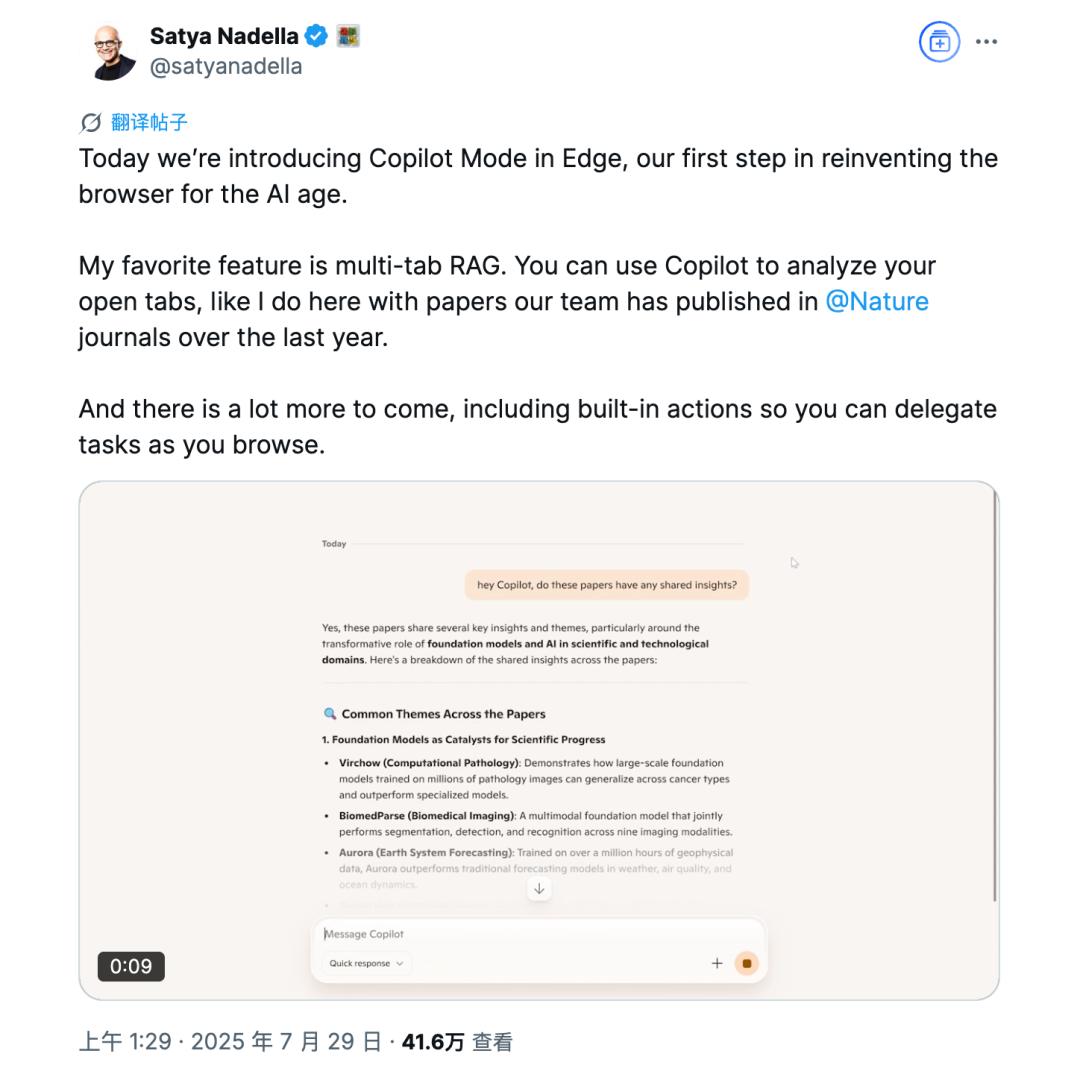
经过了两年对 Edge 浏览器 AI 功能的小修小补之后,微软在今天为 Edge 浏览器加入 Copilot 模式,正式进军 AI 浏览器市场。 具体来说,Edge 浏览器中的 AI 功能不再像以前一样只是一个聊天侧边栏,新推出的 Copilot 模式可以让 AI 阅读和理解网页内容,比如帮你做一个技术文 档页面的解读或者 Youtube 视频的观看大纲。 它也可以一次性浏览所有你已打开的网页,当你在多个商品或者酒店页面来回切换烦恼时,帮你列一个对比表格来辅助决策。微软还增加了语音功能,你 可以通过语音聊天来理解网页、和 AI 实时对话。 这些功能看上去与市面上已有的 AI 浏览器好像没什么不同,但微软 CEO 萨提亚·纳德拉(Satya Nadella)对此赞不绝口,"这是我们为 AI 时代重新定义浏 览器的第一步。"他说他最喜欢 multi-tab RAG 功能,可以让他更快地分析微软过去一年在 Nature 上发表的论文——介绍新功能的同时顺带炫耀一番。 Copilot 总结 Youtube 视频 目前该功能尚处实验阶段,微软称将会逐渐为 Copilot 模式加入新功能。实验的另一层含义是现在 Copi ...

安永大中华区人工智能与数据咨询服务联席主管合伙人陈剑光:衡量AI Agent“好用”的关键指标,需兼顾技术效能与业务价值
Mei Ri Jing Ji Xin Wen· 2025-07-29 14:37
Core Insights - The rapid development and deployment of AI Agents is being driven by major tech companies, with OpenAI and Ernst & Young launching their respective products [1] - The effectiveness of AI Agents is measured by both technical performance and business value, focusing on accuracy, response speed, efficiency improvement, cost optimization, and risk control [1][8] Industry Demand and Application - There is a significant variation in the demand for AI Agents across different industries, with common needs in personnel and administrative functions aimed at enhancing operational efficiency [2][3] - Specific industry applications include: - Financial sector: Risk control and compliance management, with agents for investment portfolio analysis and real-time trading monitoring [5][6] - Retail sector: Supply chain optimization, inventory management, and personalized marketing through consumer behavior analysis [5][6] - Manufacturing sector: Equipment maintenance, production process optimization, and quality control through predictive maintenance and quality inspection agents [6][7] Challenges in Implementation - Companies face two main challenges when deploying AI Agents: system integration barriers and insufficient vertical domain adaptation [4] - Integration issues arise from incompatible data formats and interface protocols, leading to operational inefficiencies [4][5] - The lack of specialized knowledge and high-quality structured data for training agents in specific industries presents a significant barrier [5] Measuring Effectiveness - The effectiveness of AI Agents should be evaluated through both technical efficiency metrics (accuracy, robustness, response time) and business value indicators (efficiency gains, cost savings, risk reduction, quality improvement) [8] - For companies new to AI Agents, starting with low-cost, easily implementable scenarios is recommended to gradually realize value [9] Strategic Recommendations for SMEs - Small and medium enterprises (SMEs) are advised to adopt a "small steps, quick wins" approach, beginning with lightweight scenarios that have clear demands and can quickly demonstrate value [9] - Utilizing external service APIs or SaaS products can help SMEs quickly expand AI Agent functionalities while minimizing initial costs [9] - The core value of AI Agents lies not in replacing human labor but in enhancing human capabilities and organizational efficiency through collaboration [9]
华泰证券:关注AI Agent应用落地机会
Guo Ji Jin Rong Bao· 2025-07-29 13:49
Group 1: AI Integration in Finance - Huatai Securities is exploring the deep integration of AI with business scenarios to promote digital transformation in finance [1] - The company has developed the "Taiwei" large model platform, which combines heterogeneous computing power, large model operation management, and application development [1] - The focus is on enhancing intelligent customer service capabilities in investment research and banking [1] Group 2: Evolution of AI Paradigms - The development paradigm of AI is shifting from self-supervised pre-training to reinforcement learning post-training due to data growth bottlenecks [3] - In quantitative investment, the transition from traditional manual modeling to AI modeling is significantly improving the efficiency of financial model development and deployment [3] - End-to-end modeling and general base pre-trained models are creating opportunities for quantitative investment by reducing reliance on traditional factors and allowing for low-cost cross-market strategy migration [3] Group 3: AI Agents Reshaping Financial Services - The AI empowerment model is evolving from "human + intelligent assistant" to "human + multiple intelligent agents," enhancing team collaboration [5] - AI can significantly replace current employee tasks in certain scenarios, such as automated investment advisory services [5] - Successful implementation of AI in financial institutions relies on effective data governance and open collaboration between financial institutions and technology service providers [5][6] Group 4: Future of AI in Hardware - AI servers are expected to replace smartphones as the largest category of technology hardware, driven by the growth of AI applications [11] - The development of AI agents requires higher demands for computing power and infrastructure, with current limitations in power grid infrastructure and data center land availability [11] - The physical AI development has not met expectations due to the complexity and high cost of data acquisition in the physical world [11]

2025WAIC全景观察: 算力筑基 模型进阶 AI应用实干突围
Zhong Guo Zheng Quan Bao - Zhong Zheng Wang· 2025-07-29 12:23
Group 1: AI Industry Development - The 2025 World Artificial Intelligence Conference (WAIC) showcased significant advancements in AI applications, marking the transition into a "practical era" of AI technology [1][5] - The demand for computing power is expected to increase dramatically, with predictions of a hundredfold to thousandfold growth in training computing power requirements due to the rapid evolution of AI applications [1][3] - AI models are shifting from a focus on "data + scale" to "self-optimization + multi-modal native integration," facilitating their transition from laboratories to real-world applications [5][6] Group 2: Computing Infrastructure - Companies like Huawei and ZTE presented innovative supernode solutions, with Huawei's "computing power bomb" showcasing a system where 384 cards work collaboratively, significantly enhancing resource utilization [2][3] - The introduction of the LightSphere X supernode by Shanghai Yidian and partners utilizes optical interconnect technology to overcome traditional physical limitations, allowing for dynamic scaling based on computing needs [2][3] - Companies are adapting their computing infrastructure to better meet AI demands, focusing on hardware, data centers, and intelligent scheduling of heterogeneous computing resources [3][4] Group 3: AI Applications and Agents - AI agents are becoming pivotal in various sectors, evolving from tools to "digital employees" capable of performing analysis, execution, and optimization tasks [6][7] - Personal AI applications are emerging, with products like Rokid Glasses enabling users to perform tasks through voice commands, showcasing the integration of AI into everyday life [7][8] - The Galbot robot, developed by Galaxy General, demonstrates advanced capabilities in retail and industrial settings, utilizing a combination of real and synthetic data for training to enhance operational efficiency [8]
全球最赚钱20家AI Agent公司出炉,最高爆赚5亿美元,两个趋势值得关注
3 6 Ke· 2025-07-29 12:03
Core Insights - The article highlights the "Top 20 AI Agent Startups by Revenue" published by CB Insights, which ranks companies based on actual revenue rather than funding or valuation, providing a direct view of the commercial viability of AI agents [1][2] - Two clear trends are identified: AI agents are evolving from mere tools to "digital employees" capable of autonomously completing tasks and taking responsibility for outcomes, and revenue is becoming a new benchmark for measuring the competitiveness of AI startups [1] Company Summaries - **Cursor**: An AI programming agent with an ARR of $500 million, serving over 360,000 paid users, including major clients like Stripe and OpenAI [3] - **Glean**: An enterprise search agent with an ARR of $100 million, facilitating over a billion agent operations for internal process optimization [4] - **Mercor**: An AI-driven recruitment platform with an ARR of $100 million, streamlining the hiring process through automated resume screening and candidate matching [5] - **Replit**: An AI programming agent that allows app development through natural language, achieving an ARR of $100 million and a rapid growth in valuation [6][7] - **Lovable**: The fastest-growing AI startup, reaching an ARR of $100 million in just 8 months, enabling users to create web applications without coding [8] - **Crescendo**: An AI customer service agent with an ARR of $91 million, integrating AI and human support for enhanced customer experience [9] - **Harvey**: An AI legal assistant with an ARR of $75 million, automating legal research and document drafting [10][11] - **StackBlitz**: An AI programming agent with an ARR of $40 million, providing a browser-based IDE for web application development [12] - **Clay**: A sales agent with an ARR of $30 million, optimizing lead generation through AI capabilities [13] - **Torq**: An AI security agent with an ARR of $20 million, automating security operations for enterprises [14] - **Sierra**: An AI customer service agent with an ARR of $20 million, enhancing customer interactions through advanced AI models [15][16] - **Sana**: An enterprise AI assistant with an ARR of $20 million, automating workflows and knowledge management [17] - **Nabla**: A medical AI assistant with an ARR of $16 million, supporting clinical workflows and patient interactions [18] - **Hebbia**: An AI knowledge work assistant with an ARR of $13 million, providing advanced search capabilities for financial and legal sectors [19][20] - **Decagon**: An AI customer support agent with an ARR of $10 million, utilizing generative AI for personalized customer interactions [21] - **Robin**: A contract management AI platform with an ARR of $10 million, streamlining the contract lifecycle for legal teams [22] - **11xAI**: An AI digital employee with an ARR of $10 million, rapidly growing through task-based pricing models [23] - **Fyxer.ai**: An AI executive assistant with an ARR of $9 million, automating email and meeting management for professionals [24][25] - **Legartis**: A multilingual contract review agent with an ARR of $5 million, enhancing contract compliance and efficiency [27][28] - **Artisan**: An AI virtual sales representative with an ARR of $5 million, automating the sales development process for businesses [29]