
一带一路建设

Search documents
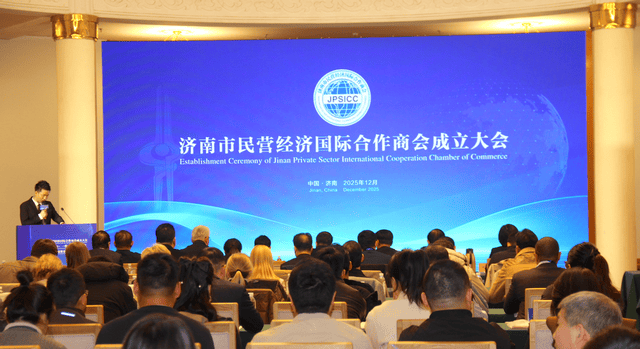
打造“聚推双器”,助力民营经济国际化高质量发展——济南市民营经济国际合作商会在济南正式成立
Sou Hu Cai Jing· 2025-12-05 22:18
Core Viewpoint - The establishment of the Jinan Private Economy International Cooperation Chamber marks a significant milestone for Jinan's private economy in international cooperation, serving as a bridge for communication and collaboration, and aiding private enterprises in expanding into international markets [1][3][24]. Group 1: Establishment and Purpose - The Jinan Private Economy International Cooperation Chamber was officially established on December 5, 2025, with over 150 attendees, including government officials and representatives from various business associations [1][3]. - The chamber aims to transition Jinan's outward-oriented private enterprises from isolated efforts to organized and alliance-based development, enhancing the city's internationalization [3][24]. Group 2: Economic Context and Significance - Jinan, as a central city in the Yellow River Basin and the core of the Shandong Peninsula urban agglomeration, is currently experiencing a period of strategic opportunities and urban quality enhancement [3]. - The establishment of the chamber aligns with the national strategy for opening up and aims to strengthen the role of private enterprises in driving economic growth and international cooperation [5][24]. Group 3: Economic Contributions - In the first three quarters of the year, Shandong Province's total foreign trade reached 2.62 trillion yuan, with private enterprises accounting for 1.98 trillion yuan, representing 75.7% of the total [5]. - The chamber is expected to play a crucial role in enhancing the international cooperation of Jinan's private economy, contributing to the province's high-level opening up and economic development [5][24]. Group 4: Future Initiatives - The chamber plans to establish a "Double Recruitment and Double Introduction" liaison station to enhance its role in attracting investment and expanding the private economy [13]. - The chamber has already signed strategic cooperation agreements with 48 domestic and international business associations, showcasing its commitment to international collaboration [16][24]. Group 5: Leadership and Vision - The chamber's leadership, under President Lin Bo, emphasizes the importance of strengthening service capabilities, optimizing the development environment, and promoting international trade activities [18]. - The chamber aims to facilitate trade with countries along the Belt and Road Initiative, having already organized multiple outbound delegations and trade events [18][20].

锐意改革提效能 聚力攻坚促多元——澳门特区行政长官岑浩辉发表2026年施政报告
Xin Hua She· 2025-11-18 16:40
Core Points - The Chief Executive of the Macao SAR, Ho Iat Seng, presented the 2026 Policy Address focusing on administrative reform, promoting diversification, optimizing livelihoods, and integrating into the national framework [1][2] Group 1: Economic Development - The main goals for the 2026 government policy include sustained economic recovery, substantial progress in economic diversification, and maintaining positive growth in local GDP [2] - The government aims to improve the business environment and enhance economic vitality, with a focus on the development of the Hengqin Cooperation Zone and further integration with Zhuhai [2][3] Group 2: Administrative and Legal Reforms - The government plans to deepen public administrative reforms to address long-standing issues, break down departmental barriers, and build a service-oriented government [3] - There will be an emphasis on "streamlining administration and delegating power," restructuring departmental functions, and enhancing e-government initiatives [3] Group 3: Social Welfare and Employment - The government aims to ensure effective employment for residents and optimize social welfare, with particular attention to vulnerable groups [2][3] - The policy will focus on improving the livelihood system and addressing practical social issues [2] Group 4: Infrastructure and Urban Development - Plans include enhancing urban infrastructure and building a smart, livable city [2] - The government will work on developing a comprehensive cultural base to promote civilizational exchange [2] Group 5: International Cooperation - The government intends to promote higher levels of openness and integrate into the national development framework, particularly through the Guangdong-Hong Kong-Macao Greater Bay Area [3][4] - There will be efforts to deepen international economic and technological exchanges and expand the international network [3]
黄奇帆:中国对外开放有五大新任务
Zhong Guo Xin Wen Wang· 2025-11-12 07:14
Group 1 - The core viewpoint of the article emphasizes five new key tasks for China's opening-up strategy as outlined in the report of the 20th National Congress of the Communist Party of China, focusing on institutional opening, service trade, Belt and Road Initiative, free trade, and the internationalization of the Renminbi [1][2][3] Group 2 - The first task is to achieve the integration of internal and external circulation mechanisms, ensuring that the rules and standards for imports, exports, and domestic sales are consistent, thereby creating a unified trade system [1] - The second task is to increase the proportion of service trade in China's overall trade, highlighting that a strong service trade sector is essential for becoming a true trade power [1] - The third task involves enhancing the Belt and Road Initiative to promote coordinated opening among different regions of China, addressing the disparity between coastal and inland areas through improved trade routes [2] - The fourth task is to advance free trade by transforming China's free trade zones from isolated points into a network that covers over 30 provinces and cities, laying the groundwork for future economic cooperation with the US, Japan, and Europe [2] - The fifth task is to orderly promote the internationalization of the Renminbi, indicating that there is significant potential for growth in its international status, which requires further efforts in cross-border trade and the development of offshore markets [3]
宁夏建材:应对关税威胁,阐述业务发展及机遇把握策略
Xin Lang Cai Jing· 2025-10-28 07:44
Core Viewpoint - The company aims to leverage policy benefits from the "Belt and Road Initiative" and "Western Development" to mitigate trade friction risks and support high-quality development amidst recent tariff threats from the U.S. against China [1] Group 1: Strategic Responses - The company will focus on "growth preservation" by driving innovation, seizing opportunities from the "dual carbon" policy, and enhancing green production, energy conservation, and digital transformation [1] - The company plans to accelerate the external business expansion of its digital logistics platform "I Find Car," aiming to improve profitability in the digital logistics sector [1] Group 2: Market Opportunities - The company is optimistic about development opportunities in the current environment, particularly through its strategic initiatives in digital logistics and sustainable practices [1]

自贸港“大家”谈丨曹远征:建设海南自贸港具有全球性意义
Hai Nan Ri Bao· 2025-10-10 03:59
Core Insights - The Hainan Free Trade Port will officially start its full island closure operation on December 18, 2025, marking a significant milestone in China's economic reform and opening-up strategy [1][4]. Group 1: Historical Significance - The establishment of the Hainan Free Trade Port represents a new historical starting point for China's higher standard of opening up and reform, reflecting a shift towards institutional openness [4]. - The current global economic landscape is undergoing profound adjustments, and the development of the Hainan Free Trade Port is seen as a response to these challenges, emphasizing the importance of defending economic globalization [4]. Group 2: Attractiveness for Enterprises - Hainan's appeal lies in its reputation as a pioneering region for innovation and experimentation, with expectations of attracting not just tens of thousands but potentially many more enterprises due to its higher standards of openness [5]. - The Free Trade Account system in Hainan facilitates financial convenience, which is crucial for attracting more businesses to the region [7]. Group 3: Financial Innovation - Hainan's issuance of RMB bonds in Hong Kong signifies its financial innovation and serves as a model for local government financing, enhancing its attractiveness to international capital [10]. - The financial policies being implemented in Hainan are designed to improve the investment environment, making it easier for international capital to enter the market [10][11]. Group 4: Service Industry Development - Hainan is focusing on high-standard openings in education and healthcare, aiming to reduce service trade deficits and improve the quality of China's service industry [13]. - The development of international medical tourism and educational institutions in Hainan is expected to attract more domestic and international students and patients, enhancing the region's global standing [13]. Group 5: Economic Benefits for Residents - The economic development driven by the Hainan Free Trade Port is anticipated to improve the living standards and income levels of local residents, benefiting the broader population [14].

国际商事法庭高质量发展有了“路线图”
Ren Min Wang· 2025-09-26 01:30
Core Viewpoint - The Supreme People's Court of China has released guidelines aimed at enhancing the development of international commercial courts and improving the judicial framework to support high-level foreign openness and the Belt and Road Initiative [1][2]. Group 1: Development of International Commercial Courts - The guidelines represent the first systematic planning for the high-quality collaborative development of international commercial courts at both the Supreme People's Court and local levels [1]. - Since the 18th National Congress, significant decisions have been made to strengthen foreign-related legal construction, leading to the establishment of international commercial courts in various cities including Shenzhen and Xi'an [1][2]. Group 2: Objectives and Mechanisms - The guidelines focus on five key areas: ensuring high-quality development of the Belt and Road Initiative, innovating the trial mechanism, promoting diversified dispute resolution, enhancing the reserve of foreign-related legal talent, and deepening international judicial cooperation [2][3]. - Specific innovations in the trial mechanism include optimizing jurisdiction for foreign-related commercial cases, improving case management, and enhancing litigation convenience [2]. Group 3: Dispute Resolution and Talent Development - A highlight of the guidelines is the improvement of multi-faceted dispute resolution mechanisms, including establishing judicial confirmation for international commercial mediation agreements and enhancing cooperation with international organizations [3]. - The guidelines emphasize the importance of foreign-related legal talent, proposing measures to strengthen talent reserves and promote the professional development of international commercial courts [3]. Group 4: International Judicial Cooperation - The guidelines outline mechanisms for judicial assistance, case sharing, and legal application exchanges, aiming to strengthen collaboration with international organizations such as the WTO and UNCITRAL [4]. - The Supreme People's Court plans to utilize resources from international commercial court cases to promote typical cases and judicial rules to international organizations, thereby enhancing China's narrative in foreign-related legal matters [4]. Group 5: Typical Cases Related to the Belt and Road Initiative - The fifth batch of typical cases related to the Belt and Road Initiative has been released, covering various legal issues such as independent guarantees and the recognition of foreign court judgments [5]. - These cases aim to provide clear guidance on legal principles and reflect China's proactive stance in international economic cooperation and judicial assistance [5].
中信建投:建筑业资产重估与景气投资并重 关注核电、新质基建、一带一路建设等优质细分领域
智通财经网· 2025-06-16 06:41
Group 1 - The construction sector's performance from Q4 2024 is primarily driven by debt resolution policies, external disturbances, and industry sentiment [1] - Since May, positive developments in US-China negotiations have improved market risk appetite, leading to a spillover of positive sentiment into the construction industry [1] - As of June 10, 2025, the construction sector's PE ratio is 10.73x, at the 58th percentile since 2014, while the PB ratio is 0.73x, at the 7.1st percentile since 2014, indicating a significant decline in profitability [1] Group 2 - Market risk appetite has been volatile, with construction dividend assets likely to benefit from changes in market preferences and policy support [2] - The construction dividend assets are mainly concentrated in eight major construction state-owned enterprises and high-dividend local infrastructure state-owned enterprises, with their profitability linked to operational performance and macroeconomic improvements [2] Group 3 - Fiscal policies have created a soft constraint on infrastructure spending, with a focus on economically developed regions and areas with sufficient investment from special bonds and central enterprises [3] - Since the implementation of debt resolution policies, 4.4 trillion yuan of refinancing special bonds have been issued to address local government debt issues [3] Group 4 - Investment opportunities are identified in low-valuation central state-owned enterprises, including China State Construction, China Railway, and others [4] - Companies benefiting from the Belt and Road Initiative, such as China National Materials, are also highlighted as potential investment targets [4] - High-growth infrastructure companies, including China Nuclear Engineering and others, are recommended for investment consideration [4]
