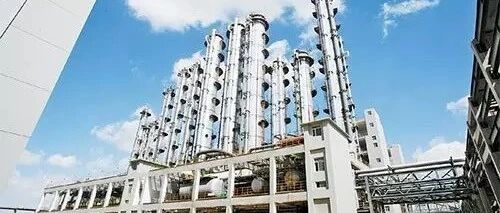
产业结构重塑

Search documents
大批外资撤离中国,西方企业准备抢夺中国市场,普通人如何降低风险
Sou Hu Cai Jing· 2025-12-05 00:28
Core Viewpoint - The narrative of foreign companies fleeing China is overly simplistic, as it highlights localized adjustments while neglecting the overall structural optimization occurring within the market [7][17]. Group 1: Foreign Investment Trends - The recent closure of Dongguan Tianhong Technology, which served major clients like IBM and Cisco for over 20 years, is attributed to North American clients shifting production to Mexico and Eastern Europe [1]. - In contrast, companies like Tesla and BMW are increasing their investments in China, with BMW's total investment in Shenyang exceeding 83 billion [1]. - Data from the Ministry of Commerce indicates that foreign investment has both inflows and outflows, which is a normal market phenomenon, particularly affecting labor-intensive industries [3]. Group 2: Sectoral Shifts - The exit of foreign companies is primarily seen in labor-intensive sectors due to rising domestic labor and land costs, leading to a natural global industrial shift [3]. - High-tech industries in China have seen a 1.1% increase in actual foreign investment in the first 11 months of 2023, particularly in medical instruments and electronic manufacturing [5]. - Foreign companies are transitioning from low-value assembly lines to high-value production lines in new display technologies and renewable energy batteries, indicating a shift towards technology-intensive sectors [5]. Group 3: Impact on Workforce - The closure of Dongguan Tianhong Technology resulted in the layoff of over 500 employees, highlighting the real impact of these changes on ordinary workers [9]. - Workers in traditional sectors like textiles and low-end electronics face increased risks due to reliance on foreign trade and investment [9]. Group 4: Strategies for Adaptation - Workers are advised to proactively adjust their career paths towards "domestic demand-oriented" industries such as healthcare and local brand consumption, which are less affected by global supply chain fluctuations [11]. - In the event of layoffs, it is crucial to seek reasonable labor compensation and maintain social insurance continuity while exploring flexible employment options [13]. - Financial strategies should focus on establishing a "survival bottom line" by cutting unnecessary expenses while maintaining essential services [15]. Group 5: Geopolitical Considerations - Geopolitical factors are increasingly influencing cross-border investment decisions, with some countries promoting industrial repatriation and investment restrictions [17]. - Despite these challenges, China's vast market size and comprehensive industrial ecosystem continue to attract foreign companies, emphasizing the need for a nuanced understanding of foreign investment dynamics [17]. Group 6: Opportunities Amidst Change - The ongoing industrial adjustments present both challenges and opportunities, as shifts in foreign company operations may create space for domestic innovation in high-tech sectors like renewable energy and biomedicine [19]. - The key lies in readiness to adapt to the profound restructuring of the industrial landscape that is already underway [19].

大全能源第三季度净赚7347万元多晶硅市场回暖
Zhong Guo Jing Ying Bao· 2025-10-28 04:25
Group 1 - The core viewpoint of the article highlights that Daqo Energy (688303.SH) has turned a profit in the third quarter of 2025, achieving a net profit of 73.48 million yuan, driven by a recovery in the polysilicon market with both volume and price increases [1] - Daqo Energy reported a revenue of 1.773 billion yuan in the third quarter, marking a year-on-year increase of 24.75% [1] - Despite the positive performance in Q3, Daqo Energy faced a significant loss of 1.147 billion yuan in the first half of 2025 due to an imbalance in supply and demand in the polysilicon market, leading to a total loss of 1.073 billion yuan for the first three quarters [1] Group 2 - The current polysilicon prices are stabilizing, with the average transaction price for n-type re-investment material at 53,200 yuan per ton and n-type granular silicon at 50,500 yuan per ton, remaining unchanged week-on-week [1] - The polysilicon industry is undergoing a critical period of structural reshaping, with supply significantly contracting year-on-year, yet inventory is slightly accumulating, indicating relatively weak terminal demand [1] - Industry policies and market expectations are expected to be the main factors supporting the stable operation of the polysilicon market in the short term [1] Group 3 - In addition to Daqo Energy, GCL-Poly Energy (03800.HK) also reported a profit of approximately 960 million yuan from its photovoltaic materials business during the same period, which includes a non-recurring tax benefit of about 640 million yuan from the sale of an associate [2]


四季度终端需求略显悲观 光伏产业链价格“按兵不动”
Zheng Quan Shi Bao Wang· 2025-10-23 14:01
Core Viewpoint - The multi-crystalline silicon market is experiencing stable prices but faces weak demand and potential supply adjustments in the coming months [1][2] Group 1: Multi-Crystalline Silicon Market - The average transaction price for N-type multi-crystalline silicon is 53,200 CNY/ton, while N-type granular silicon is 50,500 CNY/ton, both remaining stable month-on-month [1] - Demand for silicon materials is steady, with limited growth in battery component orders and stable operating rates for silicon wafer companies [1] - Three companies are resuming production this month, leading to a slight increase in multi-crystalline silicon output expected in October [1] - The fourth quarter is projected to see a total domestic multi-crystalline silicon output of approximately 382,000 tons, a year-on-year increase of 3.0% [1] - By 2025, the annual domestic multi-crystalline silicon output is expected to be around 1.34 million tons, a significant year-on-year decrease of 27.3% [1] Group 2: Market Dynamics and Price Trends - The industry is in a critical period of structural adjustment, with inventory slightly accumulating despite a significant year-on-year supply contraction [1] - The InfoLink consultancy indicates that discussions on anti-involution storage policies are ongoing, but short-term price recovery is limited due to weak terminal demand [2] - The average transaction prices for N-type G10L, G12R, and G12 single crystal silicon wafers are 1.32 CNY/piece, 1.40 CNY/piece, and 1.68 CNY/piece, respectively, showing no significant changes [2] - The fourth quarter is expected to see a slight decline in terminal component demand, putting pressure on silicon wafer companies [2] Group 3: Battery and Component Pricing - The average prices for 183N, 210RN, and 210N battery cells are 0.315 CNY/W, 0.285 CNY/W, and 0.31 CNY/W, respectively [3] - The Indian market still supports short-term demand, but prices for 183N battery cells have softened due to policy impacts and low-priced competition from domestic exporters [3] - The 210RN battery cell prices may decline further due to oversupply, potentially affecting silicon wafer prices [3] - The component market remains stable, with no significant changes in prices due to rising costs of raw materials and limited visibility for new orders [3]
多晶硅市场成交冷清,硅业分会预计全年供需仍略显过剩
Di Yi Cai Jing· 2025-10-23 07:25
Core Viewpoint - The polysilicon industry is undergoing a critical period of structural transformation, with market dynamics closely monitored due to its significance in the photovoltaic supply chain [1]. Market Performance - The average transaction price of polysilicon remained stable week-on-week, with n-type re-investment material priced between 49,000 to 55,000 CNY per ton, averaging 53,200 CNY per ton, and n-type granular silicon priced between 50,000 to 51,000 CNY per ton, averaging 50,500 CNY per ton [1]. - Despite an increase in the number of mainstream signing companies from 2-3 to 5-6, overall market transactions remain relatively sluggish, indicating weak terminal demand [1]. Demand and Supply Dynamics - The demand outlook for the fourth quarter is weak, with limited growth in battery component orders and stable operating rates for silicon wafer companies, leading to steady overall demand for upstream silicon materials [1]. - In the first three quarters of the year, the domestic polysilicon industry has reduced inventory by approximately 12,000 tons, but there was a slight inventory accumulation of about 12,000 tons in September [2]. - The polysilicon production is expected to peak in October, with a slight increase in output due to the resumption of production by three companies, followed by a gradual decline in November and December [2]. Production Forecast - The domestic polysilicon production for the fourth quarter is projected to be around 382,000 tons, a slight year-on-year increase of 3.0% [2]. - By 2025, the annual domestic polysilicon production is expected to be approximately 1.34 million tons, a significant year-on-year decrease of 27.3%, indicating a slight oversupply compared to demand [2]. Company Performance - Companies in the upstream sector are showing signs of performance recovery due to the ongoing "anti-involution" efforts and stabilization of industry prices [2]. - For instance, GCL-Poly Energy Holdings Limited reported an unaudited profit of approximately 960 million CNY in its photovoltaic materials business for the third quarter of 2025, recovering from a loss of about 1.81 billion CNY in the same period last year [2]. Pricing and Cost Analysis - In the third quarter of 2025, GCL-Poly's average external selling price for granular silicon (including tax) was 42.12 CNY per kilogram, a 30% increase from 32.93 CNY per kilogram in the second quarter [3]. - The average production cash cost for granular silicon (including R&D costs) decreased to 24.16 CNY per kilogram from 25.31 CNY per kilogram in the previous quarter, reflecting a reduction of approximately 5 percentage points [3].
中国有色金属工业协会硅业分会:预计10月多晶硅产量小幅增加
Xin Hua Cai Jing· 2025-10-22 09:46
Core Insights - The price range for multi-crystalline silicon n-type raw materials is between 49,000 to 55,000 yuan per ton, with an average price of 53,200 yuan per ton, remaining stable week-on-week [1] - The number of mainstream signing enterprises for multi-crystalline silicon has increased to 5-6, but overall market transactions remain relatively light, with signing volumes consistent with previous periods [1] - Demand expectations for photovoltaic installations in Q4 are weak, with limited increases in battery component orders, leading to stable operating rates for silicon wafer enterprises and overall steady demand for silicon materials [1] - Three companies are resuming production this month, leading to a slight increase in multi-crystalline silicon output expected in October, although most companies have reached their order limits [1] - The number of operating multi-crystalline silicon enterprises remains at 11, with production plans indicating a peak in October and a gradual decline in November and December [1] - Domestic multi-crystalline silicon production is expected to be around 382,000 tons in Q4, a slight year-on-year increase of 3.0%, while the total annual production for 2025 is projected to be approximately 1.34 million tons, a significant year-on-year decrease of 27.3% [1] - The multi-crystalline silicon industry is undergoing a critical period of structural reshaping, with inventory slightly accumulating despite a significant year-on-year supply contraction, indicating weak terminal demand [2] - Industry policies and market expectations are expected to be the main factors supporting the stable operation of the multi-crystalline silicon market in the short term [2]
硅业分会:市场供需双弱 多晶硅价格平稳运行
智通财经网· 2025-10-22 08:21
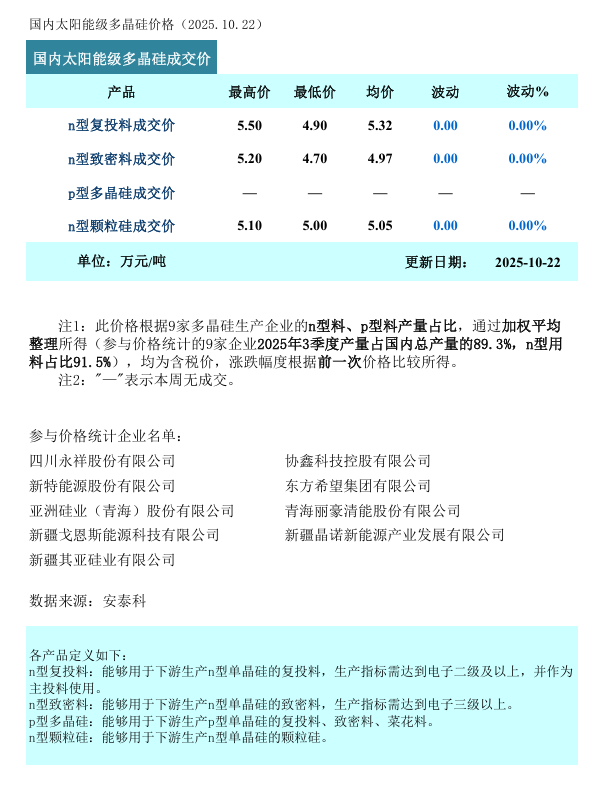
Core Insights - The polysilicon market is currently undergoing a critical phase of industrial restructuring, with supply significantly contracting year-on-year, yet inventory is slightly accumulating, indicating weak terminal demand [1][2] - The average transaction price for n-type polysilicon remains stable at 53,200 RMB/ton, while n-type granular silicon averages 50,500 RMB/ton, reflecting a lack of price movement [1][3] - The number of mainstream signing enterprises in the polysilicon market has increased to 5-6, but overall market transactions remain relatively light, with signing volumes consistent with previous periods [1] Supply and Demand Analysis - The production capacity of polysilicon enterprises remains at 11, with expectations of a peak production month in October, followed by gradual reductions in November and December due to maintenance [2] - Domestic polysilicon production is projected to be around 382,000 tons in Q4, a slight year-on-year increase of 3.0%, but a significant decrease of 27.3% is expected by 2025, leading to an estimated inventory accumulation of 20,000 tons [2] Price Trends - The price range for n-type polysilicon is between 49,000 to 55,000 RMB/ton, with no fluctuations reported this week [3] - The weighted average price for n-type recycled material is 53,200 RMB/ton, while n-type dense material averages 49,700 RMB/ton, indicating stable pricing across the board [3] Market Participants - The price statistics are based on data from nine polysilicon production companies, which account for 89.3% of the domestic total production in Q3 2025, with n-type materials comprising 91.5% of the total [3][5]
[安泰科]多晶硅周评-市场供需双弱 价格平稳运行(2025年10月22日)
中国有色金属工业协会硅业分会· 2025-10-22 08:08
Core Viewpoint - The polysilicon market is experiencing a period of structural adjustment, with supply shrinking significantly year-on-year, yet inventory is still slightly accumulating, indicating weak terminal demand [2]. Price Summary - The transaction price range for n-type recycled polysilicon is between 49,000 to 55,000 CNY/ton, with an average price of 53,200 CNY/ton, remaining stable week-on-week [1][3]. - The transaction price range for n-type granular silicon is between 50,000 to 51,000 CNY/ton, with an average price of 50,500 CNY/ton, also stable week-on-week [1][3]. - The average price for n-type dense material is 49,700 CNY/ton, with no fluctuation [3]. Market Dynamics - The number of main signing enterprises for polysilicon has increased to 5-6, but overall market transactions remain relatively light, with signing volumes similar to previous periods [1]. - Demand expectations for photovoltaic installations in Q4 are weak, leading to limited increases in battery component orders, while silicon wafer enterprises maintain stable operating rates [1]. - Three companies are resuming production this month, with a slight increase in polysilicon output expected in October, which is projected to be the peak production month for the year [1]. Production Forecast - Domestic polysilicon production in Q4 is expected to be around 382,000 tons, a slight year-on-year increase of 3.0% [1]. - By 2025, the total domestic polysilicon production is projected to be approximately 1.34 million tons, a significant year-on-year decrease of 27.3%, indicating a slight oversupply compared to demand [1]. Industry Participation - The companies involved in price statistics include Sichuan Yongxiang Co., Ltd., GCL-Poly Energy Holdings Limited, Xinte Energy Co., Ltd., and others [4].