
企业亏损

Search documents
明治在中国越卖越亏,三年复苏计划能否扭转困局?
Xi Niu Cai Jing· 2026-02-28 02:57
Group 1 - The core issue for Meiji Holdings in China is the significant increase in operating losses, which have expanded to 7.1 billion yen in FY2024 from 3.7 billion yen in the previous year, despite net sales rising to 25.5 billion yen [2] - The competitive landscape in China is challenging, with local giants like Yili and Mengniu dominating the market, leading to intense price wars that disadvantage Meiji, which positions itself as a premium brand [2] - Meiji has made substantial investments in China since 2020, including acquiring a 25% stake in Ausnutria and establishing six factories, which has contributed to increased operational costs [2] Group 2 - Ausnutria, in which Meiji holds a stake, is projected to incur losses between 1.17 billion yuan and 1.38 billion yuan in 2024, further impacting Meiji's financial performance [3] - The new managing director of Meiji China, Takashi Nagasawa, has acknowledged past overconfidence and is implementing a three-year recovery plan aimed at achieving breakeven by FY2026, which includes discontinuing unprofitable products and reassessing non-viable channels [3] - Despite the challenges, the potential of the Chinese market remains attractive for Meiji, but navigating through the current losses and competition is a critical task ahead [3]


罗普特:2025年亏损同比增加2,923.26万元
Xin Lang Cai Jing· 2026-02-27 09:48
Group 1 - The company achieved an operating revenue of 154.5613 million yuan in 2025, representing an increase of 8.11% compared to the same period last year [1] - The operating profit was -220.5564 million yuan, which is a deterioration of 23.8249 million yuan compared to the previous year [1] - The total profit amounted to -219.6435 million yuan, reflecting an increase in losses of 22.4334 million yuan year-on-year [1] - The net profit attributable to the parent company's owners was -222.4647 million yuan, which is an increase in losses by 29.2326 million yuan compared to the same period last year [1] - The net profit attributable to the parent company's owners, after deducting non-recurring gains and losses, was -227.8659 million yuan, indicating an increase in losses of 24.2936 million yuan year-on-year [1]

华侨城A“开年黑”!1月地产合同销售金额腰斩
Shen Zhen Shang Bao· 2026-02-13 23:16
Sales Performance - In January 2026, the company achieved a contracted sales area of 45,000 square meters, a decrease of 45% year-on-year; the contracted sales amount was 590 million yuan, down 53% year-on-year [1] - For the full year of 2025, the company reported a total contracted sales area of 1.21 million square meters, a decrease of 30% year-on-year; the contracted sales amount was 17.73 billion yuan, down 33% year-on-year [1] Tourism Business - In January 2026, the company's tourism enterprises received a total of 5.54 million visitors, a decrease of 15% year-on-year, primarily due to the timing difference of the Spring Festival holiday [1] - For the full year of 2025, the company’s tourism enterprises received a total of 79.7 million visitors, a decrease of 1% year-on-year, with December 2025 seeing 5.71 million visitors, down 6% year-on-year [1] Financial Outlook - The company expects a net loss attributable to shareholders of 13 billion to 15.5 billion yuan for the year 2025; the net loss after excluding non-recurring items is projected to be between 13.2 billion and 15.7 billion yuan [1] - This marks the fourth consecutive year of losses for the company, following a loss of 10.9 billion yuan in 2022, with the loss in 2025 being larger than the previous year [2]

美团:2025年预亏233亿元—243亿元
Guang Zhou Ri Bao· 2026-02-13 15:19
Group 1 - The core viewpoint of the article is that Meituan anticipates a significant loss for the fiscal year 2025, primarily due to a shift from a profit of approximately RMB 52,415 million in 2024 to an expected loss of about RMB 6,800 million to RMB 7,000 million in 2025 for its core local commerce segment [1][3] - Meituan is increasing its investment in overseas operations and the overall ecosystem to enhance its core advantages and drive sustainable growth in response to unprecedented competition in the industry [1] - Despite the anticipated losses, the company's operational status remains stable, and it has sufficient cash reserves to support robust business development [1] Group 2 - Meituan issued a profit warning on February 13, indicating an expected loss of approximately RMB 23,300 million to RMB 24,300 million for the fiscal year ending December 31, 2025, compared to a profit of about RMB 35,808 million for the fiscal year ending December 31, 2024 [3]

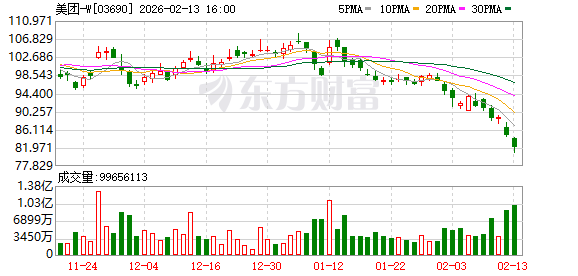
美团2025年预计亏了逾200亿
Di Yi Cai Jing Zi Xun· 2026-02-13 13:16
Core Viewpoint - Meituan has issued a profit warning, expecting a loss of approximately RMB 23.3 billion to RMB 24.3 billion for the fiscal year ending December 31, 2025, compared to a profit of approximately RMB 35.8 billion for the fiscal year ending December 31, 2024 [1] Group 1: Financial Performance - The expected loss for 2025 is primarily due to the core local commerce segment turning from an operating profit of approximately RMB 52.4 billion in 2024 to an operating loss of approximately RMB 6.8 billion to RMB 7 billion in 2025 [1] - Meituan has increased investments in its overseas business, contributing to the anticipated losses [1] Group 2: Strategic Initiatives - To address unprecedented competition in 2025, Meituan has strategically increased investments across its ecosystem to enhance core advantages and drive sustainable growth, impacting the profitability of the core local commerce segment [1] - Despite the ongoing competitive pressures, Meituan maintains a robust operational status and sufficient cash reserves to support stable business development [1] Group 3: Market Reaction - In the secondary market, Meituan's stock fell over 4% at one point, with a closing drop of 3.18%, resulting in a total market capitalization of HKD 502.1 billion [3]
飞天云动(06610)发盈警 预期2025年度将取得除税前亏损不少于约3.63亿元 同比扩大
Zhi Tong Cai Jing· 2026-02-12 15:08
Core Viewpoint - The company, Feitian Yundong (06610), anticipates a significant increase in pre-tax losses for the fiscal year ending December 31, 2025, projecting losses of at least approximately RMB 363 million, compared to pre-tax losses of about RMB 44.85 million reported for the fiscal year ending December 31, 2024 [1] Financial Summary - The increase in pre-tax losses is primarily attributed to several key factors, including: - A substantial increase in impairment losses related to trade receivables, expected to be at least approximately RMB 110 million, which is an increase of at least approximately RMB 93 million compared to the fiscal year 2024 [1] - An increase in sales and distribution expenses, projected to be at least approximately RMB 130 million, which is an increase of at least approximately RMB 42 million compared to the fiscal year 2024. This change is mainly due to increased marketing expenses from third-party service providers, reflecting the company's commitment to enhancing the launch and promotion of its services and platforms [1] - An increase in research and development expenses, expected to be at least approximately RMB 230 million, which is an increase of at least approximately RMB 146 million compared to the fiscal year 2024. This increase is primarily due to a significant rise in investments aimed at expanding the company's technical reserves across various R&D projects [1]
郁亮失联和几段江湖往事
Xin Lang Cai Jing· 2026-02-09 14:02
Group 1 - The article discusses the current situation of Vanke, highlighting the challenges faced by its leadership, particularly Wang Shi and Yu Liang, amidst significant financial losses and management changes [4][10][18] - Vanke is projected to face a record loss of 82 billion yuan in 2025, marking the largest loss in A-share history, which raises concerns about the company's future and leadership accountability [4][15][20] - The narrative includes the personal struggles of executives, such as Wang Shi's diminishing control over Vanke since 2017 and the implications of management decisions on the company's trajectory [7][19] Group 2 - The article emphasizes the importance of strategic decision-making in the real estate industry, suggesting that the turning points in Vanke's history were influenced by key choices made by its leaders [6][17] - It mentions the competitive landscape, noting that competitors like Greenland have achieved significant sales figures, indicating a shift in market dynamics [18] - The piece reflects on the broader implications of leadership changes and financial strategies within the real estate sector, illustrating how these factors can lead to both success and failure [10][20]


瑞晨环保:预计2025年净利润亏损5500万元-7500万元
Xin Lang Cai Jing· 2026-01-30 11:31
Core Viewpoint - The company anticipates a net loss of between 75 million to 55 million yuan for the fiscal year 2025, representing a year-over-year decline of 134.09% to 71.67% [1] Group 1: Financial Performance - The expected net profit decline is attributed to intensified industry competition, which has led to challenges in product pricing and a slight decrease in overall gross margin compared to the previous year [1] - The company has increased its market investment and new product development, resulting in higher selling and research & development expenses [1] Group 2: Asset Management - The company conducted a comprehensive review and impairment testing of various assets based on prudence principles, leading to the provision for impairment on receivables and other assets [1]
杰华特(688141.SH):2025年预亏6.3亿元至7.3亿元
Ge Long Hui A P P· 2026-01-30 09:06
Core Viewpoint - The company, Jiahua Technology (688141.SH), is projected to face significant financial challenges in 2025, with expected revenues between 2.6 billion to 2.75 billion yuan and a net loss attributable to shareholders ranging from 630 million to 730 million yuan [1] Financial Projections - Expected operating revenue for 2025 is estimated to be between 2.6 billion and 2.75 billion yuan [1] - Projected net loss attributable to shareholders for 2025 is forecasted to be between -630 million and -730 million yuan [1] - The net profit excluding non-recurring gains and losses is anticipated to be between -720 million and -820 million yuan [1] Expense and Investment Insights - The company has significantly increased investments in R&D, market expansion, and management improvements, leading to a notable rise in R&D, sales, and management expenses year-on-year [1] - The intensified market competition has pressured product prices, resulting in a slower-than-expected recovery of gross margins, which has contributed to the widening losses [1] Asset Impairment and Non-Recurring Gains - The company has recognized impairment indicators for inventories and has made provisions for asset impairment, which has impacted the net profit attributable to shareholders [1] - Government subsidies recognized in the current period have increased compared to the same period last year, affecting the company's non-recurring gains [1]

天智航:预计2025年净亏损1.65亿元-1.98亿元
Ge Long Hui A P P· 2026-01-28 13:35
Core Viewpoint - Tianzhihang (688277.SH) expects a net loss attributable to shareholders of the parent company for the fiscal year 2025, projected to be between 165 million and 198 million yuan, indicating an increase in losses compared to the same period last year [1] Summary by Relevant Categories Financial Performance - The anticipated net loss for 2025 is between 165 million and 198 million yuan, which represents an expansion of losses compared to the previous year [1] - The main reasons for the performance change include a significant decrease in investment income and an increase in share-based payment expenses due to the implementation of a restricted stock incentive plan [1] Taxation Impact - The increase in income tax expenses is attributed to the reversal of previously recognized losses, which has led to higher deferred tax expenses [1]
