
低位补涨

Search documents
2月3日哪些ETF上涨且净流入?
Mei Ri Jing Ji Xin Wen· 2026-02-04 05:10
Group 1 - The core viewpoint of the article indicates that the A-share market is experiencing a rebound after a decline, with various ETFs showing increases and net inflows, suggesting a positive outlook for the continuation of the upward trend in related indices [1] - The CSI 300 ETF (510330.SH) rose by 1.10% on February 3, with a net inflow of 594 million yuan, reversing a significant outflow trend since January 16, and currently has a total scale of 94 billion yuan [1] - The Food and Beverage ETF (515170.SH) increased by 0.73% on February 3, with a net inflow of 26 million yuan, bringing its total scale to 5.7 billion yuan [1] Group 2 - Other ETFs that experienced gains and net inflows on the same day include the Sci-Tech 50 ETF, ChiNext ETF, CSI 1000 ETF, AI ETF, Chip ETF, and Petrochemical ETF [1] - According to a strategy analyst from CICC, the A-share market is expected to undergo short-term fluctuations due to rapid previous gains and the upcoming Spring Festival, but the medium-term factors supporting market performance remain unchanged, indicating conditions for a slow bull market [1] - The current market favors large-cap growth styles, with an increasing number of low-position rebound opportunities emerging [1]
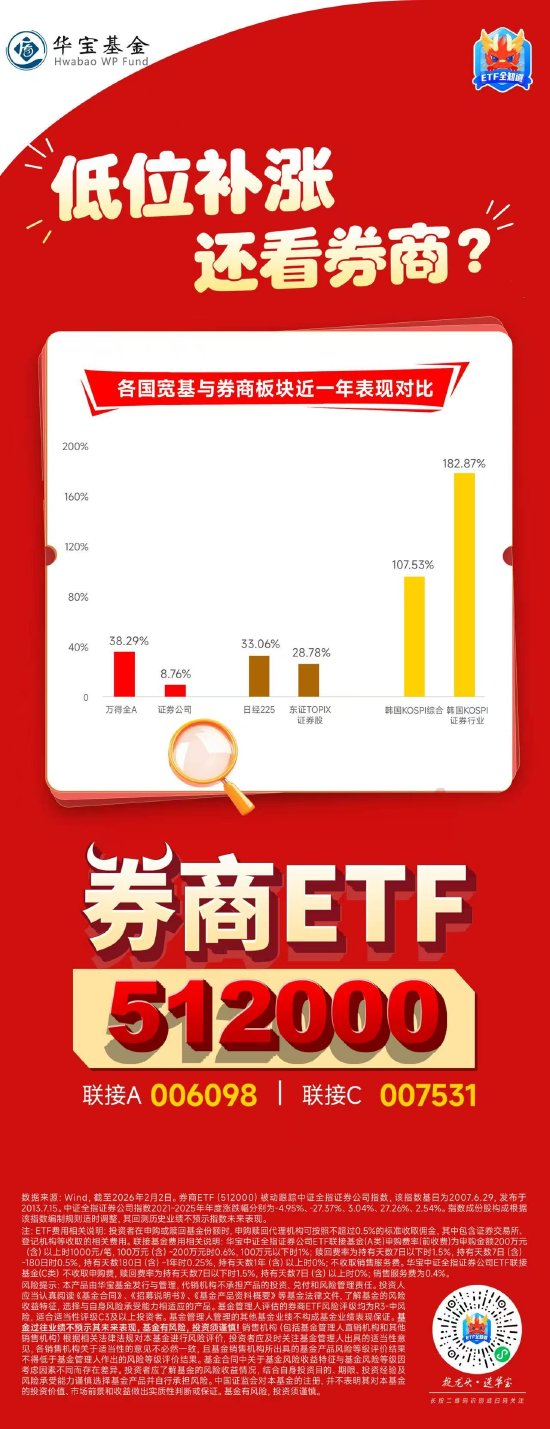
低位补涨,还看券商!关注388亿A股顶流券商ETF(512000)
Xin Lang Cai Jing· 2026-02-02 09:53
Group 1 - The article highlights the performance comparison of broad market indices and brokerage sectors over the past year, indicating significant variations in returns [1][2]. - The East Japan Index (TOPIX) and the Shanghai Composite Index (万得全A) have shown notable growth, with returns of 182.87% and 160% respectively [2]. - The securities industry has also experienced substantial gains, with a reported increase of 107.53% [2]. Group 2 - The MACD golden cross signal has formed, suggesting a bullish trend for certain stocks, which have shown promising upward movements [4][7]. - This technical indicator is often viewed as a positive sign for investors, indicating potential buying opportunities in the market [4][7].

超70亿“爆款”重现!市场风向变了
Zhong Guo Zheng Quan Bao· 2026-01-26 14:13
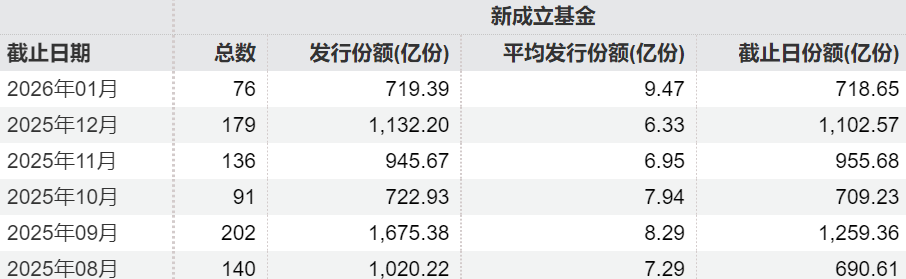
Group 1 - The core viewpoint of the articles indicates a significant rebound in the issuance of actively managed equity funds, highlighted by the launch of the Guangfa Research Smart A fund, which achieved an issuance of 7.221 billion shares, marking it as a "blockbuster product" [1][4] - As of January 25, 76 new funds have been established in 2026, with a total issuance of 71.939 billion shares, showing a recovery in the fund issuance market [2][3] - The average issuance of new funds in January 2026 reached 9.47 billion shares, significantly higher than the 6.33 billion shares in December 2025, indicating a notable improvement in market conditions [3] Group 2 - The issuance of actively managed equity funds is gaining momentum, with several funds exceeding 2 billion shares, including the E Fund Balanced Selection with 3.408 billion shares [5] - The upcoming issuance of 50 new funds before the Spring Festival suggests a balanced market between actively managed equity funds and passive index funds, with both types of funds having equal representation [5] - Institutions are cautiously optimistic about the equity market in 2026, with expectations of significant style and structural shifts, driven by positive policies and improving fundamentals [6]
明年关注低位补涨
2025-12-22 01:45
Summary of Conference Call Notes Industry or Company Involved - The discussion primarily revolves around the performance and outlook of non-financial enterprises and various industry sectors, including technology, manufacturing, consumption, and cyclical industries. Core Points and Arguments - **Earnings Growth Forecast for 2026**: Expected earnings growth for non-financial enterprises is projected to be between 5% and 10%, which is lower than the market consensus of 13%-15% [3][12]. - **Macroeconomic Influences**: The earnings growth is influenced by macroeconomic indicators such as GDP, CPI, and PPI, with a macro scenario projection suggesting a growth rate of approximately 4.8% [1][6]. - **Sector Performance**: - Cyclical, pharmaceutical, and technology sectors are expected to see improved growth rates, with the TMT (Technology, Media, and Telecommunications) sector potentially reaching a growth rate of 32% [1][8]. - Manufacturing and consumption sectors are predicted to have more cautious forecasts, with consumption expected to decline by double digits [1][10]. - **Profit Distribution**: Cyclical and manufacturing sectors account for 60% of profits, while consumption accounts for 20%, and the technology sector contributes less than 20% [11]. - **Historical Trends**: Historical data indicates that most industries exhibit similar growth patterns during earnings cycles, suggesting that future trends can be predicted based on past performance [9]. Other Important but Possibly Overlooked Content - **Valuation Disparities**: There is a significant valuation disparity in 2025, with high-valuation sectors facing challenges in further increases, suggesting a more balanced investment strategy for 2026 [2][14]. - **Investment Opportunities**: Potential investment opportunities are identified in low-valuation or mid-low sectors outside of technology, such as chemicals, new energy, and certain consumer goods [18][21]. - **K-Shaped Recovery**: The K-shaped recovery structure in 2025 indicates significant differences between high-growth and low-growth sectors, with traditional industries potentially benefiting from a recovery in 2026 [19]. - **Market Dynamics**: The market is currently influenced by passive investment flows, which may lead to exaggerated valuations in certain sectors while neglecting traditional industries with solid fundamentals [17]. This summary encapsulates the key insights and projections discussed in the conference call, providing a comprehensive overview of the anticipated market dynamics and sector performances for the upcoming year.
收评:创业板指跌逾1%,煤炭、石油等板块下挫,银行板块逆市拉升
Sou Hu Cai Jing· 2025-11-20 07:41
Core Viewpoint - The A-share market experienced a decline on November 20, with major indices falling, indicating a short-term struggle around the 4000-point mark, influenced by external and internal factors affecting technology valuations [1] Market Performance - The Shanghai Composite Index fell by 0.4% to 3931.05 points, the Shenzhen Component Index decreased by 0.76% to 12980.82 points, and the ChiNext Index dropped by 1.12% to 3042.34 points [1] - Over 3800 stocks in the market closed in the red, with total trading volume across the Shanghai, Shenzhen, and Beijing markets reaching 17.227 billion yuan [1] Sector Analysis - Sectors such as coal, oil, tourism, food and beverage, agriculture, and semiconductors saw declines, while the banking sector performed positively [1] - Active sectors included lithium mining, Hainan Free Trade Zone, and PCB concepts [1] Investment Outlook - According to Huaxin Securities, the A-share market is currently in a phase of oscillation around the 4000-point level, with three main factors contributing to market volatility: the rebound of the external dollar index, accumulation of profit-taking in technology stocks, and disappointing earnings reports from some tech companies [1] - Key indicators suggest a short-term consolidation signal, but no peak signals have been observed, indicating that the bull market is still in its mid-stage [1] - The market is expected to remain volatile in November, with a focus on low-position rebounds, earnings recovery, and technology policy themes [1]

下一波的线索是什么?股市不会止步于此,外资继续流入
Zheng Quan Shi Bao Wang· 2025-09-22 11:17
Group 1 - The overall industry selection framework focuses on resources, new productive forces, and globalization [2] - Resource stocks are shifting from cyclical attributes to dividend attributes due to supply constraints and global geopolitical expectations [2] - The globalization of leading Chinese manufacturing companies is expected to convert market share advantages into pricing power and profit margin improvements [2] Group 2 - The Chinese stock market is expected to continue its upward trajectory, driven by the demand for assets and capital market reforms aimed at improving investor returns [3] - The recent communication between Chinese and U.S. leaders indicates a stabilization of short-term risk outlook [3] - The upcoming reforms in the capital market, including the launch of the growth tier on the Sci-Tech Innovation Board, are anticipated to accelerate market adjustments [3] Group 3 - The current market remains in a consolidation phase since September, with a positive funding environment supporting the ongoing trend [4] - The key factor for the continuation of the positive feedback from the funding side is the profitability effect [4] - Focus areas for investment include domestic computing power chains, innovative pharmaceuticals, robotics, chemicals, batteries, and leading consumer stocks [4] Group 4 - The three main drivers of the current upward trend in A-shares remain unchanged, with a focus on low penetration sectors [5] - Attention is drawn to solid-state batteries, AI computing power, humanoid robots, and commercial aerospace [5] - The market is still in a bull market phase, with expectations for further growth [5] Group 5 - There has been significant inflow of both domestic and foreign capital into the Chinese stock market, with a notable increase in passive fund inflows [6] - The reduction in positions in high-priced options indicates a cautious outlook for the Shanghai Composite Index [6] - Overall, the long-term outlook for the Shanghai Composite Index remains bullish [6] Group 6 - The market is currently experiencing a rotation among sectors, with a focus on individual stocks rather than indices [7] - Key areas of interest include humanoid robots, AI, new energy, and innovative pharmaceuticals [7] - The market is expected to continue its rotation while maintaining a high level of focus on individual stock performance [7] Group 7 - The current market conditions suggest that a bull market driven by improving corporate earnings is in the making [8] - Opportunities are identified in upstream resources, capital goods, and raw materials due to improved operating conditions [8] - Domestic demand-related sectors are also expected to present opportunities as earnings recover [8] Group 8 - The market is transitioning from a focus on existing stocks to an expansion of new opportunities driven by incremental capital [9] - The emphasis is on identifying opportunities based on industry trends and economic conditions rather than merely switching between high and low positions [9] - The market is expected to see a broadening of investment opportunities as new capital flows in [9] Group 9 - The potential for low-position stocks to experience a rebound is increasing as the market approaches the fourth quarter [10] - Historical trends indicate that stocks that performed well in the third quarter may not continue their momentum into the fourth quarter [10] - The focus is on cyclical stocks and those benefiting from global pricing resources as key areas for investment in the upcoming quarter [10] Group 10 - The recovery of free cash flow in export-advantaged manufacturing sectors is anticipated due to policy changes and global re-industrialization [11] - The valuation system for China's advantageous manufacturing sectors is expected to undergo systematic restructuring [11] - The return of global capital to China is likely to drive a bullish trend in high-end manufacturing sectors [12]
收评:沪指震荡微涨,半导体等板块拉升,稀土板块爆发
Zheng Quan Shi Bao Wang· 2025-08-07 07:38
Market Overview - The Shanghai Composite Index experienced fluctuations and reached a new high for the year, closing up 0.16% at 3639.67 points, while the Shenzhen Component Index fell 0.18% to 11157.94 points, and the ChiNext Index declined 0.68% to 2342.86 points [1] - The total trading volume in the Shanghai and Shenzhen markets reached 185.28 billion yuan [1] Sector Performance - Sectors such as pharmaceuticals, insurance, steel, and automobiles saw declines, while the semiconductor sector surged [1] - The healthcare, food and beverage, agriculture, and real estate sectors showed upward movement, with the rare earth sector experiencing a significant afternoon rally [1] Investment Trends - Huaxi Securities noted that the current A-share market shows a distinct characteristic of "rotating upward and low-level replenishment" since the "623" period, contrasting with last year's "924" market [1] - The continuous profit-making effect is better, which is conducive to attracting external funds into the market [1] - The A-share financing balance has risen to around 2 trillion yuan, with the financing balance accounting for 2.3% of the circulating market value, reflecting a broad source of incremental funds in the current market [1] - The participation of public and private funds has also increased, indicating a relatively abundant micro liquidity in the current stock market [1] - The positive feedback effect of residents allocating funds into the market and the gradual rise of the stock market is expected to strengthen [1]
类权益周报:迎接轮动牛-20250727
HUAXI Securities· 2025-07-27 10:02
Market Overview - The equity market continued to strengthen from July 21-25, with the Wind All A closing at 5620.73, up 2.21% from July 18, and the China Convertible Bond Index rising 2.14% during the same period[1][8]. - Year-to-date, the Wind All A has increased by 11.93%, while the China Convertible Bond Index has risen by 11.82%[1][8]. Sector Rotation - The dominant sectors shifted from infrastructure to technology, driven by the commencement of the Yajiang Hydropower Station, which boosted market sentiment and funding participation[1][11]. - From July 21-25, the infrastructure narrative experienced three phases: a significant rise, a narrowing focus, and subsequent pressure, indicating a short-term adjustment in funding logic[1][18]. Investment Strategy - As the market approaches a period of macro events, including the Political Bureau meeting and US-China trade negotiations, maintaining a bullish mindset while employing a rotation strategy is crucial[2][41]. - The technology sector's declining heat and the strengthening of industrial narratives present ongoing investment opportunities, particularly in semiconductors and AI, which are expected to benefit from low-level rebounds[2][46]. Convertible Bond Valuation - As of July 25, the valuation of convertible bonds has reached historical highs, with the median price nearing 130 RMB, supported by strong market conditions despite the high valuation levels[2][52]. - The valuation centers for convertible bonds at various price points have increased, with the 80 RMB parity corresponding to a valuation center of 51.63%, up 1.82 percentage points from July 18[2][31]. Risk Factors - The rapid rotation of equity market styles and potential unexpected adjustments in the convertible bond market rules pose risks that investors should monitor closely[3][3].