科技主题

Search documents
千亿牛股,逆市大跌22%
Zhong Guo Ji Jin Bao· 2026-02-23 10:53
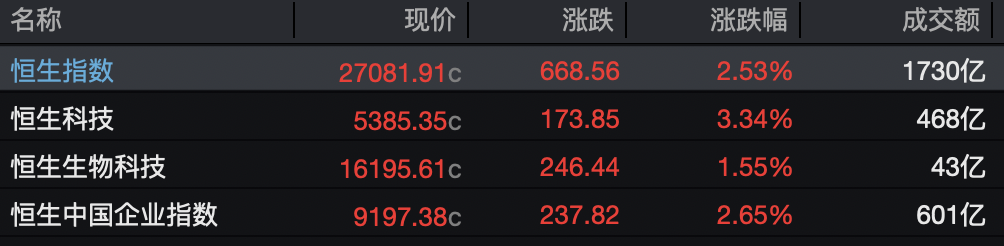
Group 1 - The Hong Kong stock market showed a positive sentiment today, with all three major indices opening high and maintaining strong fluctuations, led by the technology sector [1][2] - The Hang Seng Index rose by 2.53%, the Hang Seng China Enterprises Index increased by 2.65%, and the Hang Seng Technology Index surged by 3.34% [2][3] - Major tech stocks performed well, with Meituan rising over 5%, Alibaba, Xiaomi, and JD.com increasing by over 3%, while semiconductor stocks also saw significant gains [2] Group 2 - Zhipu, referred to as the "first stock of large models in Hong Kong," experienced a sharp decline of 22.76% due to the impact of an apology letter related to its GLM Coding Plan [4][5] - Zhipu's stock price had previously surged over 250% from February 9 to February 22, indicating a volatile trading period [4] - The company acknowledged three main errors in the GLM Coding Plan, including insufficient transparency, slow rollout of GLM 5, and poorly designed upgrade mechanisms for existing users [6] Group 3 - The precious metals sector, including gold, saw strong performance, with stocks like Tongguan Gold rising over 12% and Ganfeng Lithium increasing by over 8% [7][8] - Other notable gains in the precious metals sector included Zijin Mining and Wukuang Resources, both rising by over 6% [7]

收评:创业板指跌逾1%,煤炭、石油等板块下挫,银行板块逆市拉升
Sou Hu Cai Jing· 2025-11-20 07:41
Core Viewpoint - The A-share market experienced a decline on November 20, with major indices falling, indicating a short-term struggle around the 4000-point mark, influenced by external and internal factors affecting technology valuations [1] Market Performance - The Shanghai Composite Index fell by 0.4% to 3931.05 points, the Shenzhen Component Index decreased by 0.76% to 12980.82 points, and the ChiNext Index dropped by 1.12% to 3042.34 points [1] - Over 3800 stocks in the market closed in the red, with total trading volume across the Shanghai, Shenzhen, and Beijing markets reaching 17.227 billion yuan [1] Sector Analysis - Sectors such as coal, oil, tourism, food and beverage, agriculture, and semiconductors saw declines, while the banking sector performed positively [1] - Active sectors included lithium mining, Hainan Free Trade Zone, and PCB concepts [1] Investment Outlook - According to Huaxin Securities, the A-share market is currently in a phase of oscillation around the 4000-point level, with three main factors contributing to market volatility: the rebound of the external dollar index, accumulation of profit-taking in technology stocks, and disappointing earnings reports from some tech companies [1] - Key indicators suggest a short-term consolidation signal, but no peak signals have been observed, indicating that the bull market is still in its mid-stage [1] - The market is expected to remain volatile in November, with a focus on low-position rebounds, earnings recovery, and technology policy themes [1]

盘前必读丨美股收跌道指重挫超500点;部分日本电影宣布暂缓上映
Di Yi Cai Jing· 2025-11-17 23:29
Market Overview - The U.S. stock market experienced a decline, with the Dow Jones falling by 1.18%, the Nasdaq down by 0.84%, and the S&P 500 decreasing by 0.92% [3] - The Cboe Volatility Index (VIX) surged by 12.97%, indicating increased market volatility [3] - Major tech stocks showed mixed performance, with Google rising by 3.1% while Nvidia and Apple both dropped by 1.8% [3] Commodity Prices - International oil prices saw a slight decrease, with WTI crude oil at $59.91 per barrel and Brent crude at $64.20 per barrel, both down by 0.30% [4] - Gold prices also faced pressure, with COMEX gold futures for November delivery falling by 0.47% to $4068.30 per ounce, and later dipping to around $4040 [4] Economic Indicators - The Chinese government reported a general public budget revenue of 186,490 billion yuan from January to October, reflecting a year-on-year growth of 0.8% [5] - Tax revenue increased by 1.7% to 153,364 billion yuan, while non-tax revenue decreased by 3.1% [5] Industry Developments - The National Medical Products Administration of China announced reforms to enhance the regulation of cosmetics, aiming for a more robust regulatory framework by 2030 and achieving international standards by 2035 [6] - The automotive sector reported a decline in consumer spending, with October's automotive consumption at 425.5 billion yuan, down 7% year-on-year, while production and investment in the sector continued to grow [6] Corporate News - ST Zhongdi's stock has resumed trading after completing a suspension for verification [8] - Tianhe Solar signed a sales contract for 2.66 GWh of energy storage products [8] - Alibaba announced its entry into the AI to C market with the launch of the "Qianwen" project [3][8]

中国银河证券:预计年末仍以震荡行情为主 关注反内卷、红利主题机会
Xin Hua Cai Jing· 2025-11-17 02:04
Core Viewpoint - The recent market fluctuations are influenced by the Federal Reserve's hawkish stance and concerns over AI market trends, leading to a correction in technology stocks and a rotation of funds towards sectors like lithium batteries and consumer goods [1] Group 1: Market Overview - The overseas market is experiencing overall volatility, with technology stocks undergoing a correction phase [1] - The end of the longest U.S. government shutdown has raised attention on upcoming key economic data and its potential impact on overseas markets [1] - A-share market continues in a consolidation pattern, with rapid sector rotation and a focus on themes like lithium batteries and consumer sectors benefiting from policy support [1] Group 2: Investment Strategy - It is recommended to focus on themes such as anti-involution and dividends during sector rotations, with an emphasis on technology sectors that are poised for a rebound [2] - The anti-involution area is becoming a key focus for macroeconomic regulation, enhancing the long-term investment value of related sectors [2] - The consumption sector is crucial for stabilizing the economic foundation, with particular attention on service consumption and new consumption models [2] Group 3: Economic Indicators - The recent surge in the lithium battery supply chain reflects a tightening supply-demand balance, boosting mid-term economic improvement expectations [1] - Financial data from October confirms signals of fund migration, suggesting a favorable liquidity outlook [1] - The anticipated policy implementations and rising price expectations are expected to clarify the logic behind anti-involution sectors, while the technology sector's trends and performance are entering a verification phase [1]

中国银河证券:预计年末行情仍以震荡结构为主,关注“反内卷”、红利等主题机会
Xin Lang Cai Jing· 2025-11-17 00:10
Core Viewpoint - The A-share market is currently in a consolidation phase, with rapid rotation among sectors, particularly as funds shift towards lithium batteries and electrolyte themes, while the consumer sector benefits from favorable policies [1] Sector Analysis - The technology sector, which previously saw significant gains, is now in a state of consolidation, indicating a potential pause in upward momentum [1] - Funds are beginning to rotate towards themes such as lithium batteries and electrolytes, suggesting a shift in investor focus [1] - The consumer sector is experiencing benefits from policy support, although the sustainability of these themes remains in question [1] Market Outlook - As the year-end approaches, institutional allocations are likely to become more balanced, preparing for the economic outlook for the next year [1] - The year-end market is expected to maintain a volatile structure, characterized by fluctuations rather than a clear trend [1] - In the context of sector rotation, opportunities related to "anti-involution" and dividends are highlighted, with a focus on the technology sector's potential for catch-up gains and industry trend catalysts [1]
龙头大涨近18%!这一板块爆发
Zhong Guo Zheng Quan Bao - Zhong Zheng Wang· 2025-11-11 12:16
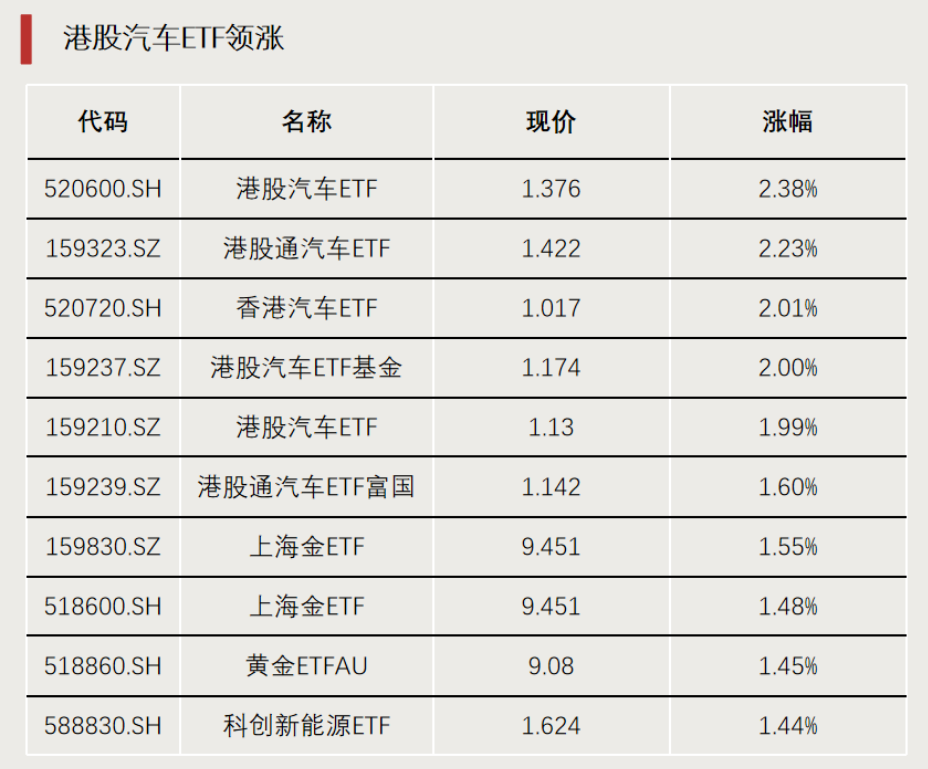
Group 1: Market Performance - Xpeng Motors' stock surged nearly 18%, leading to a strong performance in the Hong Kong automotive sector [1][2] - The overall market saw significant inflows into various ETFs, particularly in the automotive and gold sectors, with multiple ETFs tracking these sectors showing notable gains [1][2][5] Group 2: ETF Highlights - Several automotive ETFs outperformed the market, with multiple products tracking the Hong Kong automotive sector leading the gains [2][3] - Gold-themed ETFs continued to show strength, with many commodity gold ETFs rising over 1.4% [4][5] Group 3: Fund Inflows - Since October, sectors such as gold, Hang Seng technology, banking, and securities have attracted significant capital, with several ETFs seeing net inflows exceeding 50 billion [1][7] - The Huatai-PineBridge Dividend Low Volatility ETF attracted 4.166 billion in net inflows since October, indicating strong interest in dividend-focused investments [7][8] Group 4: Market Trends - The current market environment is characterized by structural trends, with a focus on dividend assets as institutional demand for high-dividend, low-valuation equities increases [9] - Analysts suggest that the market may experience rapid rotation among themes, with potential opportunities in sectors like electric grid equipment, lithium batteries, and chemicals [9]
赚翻!外资巨头抱团买入这些标的
Shang Hai Zheng Quan Bao· 2025-11-04 23:07
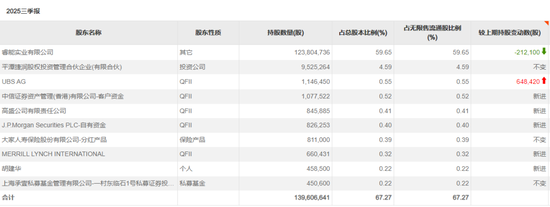
Group 1 - Multiple stocks heavily bought by foreign institutions in Q3 have shown significant price increases in October, including RuiNeng Technology, LiXing Co., YuanDa Intelligent, and GuoGuang Chain [1][2][4] - Foreign institutions such as CITIC Securities Asset Management (Hong Kong), Goldman Sachs, JPMorgan, and Merrill Lynch have increased their holdings in RuiNeng Technology, with UBS also significantly raising its stake [1][2] - RuiNeng Technology's stock price has risen by 31.85% since October [1] Group 2 - LiXing Co. has also attracted interest from several QFIIs, with firms like Morgan Stanley, UBS, and Barclays entering its top ten shareholders list in Q3 [2] - The stock price of LiXing Co. has increased by 17.5% since October [2] Group 3 - YuanDa Intelligent saw new entries from major QFIIs, including JPMorgan and Abu Dhabi Investment Authority, with significant holdings exceeding 3 million shares [3] - The stock price of YuanDa Intelligent has risen by 28.1% since October [3] Group 4 - GuoGuang Chain has been favored by QFIIs like JPMorgan and Goldman Sachs, with JPMorgan holding over 1.5 million shares [4] - The stock price of GuoGuang Chain has surged by 46.72% since October [4] Group 5 - Analysts from UBS and other foreign institutions believe that despite short-term market fluctuations, positive factors are accumulating in the A-share market, with structural opportunities worth noting [6] - Key sectors such as AI computing, semiconductors, and innovative pharmaceuticals are highlighted as maintaining high growth potential [6]
公募基金2025Q3季报分析:电子和通信配比新高
Xinda Securities· 2025-10-31 04:40
1. Report Industry Investment Rating No information provided. 2. Core Viewpoints of the Report - In Q3 2025, the total scale of the public - offering fund market approached 35.8 trillion yuan, with a quarter - on - quarter increase of 6.48% and a new - added scale of about 2.18 trillion yuan. The "fixed - income plus" strategy funds performed outstandingly, and the scale of secondary bond funds increased significantly. The technology theme of active equity funds was popular, and the allocation of electronics and communication industries reached a new high [2]. - The performance of different types of public - offering funds in Q3 2025 was significantly differentiated. Equity - heavy products generally achieved positive returns, while the median quarterly returns of medium - and long - term pure - bond funds and passive index bond funds were negative [44]. - The overall stock position of active equity funds reached the highest level since 2010, and the concentration of heavy - position stocks rebounded, but the long - term concentration was still relatively low [52][66]. 3. Summary According to the Directory 3.1 Fund Scale - **Full - market Fund Overview**: In Q3 2025, the market continued the characteristics of "total growth and structural re - balance". The scale of bond funds shrank, while money funds grew steadily. The "fixed - income plus" strategy funds, especially secondary bond funds, were favored, with a quarter - on - quarter increase of about 61.34% [14][15]. - **Newly - established Funds**: In Q3 2025, 477 newly - issued funds raised about 3788 billion yuan. Index funds were the main fundraising force, including equity index funds and bond index funds such as science and technology innovation bond ETFs [3][19]. - **Active Equity Funds**: By the end of Q3 2025, the total scale of active equity funds was about 4.02 trillion yuan, with a quarter - on - quarter increase of over 20%. However, the share continued to decline for ten quarters. Technology - themed funds were popular, and some large - scale single products changed [23][30]. - **Equity ETF Fund Flows**: With the market recovery, broad - based index ETFs such as CSI 50 and SSE 500 had a profit - taking trend, while cross - border and some low - level sectors attracted continuous inflows of ETF funds, mainly in Hong Kong - related and low - level segmented directions [3][32]. - **Fund Company Management Scale Distribution**: The competition pattern of high - equity - position fund managers was stable. In different types of funds, such as passive equity funds, standard "fixed - income plus" funds, and FOF funds, the leading positions of some fund companies were obvious, and the growth rates of some medium - sized institutions were fast [36][37]. 3.2 Fund Performance - **By Fund Type**: In Q3 2025, equity - heavy funds generally had positive returns, while medium - and long - term pure - bond funds and passive index bond funds had negative median quarterly returns and underperformed money funds in terms of cumulative performance during the year [44]. - **Active Equity Funds**: In Q3 2025, partial - stock funds outperformed the CSI 800 index. The top - performing active equity funds were mainly in the TMT and growth sectors [45][48]. 3.3 Active Equity Fund Allocation - **Stock Position**: In Q3 2025, the overall stock position of active equity funds reached 89.21%, the highest since 2010. The position divergence narrowed, but the total position of balanced hybrid funds decreased [52]. - **Hong Kong Stock Allocation**: By the end of Q3 2025, the allocation ratio of active equity funds to Hong Kong stocks was 16.61%, slightly lower than the previous quarter but still at a high level [63]. - **Fund Stock - holding Concentration**: By the end of Q3 2025, the concentration of heavy - position stocks of active equity funds rebounded, and the number of heavy - position stocks decreased slightly. Although the short - term concentration increased, the long - term concentration was still relatively low [66][67]. 3.4 Fund Heavy - position Stock Analysis - **Industry Distribution**: By the end of Q3 2025, the heavy - position stocks of active equity funds were highly concentrated in electronics, power equipment and new energy, medicine, and communication industries, with a total proportion of over 53%. The allocation ratios of electronics and communication industries reached a new high since 2010, while the banking, food and beverage, and household appliance industries were significantly reduced [71]. - **Market - value Distribution**: By the end of Q3 2025, the heavy - position stocks of active equity funds were mainly in the 100 - 500 billion yuan and 1000 - 3000 billion yuan market - value intervals. The proportion of stocks in the 3000 - 5000 billion yuan market - value interval increased, and that in the 100 - 500 billion yuan interval decreased [73]. - **Broad - based Index Component Stock Allocation**: By the end of Q3 2025, the proportion of SSE 300 component stocks in active equity funds increased, while that of CSI 500 component stocks decreased, showing a slight inclination towards large - cap stocks [76]. - **Heavy - position Stock Details**: The top ten heavy - position stocks of active equity funds were more concentrated in the leading companies of the electronics and communication industries, and the heavy - position allocation of Hong Kong stocks was more concentrated in the Internet and innovative drug fields [8]. - **Active Addition and Reduction of Heavy - position Stocks**: The top ten actively - added stocks included Industrial and Commercial Bank of China, Zhongji Innolight, etc., and the top ten actively - reduced stocks included Shenghong Technology, Midea Group, etc. [9]
2025Q3 可转债复盘:从主题热潮到高位震荡
Huachuang Securities· 2025-10-25 07:03
1. Report Industry Investment Rating The document does not mention the industry investment rating. 2. Core Viewpoints of the Report - In Q3 2025, convertible bonds first rose and then fluctuated under the influence of multiple internal and external factors. The CSI Convertible Bond Index increased by 9.43% in Q3, with its valuation rising by 5.72 pct to 30.44% compared to the end of June. However, it underperformed major stock indices. The market can be divided into two stages: a fast - bull market catalyzed by the "anti - involution" and technology themes in July, and a high - level oscillation after September due to factors such as the redemption of secondary bond funds and the weakening of the equity market [2][9]. - Looking ahead to Q4, the support on the demand side of convertible bonds may weaken. Insurance funds and general institutions may reduce their convertible bond assets, which may bring pressure on the clearance of high - rated convertible bonds. Opportunities may lie in low - priced and bond - biased convertible bonds with cost - effectiveness [6]. 3. Summary According to the Directory 3.1 2025Q3 Convertible Bond Market: From Theme Craze to High - Level Oscillation - **Overall Performance**: The CSI Convertible Bond Index increased by 9.43% in Q3 2025, outpacing the cumulative increase in the first half of the year. However, it underperformed major stock indices. The convertible bond market first rose rapidly and then oscillated. The valuation of convertible bonds first increased and then decreased, and the proportion of low - parity bonds continued to shrink. The TMT and advanced manufacturing sectors performed strongly [2][9][15]. - **Convertible Bond Terms**: In Q3 2025, 112 convertible bonds triggered the call - back clause, with 61 announced for redemption, and the call - back probability was 54.46%. The number of times the downward - revision clause was triggered decreased, but the downward - revision probability increased to 14.55%. The risk of put - back was relatively controllable [3][22][23]. - **Supply and Demand Structure**: - **Supply**: As of September 30, 2025, 28 convertible bonds were issued in the year, with a scale of 36.948 billion yuan. The number decreased by 3.45% and the scale increased by 56.34% compared to the same period in 2024. The scale of new issuance plans in Q3 was 35.5 billion yuan, a year - on - year increase of 166.32%. High - rated and large - cap convertible bonds had weak issuance. The stock of convertible bonds continued to shrink, and it was expected to continue to decline in Q4 [4][26][37]. - **Demand**: Most major holders reduced their positions, while public funds increased their holdings. As of the end of September, public funds held 233.561 billion yuan of convertible bonds, a 7.68% increase from the end of June. Enterprise annuities and insurance institutions significantly reduced their holdings of convertible bonds [38][45][48]. 3.2 Stage Review: From Theme Craze to High - Level Oscillation - **July 1 - August 26**: The equity market continued to rise after the market started at the end of June, breaking through the upper limit of the oscillation. The "anti - involution" policy and the Yajiang Hydropower Station project drove the equity market, and the TMT sector's performance in August further magnified the market. Public funds were the main force in increasing convertible bond holdings, and the share of convertible bond ETFs increased significantly. The premium rate of convertible bonds rose to 32.55% [5][58][63]. - **August 27 - September 30**: The equity market entered an oscillation phase. The TMT sector was still the main line, but external disturbances weakened market risk appetite. The redemption of bond funds at the end of August led to a short - term weakness in the demand side of convertible bonds. The share of convertible bond ETFs peaked and declined, and the premium rate of convertible bonds fell to 30.44% [66][68][71].
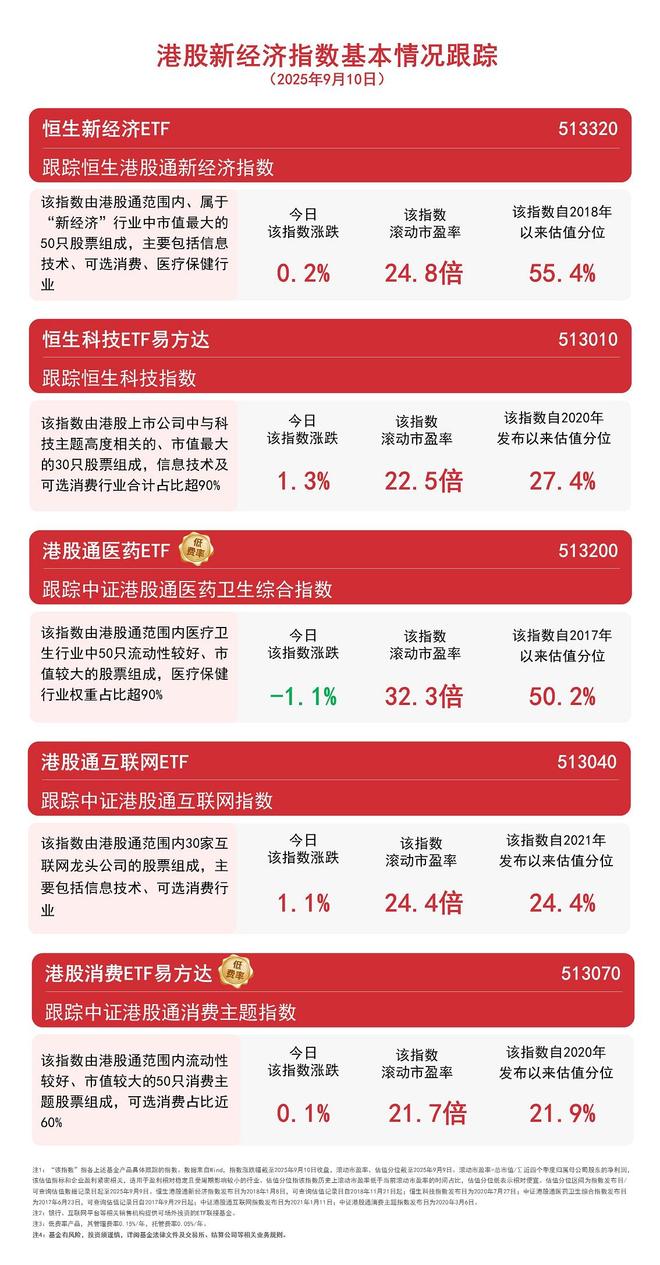
恒生科技ETF易方达(513010)连续10个交易日“吸金”,合计超20亿元,产品规模创历史新高
Mei Ri Jing Ji Xin Wen· 2025-09-10 11:22
Market Overview - The Hong Kong stock market showed mixed performance today, with financial and real estate sectors continuing to rise, while pharmaceutical and new consumption sectors experienced widespread declines [1] - The Hang Seng Technology Index increased by 1.3%, the CSI Hong Kong Stock Connect Internet Index rose by 1.1%, the Hang Seng Stock Connect New Economy Index gained 0.2%, and the CSI Hong Kong Stock Connect Consumer Theme Index saw a slight increase of 0.1%. In contrast, the CSI Hong Kong Stock Connect Pharmaceutical and Health Comprehensive Index fell by 1.1% [1] ETF Performance - The E Fund Hang Seng Technology ETF (513010) has recorded net inflows for 10 consecutive trading days, totaling over 2 billion yuan, with the latest scale reaching 17.6 billion yuan, marking a historical high [1] - The Hang Seng New Economy ETF (513320) tracks the Hang Seng Stock Connect New Economy Index, which consists of 50 stocks from the "new economy" sector with the largest market capitalization [2] - The Hang Seng Technology ETF (513010) tracks the Hang Seng Technology Index, composed of 30 stocks highly related to technology themes, with over 90% of the index comprising information technology and consumer discretionary sectors [2] - The CSI Hong Kong Stock Connect Pharmaceutical ETF (513200) tracks the CSI Hong Kong Stock Connect Pharmaceutical and Health Comprehensive Index, which includes 50 liquid and large-cap stocks in the healthcare sector [2] - The CSI Hong Kong Stock Connect Internet ETF (513040) tracks the CSI Hong Kong Stock Connect Internet Index, consisting of 30 leading internet companies, primarily in information technology and consumer discretionary sectors [2] Valuation Metrics - The rolling P/E ratio for the Hang Seng New Economy Index is 24.8 times, with a valuation percentile of 55.4% since 2018 [2] - The rolling P/E ratio for the Hang Seng Technology Index is 22.5 times, with a valuation percentile of 27.4% since its inception in 2020 [2] - The rolling P/E ratio for the CSI Hong Kong Stock Connect Pharmaceutical Index is 32.3 times, with a valuation percentile of 50.2% since 2017 [2] - The rolling P/E ratio for the CSI Hong Kong Stock Connect Internet Index is 24.4 times, with a valuation percentile of 24.4% since its inception in 2021 [2] - The rolling P/E ratio for the E Fund Hong Kong Consumption ETF (513070) is 21.7 times, with a valuation percentile of 21.9% since its inception in 2020 [3]