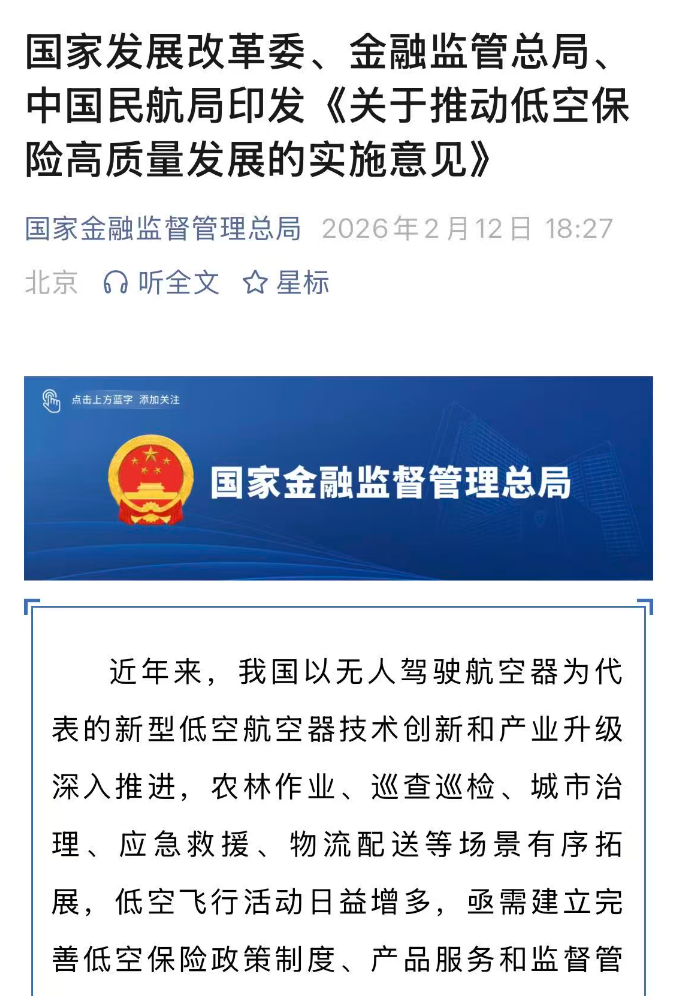
低空保险

Search documents
非银金融行业周报:利率引发保险调整,仍然看好非银板块长期表现
东方财富· 2026-03-02 10:50
Investment Rating - The report maintains an "Outperform" rating for the non-bank financial sector [2] Core Views - The non-bank financial sector is expected to show potential investment opportunities despite recent adjustments, particularly in the insurance segment, which is undergoing valuation adjustments due to interest rate changes [1][8] - The report highlights that the non-bank sector has experienced significant adjustments, suggesting that valuation levels are now attractive for potential investments [1][8] Summary by Sections 1. Securities Business Overview and Weekly Review - The China Securities Regulatory Commission (CSRC) has introduced new regulations for private fund information disclosure, effective from September 1, which aims to enhance transparency and reduce hidden risks in the private fund industry [14] - The report notes that the major indices showed mixed performance, with the non-bank financial index declining by 1.90% compared to the Shanghai Composite Index's increase of 1.08% [16][19] - The average price-to-book (PB) ratio for the securities sector is reported at 1.34, indicating it is at the 31st percentile of its historical range [18][41] 2. Insurance Business Overview and Weekly Review - A new policy has been introduced to systematically develop low-altitude insurance, addressing the growing demand for risk coverage in low-altitude flight activities [44][45] - The policy outlines a phased approach to establish a mandatory insurance system for unmanned aerial vehicles by 2027 and aims to create a comprehensive low-altitude insurance framework by 2030 [45][46] - The report anticipates that the implementation of this policy will create new growth opportunities for insurance companies, prompting them to develop innovative insurance products tailored to the low-altitude economy [46] 3. Market Liquidity Tracking - The report indicates that the central bank conducted a net withdrawal of 5,774 billion yuan in the open market during the week, with various monetary policy tools being utilized [53]



险企加速布局 低空保险
Jin Rong Shi Bao· 2026-02-25 02:57
Group 1 - The national government has been continuously releasing policy dividends, providing a clear development framework for the low-altitude economy, with low-altitude insurance being included in the government work report for the first time in 2024 [1] - Over 30 insurance companies in China are currently engaged in low-altitude insurance, offering more than 100 products that cover various types of risks, including aircraft property loss, third-party liability, and personal accidents [1] - The industry is accelerating the establishment of systems and standards, with the first national drone application insurance standard introduced in 2022 and the first regional demonstration clauses for unmanned aerial vehicle third-party liability insurance released in 2024 [1] Group 2 - The first low-altitude economic co-insurance body in China was established in Chongqing in August 2025, with 19 member units signing cooperation agreements and launching four exclusive products covering various fields [2] - Major insurance institutions are upgrading their product systems to extend from single-issue coverage to full lifecycle services, with new insurance products being developed to address diverse risks in low-altitude economic scenarios [2] - The insurance service system launched by PICC in Guangdong in May 2025 includes comprehensive coverage for cargo transportation, parking losses during downtime, and extended warranty responsibilities, enhancing the risk protection framework for the low-altitude economy [2] Group 3 - Ping An Property & Casualty is exploring the "insurance + service + technology" model, creating an insurance matrix with over 20 products that comprehensively cover personnel safety, property loss, and third-party liability risks across the low-altitude economy [3] - As of now, Ping An Property & Casualty has insured over 150,000 drones, providing risk coverage exceeding 90 billion yuan, with claims for low-altitude aircraft amounting to over 1.17 billion yuan [3] - The low-altitude insurance system in China still faces challenges, including the need for richer product offerings and deeper collaboration between insurance companies and the industry, but the insurance sector is expected to continue exploring and improving its service capabilities [3]
三部门给低空经济上保险
Jin Rong Shi Bao· 2026-02-25 02:57
Core Viewpoint - The low-altitude economy in China is transitioning from "taking off" to "utilizing," with the market expected to reach 1.5 trillion yuan by 2025 and potentially exceed 2 trillion yuan by 2030. The traditional insurance model is inadequate for the complex demands of low-altitude flight activities, prompting the release of the "Implementation Opinions" to establish a systematic approach to low-altitude insurance development [1][2]. Group 1: Policy Framework and Development Goals - The "Implementation Opinions" outlines a phased development goal for low-altitude insurance, aiming to establish a mandatory insurance system for unmanned aerial vehicles (UAVs) by 2027 and a comprehensive policy framework by 2030 [2][3]. - The document emphasizes the importance of low-altitude insurance in building a safety management system and supporting the high-quality development of the low-altitude economy [2]. Group 2: Mandatory Insurance for UAVs - A key highlight of the "Implementation Opinions" is the establishment of a mandatory insurance system for UAVs, akin to compulsory traffic insurance, which will be integrated into flight activity approval processes [3][4]. - This mandatory insurance aims to enhance public safety and compel operators to improve safety management practices [3]. Group 3: Comprehensive Risk Coverage - The low-altitude economy's diverse applications necessitate a broad and precise risk coverage approach, prompting the "Implementation Opinions" to advocate for a comprehensive insurance service system that extends across the entire industry chain [5][6]. - The document calls for the development of insurance products that address new types of risks associated with low-altitude operations, including safety in technology, data, and environmental aspects [5][6]. Group 4: Service Enhancement and Application Scenarios - The "Implementation Opinions" stresses the need for tailored insurance solutions based on various application scenarios such as agriculture, logistics, emergency management, and tourism, ensuring that insurance services evolve from mere product supply to proactive empowerment [6]. - The establishment of a robust service guarantee system is seen as a critical measure to integrate insurance into the low-altitude economy, providing a safety net for industry development [6].
低空保险需精准对接低空产业需求
Jin Rong Shi Bao· 2026-02-25 02:46
Core Insights - The low-altitude economy is rapidly transitioning from concept to reality, driven by technological breakthroughs and the expansion of application scenarios, necessitating financial support and coordinated industrial development [1] - The recent implementation of the "Implementation Opinions" by various regulatory bodies aims to optimize insurance coverage across the entire industry chain, with a goal to establish a mandatory insurance system for unmanned aerial vehicles by 2027 [1][3] Group 1: Industry Development - The low-altitude economy has been steadily growing since its inclusion in the government work report in 2024, creating a diverse application ecosystem with scenarios like "low-altitude + tourism," "low-altitude + logistics," and "low-altitude + inspection" [1] - The rapid development of the industry is accompanied by challenges in risk prevention and insurance services, which have not kept pace with the fast-evolving nature of the low-altitude sector [2] Group 2: Insurance Challenges - The insurance industry has made gradual progress in low-altitude economic coverage, but there is still a problem of product homogeneity, primarily focusing on simple drone liability insurance, while coverage for medium and large equipment and manned flights is still being developed [2] - A significant portion of low-altitude operators are small enterprises and individual pilots with limited risk-bearing capacity, leading to a concentrated demand for low-cost, highly adaptable, and quick-claim insurance products [2] Group 3: Policy and Regulatory Framework - The new policy document addresses industry pain points and provides clear guidelines for the collaborative development of low-altitude economy and insurance, including mandatory insurance requirements for unmanned aerial vehicles [3] - The document emphasizes the need to establish systems related to liability, responsibility recognition, and accident handling procedures, while also exploring the development of new insurance products for various low-altitude risks [3] Group 4: Future Directions for Insurance - The insurance industry is encouraged to break through product homogeneity by developing customized products for different scenarios such as agricultural protection, urban inspection, and low-altitude logistics, incorporating new risks like operational downtime and data security [4] - There is a push for digital transformation within the insurance sector to create a low-altitude insurance information platform, utilizing AI and IoT technologies for precise pricing and intelligent risk control [4] - With the implementation of the new policy, insurance is expected to become an essential part of the low-altitude economy, deeply integrated with industry needs to enhance safety and operational standards [4]
无人机“交强险”要来了!三部门联手给低空经济上保险
2 1 Shi Ji Jing Ji Bao Dao· 2026-02-13 06:45
Core Viewpoint - The implementation of the "Implementation Opinions" by the National Development and Reform Commission, the Financial Regulatory Bureau, and the Civil Aviation Administration marks a significant step towards the development of low-altitude insurance, which is crucial for the safety and high-quality development of the low-altitude economy [1][2]. Group 1: Policy Framework - The "Implementation Opinions" consist of six parts and twelve articles, outlining principles for systematic planning, key breakthroughs, collaborative advancement, and steady implementation [2]. - It emphasizes the establishment of a mandatory insurance system for unmanned aerial vehicles (UAVs), akin to compulsory insurance for automobiles, which will be integrated into flight activity approval processes [2][4]. Group 2: Insurance Product Development - The document encourages the development of a comprehensive insurance product system covering the entire low-altitude industry chain, including research, manufacturing, operation, and infrastructure [5]. - It highlights the need for insurance companies to adapt to new business models in the low-altitude economy, promoting the supply of insurance for medium and large UAVs while optimizing traditional manned aircraft insurance [5]. Group 3: Application Scenarios - The "Implementation Opinions" propose targeted insurance solutions for various application scenarios such as agricultural operations, low-altitude logistics, emergency management, and medical rescue, based on the specific risks and management needs of each scenario [6]. - It also encourages collaboration among industry chain leaders to reduce risk costs and supports small and medium enterprises in enhancing their risk defense capabilities through insurance [6]. Group 4: Data Infrastructure and Professional Capability - The document addresses the need for improved data infrastructure to support sustainable insurance operations, proposing the establishment of a low-altitude insurance information platform to facilitate data sharing and risk monitoring [7]. - It emphasizes the importance of enhancing professional capabilities within insurance institutions to better identify and assess new risks associated with low-altitude operations [7]. Group 5: Organizational Support and Timeline - The "Implementation Opinions" outline a clear organizational structure for implementing low-altitude insurance, with specific responsibilities assigned to various regulatory bodies [8]. - A phased timeline is set, aiming for the establishment of a mandatory UAV insurance system by 2027 and a comprehensive low-altitude insurance policy framework by 2030, indicating the growing importance of low-altitude insurance in the economic system [8].
推动低空保险高质量发展
Jin Rong Shi Bao· 2026-02-13 01:28
Core Viewpoint - The implementation of low-altitude insurance policies is essential to ensure the safety of life and property as the use of unmanned aerial vehicles (UAVs) expands across various sectors in China [1][2]. Group 1: Overall Requirements - The overall requirements emphasize the need to align with Xi Jinping's thoughts and the principles from the 20th National Congress of the Communist Party, focusing on systematic planning, key breakthroughs, collaborative advancement, and steady implementation to meet the insurance needs of various application scenarios [2]. Group 2: Policy System - The policy system aims to strengthen support for low-altitude insurance through development planning, using insurance as a tool for enhancing operational safety regulation and accident handling [2]. Group 3: Institutional Construction - A mandatory insurance system for UAVs will be established, with efforts to verify compliance and develop implementation measures and model clauses for mandatory liability insurance [2]. Group 4: Service Guarantee System - A comprehensive insurance product system covering the entire low-altitude industry chain will be gradually established, enhancing the supply and service capabilities for both UAVs and traditional manned aircraft [2]. Group 5: Sustainable Operating Capacity - The construction of a low-altitude insurance information platform will be accelerated, exploring integration with low-altitude intelligent network systems and enhancing the capabilities of insurance and reinsurance institutions [2]. Group 6: Organizational Assurance - Responsibilities among relevant departments will be clarified to strengthen risk prevention and promote awareness of low-altitude insurance [2][3].
四大证券报精华摘要:2月13日
Sou Hu Cai Jing· 2026-02-13 00:40
Group 1 - In January 2026, the number of new fund issuances reached 169, the highest level since March 2023, with several funds selling out in one day and some triggering proportionate allotment due to oversubscription [1] - Fund advisors have accelerated their reallocation strategies, with 178 out of nearly 650 fund advisor portfolios adjusting their allocations, favoring undervalued value-type funds [1] - The overall asset allocation has seen an increase in A-shares and bond positions while reducing cash assets, U.S. stocks, and Hong Kong stocks, with a focus on sectors like non-ferrous metals, electronics, and communications [1] Group 2 - The issuance of bond funds has significantly declined in 2026, with new pure bond funds being very few, while "fixed income +" funds continue to dominate the new bond fund market [3] - The latest VAT policy has excluded regular life insurance products from the exemption, leading to increased costs and a projected price rise of 5% to 10% for new products [3] - The recent rise in the onshore and offshore RMB against the USD, surpassing the 6.90 mark, is attributed to seasonal corporate demand for currency settlement and external factors affecting the USD [4] Group 3 - Several securities firms, including Caida Securities, are expanding their credit business scale, raising the upper limit of related quotas from 100% to 140% of audited net capital for 2024 [5] - The rapid expansion of margin financing demand has led to an increase in the total scale of margin financing, which is expected to boost revenue for securities firms [5] - The introduction of new refinancing policies by major exchanges is seen as a positive development for the investment banking business, with a focus on leveraging these opportunities post-holiday [6] Group 4 - The public fund of funds (FOF) sector has seen a rapid increase, with 31 new FOFs established in 2026, a year-on-year growth of 244.44%, driven by demand for stable investment products and continuous innovation [7] - The pre-prepared food market is experiencing a surge in demand as the Lunar New Year approaches, with both online and offline platforms actively promoting various meal kits and specialty dishes [7] - The urban real estate financing coordination mechanism has shown effectiveness, with significant credit support provided to "white list" projects, ensuring funding for ongoing construction and protecting homebuyer rights [8]
央行今日出手,万亿逆回购来了……盘前重要消息还有这些
证券时报· 2026-02-13 00:26
Group 1 - The Chinese Ministry of Foreign Affairs emphasized the strategic importance of high-level diplomatic communication between China and the U.S., highlighting mutual benefits in economic relations and the need for cooperation to ensure stability [2] - The Ministry of Commerce confirmed ongoing close communication between Chinese and U.S. economic teams, aiming to implement agreements reached by the two heads of state and manage differences effectively [2] - The Ministry of Commerce proposed anti-subsidy duties on dairy products imported from the EU, set to take effect on February 13, 2026, as part of regulatory measures [3] Group 2 - The People's Bank of China announced a 10 trillion yuan reverse repurchase operation scheduled for February 13, 2026, with a term of 182 days [4] - The State Administration for Market Regulation released guidelines to regulate pricing behavior in the automotive industry, promoting healthy market development [5] - The National Development and Reform Commission and other agencies outlined plans for the development of low-altitude insurance, aiming for a preliminary establishment of mandatory insurance for unmanned aerial vehicles by 2027 [5] Group 3 - Shenzhen's Industrial and Information Technology Bureau launched an action plan for "Artificial Intelligence + Advanced Manufacturing" for 2026-2027, aiming to establish a national AI application pilot base and promote industrial upgrades [6] - Double Good Energy announced indirect participation in commercial space projects but clarified no direct collaboration with SpaceX [8] - Huapei Power plans to acquire 100% equity of Meichuang Zhiguan, leading to a stock suspension on February 13 [11]

夯实低空经济“安全底座” 三部门力促低空保险高质量发展
Xin Lang Cai Jing· 2026-02-12 20:33
Core Viewpoint - The implementation of a mandatory insurance system for unmanned aerial vehicles (UAVs) is being accelerated in China, with a goal to establish a comprehensive low-altitude insurance framework by 2030, enhancing the safety and development of the low-altitude economy [1][2]. Group 1: Policy Development - By 2027, a preliminary mandatory insurance system for UAV liability will be established, with a diverse range of low-altitude insurance products to meet various application scenarios [1]. - The low-altitude economy market in China is projected to reach 1.5 trillion yuan by 2025, indicating significant growth potential [1]. Group 2: Insurance Product System - A comprehensive insurance product system covering the entire low-altitude industry chain will be gradually established, focusing on new risk guarantees related to safety, technology, data, environment, and human operation [2]. - The insurance supply for medium and large UAVs will be increased, while traditional manned aircraft insurance will be optimized to create a robust and efficient insurance system [2]. Group 3: Data and Risk Management - To enhance sustainable insurance operations, the establishment of a low-altitude insurance information platform is proposed, which will support actuarial pricing and risk monitoring through improved data standards [3]. - Insurance institutions are encouraged to collaborate with UAV manufacturers and operators to enhance the identification and assessment of new low-altitude risks, improving the scientific development of products and accuracy in rate determination [3].
事关低空经济发展,重磅文件来了
Zhong Guo Ji Jin Bao· 2026-02-12 12:26
Core Viewpoint - The implementation opinion on promoting the high-quality development of low-altitude insurance has been released, emphasizing the importance of establishing a comprehensive low-altitude insurance system to support the safety and healthy development of the low-altitude economy [1][5]. Summary by Sections 1. Importance of Low-Altitude Insurance - Low-altitude insurance is crucial for ensuring the safety of low-altitude flight activities, providing risk protection for the manufacturing and operation of low-altitude aircraft, infrastructure construction, and various specialized services [4][10]. 2. Development Goals - By 2027, a preliminary mandatory insurance system for unmanned aerial vehicle (UAV) liability insurance will be established, with a continuous enrichment of low-altitude insurance products to meet diverse application scenarios [5][10]. - By 2030, a basic policy framework for low-altitude insurance will be formed, enhancing its role in ensuring the safety and health of the low-altitude economy [5][10]. 3. Policy Framework - The implementation opinion calls for integrating insurance into the overall planning and regulatory framework for low-altitude economic development, promoting the establishment of relevant laws and regulations [11]. - It encourages local governments to incorporate insurance into their low-altitude economic policies and to develop supportive measures tailored to local conditions [11]. 4. Insurance Mechanisms - The document advocates for the use of insurance mechanisms to enhance risk management within the low-altitude economy, particularly for manufacturers and operators of low-altitude aircraft [12]. - It emphasizes the need for major enterprises in the low-altitude industry chain to collaborate through insurance to reduce risk costs across the supply chain [8][12]. 5. Technological Integration - There is a push to utilize emerging technologies to facilitate convenient and intelligent online operations for insurance related to micro, light, and small UAVs [8][13]. - The establishment of a low-altitude insurance information platform is highlighted, aiming to integrate with low-altitude intelligent network systems for better data sharing and risk management [6][14]. 6. Service Optimization - The opinion stresses the importance of developing a comprehensive insurance product system covering the entire low-altitude industry chain, including research, manufacturing, and operational aspects [13]. - It aims to provide targeted insurance protection based on various application scenarios such as agriculture, logistics, and emergency management [13]. 7. Capacity Building - The document calls for enhancing the professional capabilities of insurance institutions to better identify and assess new risks associated with low-altitude operations [14]. - It encourages the cultivation of specialized talent within the insurance sector to improve risk assessment and product development [14]. 8. Organizational Coordination - A coordinated approach among relevant government departments is necessary to implement the low-altitude insurance initiatives effectively [16]. - The establishment of a regular communication mechanism is proposed to address challenges encountered during the promotion of low-altitude insurance [16].