
债务膨胀

Search documents
GOLD AT $5,000! So What Happens Next?
Forbes· 2026-01-28 15:40
Market Overview - Gold has reached a new all-time high above $5,000 an ounce, doubling in value since September 2024 [2] - Silver has also surged, surpassing $110 an ounce [2] Price Forecasts - Goldman Sachs has raised its year-end gold price target to $5,400 an ounce due to strong demand from institutional and retail buyers [3] - The London Bullion Market Association's survey indicates bullish forecasts for gold prices as high as $7,150 [3] - A projection suggests gold could hit $7,000 by the end of President Trump's second term, driven by increasing national debt and Federal Reserve constraints [4] Factors Driving Gold Prices - The surge in gold prices is attributed to multiple factors including runaway government spending, ballooning national debt, and a crisis of confidence in fiat currencies [6][7] - Central banks globally are purchasing gold at historic rates, diversifying away from the dollar and U.S. Treasuries [8] Central Bank Dynamics - Concerns about the independence of the Federal Reserve are rising, particularly due to political pressures from the Trump administration [9][10] - The situation mirrors Turkey's experience, where undermining central bank independence led to economic instability and soaring inflation [12][13] Global Trends - Central banks from various countries are increasing their gold reserves while reducing exposure to U.S. Treasuries, indicating a broader trend of diversifying away from the dollar [15] - Gold has surpassed U.S. Treasuries as a percentage of total global foreign reserves, suggesting a potential shift in the dollar's status [16] Investment Opportunities - Gold mining stocks are seen as a leveraged play on rising gold prices, with many companies improving their financial health and focusing on shareholder returns [17] - Royalty and streaming companies are also highlighted as attractive investment options, with some reporting significant earnings growth [18] Conclusion - The current environment suggests a profound global monetary transition, with increasing recognition of the need for real assets in investment portfolios [19] - The belief in reaching $7,000 gold is supported by the ongoing erosion of confidence in central banks and rising debt levels [20]


点石成金:黄金:地缘风险频现,金价重心抬升
Guo Tou Qi Huo· 2026-01-23 10:58
1. Report Industry Investment Rating - Not provided in the given content 2. Core View of the Report - The current bull market in gold is driven by factors such as currency over - issuance, debt expansion, and the weakening of the US dollar's core position as the global legal currency. With geopolitical risks and the global trend of de - dollarization, gold is a strategic asset for hedging against currency depreciation and systemic risks, and it still has upward potential [2][3][4] 3. Summary According to Related Content Geopolitical and Market Impact - Since 2026, geopolitical events around Venezuela, Iran, and Greenland have increased political and economic uncertainties, causing the international gold price to rise by nearly 15%. The recent geopolitical tension has led to a surge in the VIX volatility index [1] - Trump's actions, including a NATO agreement on Greenland access, threats against European asset - selling and trade with Iran, and seeking regime change in Cuba, have added to market uncertainties [1] Gold as a Hedge Against Dollar Credit Weakening - The US dollar credit system is being impacted, and gold, as a natural hedge against currency credit, has an inverse relationship with the US dollar. The US debt is approaching $39 trillion, and it is predicted to exceed $50 trillion by 2030, with the debt - to - GDP ratio rising from 120% to 140% [2] - Unrestrained fiscal expansion and actions by the US government are damaging US debt credit. Some pension funds are selling US Treasuries, while Poland's central bank plans to buy up to 150 tons of gold, increasing its reserves to 700 tons [2] Global De - dollarization and Gold's Role - The global de - dollarization trend is evident. As non - US currencies lack strong competitiveness, gold, with its rigid supply, is becoming an important reserve asset. At an estimated $5000 per ounce, the global gold market value could exceed US Treasury bonds and central bank US dollar foreign exchange reserves [3] Market Outlook and Investment Considerations - The upcoming Fed interest - rate meeting and the announcement of the Fed chairperson are important events. The Fed's interest - rate policy will have a positive impact on gold prices as long as there is no expectation of a rate hike [3] - In 2026, various events bring high uncertainty to the global macro - environment. Gold is a key tool for hedging and strategic asset allocation. It still has upward potential, but short - term fluctuations may occur when it breaks through key price levels [4]
华尔街分析师观点
Sou Hu Cai Jing· 2025-12-09 09:03
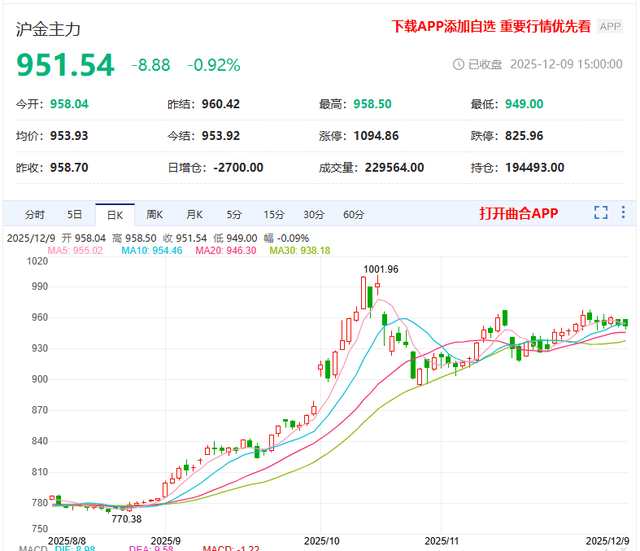
Group 1 - The expectation of interest rate cuts has been largely priced in, leading to cautious behavior among gold bulls before the decision [1] - Current gold prices are fluctuating within a key range of $4180 to $4250, with $4180 to $4200 acting as a critical support level and $4250 to $4260 as a solid resistance level [1] - UBS predicts that the expectation of interest rate cuts could drive gold prices to $4500 per ounce next year [1] Group 2 - Bank of America forecasts that gold prices could reach as high as $5000 per ounce next year, representing an approximate 19% increase from current levels [2] - Crescat Capital's macro strategist Tavi Costa provides an extreme long-term prediction, suggesting that under the backdrop of global de-dollarization and debt expansion, gold prices could be revalued to between $25,000 and $50,000 [2] Group 3 - GF Futures notes that the U.S. economy and job market are continuously impacted by government shutdowns and trade frictions, while the Federal Reserve's internal divisions and hawkish signals increase short-term policy uncertainty [4] - The frequency of geopolitical risks and financial institution failures is prompting more central banks to increase gold holdings, which may drive a similar bull market for precious metals as seen in the 1970s [4] - The market liquidity is affected by the timing of the U.S. government's end to the shutdown and statements from Federal Reserve officials, which may intensify price correction pressures, although buying strength remains [4]
特朗普法案逼走外资,美债抛售潮恐加速!
Jin Shi Shu Ju· 2025-06-30 13:32
Core Viewpoint - Foreign investors are diversifying their portfolios and reducing their holdings of U.S. Treasury bonds due to concerns over rising deficits and inflationary tariffs, which are diminishing the attractiveness of U.S. debt [2][4]. Group 1: U.S. Treasury Bonds and Foreign Investment - The U.S. national debt has quadrupled to approximately $36 trillion in less than a decade, with public holdings around $29 trillion [3]. - In April, foreign capital saw a net outflow of $14.2 billion from U.S. Treasury bonds and the banking system, influenced by Trump's tariff policies [2][3]. - Japan is the largest foreign holder of U.S. debt at $1.13 trillion, followed by the UK at $807.7 billion and China at $757.2 billion [3]. Group 2: Impact of U.S. Fiscal Policy - The Congressional Budget Office estimates that Trump's tax cuts and spending measures will increase U.S. debt by $3.3 trillion, leading to a downgrade in the U.S. credit rating by Moody's [2]. - The Senate is expected to pass a bill that may save $500 billion by using alternative calculations that do not account for the extension of the 2017 tax cuts [4]. Group 3: Shift to European and Other Markets - European bonds, particularly German and French debt, are becoming more attractive to investors as U.S. deficits expand, with Germany maintaining a debt-to-GDP ratio below 100% [4]. - The market for German bonds is expected to strengthen, creating better opportunities for equity markets and increasing the issuance of risk-free German and pan-European bonds [4]. Group 4: Long-term Trends in Investment Behavior - Foreign investors are reducing their U.S. Treasury holdings as part of a long-term structural trend towards diversification rather than a sudden withdrawal [5]. - Concerns over U.S. risk premiums are anticipated to lead to a steepening of the U.S. Treasury yield curve, as investors demand higher returns for holding U.S. debt [6].