储备资产多元化

Search documents
超越欧元,黄金何以跃升全球第二大储备资产?
Sou Hu Cai Jing· 2026-02-12 03:16
Group 1 - The international gold market experienced significant volatility entering 2026, with spot gold prices reaching a historic high of $5,598.75 per ounce, although prices later corrected but remained elevated [1] - Gold has surpassed the euro to become the world's second-largest official reserve asset, driven by increasing geopolitical risks, rising sovereign debt pressures, and weakening trust in traditional safe-haven assets [1] - Central banks have significantly increased gold reserves in response to rising sovereign credit risks, with net purchases exceeding 1,000 tons annually from 2022 to 2024, and reaching 863 tons in 2025 [1] Group 2 - The sovereign credit crisis undermines the foundation of the dollar's reserve status, as the U.S. fiscal deficit continues to grow and national debt reaches new highs, raising concerns about long-term repayment capabilities [2] - The combination of rising domestic debt interest levels and the U.S. government's "America First" policies has led to increased borrowing costs, heightening international investor concerns about U.S. creditworthiness [2] - A notable market phenomenon occurred in April 2025, where U.S. stocks, bonds, and the dollar index all declined simultaneously, indicating a shift in the definition of "safe assets" [2] Group 3 - The Federal Reserve plays a crucial role as the global "lender of last resort," providing liquidity through mechanisms like currency swaps, which is contingent on its independence [3] - The diversification of the international reserve system is accelerating, with non-dollar sovereign currencies gaining traction, and the eurozone's increased defense spending creating new opportunities for the euro [3] - Emerging currencies like the renminbi are expanding their roles in cross-border trade settlements and regional financial cooperation, while the rapid development of global digital currencies is reshaping the payment system and reserve currency landscape [3]
美元看空成本飙至历史极值!政治风险溢价重归
Jin Shi Shu Ju· 2026-01-27 11:26
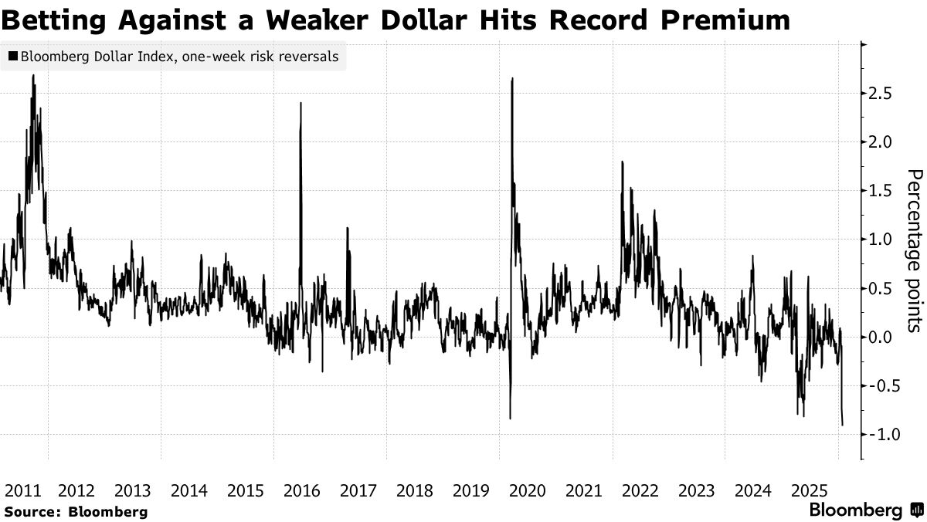
Core Viewpoint - The article highlights a significant bearish sentiment towards the US dollar, driven by political uncertainties and resulting in record-high costs for dollar bearish hedging tools. Investors are increasingly pessimistic about the dollar's long-term prospects, marking the lowest sentiment since May 2025 [1][4]. Group 1: Market Sentiment and Trends - Investors are heavily betting against the dollar, with short-term option premiums reaching the highest level since Bloomberg began tracking this data in 2011 [1]. - The Bloomberg Dollar Spot Index experienced a slight increase, but the previous three trading days saw the largest drop since April of last year, indicating a potential decline to a four-year low if the trend continues [4]. - The dollar is currently underperforming among the G10 currencies, reflecting a shift in investor perception towards this traditional safe-haven asset [4]. Group 2: Economic Factors Influencing the Dollar - Multiple pressures are affecting the dollar, including concerns over high US fiscal deficits, sanction risks, trade tensions, and a global trend of diversifying reserve assets into gold and other commodities [4]. - The recent dollar weakness is not solely sentiment-driven but is accompanied by significant capital flows, with trading volumes reaching historical highs [5]. - A severe one-sided market position is evident, with approximately two-thirds of euro and Australian dollar option trades betting on further dollar weakness [6]. Group 3: Market Volatility and Hedging Costs - Market anxiety is reflected in the soaring volatility of the dollar, which has reached its highest level since September of last year [7]. - The prices of butterfly options, which measure the demand for hedging against extreme price fluctuations, have surged to a seven-month high, indicating that traders are preparing for a potential further decline in the dollar [7]. - Speculation exists that the US government may collaborate with Japanese monetary authorities to stabilize the declining yen, further exacerbating the downward pressure on the dollar [7].

非美央行加速储备多元化有何深意?
Zheng Quan Ri Bao· 2026-01-14 15:40
Core Viewpoint - The global reserve asset landscape is undergoing a significant transformation, with non-U.S. countries' official gold reserves nearing parity with their holdings of U.S. Treasury securities, indicating a shift towards diversification in reserve assets [1][2]. Group 1: Gold Reserves and U.S. Treasury Holdings - As of November 2025, non-U.S. countries' official gold reserves exceeded 900 million troy ounces, valued at approximately $3.82 trillion based on gold prices [1]. - Non-U.S. countries held $3.88 trillion in U.S. Treasury securities as of October 2025, showing a close alignment with gold reserves [1]. - The trend of increasing gold reserves is driven by central banks' sustained and significant purchases, with a net purchase of 1,045 tons in 2024, marking the third consecutive year above 1,000 tons [1]. Group 2: Price Dynamics and Market Sentiment - The price of gold has entered a strong upward cycle, with the London spot gold price increasing over 60% in 2025 and reaching historical highs, including a peak near $4,640 per ounce in January 2026 [2]. - The increase in gold prices and the accumulation of reserves signal a declining risk appetite for dollar-denominated assets, suggesting a shift in global capital preferences [2]. Group 3: Strategic Implications of Gold Accumulation - Expanding gold reserves offers multiple strategic advantages for non-U.S. central banks, including effective hedging against the weakening of dollar credit and enhancing financial security through diversified asset allocation [3]. - Gold's properties as a safe-haven asset help countries withstand geopolitical conflicts and inflationary pressures, contributing to the stable growth of national wealth [3]. - Strengthening gold reserves can enhance the stability and resilience of national financial systems, supporting local currency settlements and aiding in the internationalization of currencies, thereby increasing countries' influence in global financial governance [3].
贵金属价格上涨能否持续
Jing Ji Ri Bao· 2026-01-13 22:04
Group 1: Precious Metals Performance - In 2025, gold prices exhibited a clear upward trend, reaching over $3000 per ounce in Q1 and surpassing $3500 in Q2, with an annual increase of approximately 64% [2] - Silver prices rose significantly, starting from around $29 per ounce at the beginning of the year to over $84 by year-end, resulting in an annual increase exceeding 140% [2] - Platinum prices experienced a dramatic rebound after a slow start, with an annual increase of about 117% driven by demand recovery and supply concerns [3] Group 2: Macro Factors Supporting Precious Metals - Precious metals prices were supported by a nearly 10% decline in the US dollar index and geopolitical tensions, which contributed to rising prices throughout 2025 [4] - The expectation of a weaker dollar and geopolitical risks heightened demand for precious metals, providing new momentum for the market at the end of 2025 [4] Group 3: Central Bank Purchases and Strategic Diversification - Central banks were a dominant force in the gold market, with purchases expected to reach between 900 to 1000 tons in 2025, reflecting a strategic move to diversify reserves and reduce exposure to the US dollar [5] - The increasing focus on gold as a "no-counterparty risk" reserve asset highlights its growing importance among various countries, particularly in Eastern Europe and developing nations [5] Group 4: Silver's Dual Role and Demand Dynamics - Silver's price surge was supported by its dual role as both a monetary metal and an industrial raw material, with significant demand driven by green energy transitions and AI investments [6] - The global silver market faced a notable supply deficit for the fifth consecutive year, with a shortfall estimated between 100 million to 118 million ounces [6] Group 5: Future Market Outlook - Major financial institutions predict that the gold market will continue its structural bull market, with prices expected to remain above current levels due to ongoing central bank purchases and increased safe-haven demand [8] - Predictions for platinum suggest a similar bullish trend, supported by supply shortages and demand from the automotive and hydrogen sectors [8] - The outlook for silver is more cautious, with concerns about increased volatility and potential downward risks despite positive industrial demand and monetary hedging [8]
人民币反击,中国连续14个月增持黄金,抛售5570亿美债
Sou Hu Cai Jing· 2026-01-13 16:39
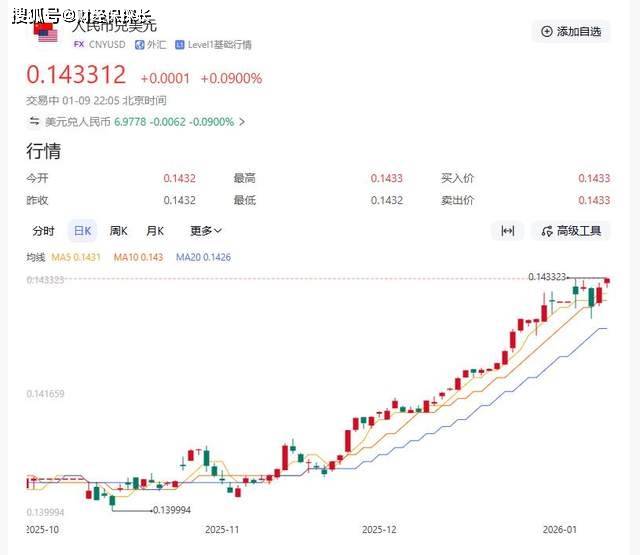
Group 1 - The article highlights a significant shift in global financial markets, with the US dollar index dropping nearly 10% over the past 12 months, while the Chinese yuan has appreciated over 4% [1][15] - Central banks worldwide, excluding the US, have increased their gold reserves to a total value of $3.98 trillion, nearing the $3.8 trillion total value of US Treasury bonds, indicating a structural change in reserve asset allocation from bonds to gold [3][4] - The article emphasizes that gold is regaining its status as a primary financial asset, a position it has not held since 1996, marking a historical turning point in asset allocation [4][5] Group 2 - The People's Bank of China has initiated a new cycle of gold purchases starting in November 2024, with total gold reserves projected to reach 7.415 million ounces (approximately 2306.39 tons) by December 2025, reflecting a strategic move amid a weakening dollar and rising geopolitical risks [8][10] - Over the past 14 months, China has sold approximately $79.9 billion in US Treasury bonds, a planned adjustment rather than a panic sell-off, with proceeds used for gold purchases and diversifying foreign exchange reserves [12][14] - The article discusses a long-term trend of de-dollarization, as evidenced by the significant reduction in China's US Treasury holdings, which have decreased by over 47% from their peak in November 2013 [12][14] Group 3 - The article outlines a strategic framework where increasing gold reserves enhances asset stability and diversity, while reducing reliance on US dollar assets and strengthening the yuan's international appeal [15][17] - The potential future scenarios include the Federal Reserve being forced to accelerate interest rate cuts, further weakening the dollar and increasing gold prices, or the emergence of a new reserve asset system where gold's status continues to rise [18][21] - The article concludes that the strategic adjustments made by China reflect a long-term vision, emphasizing the importance of maintaining reserve assets in the face of increasing global uncertainties [22][23]
3.93万亿美元!30年第一次:反超美债,黄金成全球最大储备资产!释放了什么危险信号?
Sou Hu Cai Jing· 2026-01-10 11:09
Core Viewpoint - A historic shift has occurred as gold has officially surpassed U.S. Treasury bonds to become the largest reserve asset held by global central banks, marking a significant change in the financial landscape [1][2]. Group 1: Historical Context and Current Trends - The total value of gold held by central banks has approached $4 trillion, reaching $3.93 trillion, while U.S. Treasury bonds stand at $3.88 trillion, a situation not seen since 1996 [2][4]. - In 2025, gold prices surged, with an annual increase of nearly 70%, peaking above $4,500 per ounce, prompting central banks to aggressively accumulate gold despite its high price [4][6]. - A survey indicated that 95% of central banks expect to continue increasing their gold reserves in the next 12 months, with 43% planning to add to their holdings, a record high [5]. Group 2: Motivations Behind Central Banks' Actions - A decline in trust towards U.S. dollar assets is a primary reason for this shift, as concerns over the U.S. national debt exceeding $38 trillion and ongoing political instability have raised doubts about the long-term stability of U.S. Treasury bonds [9]. - Geopolitical tensions have created a "fear premium," leading central banks to view gold as a protective asset against global uncertainties, akin to a financial "bulletproof vest" [10]. - The diversification of reserves is becoming essential, with central banks moving towards a mix of assets, including gold, euros, and renminbi, to reduce reliance on dollar-denominated assets [12]. Group 3: Future Outlook - Analysts predict that the structural demand for gold will not cease easily, as many emerging market countries still have gold reserve ratios below 10%, indicating room for growth [14]. - Even if the quantity of gold purchased may decrease from peak levels, the value proportion will likely continue to rise, providing support for gold prices [14]. - The shift towards gold signifies a broader trend of increasing volatility and uncertainty in the global financial landscape, prompting a reevaluation of what constitutes reliable wealth [14][15].
从海外投资者结构变化看美国国债风险|国际
清华金融评论· 2026-01-07 10:10
Core Viewpoint - The article discusses the changing landscape of U.S. Treasury holdings, particularly the decline in the share of U.S. debt held by foreign investors, and emphasizes the need for China to diversify its reserve assets and enhance the internationalization of the renminbi [1]. Group 1: Overview of U.S. Treasury Holdings - The total amount of U.S. Treasury securities has reached a historical peak of $38.11 trillion as of October 30, 2025, an increase of nearly $2 trillion from the end of 2024 [4]. - The ratio of U.S. debt to GDP has remained high, reaching 118.78% by the second quarter of 2025 [4]. - The total holdings of U.S. Treasury securities by various investors have surged from $3.04 trillion in Q1 2000 to $26.84 trillion by Q2 2025 [4]. Group 2: Changes in Foreign Investor Holdings - The share of U.S. Treasury securities held by foreign investors has decreased from a peak of 57.30% in Q4 2008 to approximately 34.08% by Q2 2025 [5]. - Despite the decline in share, the total amount held by foreign investors has increased from $4.91 trillion in September 2011 to $9.16 trillion by July 2025, indicating a robust growth trend [8]. - The structure of foreign holdings is shifting, with a slight increase in short-term debt holdings from 12.93% to 15.43% since September 2011, reflecting a preference for liquidity amid uncertain global interest rates [9]. Group 3: Changes in Holder Composition - The composition of foreign holders has shifted significantly, with private investors increasing their holdings from $1.74 trillion in December 2013 to $5.24 trillion by July 2025, a growth of 201.21% [10]. - The share of private investors has risen from 30% in December 2013 to 57.16% by July 2025, surpassing that of official investors for the first time [10]. - Official foreign investors have reduced their holdings from $4.05 trillion in December 2013 to $3.92 trillion by July 2025, a decline of 3.22% [10]. Group 4: Implications for Reserve Diversification - The decline in U.S. Treasury holdings by official foreign investors may be attributed to a trend towards diversifying foreign exchange reserves, with a shift from U.S. dollar assets to gold [11]. - Global official dollar reserve assets have shown a declining trend since 1999, while gold reserves have increased significantly, indicating a strategic shift in reserve management [11].

无无无无无无无无无无无无无无无无无无无无无无无无无无无无无无无无无无无无无无无无无无无无无无无无无无无无无无无无无无无无无无无无无
Zi Jin Tian Feng Qi Huo· 2025-12-22 09:51
1. Report Industry Investment Rating No information provided. 2. Core Viewpoints of the Report - International events have accelerated the trend towards multi - polarization and increased the demand for reserve asset diversification and safe assets, with gold being the key recipient [3] - The long - term support for gold lies in two macro drivers: hedging against sovereign debt and currency credit risks, and serving as an ultimate currency and value storage tool [3] - The core factors driving up gold prices, such as hedging against debt monetization, responding to de - dollarization, and central banks' increased allocation, show no signs of reversal in the short term. Short - term liquidity shortages may cause a 15% - 25% technical correction in gold prices, but the long - term upward trend remains [3] 3. Summary by Relevant Catalogs Recent Market Review - In 2025, the cumulative increase in gold prices exceeded 60%, outperforming most global risk and fixed - income assets [5] Federal Fiscal Situation - In the 2025 fiscal year, the federal fiscal deficit was $1.8 trillion, a slight reduction of $800 million from 2024. The ratio of federal public debt to GDP is about to exceed 100%, mainly due to the imbalance between fiscal revenue and expenditure [18] - The US debt - reduction experience after World War II is difficult to replicate today as the key conditions, such as significant cuts in fiscal spending, strong post - war economic growth, and a long - term low - interest - rate environment, are absent [18] - The US fiscal expenditure structure is rigid, with mandatory expenditures accounting for over 85% of the total. Reducing social welfare or net interest expenditures is politically difficult and may damage the credit of the US dollar. In the 2025 fiscal year, the net interest expenditure on public debt exceeded $1 trillion for the first time [19][23] - US fiscal deficit expansion is a cross - party and cross - cycle norm. The actual deficit rate is likely to be higher than the CBO's forecast, as different presidents have promoted tax cuts and expenditure expansion policies over the past two decades [27] - In 2026, the average effective tariff rate in the US is expected to be lower than in 2025, which will lead to a decrease in tariff revenue and a greater impact on the fiscal balance [33] - If the Trump administration distributes tariff revenue as dividends, it will increase the deficit by $6 trillion in the next decade. The "Great Beauty Act" will increase the basic deficit by about $3.4 trillion in the next decade, and the additional deficit cannot be covered by tariff revenue [38] - If the IEEPA tariffs are completely abolished, the ratio of US federal public debt to GDP is expected to rise to 127% in the next decade, and may further increase to 138% - 143% if tariff dividends are distributed. This may lead to a sell - off of US Treasuries and an increase in the demand for gold [44] Central Bank Gold Purchases - Despite the nearly 60% increase in gold prices in 2025, official demand remained strong in the first three quarters, with a cumulative purchase of 634 tons. The gold purchase scale in the third quarter ranked among the top three in history [50] - In 2025, the proportion of gold in global central bank reserve assets (foreign exchange + gold) rose to 26%, while the US dollar share decreased from 43% to 39%, indicating a continuous trend of reserve asset diversification [54] - In 2025, global gold ETFs had a net inflow of over 700 tons, reversing the four - year net outflow trend and compensating for the decline in central bank gold purchases [61] Other Gold Demand Factors - The EU plans to use frozen Russian foreign exchange reserves to support Ukraine, which increases the risk of using sovereign currencies as reserve assets and further strengthens the safe - haven property of gold [67] - As of September 30, 2025, Tether's USDT held 104.2 tons of gold reserves, accounting for 7.1% of its total reserve assets. Tether's gold purchase is to enhance the stability of USDT's collateral and diversify its assets [71] Fed's Interest Rate Policy and Gold Prices - The slowdown in the US employment market, such as a decline in non - farm payrolls and an increase in the unemployment rate, provides a basis for the Fed to cut interest rates earlier and more significantly in 2026. Meanwhile, the potential inflation trend remains stable [77] - The expectation of interest rate cuts has led to an inflow of funds into the gold market, driving up the price of gold. Once the labor market shows signs of weakness, the Fed may cut interest rates, opening a new window for capital inflows into the gold market [83] Short - Term Disturbances to Gold Prices - "Liquidity risk" and "liquidity crisis" may be the key variables causing short - term declines in gold prices. However, the Fed's improved crisis - response ability means that the significant decline in the second stage of gold price fluctuations will be reduced [89]
【黄金年报】无估值、无上限
Xin Lang Cai Jing· 2025-12-20 00:33
Group 1 - The core viewpoint of the article emphasizes the increasing demand for gold as a hedge against sovereign debt and currency credit risks, driven by the expansion of U.S. fiscal deficits and the shift towards diversified reserve assets amid geopolitical tensions [3][20][29] - The U.S. federal fiscal deficit for the fiscal year 2025 is projected at $1.8 trillion, with public debt nearing 100% of GDP, marking a significant increase in fiscal pressure [7][19] - The average effective tariff rate in the U.S. is expected to decrease in 2026, which could lead to a reduction in tariff revenue and further exacerbate the fiscal deficit [27][28] Group 2 - Central banks globally have increased their gold reserves from 13% in 2021 to 26% in 2025, while the dollar's share has decreased from 50% to 39%, indicating a trend towards asset diversification [3][41] - Despite a significant rise in gold prices, central banks continue to exhibit a rigid buying behavior, with a net inflow of over 700 tons into gold ETFs in 2025, reversing a four-year trend of net outflows [31][37] - The demand for gold remains strong, with central banks purchasing 634 tons in the first three quarters of 2025, reflecting a robust underlying demand despite price increases [40][41] Group 3 - The U.S. labor market shows signs of weakness, with recent employment data indicating a downward trend, which may influence future Federal Reserve interest rate decisions [4][50] - The Federal Reserve's recent dovish signals and anticipated interest rate cuts are expected to drive further demand for gold as a safe-haven asset [52][55] - The structural changes in the U.S. fiscal landscape, including rising mandatory spending and interest payments, are likely to sustain upward pressure on gold prices as investors seek refuge from inflation and fiscal instability [19][29][26]

中方大手一挥,再抛118亿美债,加拿大动作更大,特朗普开始换人
Sou Hu Cai Jing· 2025-12-19 13:38
Group 1 - The core point of the article highlights a significant shift in capital flows and policy confidence, particularly regarding the reduction of U.S. Treasury holdings by China and Canada, alongside political pressures on the Federal Reserve [1][22][24] - China reduced its U.S. Treasury holdings by $11.8 billion in October, reaching the lowest level since 2008, indicating a long-term strategy to diversify its reserve assets, particularly increasing gold reserves [3][5][7] - Canada's drastic sell-off of $56.7 billion in U.S. Treasuries in October reflects a defensive strategy amid rising external pressures and a reassessment of its reliance on U.S. debt [10][12][14] Group 2 - The adjustments by China and Canada signify a broader trend of questioning the stability and safety of U.S. assets, with China focusing on risk mitigation and Canada expressing a loss of trust in U.S. policies [22][24][26] - Trump's public call to replace the Federal Reserve Chairman to support significant interest rate cuts raises concerns about the independence of U.S. monetary policy, potentially undermining global confidence in the dollar [16][18][20] - The evolving financial landscape suggests a shift from a unipolar dollar system to a more diversified asset allocation strategy among countries, indicating a complex future for global investors [26][27][30]