
先进制程技术

Search documents
科创芯片设计板块领涨市场,科创芯片设计ETF易方达(589030)冲高涨超6%,重要部门发声:加快突破训练芯片、异构算力等关键技术
Xin Lang Cai Jing· 2026-01-21 04:59
Group 1 - The Shanghai Stock Exchange Sci-Tech Innovation Board Chip Design Theme Index (950162) surged by 5.48%, with the E Fund Chip Design ETF (589030) rising over 6% at one point, indicating active market trading [1] - The State Council held a press conference discussing the achievements in industrial and information technology development by 2025, emphasizing the focus on technological innovation and key technology breakthroughs in areas like training chips and heterogeneous computing [1] - AI computing power demand is continuously surging, driving the acceleration of advanced process technology iterations, with TSMC projecting record high revenue in Q4 2025, where advanced processes (7nm and below) will account for 77% of revenue, with 3nm process shipments reaching 28% [1] Group 2 - TSMC has raised its compound annual growth rate (CAGR) forecast for AI accelerator revenue to nearly mid-high 50% for 2024-2029, significantly above the company's overall long-term revenue growth target of 25% [2] - The substantial increase in capital expenditure to $52-56 billion in 2026 reflects the strong global demand for AI computing power, indicating a sustained positive outlook for the data center industry chain [2] - The E Fund Chip Design ETF closely tracks the Shanghai Stock Exchange Sci-Tech Innovation Board Chip Design Theme Index, which selects listed companies in the chip design sector to reflect the overall performance of this field [2]

台积电(TSM):2025Q4 业绩点评及法说会纪要:25Q4利润创历史新高,大幅提高资本开支预算加速产能扩张
Huachuang Securities· 2026-01-16 13:35
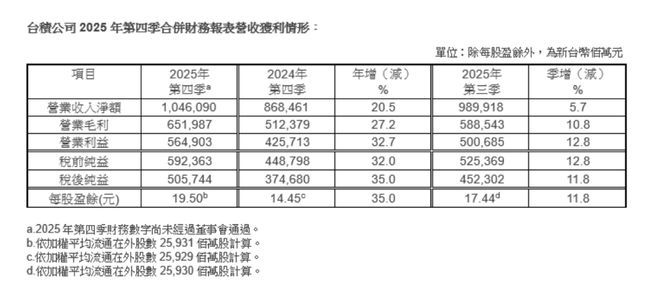
Investment Rating - The report assigns a strong buy rating for TSMC, expecting it to outperform the benchmark index by over 20% in the next six months [50]. Core Insights - TSMC's Q4 2025 revenue reached NT$1,046.09 billion (US$33.73 billion), a year-over-year increase of 25.5% and a quarter-over-quarter increase of 1.9%, exceeding the upper guidance range [8][10]. - The gross margin for Q4 2025 improved to 62.3%, up from 59.5% in the previous quarter, driven by cost improvements and higher capacity utilization [2][8]. - The company plans to significantly increase capital expenditures, with a projected budget of US$52 billion to US$56 billion for 2026, focusing on advanced technology and long-term capacity expansion [4][22]. Summary by Sections 1. TSMC Q4 2025 Operational Performance - Revenue: Q4 2025 revenue was NT$1,046.09 billion (US$33.73 billion), up 25.5% YoY and 1.9% QoQ, supported by strong demand for leading technology [8][10]. - Gross Margin: Achieved a gross margin of 62.3%, higher than the guidance range, due to cost improvements and favorable exchange rates [8][10]. - Net Profit: The net profit attributable to shareholders was NT$505.74 billion, reflecting a 35.0% YoY increase [8][10]. 2. Revenue Breakdown - By Platform: In Q4 2025, mobile accounted for 32% of revenue, HPC 55%, IoT 5%, automotive 5%, and digital consumer electronics 1% [14]. - By Process Technology: Revenue from 3nm process technology constituted 28%, while 5nm accounted for 35% [18]. 3. TSMC Q1 2026 Guidance - Revenue Guidance: TSMC expects Q1 2026 revenue to be between US$34.6 billion and US$35.8 billion, representing a YoY growth of approximately 38% [5][22]. - Gross Margin Guidance: Expected gross margin for Q1 2026 is between 63% and 65% [5][22]. 4. Capital Expenditure - Q4 2025 capital expenditure was approximately US$11.51 billion, with a total capital expenditure for 2025 increasing to US$40.9 billion from US$29.8 billion in 2024 [4][12]. - The capital budget for 2026 is projected to be between US$52 billion and US$56 billion, with a significant portion allocated to advanced technology [4][22]. 5. Global Manufacturing Layout - TSMC is accelerating capacity expansion in Arizona, with plans for multiple fabs to meet strong AI demand [11][15]. - The company is also expanding its manufacturing capabilities in Japan and Europe, supported by local government initiatives [15].
台积电今年资本支出飙新高 预期520-560亿美元
Jing Ji Ri Bao· 2026-01-15 23:36
Core Viewpoint - TSMC's expected capital expenditure for the year is projected to reach a record high of $52-56 billion, significantly exceeding previous estimates of $45-50 billion, indicating strong demand and growth potential in the semiconductor industry [1][2] Group 1: Capital Expenditure - TSMC's capital expenditure for 2024 is estimated at $29.8 billion, with $40.9 billion for 2025, and a forecast of $52-56 billion for 2026, representing an annual increase of approximately 27-36.9% [1] - Approximately 70-80% of this year's capital expenditure will be allocated to advanced process technology, with around 10% for special process technology, and another 10-20% for advanced packaging, testing, photomask production, and other projects [1] Group 2: Customer Support and Growth - TSMC emphasizes its primary responsibility is to support customer growth, having invested $167 billion in capital expenditures and $30 billion in R&D over the past five years [2] - The company plans to continue investing in cutting-edge, special, and advanced packaging technologies to ensure sustainable returns and support customer growth [2] Group 3: Cost Challenges - The rising costs associated with advanced processes and manufacturing complexities present challenges, with equipment costs becoming more expensive and the capital expenditure for the 2nm process significantly higher than for the 3nm process [2] - Additional cost challenges arise from global manufacturing footprint expansion, new investments in special process technologies, and inflationary pressures [2]
AI芯片需求持续火热
Xin Lang Cai Jing· 2026-01-15 05:57
Core Viewpoint - TSMC achieved strong performance growth in Q4 2025, with a net profit after tax increasing by 35% to NT$505.74 billion, driven by sustained demand for advanced process technologies [1] Financial Performance - TSMC's consolidated revenue for Q4 reached NT$1.05 trillion, a year-on-year increase of 20.5%, with earnings per share rising to NT$19.50 [1][3] - In USD terms, the quarterly revenue was $33.73 billion, reflecting a 25.5% year-on-year growth and a 1.9% quarter-on-quarter increase [1] - The company's gross margin climbed to 62.3%, and operating margin reached 54.0%, both at historical high levels [1] Capital Expenditure - TSMC's total capital expenditure for 2025 amounted to $40.9 billion [1] Advanced Process Technology - Advanced process technologies (including 7nm and more advanced nodes) have become the main revenue pillar for TSMC, accounting for 77% of total wafer sales for the quarter [4] - The share of the cutting-edge 3nm process shipments increased to 28%, indicating key customers are accelerating the transition to the latest technology nodes [4] - The 5nm process remains the largest single contributor, accounting for 35% of total sales, while the 7nm process holds a 14% share [4]

交银国际:维持中芯国际(00981)“买入”评级 收购中芯北方或增厚母公司利润
智通财经网· 2026-01-06 02:17
Group 1 - The core viewpoint of the report is that China International Capital Corporation maintains a "buy" rating for SMIC (00981) and raises the target price to HKD 93.0, following the announcement of a plan to acquire 49% of Northern SMIC for CNY 40.6 billion, which will make it a wholly-owned subsidiary [1] - The acquisition is expected to enhance the company's EPS and net profit, with the diluted EPS forecasted to increase from CNY 0.49 to CNY 0.55 for the period of January to August 2025, and from CNY 0.46 to CNY 0.53 for 2024 [1] - The total equity attributable to shareholders is projected to rise from approximately CNY 1,482 billion before the transaction to about CNY 1,682 billion after [1] Group 2 - The report indicates that Northern SMIC primarily engages in 12-inch wafer foundry services, which are highly profitable, and the acquisition is expected to increase SMIC's net profit by over USD 120 million in 2026, positively impacting EPS and BVPS [2] - SMIC plans to invest approximately USD 77.8 billion into Southern SMIC, with about USD 36.6 billion coming from SMIC, increasing its ownership from approximately 38.5% to 41.6% [3] - The capital increase will raise Southern SMIC's registered capital from USD 6.5 billion to USD 10.08 billion, and the net profit for Southern SMIC is estimated to be around CNY 3.67 billion and CNY 3.93 billion for the fiscal years 2023 and 2024, respectively [3]

美股异动|台积电涨超3%,再创历史新高,市值达1.7万亿美元
Ge Long Hui· 2026-01-05 14:39
Core Viewpoint - TSMC's stock surged 3.4% to $330 per share, reaching a historic high with a market capitalization of $1.7 trillion, driven by advancements in its 2nm process technology [1] Group 1: Company Developments - TSMC's official website indicates that the 2nm process technology began mass production as scheduled in Q4 of last year, representing the most advanced technology in the semiconductor field in terms of transistor density and energy efficiency, significantly enhancing chip performance [1] - Initial production capacity for TSMC's 2nm advanced process is approximately 35,000 wafers per month, with expectations to increase to 140,000 wafers per month by the end of this year, surpassing previous market estimates of 100,000 wafers per month [1]
台积电高管:中国大陆客户可获全球先进制程支持
Guan Cha Zhe Wang· 2025-12-26 07:28
Core Viewpoint - TSMC's China head clarified that mainland Chinese customers can access advanced manufacturing processes globally, not limited to the Nanjing facility [1] Group 1: TSMC's Operations and Capacity - TSMC's Nanjing plant currently produces approximately 20,000 wafers of 16/12nm and 40,000 wafers of 28/22nm monthly, accounting for about 3% of TSMC's overall capacity [2] - The Nanjing facility primarily serves special demands such as automotive chips [2] Group 2: Regulatory and Market Clarifications - TSMC's capacity allocation is based on customer technology requirements, product positioning, and compliance considerations, rather than the customer's location or a single wafer fab [1] - TSMC is actively working to resolve issues related to the VEU (Vendor Eligibility for Use) qualification, aiming to meet regulatory requirements and fulfill customer commitments [1] - The U.S. announced the termination of TSMC's Nanjing plant's VEU qualification effective September 2025, transitioning to a case-by-case application process [1]

英特尔(INTC.US)开盘跌近3% 传英伟达暂停测试其18A制程工艺
Zhi Tong Cai Jing· 2025-12-24 14:50
Core Viewpoint - Intel's stock opened down nearly 3% at $35.53 following reports that Nvidia, the "AI chip leader," has paused testing of Intel's 18A advanced process technology for manufacturing one of its AI chips [1] Group 1: Intel's 18A Process Technology - Intel's 18A process, equivalent to 1.8nm technology, is a significant milestone in its advanced process roadmap aimed at enhancing chip performance and efficiency through the use of RibbonFET transistor structure and PowerVia back power delivery technology [1] - The 18A process is not only intended for Intel's own CPU product line but is also seen as a critical technology node to attract customers for its foundry business [1]


美股异动 | 英特尔(INTC.US)开盘跌近3% 传英伟达暂停测试其18A制程工艺
智通财经网· 2025-12-24 14:48
Core Viewpoint - Intel's stock opened nearly 3% lower at $35.53 following news that Nvidia has paused testing of Intel's 18A advanced process technology for manufacturing an AI chip, which is a significant setback for Intel's advanced manufacturing roadmap [1] Group 1: Intel's 18A Process Technology - The 18A process, equivalent to 1.8 nm technology, is a crucial milestone in Intel's advanced manufacturing roadmap aimed at enhancing chip performance and efficiency through the use of RibbonFET transistor structure and PowerVia back power delivery technology [1] - The 18A process is not only intended for Intel's own CPU series but is also seen as a key technology node to attract customers for its foundry business [1] Group 2: Market Reaction - Following the news, Intel's stock price dropped nearly 3%, indicating market concerns regarding the company's competitive position in the semiconductor industry [1]
员工跳槽引发激烈对峙:台积电称已泄密,英特尔回击
Di Yi Cai Jing· 2025-11-27 04:16
Core Viewpoint - The semiconductor industry is currently facing a significant controversy involving Intel and TSMC, centered around allegations of trade secret theft related to advanced manufacturing processes [1][2]. Group 1: Legal Dispute - TSMC has filed a lawsuit against former senior vice president Luo Wei-ren, accusing him of violating confidentiality agreements and transferring proprietary information about 2nm technology to Intel [1]. - Intel has responded by asserting that it has strict policies in place to prevent the use or transfer of third-party confidential information, labeling TSMC's claims as unfounded rumors [2]. Group 2: Technological Developments - Intel's 18A process technology, which utilizes RibbonFET transistors and PowerVia technology, has commenced mass production in Arizona, achieving a 30% increase in transistor density and a 15% performance improvement at the same energy consumption compared to the previous generation [2]. - The differences between Intel's and TSMC's process technologies are highlighted, with Intel being an early adopter of High-NA EUV technology, which TSMC has not yet implemented [2]. Group 3: Market Dynamics - The global pure wafer foundry industry is projected to see a 33% year-on-year revenue growth in Q2 2025, driven primarily by the application of advanced processes in AI GPU sectors [3]. - Intel's ability to enhance the yield of its 18A process to commercial levels within the next 1-2 years is critical, as failure to do so may result in losing its competitive edge in the high-end foundry market to TSMC and Samsung [3].