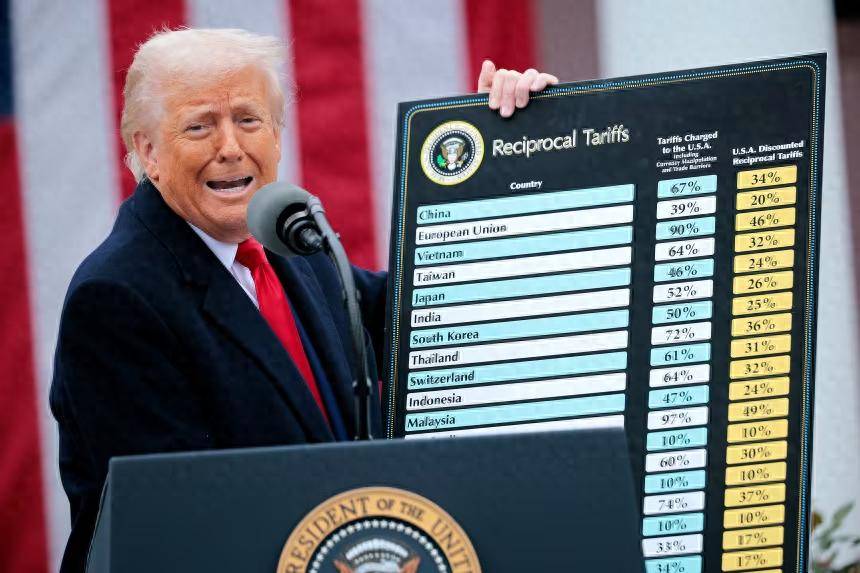
关税退税

Search documents
美国海关:关税退税系统建设已完成40%至80%
第一财经· 2026-03-13 00:10
Core Viewpoint - The U.S. Customs and Border Protection (CBP) has reported that the system for refunding approximately $166 billion in illegally collected tariffs and interest is 40% to 80% complete [1] Group 1 - CBP is developing an online claims portal for importers and intermediaries to submit refund requests, expected to launch by mid-April [1] - The U.S. Supreme Court rejected most of the Trump administration's tariff policies in February but did not provide specific guidance on the refund process [1]


铝:偏强运行,氧化铝:区间震荡,铸造铝合金:跟随电解铝
Guo Tai Jun An Qi Huo· 2026-03-03 02:57
Report Industry Investment Rating - Aluminum: Bullish operation [1] - Alumina: Range-bound oscillation [1] - Cast aluminum alloy: Follow electrolytic aluminum [1] Core Viewpoints - The report updates the fundamental data of aluminum, alumina, and cast aluminum alloy, including futures and spot market prices, trading volumes, positions, spreads, and inventory levels [1] - It also mentions external events such as the 175 - billion - dollar tax - refund battle in the US and the potential impact of the blockade of the Strait of Hormuz on the global energy market [2] Summary by Related Catalogs Futures Market - **Aluminum**: The closing price of the Shanghai aluminum main contract is 24,465, up 630 from T - 1. The trading volume is 483,091, and the position is 277,833. LME aluminum 3M closing price is 3,185. The LME注销仓单占比 is 9.21% [1] - **Alumina**: The closing price of the Shanghai alumina main contract is 2,773, up 29 from T - 1. The trading volume is 365,789, and the position is 344,019 [1] - **Aluminum alloy**: The closing price of the aluminum alloy main contract is 23,180, up 450 from T - 1. The trading volume is 14,947, and the position is 6,875 [1] Spot Market - **Electrolytic aluminum**: The domestic aluminum ingot social inventory is 124.60 million tons, up 7.10 million tons from T - 1. The electrolytic aluminum enterprise profit and loss is 7,415.24 [1] - **Alumina**: The domestic average alumina price is 2,663. The alumina Lianyungang CIF price is 330 US dollars/ton [1] - **Aluminum alloy**: The ADC12 theoretical profit is 709. The three - place inventory total is 39,336 [1] External Events - The US Federal Appellate Court rejected the Trump administration's request for a tariff - refund extension. The Trump administration faces over 2,000 tariff cases [2] - JPMorgan warns that if the Strait of Hormuz is blocked, the storage limit may lead to a full - scale shutdown of Middle - East crude oil production, and the global energy market is approaching the physical supply - cut - off critical point [2] Trend Intensity - Aluminum trend intensity: 1; Alumina trend intensity: 0; Aluminum alloy trend intensity: 1 [2]
特朗普关税,中国要得回来吗?
财富FORTUNE· 2026-02-27 13:07
Core Viewpoint - The recent U.S. Supreme Court ruling declared that the global tariffs imposed by Trump under "emergency powers" were illegal, raising significant questions for governments and companies regarding the validity of previously negotiated tariff agreements and the possibility of reclaiming paid tariffs [1][3]. Group 1: Legal and Financial Implications - Over 900 U.S. companies have filed lawsuits seeking refunds for tariffs paid, with expected total claims exceeding $130 billion [3]. - The U.S. government collected approximately $175 billion in IEEPA tariffs over the past year, which constituted about half of its total tariff revenue during that period [4]. - The likelihood of the government returning the full amount of collected tariffs is considered low due to the substantial financial burden it would impose [4]. Group 2: Chinese Companies' Involvement - Chinese companies can potentially join the refund claims through various avenues, with 20% of U.S. imports from China being registered as eligible for refunds [3][6]. - There are three scenarios where Chinese exporters could claim refunds: sharing refunds with U.S. importers, using DDP (Delivered Duty Paid) shipping terms, or having U.S. branches that can apply for refunds [6][8]. - The trend of Chinese companies registering as U.S. importers has increased significantly, from 9% to 20% of trade volume by the end of the year [8]. Group 3: Impact on U.S.-China Trade Relations - The Supreme Court ruling has enhanced China's negotiating position in trade discussions with the U.S., especially with Trump's upcoming visit to China [10]. - The ruling resulted in a 7.1% decrease in the trade-weighted average tariff on China, while some countries with prior agreements may face increased tariffs [11]. - Despite the short-term reduction in tariffs, long-term uncertainties remain as Trump indicated intentions to continue imposing tariffs through other legal frameworks [11][12]. Group 4: Future Tariff Strategies - Trump may utilize Section 232 and Section 301 tariffs, which do not require congressional approval, to impose new tariffs on various sectors, including electric batteries and telecommunications [12][13]. - The White House has indicated plans to investigate and potentially impose new tariffs on industries related to intellectual property theft and market distortions [14]. - The Supreme Court ruling has created structural constraints that may hinder the rapid imposition of new tariffs, suggesting a temporary period of stability for Chinese exporters [14].

联邦快递起诉美政府要求全额退还关税
Xin Hua Wang· 2026-02-24 10:43
Group 1 - FedEx has filed a lawsuit against the U.S. Customs and Border Protection and the U.S. government for a full refund of import duties imposed under the International Emergency Economic Powers Act [2] - The lawsuit follows a Supreme Court ruling that overturned the President's authority to impose large-scale tariffs under the International Emergency Economic Powers Act [4] - Over 1,000 companies, including major firms like Costco and Reebok, have joined the legal action seeking refunds for duties paid [4] Group 2 - FedEx executives have indicated that the government's tariff policy is expected to impact the company's earnings by $1 billion in fiscal year 2026 [4] - The Supreme Court's ruling could lead to a total refund amount of $175 billion for affected companies, as estimated by the Wharton School's budget model [4]

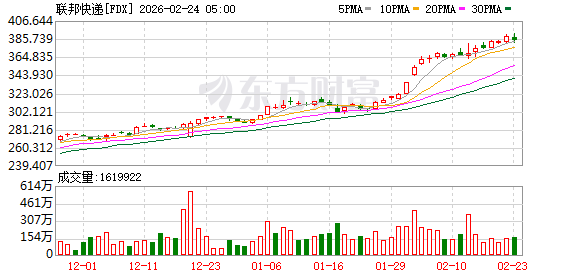
【环球财经】联邦快递起诉美国联邦政府要求退还关税
Xin Hua Cai Jing· 2026-02-24 06:33
Core Viewpoint - FedEx and its subsidiary FedEx Logistics Inc. have filed a lawsuit against the U.S. Customs and Border Protection (CBP) and the U.S. government for a full refund of import duties paid under the International Emergency Economic Powers Act, following a recent Supreme Court ruling that overturned the imposition of these tariffs [2][3]. Group 1 - FedEx seeks a full refund of the duties paid under the International Emergency Economic Powers Act, as the Supreme Court ruled that the President did not have the authority to impose large-scale tariffs [2][3]. - The lawsuit was filed in the U.S. International Trade Court, which has jurisdiction over judicial challenges to these tariffs and can issue relief measures [2]. - Over 1,000 companies, including major firms like Costco and Reebok, have joined the legal action to demand refunds of the duties paid [3]. Group 2 - FedEx executives have indicated that trade fluctuations are expected to impact the company's performance by $1 billion in fiscal year 2026, starting June 1, 2025 [3]. - The U.S. International Trade Court has issued an administrative order to pause the proceedings of all cases related to the International Emergency Economic Powers Act tariffs that have not yet been assigned a judge, pending further decisions after the Supreme Court's final ruling [3]. - The Supreme Court's ruling is estimated to involve a total refund amount of $175 billion related to the tariffs imposed under the International Emergency Economic Powers Act [3].
美拟以国家安全为由推出新关税!超1000家企业起诉美国政府要求“退税”
Mei Ri Jing Ji Xin Wen· 2026-02-24 01:53
Group 1 - The U.S. government is considering imposing new tariffs on approximately six industries, citing "national security" as the reason. The proposed tariffs may include large batteries, cast iron and iron fittings, plastic pipes, industrial chemicals, and equipment for electric grids and telecommunications [1] - The U.S. Supreme Court recently ruled that the International Emergency Economic Powers Act (IEEPA) does not authorize the President to impose large-scale tariffs, leading to the termination of previously enacted tariffs under this act [1][4] - Over 1,000 companies, including major firms like Costco and Reebok, have joined legal actions seeking refunds for tariffs already paid [2] Group 2 - U.S. Treasury Secretary Scott Bencet emphasized that the Supreme Court's ruling did not address the refund process for the tariffs, which will be determined by lower courts [7][8] - The potential refund amount is estimated to be around $134 billion, with some models suggesting it could exceed $175 billion when considering future adjustments [11][12] - The refund process is expected to involve a combination of court actions, customs, and administrative departments, with companies filing lawsuits to secure their claims within specific timeframes [12][13] Group 3 - The situation surrounding the IEEPA tariffs represents a significant legal and financial tug-of-war between businesses and the U.S. Treasury, with political implications as the Trump administration seeks to maintain a strong stance despite legal setbacks [16]
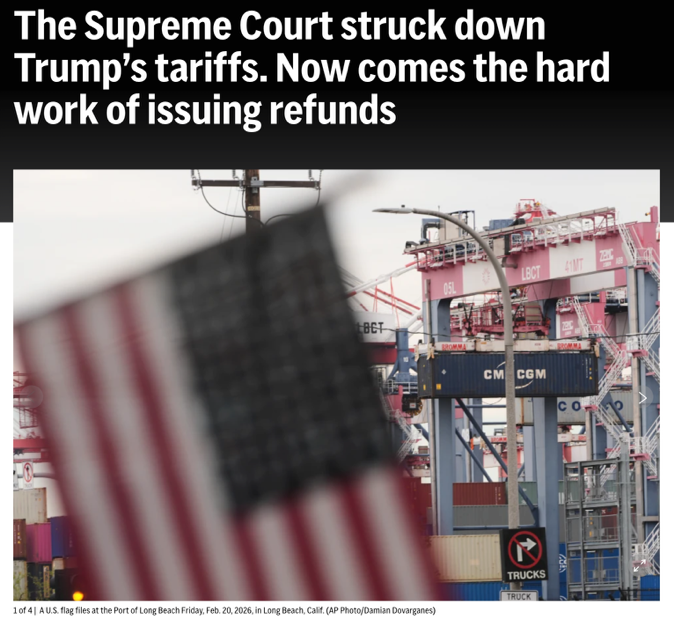
全球运输巨头联邦快递向美国政府提起诉讼要求全额退税!引发热议!
Sou Hu Cai Jing· 2026-02-24 01:09
Core Viewpoint - FedEx Corporation has filed a lawsuit against the U.S. government seeking a full refund of the payments made due to tariffs imposed unilaterally by former President Donald Trump last year [2] Group 1 - The lawsuit aims to recover funds that the company believes were unjustly paid as a result of the tariffs [2] - The tariffs in question were implemented without the company's consent, highlighting concerns over unilateral trade actions [2]

美国两党都支持!“关税退税”变“全民发钱”?
Hua Er Jie Jian Wen· 2026-02-24 01:05
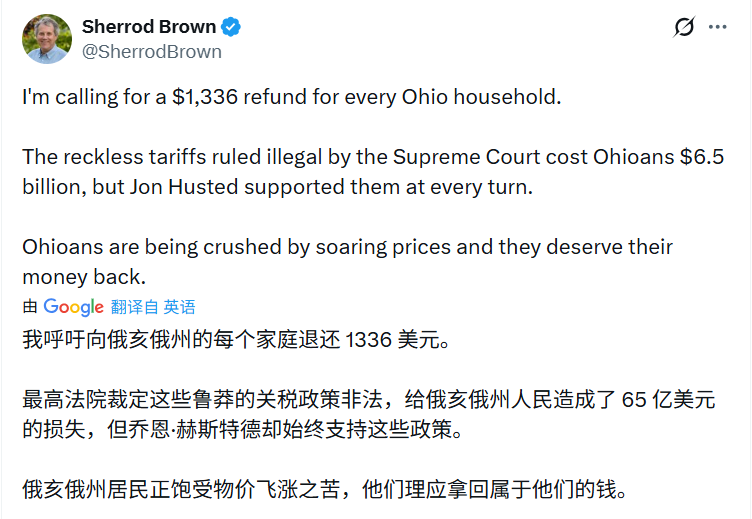
Core Viewpoint - The Democratic Party is advocating for the full refund of tariffs collected after a Supreme Court ruling, aligning with former President Trump's earlier proposal for tariff "dividend" checks to American families [1][5]. Group 1: Political Responses - Prominent Democrats, including Senators Elizabeth Warren and Sherrod Brown, are calling for the refund of approximately $175 billion in tariffs, citing inflation as a key issue and blaming Republicans for the situation [1][2]. - Brown specifically mentioned a proposed refund of $1,336 per household in Ohio, while California and Illinois governors suggested refunds of $1,700 or more [1][4]. - The Senate Democratic leadership has introduced legislation to mandate the refund, although it lacks enforcement mechanisms for businesses to pass the refunds to consumers [1][2]. Group 2: Trump's Position - Trump has initiated a new 15% global tariff to replace the overturned tariffs and indicated that refunds could be delayed for years due to legal processes [1][6]. - Despite his complex stance, Trump previously promoted the idea of distributing $2,000 "dividend" checks to low- and middle-income families, although this proposal received a lukewarm response from Republican leaders [5][6]. Group 3: Legislative Challenges - The tariff issue is expected to play a significant role in key Senate races in battleground states like Ohio, Maine, Alaska, and Iowa, with substantial campaign spending anticipated [2]. - Republican Senator Jon Husted has faced criticism for supporting tariffs, while his opponent, Bernie Moreno, argues that Democrats historically supported tariffs as a working-class party [3]. - The likelihood of Congress taking action on refunds appears low, as indicated by House Ways and Means Committee Chairman Jason Smith, amidst concerns over the federal budget deficit nearing $20 trillion [7].
美国国内各方围绕关税角力仍将持续
Qi Huo Ri Bao· 2026-02-23 23:18
Group 1 - The U.S. Supreme Court ruled that the International Emergency Economic Powers Act does not authorize the president to impose large-scale tariffs, yet the Trump administration continues to pursue other methods to increase tariffs [1] - The ongoing debate over tariffs involves both political parties, the government, and businesses, indicating that negotiations will persist [1] - The House Speaker Mike Johnson stated that Congress and the federal government will decide on the "best way forward" in the coming weeks [1] Group 2 - Recent studies indicate that the tariffs imposed are primarily borne by U.S. businesses and consumers, contradicting the government's claim that foreign exporters bear the cost [1] - The potential refund amount related to the Supreme Court's tariff ruling is estimated at $175 billion, leading to prolonged disputes between U.S. importers and the government over refunds [1] - Over 1,000 companies, including major firms like Costco and Reebok, have joined legal actions seeking refunds for tariffs already paid [2]
关税大王输了官司,特朗普会退款吗?中国可拿回1000亿美元
Sou Hu Cai Jing· 2026-02-22 04:35
Group 1 - The U.S. Supreme Court ruled that the tariffs imposed by Trump under the International Emergency Economic Powers Act were illegal, with a vote of 6 to 3, indicating that even justices appointed by Trump believed he overstepped his authority [1] - The ruling does not clarify whether the collected tariff amounts will be refunded, leaving the actual refund process complex and uncertain [1][4] - Trump is unlikely to initiate refunds as it would require him to admit wrongdoing, which could damage his political brand [1][6] Group 2 - The total tariffs collected by Trump exceed $175 billion, representing a significant portion of U.S. tariff revenue, and refunding this amount could severely impact the U.S. fiscal situation [1][4] - Chinese companies could theoretically reclaim a substantial amount of tariffs, estimated between $100 billion and $180 billion, but the actual refund process will be lengthy and complicated [4][8] - The refund process requires companies to file lawsuits, and even with a court ruling, the execution of refunds may take years, making it a prolonged battle for businesses [4][8] Group 3 - Trump announced new tariffs of 10% on global imports under the Trade Act of 1974, indicating a continuation of his aggressive trade policies despite the Supreme Court ruling [6][8] - The political landscape is divided, with critics viewing the ruling as a victory for justice, while supporters see it as an infringement on presidential power [8] - The complexities of the refund process highlight the internal contradictions within the U.S. system regarding presidential authority, fiscal pressures, and political intentions [8]