化工产品涨价

Search documents
巴斯夫一个月内第五次涨价,化学原料板块盘中拉升
2 1 Shi Ji Jing Ji Bao Dao· 2026-03-27 02:17
Group 1 - BASF announced price increases for its basic amine product portfolio in Europe, with increases up to 30%, effective immediately [1][3] - This marks the fifth price increase announcement from BASF since the onset of the conflict in the Middle East [2] - The price hikes are a response to rising raw material, energy, and logistics costs due to the military conflict [3] Group 2 - Other chemical companies, such as Lanxess and Dow Chemical, are also raising prices significantly, with increases up to 50% and doubling previous price hikes for polyethylene, respectively [4] - The chemical industry is facing ongoing price pressures due to uncertainties in oil and gas supply, which are expected to persist [4] - Domestic supply remains stable, providing opportunities for order transfers and improved market share for certain products, particularly in the pharmaceutical and pesticide sectors [4]



医药行业专题研究:原料药及耗材迎来提价契机,行业景气度有望回升
SINOLINK SECURITIES· 2026-03-23 13:18
Investment Rating - The report suggests a focus on the pharmaceutical raw materials and medical consumables sectors, particularly highlighting the potential for price increases in raw materials due to rising costs in the chemical industry and the supply chain advantages of leading companies in the medical nitrile gloves market [6][22]. Core Insights - The pharmaceutical raw materials sector is expected to see price increases driven by rising costs of upstream raw materials, with downstream products likely to benefit from improved profit elasticity as customer inventory levels remain low [2][19]. - The medical consumables sector, particularly the nitrile gloves market, is characterized by high barriers to entry and stable supply dynamics, with potential for price recovery as raw material costs rise and supply-demand conditions improve [3][4][48]. Summary by Sections Pharmaceutical Raw Materials - The chemical products have seen significant price increases due to rising international oil prices and high overseas energy costs, which are expected to drive up costs in downstream industries such as pharmaceutical intermediates and raw materials [2][12]. - The supply side has experienced pressure due to concentrated capacity expansion from 2020 to 2022, leading to a gradual transmission of cost pressures downstream [14][15]. - Demand-side factors indicate that customer inventory levels have been low for an extended period, suggesting that any price increases will likely be sustainable [19][22]. Medical Consumables - The nitrile gloves market is dominated by production in China and Malaysia, with significant barriers to entry due to the need for long-term investment in production capabilities and technology [3][4]. - The price of medical nitrile gloves is currently at historical lows, but is expected to rise due to geopolitical tensions affecting raw material prices and improving supply-demand dynamics [3][4][48]. - Leading companies in this sector are extending their operations upstream into nitrile latex production, which enhances their supply chain advantages and cost control capabilities [4][61]. - The report highlights that the global demand for disposable gloves is expected to stabilize and grow, driven by increased health awareness and regulatory standards in the medical industry [63].
化工板块的三层涨价逻辑
雪球· 2026-03-19 07:45
Core Viewpoint - The article discusses the recent price increases in the chemical industry, driven primarily by rising oil prices and market dynamics, indicating a shift from a focus on reducing competition to a focus on price increases [3][4]. Group 1: Price Increase Dynamics - The first layer of price increase is attributed to rising oil prices due to escalating conflicts in the Middle East, which has led to a surge in the prices of basic raw materials in the chemical industry [5][6]. - A significant number of chemical products have seen price increases, with 223 out of 380 tracked products experiencing notable price hikes, some exceeding 50% or even doubling since the beginning of the year [7]. - A table highlights the top ten products with substantial price increases, showcasing examples like para-nitrochlorobenzene and liquid hydrogen, with some products experiencing over 150% price increases [8]. Group 2: Transmission of Price Increases - The second layer of price increase involves expectations of further price hikes, where some products can quickly pass on increased costs while others struggle due to market conditions [9][10]. - Examples include fertilizers, which can easily transmit cost increases during the spring planting season, while products like polyester filament face volatile pricing and low transaction volumes [11][12]. Group 3: Competitive Pricing Effects - The third layer of price increase is influenced by competitors raising their prices, particularly in the context of substitute products. For instance, as oil prices rise, coal chemical products become more attractive due to their lower relative costs [14][15]. - The article emphasizes the importance of developing modern coal chemical industries in China, especially in regions rich in coal, as a response to rising oil prices and energy security concerns [15]. Group 4: Valuation Considerations - The article concludes with a discussion on the valuation of the chemical sector, noting that while current valuations are not in a low range, they are still below previous cycle peaks, suggesting a need for careful consideration by investors [17][21].

中东战火点燃化工涨价链,巴斯夫再发提价公告,部分产品涨幅达30%
Feng Huang Wang· 2026-03-18 11:34
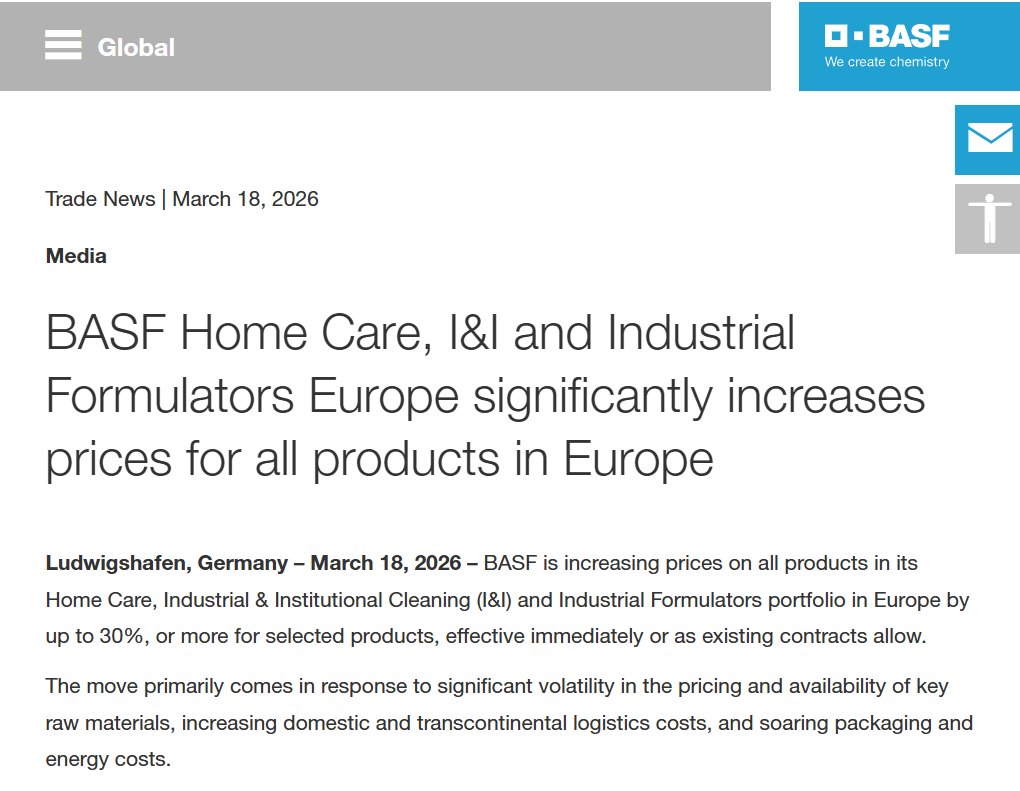
Core Viewpoint - The ongoing conflict in the Middle East is significantly impacting global prices, prompting BASF to announce price increases of up to 30% for its household care, industrial and institutional cleaning (I&I), and industrial formulation products in Europe [1][3]. Group 1: Price Increases - BASF has stated that the price adjustments will take effect immediately and may be implemented gradually according to existing contracts [3]. - The price increase affects a wide range of products, including surfactants, enzymes, water-soluble polymers, emulsifiers, stabilizers, biocides, optical brighteners, and moisturizers, as well as customized formulations using various industrial raw materials [3]. - The reasons for the price hikes include significant fluctuations in key raw material prices and supply, rising domestic and cross-continental logistics costs, and substantial increases in packaging and energy costs [3]. Group 2: Supply Chain Concerns - The supply chain disruptions are attributed to the recent outbreak of conflict, specifically the war involving the U.S., Israel, and Iran [3]. - BASF had previously announced a price increase of up to 20% for its antioxidant, processing stabilizer, and light stabilizer products used in plastic applications due to rising costs of key raw materials and shipping [3]. - The German Chemical Industry Association (VCI) has warned of early signs of supply chain disruptions, particularly concerning the supply of ammonia, phosphate fertilizers, helium, and sulfur due to the blockade of the Strait of Hormuz [3]. Group 3: Financial Outlook - Prior to the renewed conflict, BASF had already issued a warning regarding its performance for 2026, indicating that adjusted operating profit may only see slight increases or declines in a challenging market environment [4]. - The company expects adjusted EBITDA for 2026 to be between €6.2 billion and €7 billion, compared to €6.6 billion for the fiscal year 2025 [4].
宝理-赢创,PEEK和尼龙涨价
DT新材料· 2026-03-05 16:05
Group 1 - The core viewpoint of the articles highlights the price adjustments announced by major chemical companies, including Japan's Toray and Evonik, due to the inability to absorb the impacts of currency fluctuations (Yen depreciation) and rising raw material costs [3] - Toray and Evonik will implement price increases on various product categories starting from April 1, 2026, with specific adjustments such as an increase of 200 JPY per kilogram for PA12, PA612, and transparent resins, and a 10% increase for polyether ether ketone [3] - Other major chemical companies, including BASF, Covestro, and Wanhua Chemical, are also raising prices across their product lines, indicating a broader trend in the industry [3] Group 2 - The articles provide detailed pricing information for various chemical products, including methyl tert-butyl ether (MTBE), butanol (TBA), and styrene (SM), with price changes ranging from 1100 to 1850 CNY per ton across different regions [5][6][7] - Specific price adjustments for acrylates and polyolefins are also noted, with increases of 1200 to 1500 CNY per ton reported for products like butyl acrylate and LLDPE [6][7] - The articles mention that the prices listed are indicative and actual transaction prices may vary based on contracts [7]

金发科技,涨价!
DT新材料· 2026-03-04 16:05
Price Increases in Chemical Industry - The ongoing price increase trend has rapidly spread from oil and chemical raw materials to the materials sector, with significant price hikes observed in polyurethane, elastomers, and organosilicon, and now potentially affecting more categories like plastics [3][4] - BASF announced a global price increase for plastic application antioxidants, processing aids, and light stabilizers by up to 20%, driven by rising raw material costs, inflation pressures, and increased shipping costs [3] - Wanhua Chemical stated that the price of its entire PA12 product line would increase by 5%-10% starting March 1, citing significant upward pressure on production costs due to continuous increases in upstream raw material prices [3][4] Specific Product Price Adjustments - Zhuhai Jinfa Biochemical Co., Ltd. announced price adjustments for PBAT products, with increases of 700 RMB/ton for PBAT resin, 500 RMB/ton for PBAT modified series, and 400 RMB/ton for PBAT masterbatch series [6][7] - The price of PTA, a core upstream raw material for PBAT, has risen significantly, leading to increased prices for downstream products such as polyester chips and bottles [8][9] - The price of adipic acid, another key raw material, has also surged due to upstream oil price fluctuations, impacting the nylon and polyurethane markets [9] Market Dynamics and Trends - The price increases are supported by leading manufacturers like Jinfa Technology, which operates at full capacity with an annual PBAT production capacity of 180,000 tons [8] - The domestic PP market has seen price increases of 300-500 RMB/ton, with some producers reducing output, exacerbating supply tightness [11] - Despite rising prices in the plastics sector, major consumers in electronics, automotive, and construction have not shown a strong willingness to increase prices, focusing instead on promotions [13]



化工ETF(159870)盘中净申购6750万份,供需角度TDI涨价基础坚挺
Xin Lang Cai Jing· 2026-02-27 03:13
Group 1: TDI Market Insights - BASF's TDI facility is undergoing maintenance, leading to an increase in TDI prices. Wanhua Chemical's TDI price was set at 15,700 CNY/ton in early March, up 1,200 CNY/ton month-on-month, with limited supply [1] - The latest average TDI market price is 14,881 CNY/ton, reflecting a year-on-year increase of 16% [1] - Wanhua Chemical holds a significant market share, accounting for approximately 60% of China's total TDI capacity and 33% of global capacity, as overseas production gradually exits [1] - Global TDI capacity expansion is slowing, with only a planned increase from Covestro in Shanghai by 2026, indicating a clear inflection point in supply growth [1] - Demand for TDI is significantly driven by exports, with China's cumulative TDI export volume expected to reach 556,500 tons in 2025, a year-on-year increase of 51.84%, surpassing 35% of domestic production [1] Group 2: MDI Market Dynamics - MDI prices are frequently increasing overseas, with BASF raising prices by 200 USD/ton in ASEAN, Covestro by 220 USD/ton in North America, and Huntsman by 260 USD/ton in the U.S. [2] - The current MDI plant operating rate is approximately 87%, with historical operating rate at 81%, and inventory levels are low at around 14% [2] - The U.S. housing market is expected to recover, driven by lower mortgage rates due to ongoing interest rate cuts, which will likely boost MDI demand [2] Group 3: Chemical ETF Overview - The Chemical ETF closely tracks the CSI Sub-Industry Chemical Theme Index, which consists of seven sub-indices reflecting the overall performance of major listed companies in related sectors [3] - As of January 30, 2026, the top ten weighted stocks in the CSI Sub-Industry Chemical Theme Index include Wanhua Chemical, Salt Lake Co., and others, collectively accounting for 44.82% of the index [3]
巴斯夫、科思创、万华化学,再涨价!
DT新材料· 2026-02-26 16:05
Group 1 - The chemical industry is experiencing a resurgence due to rising global energy prices driven by geopolitical tensions and policy changes [3][4] - In January 2026, 119 chemical products saw price increases, with 44 products rising over 5%, including PVA, vitamins, and lithium carbonate [3] - Zhejiang Longsheng announced price hikes for disperse dyes, with increases of 2000 to 4000 yuan per ton [3] Group 2 - MDI and TDI prices are increasing due to traditional price increase cycles and downstream restocking demands after the holiday [4] - Huntsman announced a price increase of $260 per ton for MDI products in the U.S. market [5] - Covestro plans to raise prices for all MDI products in North America by $0.10 per pound, equivalent to $220 per ton [6] Group 3 - Global TDI production capacity is facing temporary reductions, with about 86,000 tons of TDI capacity under maintenance, representing nearly 24% of global capacity [8] - Wanhua Chemical has become the largest TDI supplier globally, with a production capacity of 1.47 million tons per year, accounting for over 40% of global capacity [8] - The global MDI supply-demand balance is improving, with a projected supply gap of 650,000 tons to 1.07 million tons in 2026-2027 [10]

MDI+制冷剂开始掀起涨价潮,化工ETF(159870)备受关注
Xin Lang Cai Jing· 2025-12-09 01:52
Group 1 - Wanhua Chemical announced a price increase of $350/ton for MDI products in the Middle East, Africa, and Turkey [1] - Other companies such as Dow Chemical and Huntsman also announced price increases for MDI products in various regions, with increases of €300/ton and €350/ton respectively [1] - The price hikes are driven by rising raw material, energy, and transportation costs, with domestic average prices for pure MDI, polymer MDI, and TDI reported at 19,500, 14,600, and 14,356 CNY/ton respectively as of December 8, 2025 [1] Group 2 - Refrigerant prices are also on the rise, with significant increases reported for R125, R410A, R32, and R134a, reflecting strong industry confidence [2] - As of December 8, 2025, the CSI Sub-Industry Chemical Theme Index rose by 0.15%, with notable increases in stocks such as Hangyang Co., Ltd. and Juhua Co., Ltd. [2] - The Chemical ETF closely tracks the CSI Sub-Industry Chemical Theme Index, which includes major companies in the chemical sector [3]
化工板块大幅降温,是行情终结还是加仓机会?
Di Yi Cai Jing· 2025-11-18 11:28
Group 1 - The core viewpoint of the articles indicates that the chemical sector is experiencing a significant price increase driven by specific sub-sectors such as lithium mining and phosphorus chemicals, which are expected to continue to perform well in the future [1][6] - The Wind Chemical Index (882101.WI) has shown a cumulative increase of over 12% from October 17 to November 17, significantly outperforming the Shanghai Composite Index's 1.43% during the same period [2][3] - The recent sharp decline in the chemical sector on November 18, with a drop of 3.45% in the Wind Chemical Index, raises questions about whether this is a market correction or an opportunity for further investment [5] Group 2 - The surge in the chemical sector is attributed to price hikes in products within the fluorochemical, phosphorus chemical, and organic silicon markets, reflecting strong demand and limited supply [3][4] - The influx of capital into chemical ETFs, with the Penghua Chemical ETF (159870.OF) seeing a net inflow of over 154 billion yuan in three months, highlights the market's recognition of the price increase logic in the chemical sector [4] - The current low price-to-book (PB) ratio of 2.2 indicates an increasing investment value in the chemical industry, particularly in phosphorus chemicals, which are experiencing supply-demand imbalances due to new demands from lithium battery materials [6]