
活性染料

Search documents
聚炳析-化工核心资产-黄金坑
2026-03-30 05:15
Summary of Conference Call Records Industry Overview - The chemical industry in China is experiencing enhanced export competitiveness, with 80% of major chemical products expected to be above the 80th percentile of the past six years by 2025. In contrast, the EU's capacity utilization has dropped to 74.6%, indicating a shift in the global chemical landscape towards the East and away from the West [1][3] - Geopolitical tensions in the Middle East threaten 27% of global oil supply, impacting olefin production capacities in Southeast Asia and Central Europe, with affected proportions of 20.4% and 60% respectively. High oil prices may accelerate the exit of outdated capacities, potentially bringing forward the olefin cycle [1][4] Company-Specific Insights - Wanhua Chemical's profit forecast for Q1 2026 is estimated to be between 3.5 billion to 4 billion yuan, benefiting from geopolitical challenges affecting overseas supply stability in the MDI/TDI market [1][4] - The polyester filament industry has seen its CR6 increase to 79%, with capacity growth expected to slow to 4% by 2026, indicating a more favorable supply-demand balance compared to 2022. Current inventory levels are low at 20-25 days, and profitability is expected to improve as downstream restocking begins in April [1][5] Market Dynamics - The dye industry is currently facing extremely low inventory levels, with production-side stocks below 7 days and client-side stocks below 5 days. A supply-demand gap of over 10% exists for H-acid due to safety incidents and environmental pressures, which could lead to price increases [1][8][9] - The active dye market is expected to see price elasticity release driven by supply issues with H-acid, which has faced production challenges due to environmental regulations and safety incidents. If H-acid prices rise to 80,000 yuan/ton, it could increase active dye costs by 8,000 yuan/ton [1][10] Fertilizer Industry Insights - The sulfur market is under threat from Middle Eastern supply issues, with a projected shortfall exceeding 10 million tons by 2026. The global supply of potassium fertilizer is also expected to be less than anticipated, while diammonium phosphate is benefiting from the expansion of iron phosphate production, closely tied to the new energy sector [2][10] - The fertilizer industry is experiencing a resonance of short-term supply disruptions and seasonal demand due to the spring farming season. The geopolitical situation is significantly impacting sulfur supply, while potassium fertilizer supply is constrained by geopolitical risks and limited net increases in global supply [10][11] Future Trends - The phosphoric acid market is entering a phase of stock optimization from 2026 to 2030, with limited new capacity expected. The demand for diammonium phosphate is closely linked to the expansion of iron phosphate production, which is projected to increase significantly in the coming years [12] - China's export capacity for phosphoric acid products is expected to grow significantly, driven by domestic and international price differentials, enhancing the bargaining power and profitability of leading domestic companies [12]
基础化工行业研究:原油继续大涨,影响时间和幅度或超预期
SINOLINK SECURITIES· 2026-03-29 08:24
Investment Rating - The report does not explicitly provide an investment rating for the chemical industry Core Insights - The geopolitical tensions, particularly between the US and Iran, have led to significant disruptions in the chemical supply chain, affecting various sectors including fertilizers and semiconductors [1][2] - The chemical market is experiencing price fluctuations due to supply chain vulnerabilities, with specific products like helium and fertilizers facing acute shortages [1][2] - The AI industry is facing challenges due to increased demand for computing power, leading to a surge in CPU prices and extended delivery times [1] - Major companies are actively expanding production capacities to meet rising demand, with significant investments in AI infrastructure [1] Summary by Sections Market Review - Brent crude oil settled at an average of 105.45 USD/barrel, down 0.87% week-on-week, while WTI crude oil averaged 92.98 USD/barrel, down 3.22% [9] - The basic chemical sector outperformed the index with a 2.31% increase, while the petrochemical sector saw a slight decline of 0.10% [10] Recent Views from the Chemical Team - The tire industry is stabilizing with a slight increase in production rates, while raw material prices are on the rise [23] - The dye market remains stable, with prices for disperse dyes holding steady and active dyes experiencing an upward trend due to strong cost support [25] - The carbon dioxide market is seeing limited price increases due to insufficient demand support [27] Key Events - Iran's response to the US ceasefire proposal has introduced new conditions, impacting market stability [2] - Australia's largest ammonia plant has been offline for two months, exacerbating global fertilizer shortages during the planting season [2] - A significant reduction in helium supply from Qatar due to Iranian attacks poses a threat to the semiconductor industry [2]
闰土股份(002440) - 2026年3月11日投资者关系活动记录表
2026-03-11 09:32
Industry Overview - China is the world's largest producer, trader, and consumer of dyes, accounting for approximately 70%-75% of global dye production [1] - Major dye production regions in China include Zhejiang, Jiangsu, and Shandong, with a high industry concentration [1] - Key players in disperse dyes include Zhejiang Longsheng, Runtao Co., Jihua Group, and Annochi; for reactive dyes, major producers are Runtao Co., Zhejiang Longsheng, and Jinjia Co. [1] Market Competition - The dye industry is characterized by full competition, with increasing production capacity both domestically and internationally, leading to intensified market competition [2] Financial Performance Forecast - The company forecasts a net profit attributable to shareholders of 600 million to 700 million yuan for 2025, representing a year-on-year growth of 181.05%-227.89% [3] - The expected net profit after deducting non-recurring gains and losses is projected to be between 270 million and 370 million yuan, with a growth rate of 26.75%-73.70% [3] Raw Material Pricing - The price of reducing agents, a key intermediate for disperse dyes, has been low but has started to rise since late January, currently quoted at around 100,000 yuan per ton [4] - The price of disperse black dye has increased by approximately 24,000 yuan per ton recently, now priced at around 40,000 yuan per ton, driven by rising costs of key raw materials [5] Production Capacity - The company's annual production capacity for reducing agents is approximately 8,000 tons, primarily for self-use in supporting disperse dye production [6] Safety and Environmental Standards - Safety production is fundamental for high-quality development, with the company adhering to a "safety, environmental protection, and efficiency" operational philosophy [7] Industry Chain Strategy - The company implements a "backward integration" strategy to extend its industry chain, significantly enhancing the supply of key intermediates [8] - The dye industry system has been established, encompassing thermal power, steam, chlorine, caustic soda, intermediates, filter cakes, and dyes, ensuring a complete industry chain [9]

《化工周报26/3/2-26/3/6》:地缘冲突下煤气化工套利空间提升,MDI、TDI、蛋氨酸等价格上涨,农药板块或迎涨价潮-20260309
Shenwan Hongyuan Securities· 2026-03-09 06:40
Investment Rating - The report maintains an "Optimistic" rating for the chemical industry [2][3]. Core Insights - The report highlights that geopolitical conflicts have led to a significant increase in oil prices, with Brent crude reaching $93 per barrel as of March 6, 2026. If the Strait remains blocked for 4-6 weeks, prices may rise above $120, impacting the chemical sector positively in the short term [2][3]. - The report indicates that the chemical sector is experiencing upward price trends for MDI, TDI, and methionine due to increased costs and supply constraints, suggesting a potential price surge in the pesticide sector as well [2][3]. - The report emphasizes the importance of focusing on key materials for growth, particularly in semiconductor materials and packaging materials, as well as the impact of "anti-involution" policies accelerating the exit of outdated capacities [2][3]. Summary by Sections Macro Economic Analysis - Oil prices have surged due to geopolitical tensions, with Brent crude at $93 per barrel. If the situation persists, prices could exceed $120, which would have significant implications for the chemical industry [3][4]. - Coal prices are stabilizing, and natural gas prices are expected to decline as the U.S. accelerates its export facilities [3]. Chemical Sector Dynamics - The report notes that MDI and TDI prices are rising due to sustained cost pressures and supply constraints, with domestic companies controlling shipment volumes [2][3]. - The methionine market is expected to recover, with prices increasing to 22.5 yuan/kg, driven by geopolitical disruptions affecting supply [2][3]. Investment Recommendations - The report suggests focusing on various chains, including textile, agricultural chemicals, and export-related sectors, with specific companies highlighted for potential investment [2][3]. - Key companies to watch include Wanhua Chemical, Cangzhou Dahua, and others in the agricultural sector like Yangnong Chemical and Runfeng Co., which are expected to benefit from rising prices [2][3]. Company Valuation Insights - The report provides a valuation table for key companies, indicating their market capitalization and projected earnings, with specific recommendations for buy, hold, or sell based on their performance [14][15].




闰土股份(002440) - 2026年3月4日投资者关系活动记录表
2026-03-04 11:00
Industry Overview - China is the world's largest producer, trader, and consumer of dyes, accounting for approximately 70%-75% of global dye production [1] - Major dye production regions in China include Zhejiang, Jiangsu, and Shandong provinces, with a high industry concentration [1] - The dye industry is characterized by intense competition, with increasing production capacity both domestically and internationally [2] Company Performance Forecast - The company forecasts a net profit attributable to shareholders of 600 million to 700 million yuan for 2025, representing a year-on-year growth of 181.05%-227.89% [3] - The expected net profit after deducting non-recurring gains and losses is projected to be between 270 million and 370 million yuan, with a growth rate of 26.75%-73.70% [3] Raw Material Pricing - The price of reducing agents, a key intermediate for disperse dyes, has been low but has started to rise since late January, currently quoted at around 100,000 yuan per ton [4] - The price of disperse black dye has increased by approximately 14,000 yuan per ton recently, now priced at about 30,000 yuan per ton, driven by rising raw material costs [5] Production Capacity - The company has an annual production capacity of approximately 8,000 tons for reducing agents, primarily for internal use to support disperse dye production [6] Safety and Environmental Practices - Safety in production is emphasized as a fundamental requirement for high-quality development, with a focus on risk prevention and maintaining operational integrity [7] Supply Chain Strategy - The company implements a "backward integration" strategy to extend its supply chain, achieving significant results in securing raw material supply through the production of key intermediates [8] - The dye production system has been established to include a complete supply chain from thermal power, steam, chlorine, caustic soda, intermediates, to dyes [9]
闰土股份(002440) - 2026年3月3日投资者关系活动记录表
2026-03-03 11:54
Group 1: Industry Overview - China is the world's largest producer, trader, and consumer of dyes, accounting for approximately 70%-75% of global dye production [1] - The domestic dye industry is concentrated in Zhejiang, Jiangsu, and Shandong provinces, with major players including Zhejiang Longsheng, Runtao Co., and Jihua Group [1][2] Group 2: Company Performance Forecast - The company forecasts a net profit attributable to shareholders of 600 million to 700 million yuan for 2025, representing a year-on-year growth of 181.05%-227.89% [3] - The expected net profit after deducting non-recurring gains and losses is projected to be between 270 million and 370 million yuan, with a growth rate of 26.75%-73.70% [3] Group 3: Market Trends and Pricing - The price of reducing agents, a key intermediate for disperse dyes, has been low but has started to rise, currently quoted at around 100,000 yuan per ton [4] - The price of disperse black dye has increased by approximately 9,000 yuan per ton recently, now priced at about 25,000 yuan per ton, driven by rising costs of key raw materials [5] Group 4: Production Capacity and Safety - The company's annual production capacity for reducing agents is approximately 8,000 tons, primarily for self-use in supporting disperse dye production [5] - Safety in production is emphasized as a fundamental requirement for high-quality development, with a focus on risk prevention and operational integrity [6] Group 5: Supply Chain Strategy - The company implements a "backward integration" strategy to extend its supply chain, achieving significant results in the layout of key intermediates [7][8] - The dye industry system has been established to include a complete supply chain from thermal power, steam, chlorine, and caustic soda to intermediates and dyes [8]
涨价潮起 接力棒传向何方
Zhong Guo Zheng Quan Bao· 2026-02-27 20:43
Group 1: Precious Metals - International gold prices have exceeded previous optimistic forecasts, with predictions for 2026 ranging from $4,800 to $5,500 per ounce, but prices have already surpassed this range early in the year [1] - As of February 27, 2026, the spot price of gold in London has increased by over 90%, while silver has surged by more than 200% [1] - The demand for precious metals is driven by factors such as weakening dollar credit, rising geopolitical tensions, and increased investment in gold as a safe-haven asset [2][3] Group 2: Industrial Metals - Industrial metals are experiencing price increases supported by solid supply and demand fundamentals, with a projected annual growth rate of 1.5% for ten types of non-ferrous metals in China, which is below the expected consumption growth of 2.2% [3] - The price of copper has reached historical highs, leading to increased costs in the semiconductor manufacturing process, with futures prices for gold, silver, and copper expected to rise by over 50% by 2025 [3] - The chemical sector is also seeing price increases, particularly in dye products, where leading companies are able to raise prices due to supply constraints [3] Group 3: Energy Sector - International oil prices are rising due to geopolitical tensions and supply-demand rebalancing, with VLCC (Very Large Crude Carrier) daily rental rates reaching $15.7 million as of February 20, 2026, and further increasing to over $20 million shortly after [2][4] - The surge in oil tanker rental rates reflects a heightened perception of risk in the market, driven by geopolitical conflicts and the need for additional compensation for shipping [4] Group 4: Market Trends and Predictions - The chemical sector is expected to become the new leading area for price increases, with low inventory levels and tightening supply constraints, while the market awaits demand signals [4] - The precious metals market is anticipated to experience strong fluctuations but maintain an upward trend in the medium term, supported by geopolitical risks and trade policy uncertainties [5] - The price increase logic is spreading from metals and semiconductors to broader sectors such as oil, construction materials, chemicals, and food and beverage industries, with AI and semiconductor sectors continuing to benefit [5]
化工马年“开门红”,估值修复落幕,涨价兑现期来了!
Hua Er Jie Jian Wen· 2026-02-24 11:04
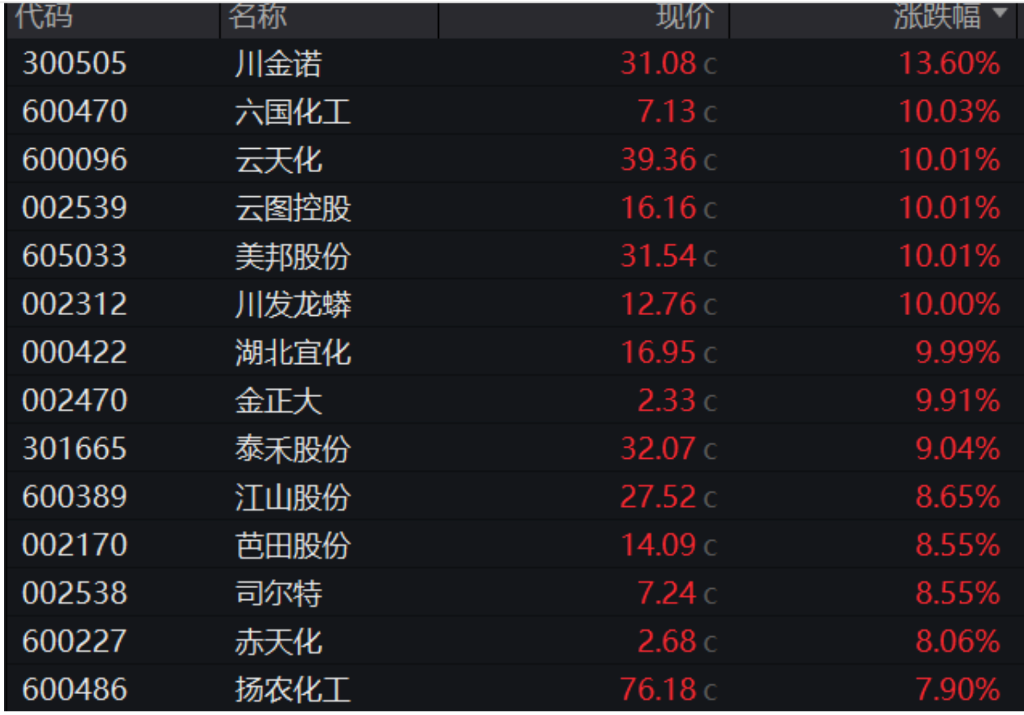
Core Viewpoint - The chemical sector in A-shares is experiencing a strong upward trend, particularly in sub-sectors like phosphate chemicals and pesticides, with multiple stocks hitting the daily limit up [1] Group 1: Market Performance - On the first trading day of the Year of the Rabbit, the chemical sector saw significant gains, with stocks like Liuguo Chemical, Yuntu Holdings, and Hubei Yihua reaching their daily limit up [1] - Key stocks showing strong performance include Chuanjinno, Liuguo Chemical, Yuntianhua, and Yuntu Holdings, all with notable price increases [2] Group 2: Industry Outlook - According to Guotou Securities, the chemical industry is at a turning point after four years of decline, with several indicators suggesting that the sector has bottomed out, and 2026 is expected to be a pivotal year for the cycle [2][3] - The China Chemical Product Price Index (CCPI) has dropped 39% from its peak in 2021, indicating that prices are at historical lows [3] Group 3: Capital Expenditure and Supply Dynamics - Industry capital expenditure has decreased by 18.3% year-on-year, marking seven consecutive quarters of negative growth, signaling the end of the supply expansion phase [5] - The market is expected to shift from a phase of "weak reality, strong expectations" to a verification period focused on whether price increases can be sustained [5] Group 4: Sub-sector Analysis - The dye sector has seen significant price increases, with disperse dye prices rising by 23.53% this year, driven by a concentrated intermediate market [6] - TMP (Trimethylolpropane) prices have surged by 43.71% this year due to supply-demand mismatches and cost pressures, indicating a strong market outlook [7] - The chemical fiber sector is entering a traditional demand peak season, with low inventory levels expected to drive price elasticity [8] Group 5: Phosphate Chemicals - The phosphate chemical sector is gaining attention due to geopolitical factors, with the U.S. recognizing phosphorus as a strategic material, enhancing the competitive position of Chinese companies [9] - The industry is expected to see a supply-demand gap in phosphoric acid until mid-2026, with strong demand anticipated from the battery sector [9][10] Group 6: Overall Market Sentiment - The underlying logic of the chemical market is showing positive changes, with price levels at historical lows and profitability stabilizing [11] - However, the recovery of demand remains uncertain, with the need for a substantial revival in downstream sectors to confirm a market reversal [11]


基础化工行业专题:染料产业链格局改善,景气度有望迎来修复
Huaan Securities· 2026-02-12 08:01
Investment Rating - The industry investment rating is "Overweight" [2] Core Insights - The dye industry is expected to see a recovery in demand due to both domestic and international factors, with China maintaining its position as the world's largest producer, consumer, and exporter of dyes, with an annual production exceeding 900,000 tons [5][18] - The supply structure of dyes is improving, with leading companies possessing significant pricing power due to the elimination of smaller, less compliant enterprises [7][29] - The price increase of dyes is driven by the intermediate production process, benefiting companies with integrated supply chains [8][48] Summary by Sections Demand and Supply Dynamics - The dye industry is characterized by diverse products and applications, with significant growth in downstream printing and dyeing fabric production, which is projected to grow at a compound annual growth rate (CAGR) of 2.59% from 2018 to 2024 [20] - China's dye export volume is expected to reach 272,000 tons in 2024, reflecting an 11% year-on-year increase, supported by a compound annual growth rate of 7.51% from 2020 to 2025 [23] Environmental and Regulatory Landscape - The dye industry faces stringent environmental regulations, leading to the gradual elimination of high-pollution, low-compliance small enterprises, thus optimizing the industry structure [26][29] - Recent regulatory changes have increased compliance costs for smaller players, further consolidating market share among larger firms [30] Intermediate Supply and Price Trends - The production of key intermediates, such as H acid and reducing agents, is critical for dye manufacturing, with recent supply disruptions leading to price increases [40][45] - The price of reducing agents has surged from 25,000 yuan/ton to approximately 50,000 yuan/ton, directly impacting the production costs of disperse dyes [43] Key Companies in the Industry - Zhejiang Longsheng is a leading enterprise with a dye production capacity of 300,000 tons and a strong integrated supply chain [51] - RunTu Co. has a well-established dye industry system with a total dye production capacity of 238,000 tons [53] - Annoqi focuses on differentiated dye products and is integrating AI technology into its production processes [54] - Jinhua Group has a dye production capacity of 95,000 tons and is expanding its product portfolio through strategic acquisitions [56]




中银国际:染料价格上行 一体化企业有望受益
智通财经网· 2026-02-12 02:53
Group 1 - The core viewpoint is that the prices of dye intermediates, particularly reducing agents, have been rising since mid-January, leading to an increase in dye prices. This trend is supported by a concentrated supply and stringent safety and environmental regulations, which are optimizing the industry landscape. Current prices are at historically low levels, and cost pressures are expected to further transmit downstream, benefiting companies with stable market shares and related intermediate support [1][2][4]. Group 2 - The cost of intermediates is driving a rapid increase in dye prices. The price of reducing agents, a key intermediate for disperse dyes, has surged from 25,000 yuan/ton to around 70,000 yuan/ton since mid-January. Companies like Zhejiang Longsheng and Runtao Co. have announced price increases for disperse dyes, with Zhejiang Longsheng raising prices by 2,000 yuan/ton and Runtao Co. by 5,000 yuan/ton for certain products [2][3]. - The dye prices have been historically low due to intensified industry competition. By 2025, the average export price of disperse dyes is expected to decline by 6.66% year-on-year to $4.36/kg, marking the lowest level in nearly a decade [2][3]. - The supply of dyes is concentrated, with China being the largest producer, trader, and consumer of dyes globally, accounting for approximately 70%-75% of the world's total production. The top five dye-producing companies in China are projected to account for 61.07% of the total national output in 2024, an increase of 1.54 percentage points from 2023 [3][4]. Group 3 - The investment recommendation suggests that dye prices are at a bottom range, and changes in cost and strict regulations may improve industry conditions. Companies with stable market shares, high safety and environmental investments, and complete industrial chain support are likely to benefit. Recommended companies include Zhejiang Longsheng, with Runtao Co. suggested for further attention [4].