单边加征关税

Search documents
商务部回应美最高法院公布关税诉讼案裁决结果
Qi Huo Ri Bao Wang· 2026-02-24 01:31
Core Viewpoint - The U.S. Supreme Court ruled that the government's imposition of tariffs under the International Emergency Economic Powers Act is illegal, which has significant implications for U.S.-China trade relations [1] Group 1: Tariff Rulings - The Supreme Court's decision on February 20 declared that the tariffs imposed on trade partners, including the fentanyl tariffs, are unlawful [1] - The Chinese Ministry of Commerce emphasized that unilateral tariff measures violate international trade rules and U.S. domestic law, and do not serve the interests of any party involved [1] Group 2: Trade Relations - The Chinese side reiterated its stance against unilateral tariff increases, stating that trade wars yield no winners and protectionism is not a viable solution [1] - The Ministry of Commerce urged the U.S. to eliminate the unilateral tariffs imposed on trade partners, highlighting the mutual benefits of cooperation between China and the U.S. [1] Group 3: Future Actions - The Chinese Ministry of Commerce noted that the U.S. is preparing to implement trade investigations as alternative measures to maintain tariffs on trade partners, which will be closely monitored by China [1]
正对相关内容和影响 进行全面评估
Zhong Guo Zheng Quan Bao· 2026-02-23 22:25
Core Viewpoint - The Chinese Ministry of Commerce is closely monitoring the recent U.S. Supreme Court ruling on tariffs and is evaluating its implications, while also noting that the U.S. is preparing alternative trade investigations to maintain tariffs on trade partners [1] Group 1: U.S. Supreme Court Ruling - The U.S. Supreme Court ruled on February 20 that the U.S. government's imposition of reciprocal tariffs and fentanyl tariffs under the International Emergency Economic Powers Act is illegal [1] - The Chinese government opposes unilateral tariff measures and emphasizes that trade wars yield no winners and protectionism is not a viable path [1] Group 2: Trade Relations - The Chinese Ministry of Commerce asserts that unilateral measures by the U.S. violate international trade rules and U.S. domestic law, and do not align with the interests of all parties involved [1] - The Ministry urges the U.S. to eliminate the unilateral tariffs imposed on trade partners, highlighting that cooperation benefits both China and the U.S., while conflict results in mutual harm [1]
美国最高法院公布关税诉讼案裁决结果,中方回应
Xin Lang Cai Jing· 2026-02-23 05:22
Core Viewpoint - The U.S. Supreme Court ruled that the tariffs imposed by the U.S. government under the International Emergency Economic Powers Act, including reciprocal tariffs and fentanyl tariffs, are illegal. The Chinese government opposes unilateral tariff measures and emphasizes that trade wars have no winners and protectionism is not a viable path [1]. Group 1 - The Chinese government is conducting a comprehensive assessment of the implications of the Supreme Court's ruling on tariffs [1]. - The Chinese side has consistently opposed various forms of unilateral tariff increases and has reiterated that both sides benefit from cooperation while conflict leads to mutual harm [1]. - The Chinese government urges the U.S. to cancel the unilateral tariff measures imposed on trade partners [1]. Group 2 - The U.S. is reportedly preparing to adopt alternative measures, such as trade investigations, to maintain tariffs on trade partners [1]. - The Chinese government will closely monitor these developments and firmly protect its interests [1].
美国关税动向,中方正式表态
Sou Hu Cai Jing· 2026-02-23 03:53
Core Viewpoint - The U.S. Supreme Court ruled that the government's imposition of tariffs under the International Emergency Economic Powers Act was illegal, which has significant implications for U.S.-China trade relations [1]. Group 1: U.S. Tariff Measures - The Chinese government opposes unilateral tariff measures and emphasizes that trade wars yield no winners and protectionism is not a viable solution [1]. - The U.S. tariffs, including the counterpart tariffs and fentanyl tariffs, are deemed to violate international trade rules and U.S. domestic law, which does not align with the interests of all parties involved [1]. Group 2: Call for Action - The Chinese side urges the U.S. to eliminate the unilateral tariffs imposed on trade partners [1]. - There is an indication that the U.S. is preparing to adopt alternative measures, such as trade investigations, to maintain tariffs on trade partners, which will be closely monitored by China [1].

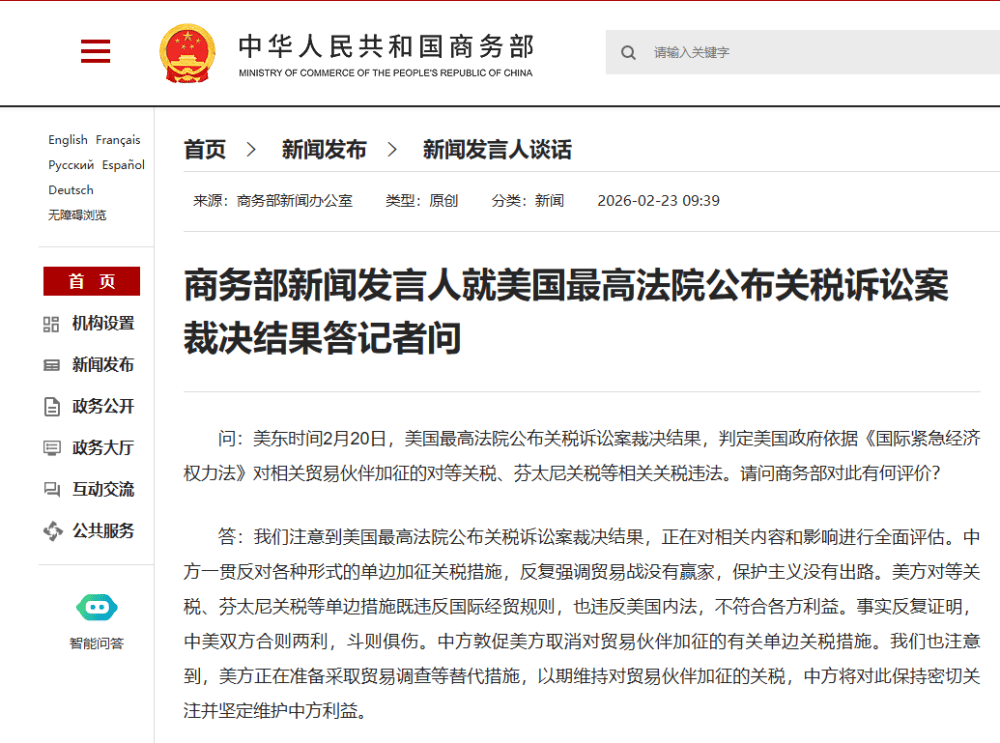
商务部回应美国最高法院公布关税诉讼案裁决结果:正对相关内容和影响进行全面评估
Xin Hua She· 2026-02-23 03:33
Core Viewpoint - The Chinese Ministry of Commerce is closely monitoring the recent ruling by the U.S. Supreme Court regarding tariffs and is evaluating its implications while emphasizing the importance of maintaining national interests [1] Group 1: U.S. Supreme Court Ruling - The U.S. Supreme Court ruled on February 20 that the U.S. government's imposition of reciprocal tariffs and fentanyl tariffs under the International Emergency Economic Powers Act is illegal [1] - The ruling indicates that unilateral tariff measures by the U.S. violate both international trade rules and U.S. domestic law [1] Group 2: China's Position - China consistently opposes all forms of unilateral tariff measures and reiterates that trade wars yield no winners and protectionism is not a viable path [1] - The Ministry of Commerce urges the U.S. to eliminate the unilateral tariff measures imposed on trade partners, highlighting that cooperation benefits both sides while conflict leads to mutual harm [1]
商务部就美国最高法院公布关税诉讼案裁决结果答记者问
Shang Wu Bu Wang Zhan· 2026-02-23 03:12
Core Viewpoint - The U.S. Supreme Court ruled that the U.S. government's imposition of tariffs under the International Emergency Economic Powers Act is illegal, which has significant implications for U.S.-China trade relations [1]. Group 1: U.S. Supreme Court Ruling - The ruling declared that the tariffs imposed on trade partners, including the fentanyl tariffs, are unlawful [1]. - The Chinese government is conducting a comprehensive assessment of the ruling's content and impact [1]. Group 2: Chinese Government's Response - The Chinese government opposes unilateral tariff measures and emphasizes that trade wars yield no winners and protectionism is not a viable solution [1]. - It is highlighted that unilateral measures by the U.S. violate international trade rules and U.S. domestic law, which do not align with the interests of all parties involved [1]. - The Chinese government urges the U.S. to eliminate the unilateral tariffs imposed on trade partners [1]. Group 3: Future Trade Measures - The Chinese government is aware that the U.S. is preparing to adopt alternative measures, such as trade investigations, to maintain tariffs on trade partners [1]. - The Chinese government will closely monitor these developments and firmly protect its interests [1].
中方正在对相关内容和影响进行全面评估
Zhong Guo Ji Jin Bao· 2026-02-23 02:57
Group 1 - The U.S. Supreme Court ruled that the government's imposition of tariffs under the International Emergency Economic Powers Act, including counterpart tariffs and fentanyl tariffs, is illegal [1] - The Ministry of Commerce of China expressed opposition to unilateral tariff measures, emphasizing that trade wars have no winners and protectionism is not a viable path [1] - China urged the U.S. to cancel the unilateral tariffs imposed on trade partners and noted that the U.S. is preparing to adopt alternative measures such as trade investigations to maintain tariffs [1] Group 2 - Following the news, there was a significant increase in the prices of gold and silver [2]
美国最高法院公布关税诉讼案裁决结果,商务部回应
2 1 Shi Ji Jing Ji Bao Dao· 2026-02-23 02:43
Core Viewpoint - The U.S. Supreme Court ruled that the U.S. government's imposition of tariffs under the International Emergency Economic Powers Act, including counterpart tariffs and fentanyl tariffs, is illegal [1] Group 1: U.S. Tariff Measures - The Chinese Ministry of Commerce opposes unilateral tariff measures and emphasizes that trade wars yield no winners and protectionism is not a viable solution [1] - The U.S. tariffs on trade partners violate international trade rules and U.S. domestic law, which does not align with the interests of all parties involved [1] - The Ministry of Commerce urges the U.S. to eliminate the unilateral tariffs imposed on trade partners [1] Group 2: Future Trade Actions - The U.S. is preparing to implement trade investigations as alternative measures to maintain tariffs on trade partners [1] - The Chinese side will closely monitor these developments and firmly protect its own interests [1]
墨西哥明年起对华等多个亚洲国家加征关税,大部分商品的关税税率被设定为35%,中方:密切关注
Huan Qiu Shi Bao· 2025-12-12 00:17
Core Viewpoint - Mexico's Senate has passed a new import-export tariff law, set to impose tariffs ranging from 5% to 50% on various products from several Asian countries, including China, starting January 1, 2026. This move, aimed at supporting domestic industries, has faced significant opposition from various business groups in Mexico [1]. Group 1: Legislative Details - The Senate approved the tariff law with a vote of 76 in favor, 5 against, and 35 abstentions, following its earlier passage in the House of Representatives [1]. - The law will impose tariffs on a wide range of products, including automobiles, auto parts, textiles, clothing, plastics, and steel, with most tariffs set at 35% [1]. - The final version of the law is considered milder than an earlier proposal that was shelved, with at least 750 amendments made [1]. Group 2: Industry Impact - Business leaders warn that the tariffs will disrupt key manufacturing sectors that support Mexico's production, employment, and exports, particularly in electrical and electronic components [2]. - The president of the National Chamber of Commerce highlighted that 66% of the national GDP sectors were not consulted before the proposal was submitted, leading to decisions lacking technical assessments, which have already caused contractions in some industrial and service sectors [2]. - The board member of the Mexican Business Coordinating Council stated that tariff increases will immediately reflect in final prices, disproportionately affecting low-income consumers [2]. Group 3: International Response - The Chinese Ministry of Commerce expressed opposition to unilateral tariff measures and is conducting a trade barrier investigation against Mexico to protect its industries [3].
新华财经晚报:中央经济工作会议12月10日至11日在北京举行
Zhong Guo Jin Rong Xin Xi Wang· 2025-12-11 10:12
Domestic News - The Central Economic Work Conference was held in Beijing from December 10 to 11, emphasizing the need for a stable yet progressive economic policy, focusing on quality improvement and efficiency enhancement, and increasing counter-cyclical and cross-cyclical adjustments [2] - In November, China's monthly automobile production exceeded 3.5 million units for the first time, setting a historical record. For the first 11 months of the year, both production and sales surpassed 31 million units, with a year-on-year growth of over 10%. The production and sales of new energy vehicles approached 15 million units, with a year-on-year increase of over 30% [2] International News - The Swiss National Bank maintained its key policy rate at 0% for the second consecutive time, indicating openness to further rate cuts if persistent price declines pose a deflation threat [5] - The Central Bank of Brazil announced that it would keep its benchmark interest rate unchanged at a high level of 15% [6] - The International Energy Agency (IEA) revised down its forecast for global oil supply surplus for this year and next year, projecting a surplus of 3.815 million barrels per day by 2026, a reduction of 231,000 barrels per day from last month's forecast [6] Market Overview - The Shanghai Composite Index closed at 3873.32, down 0.7% [8] - The Shenzhen Component Index closed at 13147.39, down 1.27% [8] - The Hang Seng Index closed at 25530.51, down 0.04% [8]