双顶形态

Search documents
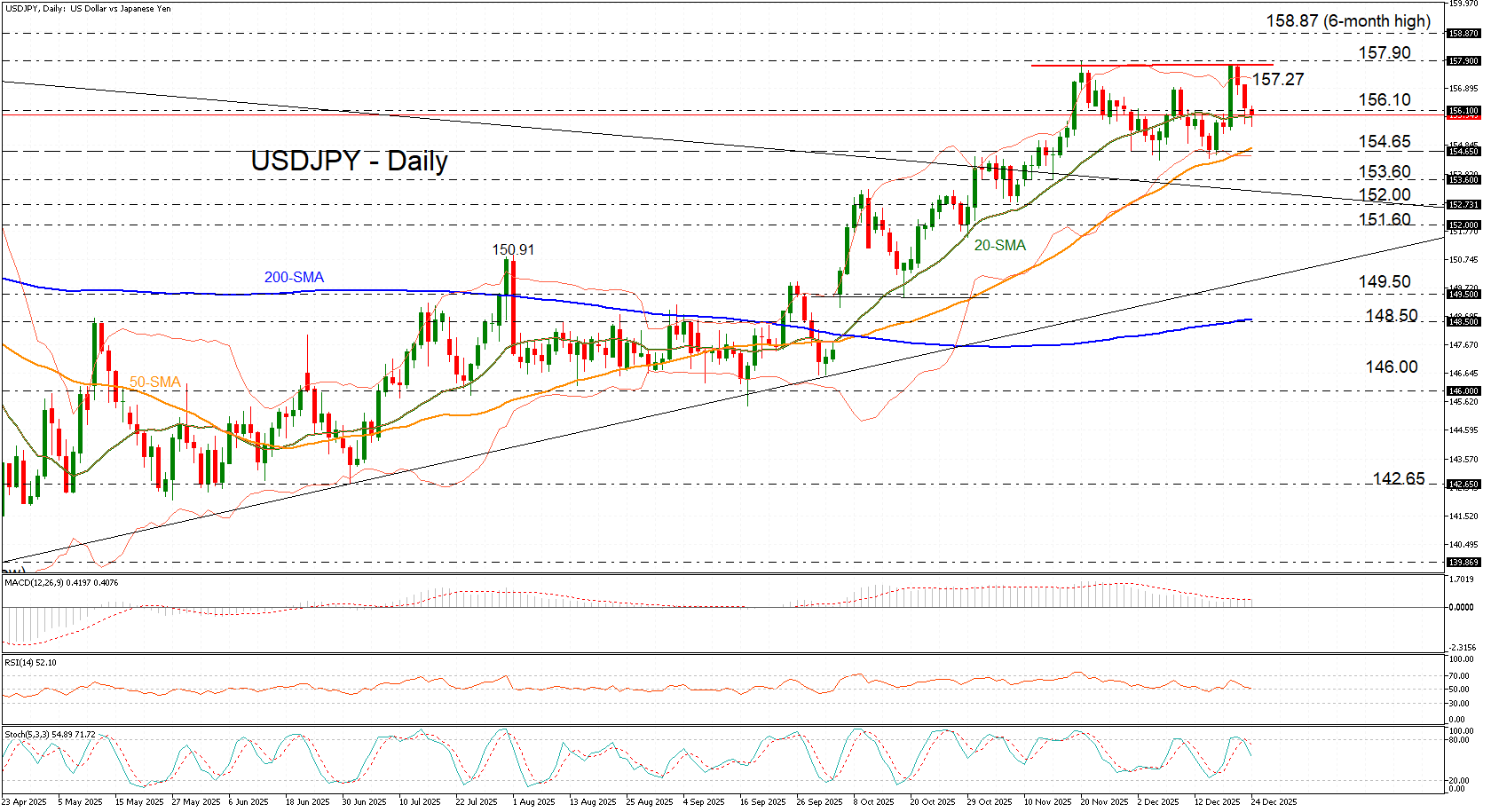
IC平台技术分析 – 美元兑日元在157.90附近形成双顶后承压下跌
Sou Hu Cai Jing· 2025-12-24 10:02
Core Viewpoint - The USD/JPY currency pair has experienced a decline for three consecutive trading days, currently testing the support level at 155.70, which is near the 20-day simple moving average (SMA) [1][3]. Group 1: Market Dynamics - The recent decline from 157.90 reflects a bearish double top pattern, influenced by the divergence in monetary policies between the Bank of Japan and the Federal Reserve [3]. - Investors are processing the Bank of Japan's meeting minutes, which discussed the necessity for further interest rate hikes, while expectations for Fed rate cuts are increasing, putting pressure on the USD [3]. Group 2: Technical Indicators - Momentum indicators are confirming a bearish bias, with the MACD falling below its red signal line but remaining above the zero line, and the RSI trending towards breaking below the neutral level of 50 [3]. - The stochastic indicator has formed a bearish crossover from the overbought region, indicating potential further declines [3]. - The Bollinger Bands are narrowing, suggesting that the market is in a wait-and-see mode before the next decisive move [4]. Group 3: Support and Resistance Levels - A break below the 20-day SMA could lead to a test of the strong support level at 154.65, which has limited declines for over a month and coincides with the lower Bollinger Band [3]. - If this level is breached, the next targets would be the low of 153.60 from November 14, followed by the lows of 152.00 and 151.60 from October and September, respectively [3]. - Conversely, if a rebound occurs, potential targets include the upper Bollinger Band near 157.27, followed by 157.90 and the six-month high of 158.87 [4].

“8连涨”后白银回调,这一次“白银牛市”会像1980年、2011年那样“新高后崩盘”吗?
Hua Er Jie Jian Wen· 2025-12-05 04:37
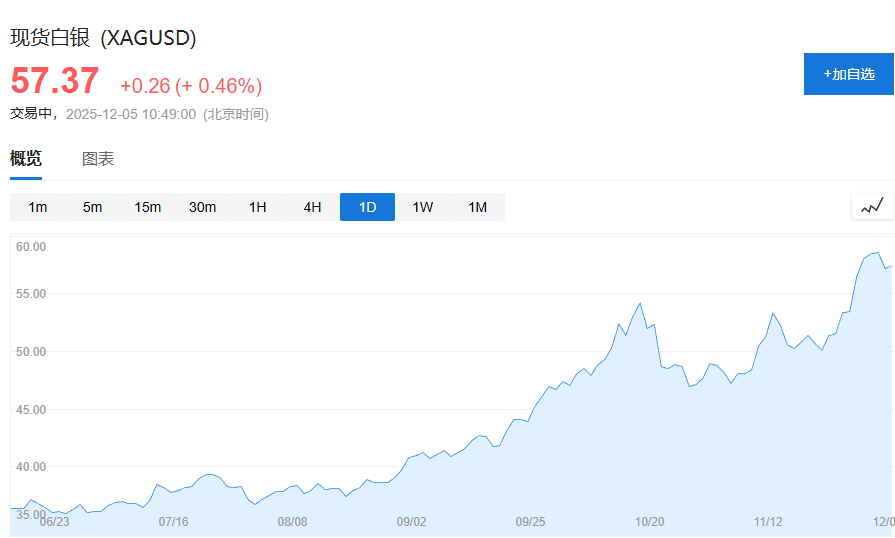
Core Viewpoint - Silver has experienced a significant price increase this year, nearing a doubling in value, but analysts believe the current market dynamics differ fundamentally from past collapses in 1980 and 2011, suggesting a more stable supply-demand environment and a technical pattern akin to recent gold price movements [3][10]. Price Movement and Market Sentiment - Silver prices have recently retraced from a historical high of nearly $59 per ounce, dropping below $57, following an eight-day consecutive rise [1][3]. - The Relative Strength Index (RSI) indicates that silver has fallen back below 70, suggesting a slowdown in the previous rapid price increase [1]. Historical Context - The collapses in 1980 and 2011 saw silver prices surge past $48 only to quickly retract, raising concerns among traders about a potential repeat of these patterns [4][6]. - In both historical instances, silver experienced rapid price increases followed by significant declines, which has led to current market apprehension [8]. Technical Analysis - Current market conditions show that silver has maintained support around the $48 level, unlike in previous years where it failed to do so [8]. - Analysts suggest that for a bearish double-top pattern to be confirmed, silver would need to drop below $46 [8]. Comparison with Gold - The current price behavior of silver is likened to gold's breakout process observed in late 2023 and early 2024, where gold also experienced sharp corrections after reaching new highs [10]. - Predictions indicate that silver may follow a similar trajectory, with a potential breakout expected in early 2026, similar to gold's performance [10]. Supply and Demand Dynamics - The silver market is facing a structural supply shortage, with predictions of a supply deficit of 95 million ounces this year, contributing to a cumulative five-year deficit of 820 million ounces [12]. - The low inventory levels in China, nearing a ten-year low, further highlight the ongoing supply constraints in the silver market [12]. - The anticipated shift to a more accommodative monetary policy by the Federal Reserve is expected to support silver prices in the coming year [12].
黄金4200拉锯区间4160-4220
Jin Tou Wang· 2025-12-05 03:15
Core Viewpoint - The current gold price movement is characterized as a consolidation phase rather than a peak, with a significant breakthrough expected in March 2024 [2][3]. Group 1: Current Gold Price Trends - As of December 4, 2023, spot gold is trading around $4,196.77 per ounce, showing a slight decline of 0.23% [1]. - Gold reached a high of $4,210.00 per ounce and a low of $4,194.23 per ounce during the trading session, indicating a short-term sideways movement [1]. Group 2: Market Analysis and Predictions - The recent price action of gold resembles a breakout trend for 2023 and 2024, rather than the bull markets seen in 1980 and 2011 [2]. - After breaking the strong resistance level of $2,000 per ounce in December 2023, gold quickly surged to $2,100 but faced significant selling pressure shortly after [2]. - Experts initially misinterpreted the price movements as a double top pattern, but it was actually a period of consolidation and range trading [2]. Group 3: Economic Indicators Impacting Gold Prices - The latest jobless claims data from the U.S. Labor Department shows a decrease to 191,000, down from 218,000, which supports the resilience of the U.S. labor market [3]. - This positive labor market data has led to rising yields, which in turn limits the upward movement of gold prices, keeping them in a consolidation phase [3]. - The market is currently awaiting PCE data and Federal Reserve decisions, with expectations of maintaining slight fluctuations until a breakout occurs [3].
张德盛:9.21下周黄金价格还能继续涨吗?积存金行情走势分析
Sou Hu Cai Jing· 2025-09-21 07:19
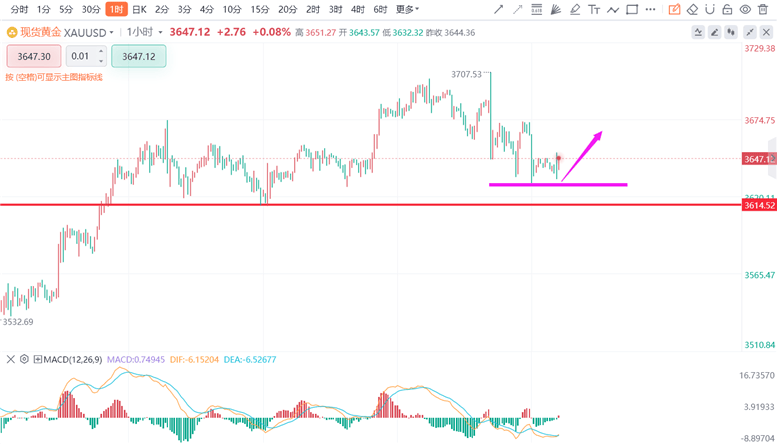
Group 1 - The core viewpoint indicates that gold has failed to break through the resistance level of $3705 twice, suggesting the formation of a double top pattern, which is nearly confirmed [2] - Gold has turned downward, breaking below the 5-day moving average, with the daily RSI retreating from high levels, indicating a weakening short-term trend [2] - The key support area to watch is between $3613 and $3620, where a rebound could occur if prices remain above this level [2] Group 2 - In the four-hour analysis, after breaking resistance earlier in the week, gold has faced new resistance at $3674, which is now a critical dividing line for short-term trends [2] - A significant drop occurred after failing to hold above the $3675 resistance level, with potential declines towards $3625 and testing the $3600 to $3580 range [2] - Domestic gold prices have been advised to exit all long positions before the Federal Reserve's interest rate decision, with new long positions suggested at $830 for Shanghai gold and $820 for accumulated gold [2]
黄金日内双顶形态确认!颈线3392反弹不破,空头下跌能否延续?立即观看超V推荐官Jason的讲解,直播间可领取超V9.9体验包>>>
news flash· 2025-07-22 09:44
Group 1 - The article discusses the confirmation of a double top pattern in gold prices, indicating potential bearish trends if the neckline at 3392 is not broken [1] - It raises the question of whether the downward movement of the bears can continue, suggesting a focus on market sentiment and technical analysis [1]
白银32.5美元盘整待变:黄金新高能否带动银价突破?
Sou Hu Cai Jing· 2025-04-24 02:31
Core Viewpoint - Silver is currently experiencing a period of consolidation around the $32.5 mark, contrasting sharply with gold's recent record highs, amid a backdrop of a weak dollar and high policy uncertainty [2] Group 1: Technical Analysis - Silver is oscillating within a narrow range between the support level of $32.40 and the resistance level of $32.80, with MACD indicators showing weak short-term momentum (DIFF=-0.027, DEA=-0.017) and RSI at 47.32 indicating a neutral stance [3] - A "double top" pattern has formed as silver failed to break the $33 mark twice, and a drop below $32.20 could trigger technical selling, potentially leading to a decline towards the $32 support level [3] - The daily chart indicates a more complex situation, with a significant selling pressure at high levels, and the price between $32 and $33 acting as a "watershed" for bulls and bears [3] Group 2: Dollar and Policy Variables - The policy divergence between Trump and Fed Chairman Powell is a core variable affecting silver, with their public disputes over interest rate cuts putting pressure on the dollar index, thereby increasing the attractiveness of silver priced in dollars [4] - Despite rising concerns about trade uncertainties, the recent statement from U.S. Treasury Secretary Mnuchin about easing trade tensions has led to a significant drop in gold prices, raising questions about silver's potential reaction [5] Group 3: Market Sentiment - The precious metals market is currently characterized by a "gold leads, silver lags" dynamic, with gold benefiting from central bank purchases and ETF inflows, while silver's follow-through effect remains limited [6] - Silver's volatility is typically higher than gold, suggesting that its delayed response could lead to explosive movements once key price levels are breached [6] - Despite a drop in U.S. stocks, gold has not experienced a significant sell-off, indicating that safe-haven funds are still flowing into precious metals, which could eventually benefit silver if sentiment shifts [6] Group 4: Key Challenges and Opportunities - For bulls, breaking through the $33 mark requires overcoming three significant obstacles, while bears need to be cautious of two major risks [8] - Morgan Stanley's report highlights that despite short-term volatility, silver retains medium to long-term upward momentum due to recession risks and de-dollarization trends, suggesting investors should watch for opportunities around the $32 support level [8] - The current consolidation at $32.5 is a battleground for both bulls and bears, with the strength of defense at $32 and the breakthrough potential at $33 determining the future price trajectory of silver [8]