地缘政治和经济不确定性

Search documents
2025年全球黄金总需求创历史新高 高金价压制金饰需求
Sou Hu Cai Jing· 2026-01-29 11:20
Core Insights - The World Gold Council's report indicates that global gold demand is projected to reach 5002 tons in 2025, marking a historical high, with a total demand value of $555 billion [1] - China's gold demand is expected to hit 1003 tons in 2025, a 6% increase year-on-year, representing the highest level since 2021, with a total demand value of 796 billion yuan [1] Investment Demand - Global gold investment demand is set to rise to 2175 tons, becoming the main driver for the record-breaking total demand in 2025 [1] - Gold ETFs are projected to see a net increase of 801 tons, while physical gold investment demand remains strong, with bar and coin demand reaching 1374 tons, valued at $154 billion [1] - China and India are leading the investment demand growth, with increases of 28% and 17% respectively, together accounting for over 50% of this segment's demand [1][2] Jewelry Demand - Global gold jewelry demand is expected to decline by 18% in 2025 compared to 2024, despite a year-on-year increase of 18% in consumption value to $172 billion [1] - In China, gold jewelry demand is projected to decrease by 25% to 360 tons, while total spending is expected to rise by 8% to 281.4 billion yuan [1] Market Trends - In Q4, China's demand for gold bars and coins surged by 61% quarter-on-quarter and 42% year-on-year, reaching 119 tons [2] - The report highlights a shift towards more affordable gold jewelry products due to high gold prices and stagnant income growth, with lightweight hard gold products gaining popularity among younger consumers [2] Central Bank Activity - Global central bank gold purchases are expected to remain high, with an increase of 863 tons in 2025, although not surpassing the previous three-year average of over 1000 tons [2] - China's official gold reserves are projected to increase by 27 tons, reaching a total of 2306 tons by year-end [2] Supply Dynamics - Global gold supply is expected to grow by 1% in 2025, reaching 5002 tons, with mine production slightly increasing to 3672 tons and recycled gold rising by 3% to 1404 tons [2] Future Outlook - The ongoing economic and geopolitical risks are expected to continue, with strong gold demand trends likely to persist into 2026, as indicated by the recent surge in gold prices [3] - The price of gold is anticipated to exceed $5000 per ounce at the beginning of 2026, reinforcing gold's role as a safe-haven asset during uncertain times [3]
FPG财盛国际:黄金劲爆行情突袭!特朗普关税传来大消息 金价暴涨52美元
Sou Hu Cai Jing· 2026-01-27 02:59
Group 1 - The core viewpoint of the news highlights the geopolitical and economic uncertainties that are supporting gold prices, with central banks diversifying their foreign exchange reserves and reducing dependence on the US dollar while remaining strong buyers [2] - The US President Trump announced an increase in tariffs on various goods from South Korea to 25% due to the lack of approval from the South Korean parliament on a previously agreed trade deal [1] - Speculation about coordinated intervention measures in the foreign exchange market by US and Japanese authorities has led to a surge in the yen and a decline in the US dollar index, which has fallen to a four-month low, benefiting gold prices [1] Group 2 - FPG analysts predict that gold prices, which have already risen nearly 18% this year, could continue to rise towards $5,200 per ounce, with a historical high of $5,111 per ounce reached before a pullback [2] - The return of investors to physical gold ETFs has resulted in a year-on-year increase of approximately 20% in holdings, further supporting gold prices [2] - If gold prices fall below $5,050 per ounce, it could pave the way for a decline to $5,000 per ounce or lower, with the next support level identified at $4,899 per ounce [2]

市场快讯-COMEX白银站上100美元(20260124)
格林大华期货· 2026-01-24 04:40
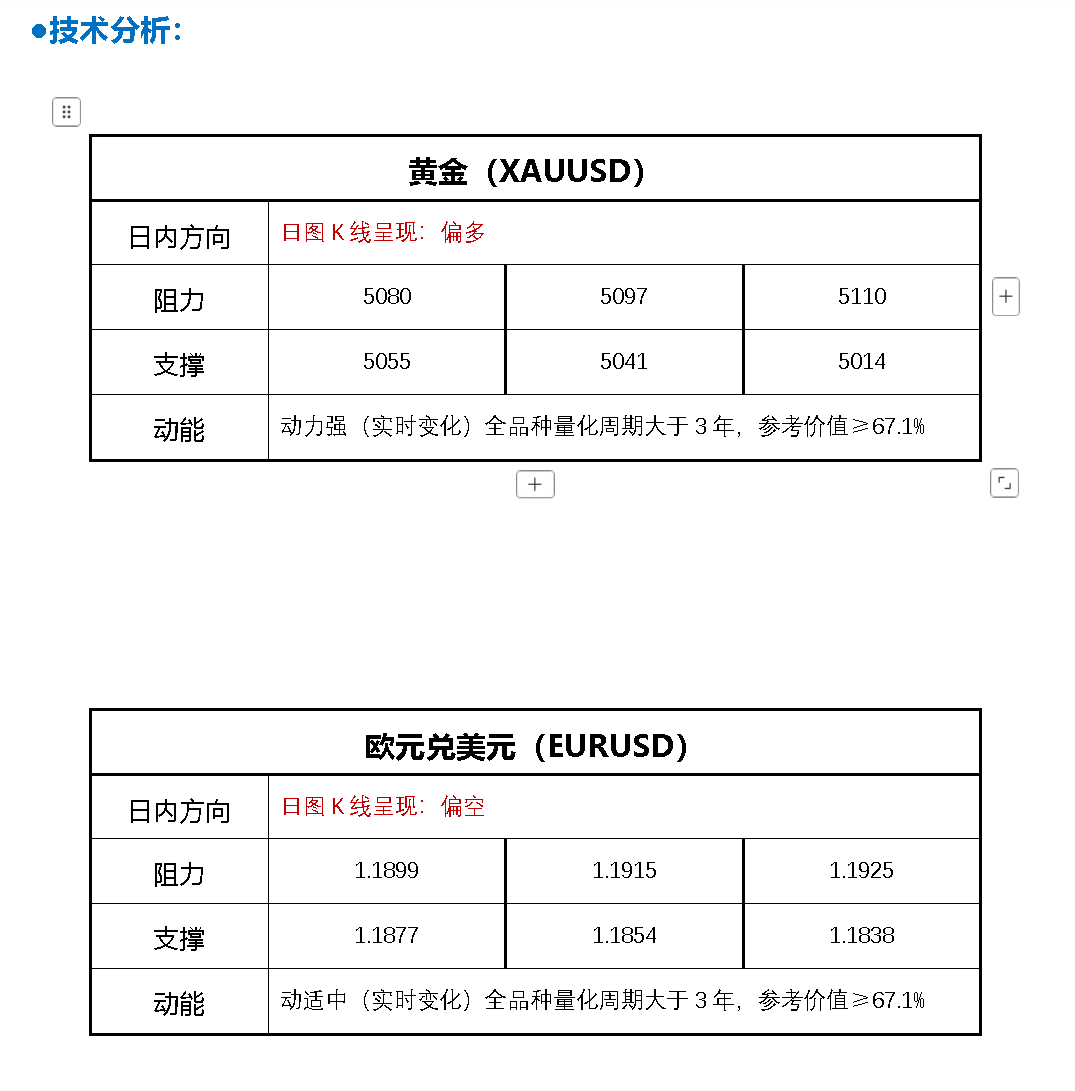
Market Performance - On January 23, COMEX silver futures rose by 7.15%, closing at $103.26 per ounce[2] - COMEX gold futures increased by 1.42%, closing at $4983.10 per ounce[2] Geopolitical Factors - Geopolitical tensions, including U.S. military movements towards Iran, have heightened demand for safe-haven assets like gold and silver[2] - The weakening of the U.S. dollar, which fell by 1.88% to a value of 97.51, contributed to the rise in precious metals[2] Market Expectations - The likelihood of a Federal Reserve interest rate cut on January 28 is nearly zero, with expectations for the first cut in June 2026[2] - Short-term bullish sentiment in the silver and gold markets is increasing, with silver surpassing the $100 per ounce mark and gold approaching $5000 per ounce[2] Risk Management - Despite a positive long-term outlook, short-term volatility may increase, prompting exchanges to potentially raise margin requirements and limit new positions[2] - Investors are advised to maintain long positions while managing risk effectively[2]
富格林:识鉴欺诈倚仗方策畅顺出金
Sou Hu Cai Jing· 2026-01-14 02:34
Core Viewpoint - The article discusses the impact of U.S. inflation data and geopolitical uncertainties on commodity prices, particularly gold, silver, and oil, highlighting market reactions and trends in response to these factors [1]. Group 1: Gold and Silver Market - Spot gold reached a historical high but ultimately closed down by 0.26% at $4,585.95 per ounce due to profit-taking by traders after initial gains [1]. - Spot silver hit a historical peak of $89.12 before retreating, ultimately closing up 2.14% at $86.91 per ounce [1]. Group 2: Oil Market - Concerns over potential reductions in Iranian exports due to geopolitical tensions and Trump's announcement of a 25% tariff on countries doing business with Iran led to an increase in international oil prices [1]. - WTI crude oil closed up 2.11% at $61.09 per barrel, while Brent crude oil rose 1.79% to $65.44 per barrel [1]. Group 3: U.S. Economic Indicators - The U.S. Consumer Price Index (CPI) growth remained stable in December, with core CPI slightly below expectations, leading to mixed reactions from market participants [1]. - The ADP weekly employment report indicated that private sector employers added an average of 11,750 jobs per week over the four weeks ending December 20, 2025 [1]. - Federal Reserve's Musalem noted limited reasons for further policy easing in the short term, emphasizing that inflation risks may be more persistent than anticipated [1].
世界黄金协会2026年黄金展望:继续推进还是回撤?
Xin Lang Cai Jing· 2025-12-04 09:28
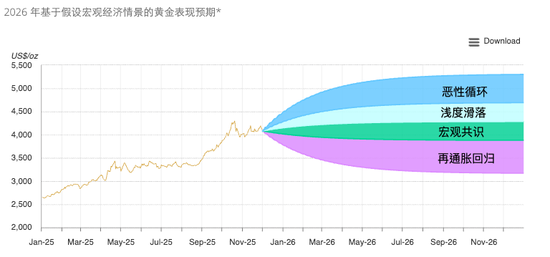
Core Viewpoint - Gold is expected to perform strongly in 2025, achieving over 50 historical highs and a cumulative increase of over 60%, driven by geopolitical tensions, economic uncertainty, a weakening dollar, and enhanced price momentum [1][4][27] - The World Gold Council anticipates that the outlook for 2026 will still be dominated by ongoing geopolitical and economic uncertainties, with gold prices likely to remain in a range-bound fluctuation [1][24] Group 1: 2025 Performance - Gold's significant rise in 2025 is attributed to strong geopolitical and economic pressures, alongside a generally weaker dollar and slight interest rate declines [4][27] - Investment demand for gold has surged globally, with central banks continuing to buy gold, although at levels lower than the record highs of previous years [4][27] - The four main factors contributing to the rise in gold prices this year are balanced, indicating that multiple forces are at play rather than a single dominant factor [6][27] Group 2: 2026 Outlook - The World Gold Council suggests that the macroeconomic data may show divergence, and the heavy geopolitical shadows will keep uncertainties high in 2026 [28][44] - Three potential scenarios for gold price movements in 2026 are outlined: "shallow decline," "vicious cycle," and "return of re-inflation," each with different implications for gold prices [26][29] - In a "shallow decline" scenario, gold could rise by 5% to 15% if economic slowdown and further interest rate cuts occur [30][32] - In a "vicious cycle" scenario, gold could increase by 15% to 30% due to significant declines in yields and heightened geopolitical pressures [33][34] - The "return of re-inflation" scenario could lead to a decline in gold prices by 5% to 20% if economic growth accelerates and interest rates rise [37][38] Group 3: Investment Demand and Central Bank Activity - Investment demand, particularly through gold ETFs, is expected to remain a core driver, offsetting weakness in jewelry and technology sectors [34][40] - Central bank purchases of gold are projected to remain strong, with estimates for 2025 indicating purchases between 750 to 900 tons [40][41] - The recovery supply of gold may also play a significant role, with low recovery rates potentially supporting prices, although economic slowdowns could trigger increased secondary supply [41][42]
世界黄金协会:金价明年可能保持区间波动 或将继续带来惊喜
Di Yi Cai Jing· 2025-12-04 08:49
Core Insights - The World Gold Council released a 2026 outlook indicating that gold had a remarkable 2025, achieving over 50 historical highs with a return rate exceeding 60% [1] - This performance was supported by increased geopolitical and economic uncertainty, a weakening dollar, and positive price momentum [1] - Both investors and central banks increased their allocation to gold, seeking diversification and stability [1] - The geopolitical economic uncertainty is expected to influence gold's outlook for 2026, with gold prices reflecting macroeconomic consensus expectations [1] - If current conditions persist, gold prices may remain within a range, but 2026 is likely to continue delivering surprises based on this year's trends [1]
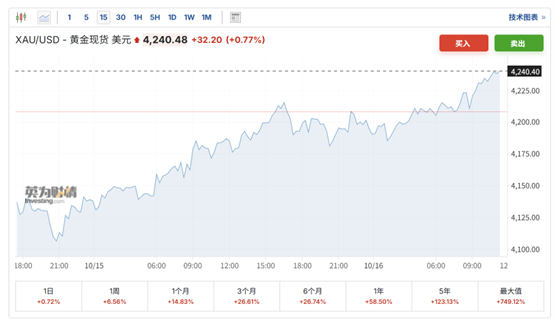
现货黄金站上4240美元,又一大行“撕报告”:年底看向4400美元
Feng Huang Wang· 2025-10-16 05:23
Group 1 - The core viewpoint is that the recent surge in gold prices is expected to continue due to geopolitical and economic uncertainties, as well as the Federal Reserve's easing policies [1][3] - ANZ analysts predict that gold prices will reach $4,400 by the end of 2025 and nearly $4,600 by June 2026, before a decline in the latter half of the following year [4] - The forecast for gold prices has been significantly revised upward from ANZ's previous predictions, with a target of $3,800 per ounce by the end of this year and a peak near $4,000 by June next year [4] Group 2 - The Federal Reserve is expected to lower interest rates four more times by March 2026, with a final rate stabilizing at 3.25%, which will benefit gold as a non-yielding asset [4] - Increased political and trade tensions, concerns over the independence of the Federal Reserve, and rising U.S. debt levels are anticipated to keep investment demand for gold high [4] - Silver prices are also expected to rise, potentially reaching $57.5 per ounce by June 2026, as investors look for opportunities in silver following gold's price increase [4] Group 3 - Recently, Bank of America also raised its price targets for gold and silver, setting the 2026 gold target at $5,000 per ounce and silver at $65 per ounce, with average annual price predictions of $4,400 and $56.25 respectively [5]

以色列央行行长:以色列的地缘政治和经济不确定性仍然处于非常高的水平。
news flash· 2025-07-07 13:40
Group 1 - The Governor of the Bank of Israel stated that geopolitical and economic uncertainty in Israel remains at a very high level [1]
秦氏金升:3.24金价短线震荡,黄金行情走势分析及操作建议
Sou Hu Cai Jing· 2025-03-24 19:52
Core Viewpoint - Gold prices are stabilizing after reaching a historical high, with traders awaiting new market catalysts [1][3] Group 1: Market Analysis - As of March 24, the spot gold price has slightly risen to around $3,030 per ounce, following a previous peak of $3,057.21 per ounce [1] - The recent price fluctuations are attributed to a rebound in the US dollar index and a correction from the upward trend observed this year [3] - The current support level for gold is at $3,000, with potential technical selling if it falls below this threshold, possibly leading to further declines to $2,982-$2,978 or even $2,956-$2,954 [3] Group 2: Future Outlook - The outlook for gold remains bullish due to ongoing geopolitical and economic uncertainties, alongside expectations of interest rate cuts by the Federal Reserve [3] - If gold prices continue to break above $3,050 per ounce, it could signal a further upward movement towards $3,100-$3,200 per ounce, although this scenario currently appears unlikely [5] - Short-term price movements will depend on risk sentiment and economic data, with a focus on upcoming PMI and PCE data releases [5]