均衡利率

Search documents
外资行美债&汇率2026展望汇总
2025-12-31 16:02
Summary of Key Points from the Conference Call Records Industry Overview - The conference call records focus on the U.S. Treasury market and interest rate outlook for 2026, with insights from various financial institutions including Barclays, HSBC, Morgan Stanley, Deutsche Bank, and Bank of America Merrill Lynch. Core Insights and Arguments U.S. Treasury Market Outlook 1. **Yield Curve Dynamics**: - Barclays predicts a steepening of the yield curve, with 2-year yields expected to drop to 3.1% and 30-year yields remaining around 4.7%, resulting in a 2s30s spread of 160 basis points [6][10]. - HSBC anticipates a bear steepening of the yield curve, projecting a 10-year yield of 4.30% by the end of 2026 [15][19]. - Morgan Stanley suggests that the Fed's rate cuts may be less than market expectations, with a forecast of only 50 basis points of cuts [25][26]. 2. **Federal Reserve Policy**: - The new leadership at the Federal Reserve is expected to adopt a more dovish stance, potentially lowering rates below neutral levels [6][7]. - The Fed is projected to end quantitative tightening (QT) and begin purchasing T-bills to maintain adequate reserves, with an estimated purchase of $330 billion in T-bills in 2026 [10][31]. 3. **Fiscal Deficit and Inflation**: - The fiscal deficit is expected to remain around 6% of GDP, approximately $1.9 trillion, with inflation projected to stabilize around 2% [6][10][25]. - Concerns about inflation resurgence due to fiscal expansion and tariff impacts are highlighted, with core PCE inflation expected to remain above 2% [41][48]. Supply and Demand Dynamics 1. **Net Supply Projections**: - A significant reduction in net supply of U.S. Treasuries is anticipated, with a decrease of approximately $470 billion to $1.2 trillion in 2026 [6][58]. - Investment-grade corporate bonds are expected to see an increase in net supply, driven by mergers and acquisitions [58]. 2. **Market Demand**: - Bank demand for mid-term Treasuries is expected to rebound due to regulatory changes [9]. - Continuous inflows into bond funds are supporting demand, particularly for MBS, which are favored due to their attractive spreads [58][62]. Investment Recommendations 1. **Asset Recommendations**: - Barclays recommends going long on 2-year Treasuries to capitalize on anticipated rate cuts [10]. - HSBC suggests positioning in the belly of the curve (5-year Treasuries) for lower structural risk and positive carry [21]. - Deutsche Bank advises a cautious approach to long-dated Treasuries, predicting underperformance relative to swaps [39]. 2. **Strategic Themes**: - "Carry is king" is emphasized as a core investment strategy, focusing on high-yield bonds and leveraged loans due to their attractive coupon rates in a stable interest rate environment [41][47]. - The potential for a bear steepening of the yield curve is noted, with strategies to exploit this dynamic [21][47]. Other Important Insights - The reports highlight a complex economic landscape characterized by resilient growth, sticky inflation, and the dual risks of fiscal deterioration and inflation rebound [7][17]. - The impact of AI-driven capital expenditures and fiscal stimulus from legislation like the One Big Beautiful Bill Act (OBBBA) is noted as a potential growth driver [41][48]. - The need for caution regarding economic recession risks and policy uncertainties is emphasized, particularly in relation to tariffs and Fed independence [26][37]. This summary encapsulates the key points from the conference call records, providing a comprehensive overview of the U.S. Treasury market outlook and associated investment strategies for 2026.
美联储的AI困局:学格林斯潘是“死路”,不降息是“绝路”
美股研究社· 2025-12-01 10:49
Core Viewpoint - The current narrative surrounding AI is pushing the Federal Reserve into a dilemma, where following Greenspan's approach could lead to dangerous outcomes, while not lowering interest rates could result in severe market consequences [2][5]. Group 1: Federal Reserve's Dilemma - The report from TS Lombard highlights two potential paths for the Federal Reserve: adopting a deflationary productivity boom similar to the 1990s or facing increased equilibrium interest rates due to significant capital expenditures [2][8]. - If the Fed lowers interest rates based solely on the expectation of AI enhancing productivity, it risks repeating the mistakes of the past, particularly given the current inflationary environment [2][5]. - Conversely, if the Fed does not lower rates, it may inadvertently push the market into a crisis, especially if inflation resurfaces as a primary concern by 2026 [2][3]. Group 2: Historical Context and Lessons - Greenspan's strategy of "cleaning up rather than intervening" suggests that the Fed may not actively burst asset bubbles but will respond post-factum [3][15]. - Potential candidates for the Fed chair are positioning themselves as successors to Greenspan, citing the AI revolution as a justification for lowering rates, despite historical lessons indicating caution [5][6]. - The dual legacy of Greenspan illustrates the Fed's challenge in balancing the benefits of technological advancements against the risks of rising equilibrium interest rates [6][8]. Group 3: Key Questions Influencing Policy - The report identifies three critical questions that will shape the Fed's policy direction: 1. Whether large-scale capital expenditures in the tech sector will be inflationary [10]. 2. The potential for AI to deliver productivity gains similar to those seen in the 1990s [12]. 3. Who will benefit from the productivity improvements brought about by AI [13][14]. Group 4: Economic Implications of AI - AI could act as a deflationary force if productivity increases while wage growth remains stable, leading to lower unit labor costs and potentially lower prices for consumers [8][12]. - However, a surge in capital expenditures driven by AI may elevate equilibrium interest rates, necessitating a careful approach from the Fed to avoid overly loose monetary policy [8][10]. - Historical data suggests that during the 1990s, wage growth outpaced productivity growth, indicating that workers may benefit more from productivity gains than corporations [12][13].


美联储的AI困局:学格林斯潘是“死路”,不降息是“绝路”
华尔街见闻· 2025-11-29 13:26
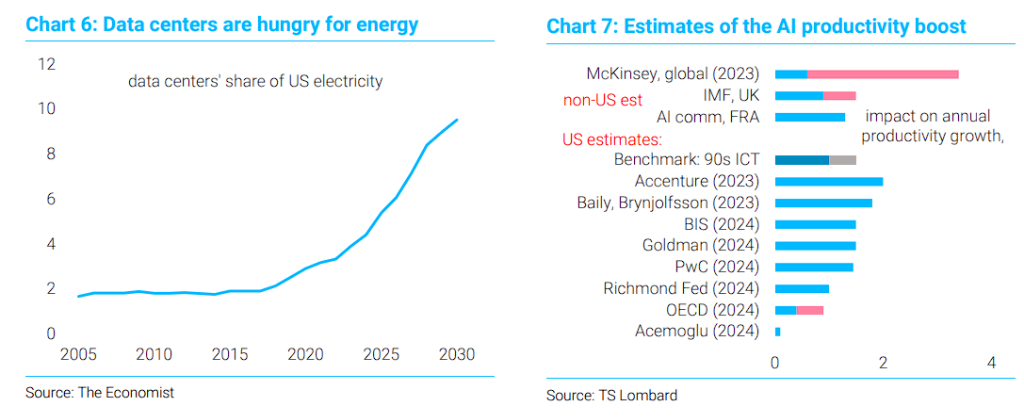
Core Viewpoint - The current narrative surrounding AI is pushing the Federal Reserve into a dilemma, where following Greenspan's approach could lead to dangerous outcomes, while not lowering interest rates could result in severe consequences for the market [1][2]. Group 1: Federal Reserve's Dilemma - The report from TS Lombard highlights that AI could either lead to a deflationary productivity boom similar to the 1990s or push up the equilibrium interest rate (r*), creating two opposing monetary policy paths [1]. - If the Federal Reserve lowers interest rates based solely on the expectation of increased productivity from AI, it risks repeating the mistakes of the past, particularly given the current inflation environment is less favorable than in the 1990s [1][5]. - Conversely, if the Federal Reserve does not lower rates, it may inadvertently push the market into a crisis, especially if inflation resurfaces as a primary concern by 2026 [1][2]. Group 2: Greenspan's Legacy - The report discusses Greenspan's dual legacy, where potential successors to the Federal Reserve chair are attempting to position themselves as inheritors of his policies, citing the AI revolution as a justification for lowering rates [3][4]. - Greenspan's 1996 decision to delay rate hikes based on underestimated productivity growth is noted as a pivotal moment, which was later contradicted by his 2000 shift towards tightening monetary policy due to rising equilibrium rates [5][6]. Group 3: Key Questions Influencing Policy - Three critical questions are identified that will shape the Federal Reserve's policy direction: 1. Whether large-scale capital expenditures in the tech sector will be inflationary, with concerns that increased energy consumption from data centers could pose inflation risks [8]. 2. The potential for AI to deliver productivity gains akin to those seen in the 1990s, with estimates of AI's contribution to productivity varying significantly among experts [10]. 3. Who will benefit from productivity gains, as historical trends suggest that workers, rather than corporations, may reap the rewards [11][12]. Group 4: AI's Economic Impact - AI could act as a deflationary force if productivity increases while wage growth remains stable, leading to lower unit labor costs and potentially lower prices for consumers [12]. - However, the surge in capital expenditures driven by AI may also elevate equilibrium interest rates, necessitating careful monitoring by the Federal Reserve to avoid overly loose monetary policy [12][14]. Group 5: Market Implications - The Federal Reserve's traditional approach of "cleaning up after the fact" rather than preemptively intervening in asset bubbles is emphasized, suggesting that while they may not actively burst bubbles, they could do so inadvertently [14][15]. - The current inflation dynamics are less favorable than those in the 1990s, which could lead to higher risks if the Federal Reserve attempts to replicate Greenspan's strategies in a different economic context [15].
美联储的AI困局:学格林斯潘是“死路”,不降息是“绝路”
美股IPO· 2025-11-28 12:42
Core Viewpoint - The AI revolution presents a dilemma for the Federal Reserve: lowering interest rates due to anticipated productivity gains could be risky in the current inflationary environment, while not lowering rates may lead to forced hikes in 2026 if inflation resurges, potentially bursting asset bubbles [1][3][12]. Group 1: Federal Reserve's Dilemma - The current narrative surrounding AI is pushing the Federal Reserve into a predicament where emulating Greenspan's approach could lead to dangerous outcomes, while not lowering rates could also result in severe market consequences [3][6]. - If the Federal Reserve lowers rates based on expected productivity gains from AI, it risks ignoring the current inflation environment, which is less favorable than in the 1990s [3][5]. - Conversely, if the Federal Reserve does not lower rates and inflation returns in 2026, it may be forced to tighten policy, which could inadvertently trigger a market collapse [3][12]. Group 2: Historical Context and Lessons - Greenspan's strategy of "cleaning up rather than intervening" suggests that the Federal Reserve may not actively burst bubbles but could inadvertently do so through its policies [4][13]. - The report highlights that potential candidates for the Federal Reserve chair are attempting to position themselves as successors to Greenspan, advocating for rate cuts based on the AI revolution [5][6]. - Historical data shows that during the 1990s, productivity growth was underestimated, leading to a significant increase in interest rates when inflation concerns arose, which ultimately contributed to the bursting of the internet bubble [5][11]. Group 3: Key Questions Influencing Policy - Three critical questions will determine the Federal Reserve's policy path: 1. Whether large-scale capital expenditures in the tech sector are inflationary [8]. 2. The potential for AI to deliver productivity gains similar to those seen in the 1990s [10]. 3. The balance between AI's deflationary effects and its potential to raise equilibrium interest rates [11][12]. Group 4: Economic Implications of AI - AI could act as a deflationary force if productivity increases while wage growth remains stable, leading to lower unit labor costs and potentially lower prices for consumers [11][12]. - However, the surge in capital expenditures driven by AI may push up equilibrium interest rates, necessitating a careful balance in monetary policy [11][12]. - The report indicates that the actual benefits of AI may primarily accrue to workers rather than corporations, contrasting with the historical narrative of the 1990s [12].
美联储的AI困局:学格林斯潘是“死路”,不降息是“绝路”
Hua Er Jie Jian Wen· 2025-11-28 12:36
Core Insights - The current narrative surrounding AI is pushing the Federal Reserve into a dilemma, where lowering interest rates could lead to dangerous outcomes, while not lowering rates could push the market into a crisis [1][4] Group 1: Federal Reserve's Dilemma - The report from TS Lombard highlights that AI could either lead to a deflationary productivity boom similar to the 1990s or push up the equilibrium interest rate (r*), resulting in contrasting monetary policy paths [1][4] - Lowering interest rates based on the expectation of AI enhancing productivity is deemed a "dead end," as the current inflation environment is less favorable than in the 1990s [1][3] - Not lowering rates could lead to a scenario where inflation resurfaces in 2026, forcing the Federal Reserve to adopt tightening policies, which could inadvertently burst market bubbles [1][4] Group 2: Historical Context and Lessons - The report discusses Alan Greenspan's strategy of "cleaning up rather than intervening," suggesting that future Federal Reserve chairs may follow this approach, especially those appointed by pro-technology leaders [2][12] - Greenspan's legacy is complex, as he initially delayed rate hikes in the 1990s due to underestimating productivity growth, but later raised rates to prevent excessive monetary policy [3][4] - The historical context indicates that simply advocating for rate cuts based on past experiences with Greenspan overlooks the nuanced challenges faced by the Federal Reserve during technological revolutions [4][12] Group 3: Key Questions Influencing Policy - Three critical questions will shape the Federal Reserve's policy path: 1. Whether large-scale capital expenditures in the tech sector are inflationary [6] 2. If AI can deliver productivity gains similar to those seen in the 1990s [10] 3. Who benefits from productivity improvements, with historical trends suggesting workers may gain more than corporations [11] Group 4: Economic Implications of AI - AI could act as a powerful deflationary force if productivity increases while wage growth remains stable, leading to lower unit labor costs and potentially lower prices for consumers [7] - Conversely, the surge in capital expenditures driven by AI may elevate the equilibrium interest rate, as higher expected returns on capital encourage significant investments [7][10] - The report notes that the potential for AI to replicate the productivity growth of the 1990s is uncertain, with estimates of AI's contribution to productivity varying widely among experts [10][11] Group 5: Future Considerations - The Federal Reserve's traditional approach of not actively bursting asset bubbles may lead to unintended consequences if inflation becomes a primary concern again [12] - The current inflation dynamics are less favorable than those in the 1990s, which could complicate attempts to replicate Greenspan's policies without risking a tech bubble [12]