科创新能源ETF易方达

Search documents
公募基金大搞GEO营销,投资者需防范AI选基陷阱
市值风云· 2026-03-18 10:16
Core Viewpoint - The article emphasizes the urgent need to prevent information pollution in the context of AI-generated financial recommendations, highlighting the potential biases and risks associated with AI marketing strategies in the investment industry [3][9]. Group 1: AI and Investment Recommendations - AI tools are increasingly used to generate investment recommendations, but their objectivity may be compromised by marketing influences from fund companies [6][9]. - A case study shows that an AI tool recommended three ETFs, all from the same fund company, raising concerns about the impartiality of such recommendations [4][6]. Group 2: Marketing Strategies in Fund Industry - The marketing landscape for public funds is shifting from traditional search engine optimization to Generative Engine Optimization (GEO), which prioritizes specific brands and products in AI-generated responses [7]. - Reports indicate that a fund's recommendation rate in AI systems can significantly increase through targeted marketing efforts, with one fund's visibility rising from 8% to 69% after optimization [7][8]. Group 3: Risks of Information Pollution - The practice of feeding AI with biased data can lead to information pollution, making it difficult for investors to discern objective recommendations from marketing-driven content [9]. - Investors relying solely on AI-generated recommendations may fall into traps of algorithmic bias and hidden interests, especially if the marketing support ceases [9][10]. Group 4: Investor Education - It is crucial for investors to enhance their financial literacy and view AI as a tool for data collection rather than a decision-making authority [10].

加仓!资金大幅涌入这些方向
Zhong Guo Zheng Quan Bao· 2026-02-08 23:07
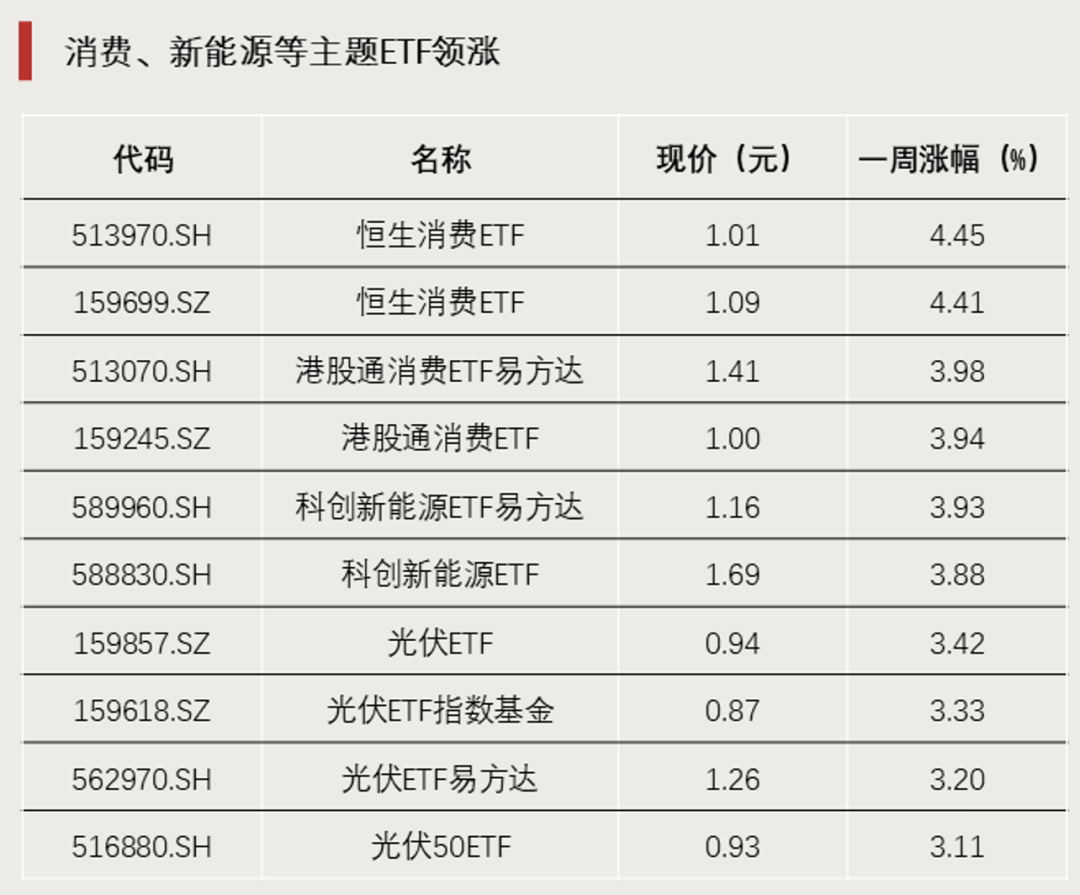
Group 1: Market Performance - The consumption and photovoltaic sectors saw significant gains last week, with several related ETFs, such as the E Fund Consumption ETF (513070) and E Fund New Energy ETF (589960), recording over 3% weekly increases [1][4] - Conversely, gold and artificial intelligence sectors experienced notable adjustments, with multiple related ETFs declining over 9% [1][6] Group 2: Trading Activity - The A-share market saw active trading in broad-based products, with the A500 ETF (159361) and others tracking the CSI A500 index achieving a total trading volume exceeding 254.8 billion yuan [2][8] - The Hang Seng Technology sector attracted significant capital inflow, with ETFs like the E Fund Hang Seng Technology ETF (513010) seeing substantial net inflows [3][10] Group 3: Sector Highlights - The Hang Seng Consumption ETF (513070) tracked the CSI Hong Kong Consumption Index, which rose over 4%, while the E Fund New Energy ETF (589960) and E Fund Photovoltaic ETF (562970) tracked indices that increased over 3% [4][5] - The gold sector showed weakness, with all 14 commodity gold ETFs declining over 5%, and some gold stock ETFs dropping more than 13% [6][7] Group 4: Future Outlook - Industry experts express optimism for the Hong Kong consumption sector in 2026, focusing on high-dividend consumer stocks, resilient domestic demand sectors like education, and timing strategies for new consumption sectors [5] - The market is expected to shift focus towards macroeconomic and industrial cues post-holiday, with a clearer framework for high-quality development and new-old kinetic energy conversion [12]
资金加仓恒生科技等赛道 宽基核心资产受关注
Zhong Guo Zheng Quan Bao· 2026-02-08 21:55
Group 1 - The consumer and photovoltaic sectors saw significant gains last week, with several related ETFs rising over 3% [1][2] - The A-share market's broad-based products experienced active trading, with ETFs tracking the CSI A500 index exceeding a total transaction volume of 250 billion yuan [1][2] - The market outlook for February suggests a continuation of the upward trend, driven by concentrated earnings forecasts and the recovery of leading companies' performance [1][4] Group 2 - The Hong Kong consumer sector performed strongly, with ETFs such as the Hang Seng Consumer ETF leading the gains [2] - Gold-related ETFs faced a downturn, with an average decline of over 5% across 14 commodity gold ETFs, and some gold stock ETFs dropping more than 13% [2] - The technology sector attracted significant capital inflow, with the Huatai-PineBridge Hang Seng Technology ETF seeing a net inflow of over 3.8 billion yuan last week [3] Group 3 - Several asset management institutions have released macro outlooks for China's equity market in 2026, highlighting diverse growth paths driven by the 14th Five-Year Plan [4][5] - Key investment areas identified include technology, manufacturing, renewable energy, healthcare, and emerging consumer sectors [4][5] - The market is expected to maintain a structural trend in February, with a focus on core growth assets that are currently at historical median valuation levels [5]
资金加仓恒生科技等赛道宽基核心资产受关注
Zhong Guo Zheng Quan Bao· 2026-02-08 20:22
Group 1 - The consumer and photovoltaic sectors saw significant gains, with several related ETFs rising over 3% last week, while gold and artificial intelligence sectors experienced declines, with some ETFs dropping over 9% [1][2] - A-shares market showed active trading in broad-based products, with ETFs tracking the CSI 500 index exceeding a total trading volume of 250 billion yuan, and those tracking the Sci-Tech 50 index surpassing 30 billion yuan [1][2] - The market outlook for February suggests a continuation of the upward trend, driven by concentrated earnings forecasts and the recovery of leading companies' performance, benefiting core assets [1][4] Group 2 - The Hong Kong consumer sector performed strongly, with ETFs such as the Hang Seng Consumer ETF leading the gains, while the photovoltaic sector also showed positive performance [1] - The gold sector underperformed, with commodity gold ETFs declining over 5%, and gold stock ETFs experiencing even greater declines, with some dropping over 13% [2] - The technology sector attracted significant capital inflow, with the Hang Seng Technology ETFs seeing substantial net inflows, particularly the Huatai-PineBridge Hang Seng Technology ETF, which had a net inflow of over 3.8 billion yuan last week [2] Group 3 - The satellite communication sector also experienced notable capital inflow, with the Yongying National Commercial Satellite Communication Industry ETF seeing a net inflow of over 1.8 billion yuan [3] - Several ETFs, including the Huazhong Gold ETF and the Southern CSI Nonferrous Metals ETF, reported net inflows exceeding 10 billion yuan this year [3] - Investment firms are focusing on five key areas for the Chinese equity market by 2026: technology, manufacturing, renewable energy, healthcare, and emerging experiential consumption [3] Group 4 - The market is expected to stabilize in February, with a shift in focus from January's credit and liquidity performance to macro and industry clues [4] - The "14th Five-Year Plan" is anticipated to provide a clearer framework for high-quality development and new growth drivers, stabilizing market perceptions of future growth [4] - Core assets are recommended for continued attention, as their valuations are at historical median levels, with stable profit expectations and increasing foreign capital inflow [4]
Space X催化下卫星主题强势回归,聚焦太空光伏+固态电池的科创新能源ETF易方达(589960)涨超4.5%
Ge Long Hui· 2026-02-03 07:17
Group 1 - The core viewpoint of the article highlights the significant rise in the space photovoltaic industry, driven by SpaceX's acquisition of xAI, which integrates resources across AI, rockets, and space internet [1] - SpaceX's acquisition is seen as a step towards completing the puzzle of space computing power, with the domestic industry benefiting directly from this development [1] - The article emphasizes that the space photovoltaic sector is on the verge of large-scale deployment, fueled by new demands from "space computing power + AI" and the ongoing competition for low Earth orbit resources [1] Group 2 - The E Fund's Innovation Energy ETF (589960) has seen a rise of over 4.5%, focusing on new energy companies in the Sci-Tech Innovation Board, with nearly 50% weight in space photovoltaics and about 40% in solid-state battery themes [1] - Solid-state batteries, as the next-generation battery technology, are noted for their higher energy density and smaller size, making them suitable for satellite applications and likely to benefit from the space computing power development [1] - CITIC Securities asserts that the growth of space photovoltaics is not speculative but rather a response to emerging demands and competitive dynamics in the industry [1]
ETF午评 | 两只巴西ETF涨停,大宗商品板块掀涨停潮,黄金股ETF涨超8%
Ge Long Hui· 2026-01-28 05:12
Market Overview - The three major A-share indices showed mixed performance in the morning session, with the Shanghai Composite Index up by 0.49%, the Shenzhen Component Index up by 0.09%, and the ChiNext Index down by 0.37% [1] - The total trading volume in the Shanghai, Shenzhen, and Beijing markets reached 19,307 billion yuan, an increase of 402 billion yuan compared to the previous day [1] - Over 3,500 stocks in the market experienced declines [1] Sector Performance - The sectors that saw significant gains included gold, non-ferrous metals, oil and natural gas, chemical industry, coal, agriculture, real estate, securities, port shipping, copper cable high-speed connections, and cloud computing [1] - Conversely, sectors that faced declines included photovoltaic equipment, biopharmaceuticals, photolithography machines, military equipment, education, and PEEK materials [1] ETF and Commodity Trends - Two Brazilian ETFs hit the daily limit up [1] - The commodity sector experienced a surge, with the Yongying Fund Gold Stock ETF and the Huaxia Fund Gold Stock ETF rising by 8.56% and 8.47%, respectively [1] - The Huatai-PB Fund China-Korea Semiconductor ETF increased by 5.35%, while oil stocks strengthened, with the Yinhua Fund Oil and Gas Resources ETF rising by 4.73% [1] - The photovoltaic sector declined, with the Sci-Tech Innovation Board New Energy ETF and the E Fund New Energy ETF falling by 3% and 2.99%, respectively [1] - The machinery sector also saw a downturn, with the Machinery ETF dropping by 2.84% [1]
新能源相关ETF集体回调 宽基ETF逆势“吸金”
Zhong Guo Zheng Quan Bao· 2025-11-23 21:45
Group 1: ETF Performance - The S&P Biotechnology ETF and Emerging Asia ETF led the gains from November 17 to 21, with weekly increases of 1.35% and 0.67% respectively [2] - During the same period, many bond ETFs saw increases, while renewable energy-related ETFs experienced significant declines, with the Sci-Tech Board Renewable Energy ETF dropping 13.44% [2][3] Group 2: Fund Flows - Several broad-based ETFs experienced net inflows, with the CSI 500 ETF (510500) seeing the highest net inflow of 5.778 billion yuan [3] - Other ETFs such as the ChiNext ETF, CSI 300 ETF (510300), and Sci-Tech 50 ETF also had net inflows exceeding 2 billion yuan each [3] Group 3: New Fund Approvals - On November 21, 16 hard technology-themed funds were approved, including seven Sci-Tech Entrepreneurship AI ETFs and three Sci-Tech Board Chip ETFs, indicating a focus on semiconductor and AI sectors [4] - This approval is expected to provide investors with tools to invest in the semiconductor industry and direct market funds towards hard technology sectors [4] Group 4: Market Outlook - Despite recent market adjustments, the overall downward space for A-shares is considered limited, with long-term bullish sentiment maintained by various funds [5][6] - The market is expected to continue a gradual upward trend, with recommendations to focus on technology, consumption, high-end manufacturing, and pharmaceuticals for investment opportunities [6]
新能源相关ETF集体回调宽基ETF逆势“吸金”
Zhong Guo Zheng Quan Bao· 2025-11-23 20:06
Group 1 - The core viewpoint of the articles highlights the performance of various ETFs, particularly the rise of cross-border ETFs and the decline of renewable energy-related ETFs during the period from November 17 to 21 [1][2][3] - The S&P Biotechnology ETF and Emerging Asia ETF led the gains among ETFs, with weekly increases of 1.35% and 0.67% respectively, while several renewable energy ETFs experienced significant declines, with the Sci-Tech Board New Energy ETF dropping 13.44% [1][2] - Despite the overall market adjustment, several broad-based ETFs saw substantial net inflows, with the CSI 500 ETF receiving the highest net inflow of 5.778 billion yuan during the same period [2][3] Group 2 - A notable trend is the premium observed in several cross-border ETFs, with the Nasdaq Technology ETF showing a premium rate exceeding 10% as of November 21, prompting multiple fund companies to issue risk warnings [2][3] - The approval of 16 hard technology-themed funds on November 21, including AI and semiconductor ETFs, indicates a growing interest in technology sectors, providing investors with tools to access the semiconductor industry [3] - The overall market sentiment remains cautious, with expectations of continued volatility, but the long-term outlook for A-shares is positive due to structural improvements in the domestic economy and supportive policies [4]
ETF收评 | 科技板块全线重挫,中韩半导体ETF、恒生互联网ETF分别跌4.45%和3.66%
Ge Long Hui· 2025-11-14 08:50
Market Performance - The Shanghai Composite Index fell by 0.97%, closing below the 4000-point mark after briefly turning positive during the day, marking a new 10-year high [1] - The ChiNext Index dropped by 2.82%, indicating a significant decline in the growth sector [1] Sector Performance - The computing and semiconductor industry chain led the decline, with storage chips, HBM, CPO, and advanced packaging showing the largest drops [1] - The chemical and non-ferrous metal sectors also experienced a pullback [1] - Conversely, the oil and gas sector showed resilience, with oil and gas ETFs from Bosera, Huatai-PineBridge, and Yinhua rising by 2%, 1.68%, and 1.48% respectively [1] - The new energy sector on the Sci-Tech Innovation Board rose against the trend, with ETFs from Fortune and E Fund both increasing by 1% [1] ETF Performance - The technology sector faced widespread declines, with the Hang Seng Internet ETF and the Guotai AI ETF falling by 3.66% and 3.64% respectively [1] - The semiconductor sector was particularly weak, with the China-Korea Semiconductor ETF and the Chip ETF dropping by 4.45% and 3.55% respectively [1]
ETF市场日报 | 油气相关ETF逆市领涨!AI资产回调居前
Sou Hu Cai Jing· 2025-11-14 07:54
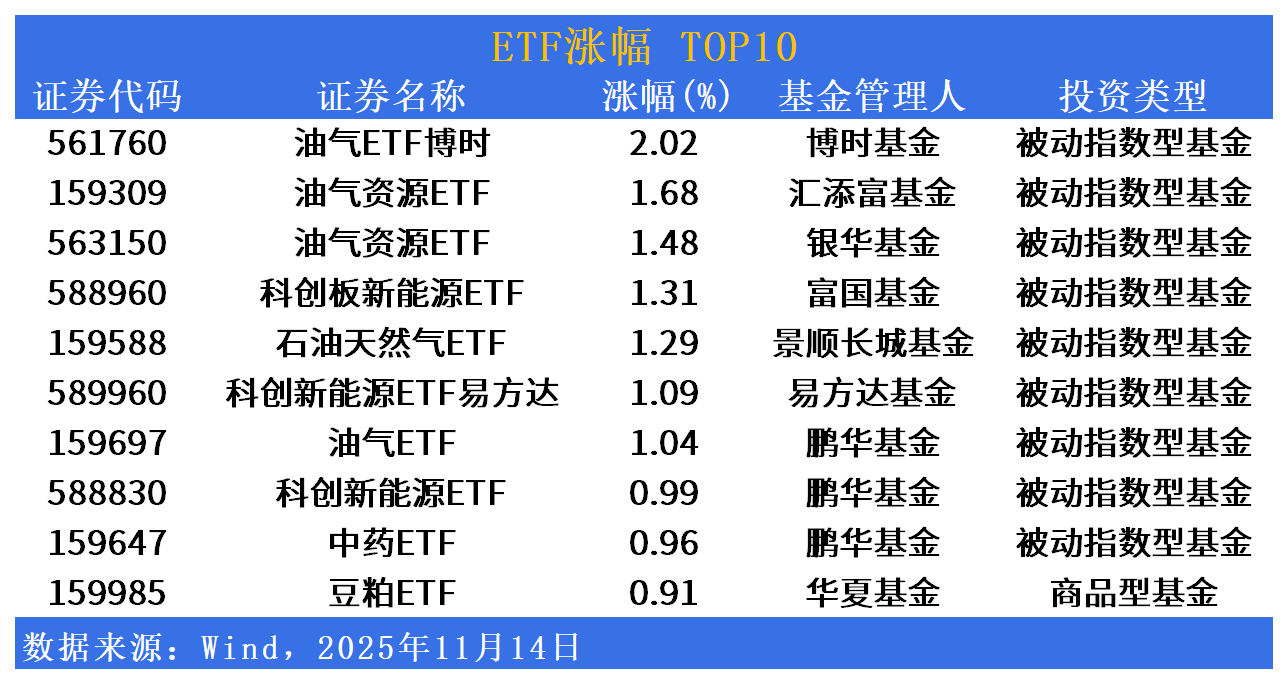
Market Overview - A-shares experienced a collective pullback with the Shanghai Composite Index down by 0.97%, Shenzhen Component down by 1.93%, and ChiNext down by 2.82% on November 14, 2025, with a total trading volume of 1,958.1 billion yuan [1] ETF Performance - Oil and gas-related ETFs led the gains, with the top performers including: - Oil and Gas ETF Bosera (561760) up by 2.02% - Oil and Gas Resource ETF (159309) up by 1.68% - Oil and Gas Resource ETF (263150) up by 1.48% [2] - Conversely, the top decliners included: - Sino-Korea Semiconductor ETF (513310) down by 4.45% - Hang Seng Internet ETF (159688) down by 3.66% - ChiNext AI ETF Guotai (159388) down by 3.64% [4] Sector Insights - Guolian Minsheng Securities noted that OPEC+ unexpected production increases and U.S. tariffs are pressuring oil prices, but a slowdown in U.S. oil and gas production growth may provide fundamental support. The focus remains on leading oil and gas central enterprises with quality upstream assets and high dividends [3] - The current investment strategy is diversified, emphasizing "anti-involution," domestic demand, and emerging industries. The traditional cyclical chemical sector is expected to see improvements as excess capacity is gradually eliminated [3] A-share Strategy Outlook - Guoxin Securities projected that the bull market initiated in 2024 is not over, entering its second phase with a shift from sentiment to fundamentals. The focus for 2026 will be on technology, particularly in AI applications, robotics, and smart driving [5] - The market is expected to revolve around themes of technological self-reliance, industrial upgrades, and resource security, with opportunities in AI, semiconductors, and high-end manufacturing [5] ETF Trading Activity - The Short-term Bond ETF (511360) had the highest trading volume at 19.797 billion yuan, followed by Silver Hua Daily ETF (211880) at 12.553 billion yuan and Huabao Tianyi ETF (211990) at 11.818 billion yuan [6][7] - The National Debt Policy Bond ETF (511580) led in turnover rate at 275%, indicating high trading activity [7] New ETF Launch - A new QDII product, the Hang Seng Technology ETF Southern (520570), will be launched next Monday, tracking the Hang Seng Technology Index. It is suitable for investors optimistic about China's long-term tech development [8]