传媒ETF

Search documents
权益ETF周度跟踪:工业有色和稀土获逆势布局-20260308
HUAXI Securities· 2026-03-08 07:52
Report Industry Investment Rating No information provided in the given content. Core Viewpoints of the Report - Combining the "Gain/Loss - Crowding" quadrant chart and ETF fund flow, there are gaming opportunities in the industrial non - ferrous metals and rare earth sectors [1]. - The oil and gas and power grid equipment sectors led the gains from March 2 - 6, becoming the market's main lines, while the gaming and media sectors had significant declines [1]. - Industrial non - ferrous metals and rare earths received reverse capital increases, presenting potential opportunities, while the power grid equipment may be volatile in the short term, and the oil and gas sector's future is highly uncertain [1]. Summary by Directory 1. Market Review: Oil and Gas and Power Grid Equipment Led the Gains - **Overall Market Trend**: From March 2 - 6, the market declined and then stabilized. As of March 6, 2026, the closing price of the Wind All - A Index was 6783.03, a 2.30% drop from February 27 [6]. - **Performance of Major Indexes**: Large - cap stocks outperformed. The Shanghai Composite Index and CSI 300 Index fell 0.93% and 1.07% respectively, while the STAR 50 Index and CSI 1000 Index had larger declines of 4.95% and 3.64% [7]. - **ETF Fund Flow**: Stock - type ETFs had a net outflow of 7.349 billion yuan from March 2 - 6, a narrower outflow compared to February 24 - 26. Broad - based index ETFs had a net outflow of 42.875 billion yuan, while theme index ETFs had a net inflow of 23.533 billion yuan, and industry index ETFs had a net inflow of 13.731 billion yuan [10][11]. - **Market Focus**: The market focused on the oil and gas and power grid equipment sectors. The oil and gas index rose 9.50% with a crowding degree of 3.7%, reaching a new high since 2020. The power grid equipment index rose 5.49%, and its crowding degree increased from the 98.7% percentile to the 99.7% percentile since 2020. The gaming and media sectors fell 7.44% and 7.04% respectively, and their crowding degrees decreased for the second consecutive week. The rare earth and industrial non - ferrous metals sectors fell 7.00% and 4.74% respectively, with a slight decrease in crowding degree [14][15]. 2. Future Focus: Rare Earths and Industrial Non - Ferrous Metals May Present Gaming Opportunities - **Fund Flow Analysis**: Industrial non - ferrous metals and rare earths received reverse capital increases. The Industrial Non - Ferrous Metals ETF Wanjia and Rare Earth ETF Jiashi fell 4.91% and 7.15% respectively, but had net inflows of 559 million yuan and 1.991 billion yuan [22]. - **Power Grid Equipment**: The power grid equipment ETF had a net inflow of 5.284 billion yuan from March 2 - 5, accounting for 17.49% of its fund size. However, its crowding degree reached 3.92%, at the 99.7% percentile since 2020, and there may be a risk of adjustment [23]. - **Oil and Gas**: The oil and gas ETF had a net inflow of 5.108 billion yuan from March 2 - 5. The sector's future depends on the development of the US - Iran situation [26]. - **Gaming and Media**: The media ETF and gaming ETF fell 7.29% and 6.99% respectively, with net outflows of 1.505 billion yuan and 538 million yuan. If the HALO trading trend remains unchanged, these two industries will continue to face pressure [26].
56亿,加仓
3 6 Ke· 2026-02-25 09:42
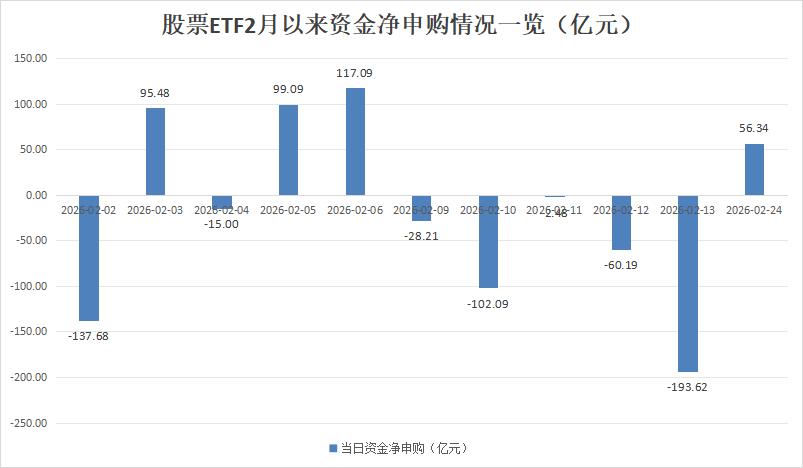
Group 1 - The stock ETF market experienced a significant net inflow of 56.34 billion yuan on February 24, reversing the trend of net outflows observed in the first five trading days of the year [1][2] - The A-share market opened higher and closed with the Shanghai Composite Index up by 0.87%, while the ChiNext Index saw a peak increase of over 2% [2] - The total scale of all stock ETFs reached 3.92 trillion yuan, with 1,339 stock ETFs in the market [2] Group 2 - The Hong Kong stock market ETFs led the net inflow, with 84.72 billion yuan, while broad-based ETFs saw a net outflow of 50.11 billion yuan [4] - ETFs tracking the Hang Seng Technology Index had the highest single-day net inflow of 46.59 billion yuan, while those tracking the CSI A500 Index faced a net outflow of 17.18 billion yuan [4] - Major fund companies like E Fund and Huaxia Fund reported significant net inflows in their ETFs, with E Fund's total ETF scale reaching 659.7 billion yuan [4][5] Group 3 - Specific ETFs such as the Hang Seng Technology Index ETF and the China Internet ETF saw net inflows of 16.53 billion yuan and 13.41 billion yuan, respectively [5][6] - The performance of the robotics and power grid equipment ETFs also attracted over 4 billion yuan in net inflows, indicating growing interest in these sectors [8] Group 4 - The market saw notable net outflows from broad-based ETFs, including the CSI 500 ETF and the media ETF, with the latter experiencing a net outflow of 4.46 billion yuan [9] - The short-term bond ETF faced the largest single-day net outflow of 11.54 billion yuan, reflecting a shift in investor sentiment towards riskier assets [9]

加仓!资金“盯上”这些方向
Zhong Guo Zheng Quan Bao· 2026-02-11 12:17
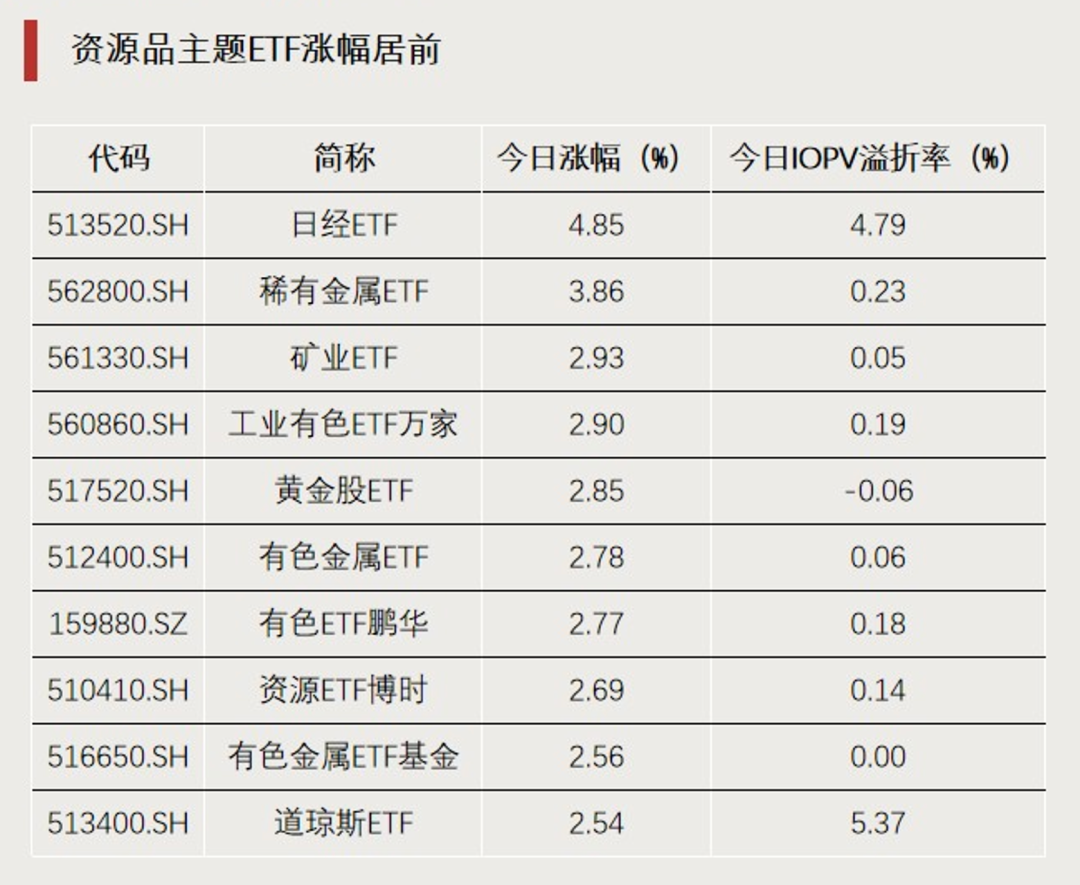
Group 1 - The resource sector, represented by non-ferrous metals, showed strong performance with multiple rare metal ETFs rising over 3% and mining, non-ferrous, gold, rare earth, and chemical ETFs generally increasing over 2% [1][2] - The Nikkei 225 theme ETF rose by 4.85%, with a premium rate increasing to 4.79%, while the Dow Jones ETF also saw a premium rate rise above 5% as the Dow Jones Industrial Average reached a new high [2][3] - Bond ETFs experienced significant trading activity, with total transaction volume increasing by over 90 billion yuan compared to the previous day, and the short-term bond ETF Hai Futong reached a historical high transaction volume of over 63 billion yuan [5][6] Group 2 - Recent market trends indicate a shift of funds from broad-based ETFs to industry-specific theme ETFs, with significant net outflows from the CSI 300 and CSI A500 theme ETFs, while the tourism ETF maintained a net inflow for 17 consecutive trading days, reaching a historical high in scale [7][8] - The film and media ETFs, which benefited from AI applications, experienced a collective pullback, with the film ETF dropping nearly 6% and the media ETF declining over 2% [3][4] - Fund managers are focusing on three key areas for investment: AI hardware driven by overseas trends, high-end manufacturing in new energy and innovative pharmaceuticals, and domestic price increase chains in chemicals, building materials, and steel [9]
ETF收评 |AI应用板块领跌,影视ETF跌近6%
Ge Long Hui· 2026-02-11 07:33
Group 1 - The Shanghai Composite Index rose by 0.09%, while the ChiNext Index fell by 1.08% [1] - The chemical, building materials, non-ferrous metals, oil and gas, and coal sectors showed strong gains, while AI applications, computing hardware, space photovoltaics, commercial aerospace, and consumer sectors experienced adjustments [1] - In the ETF market, Japanese stocks continued to perform strongly, with Huaxia Fund's Nikkei ETF and E Fund's Nikkei 225 ETF rising by 4.85% and 3.46% respectively [1] Group 2 - The film and television sector saw significant declines, with film ETFs dropping by 5.9% and 5.8% [2] - The media sector also declined, with media ETFs falling by 2.8% [2] - The AI hardware sector showed negative performance, with the ChiNext AI ETF down by 2% [2]
超百亿“跑了”!这些宽基ETF成为“失血”大户
Zhong Guo Jing Ji Wang· 2026-02-11 07:26
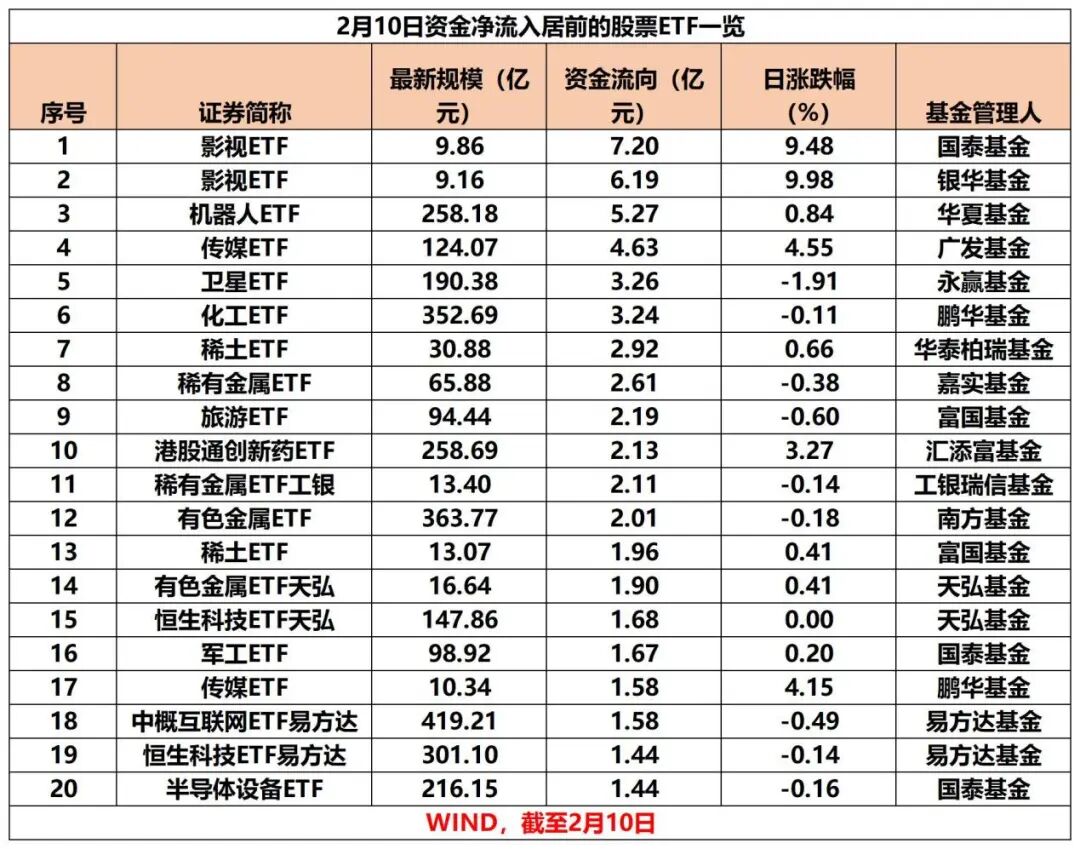
Core Viewpoint - The stock market experienced narrow fluctuations on February 10, with active performance in media and humanoid robot sectors, while stock ETFs saw a net outflow exceeding 10.26 billion yuan [1][2]. ETF Fund Flows - On February 10, the total net outflow from stock ETFs (including cross-border ETFs) reached 10.259 billion yuan, with the CSI 300 index-related ETFs experiencing a net outflow of 2.904 billion yuan, while the CSI Film Index-related ETFs saw a net inflow of 1.339 billion yuan [2][4]. - Over the past five days, the Hang Seng Technology Index-related ETFs attracted over 8.5 billion yuan, and the SGE Gold 9999 Index-related ETFs received over 6.2 billion yuan [2]. Fund Company Performance - E Fund's ETF scale reached 661.58 billion yuan, with a net inflow of 1.05 billion yuan. The China concept internet ETF saw a net inflow of 158 million yuan, while the Hang Seng Technology ETF had a net inflow of 144 million yuan [2]. - Huaxia Fund's robot ETF and sci-tech semiconductor ETF had significant net inflows of 527 million yuan and 117 million yuan, respectively, with their latest scales at 25.818 billion yuan and 8.196 billion yuan [3]. - GF Fund's media ETF received the highest net inflow of 460 million yuan, with a year-to-date increase of over 26%, making it one of the top three ETFs in the market [3]. Market Trends and Insights - The market is expected to shift focus from January's credit and liquidity performance to subsequent macroeconomic and industrial clues, as indicated by E Fund's index investment department [5]. - The manager from GF Fund highlighted the importance of vertical multi-modal AI application opportunities by 2026, emphasizing the deep penetration of AI technology in the production processes of games and films, which could enhance content innovation efficiency [5].
股票ETF资金净流出超百亿元
Zhong Guo Ji Jin Bao· 2026-02-11 06:26
Core Viewpoint - The A-share market experienced a narrow fluctuation on February 10, with significant capital outflows from stock ETFs exceeding 10.26 billion yuan, while sectors like media and humanoid robots showed active performance [1][2]. Group 1: Market Performance - On February 10, the three major A-share indices showed mixed results: the Shanghai Composite Index rose by 0.13%, the Shenzhen Component Index increased by 0.02%, while the ChiNext Index fell by 0.37% [2]. - The overall market saw a net outflow of 102.59 billion yuan from stock ETFs, including cross-border ETFs [2]. Group 2: ETF Capital Flows - The net inflow for the media-related ETFs was significant, with the film and television index-related ETFs seeing a net inflow of 13.39 billion yuan, while the CSI 300 index-related ETFs experienced a net outflow of 29.04 billion yuan [2]. - Over the past five days, the Hang Seng Technology Index-related ETFs attracted over 8.5 billion yuan, and the SGE Gold 9999 Index-related ETFs saw inflows exceeding 6.2 billion yuan [2]. Group 3: Fund Company Insights - E Fund's ETF had a latest scale of 661.58 billion yuan, with a net inflow of 1.05 billion yuan. The China concept internet ETF saw a net inflow of 158 million yuan, while the Hang Seng Technology ETF had a net inflow of 144 million yuan [2]. - Huaxia Fund's robot ETF and sci-tech semiconductor ETF had notable net inflows of 527 million yuan and 117 million yuan, respectively, with their latest scales reaching 25.818 billion yuan and 8.196 billion yuan [3]. Group 4: Notable ETFs - The top ETFs by net inflow on February 10 included the film and television ETF with a net inflow of 720 million yuan, and the robot ETF with a net inflow of 527 million yuan [4]. - Conversely, the top ETFs by net outflow included the CSI 300 ETF with a net outflow of 1.558 billion yuan and the CSI 500 ETF with a net outflow of 1.428 billion yuan [5]. Group 5: Future Market Outlook - The investment focus may shift from January's credit and liquidity performance to macroeconomic and industrial clues as the market enters a relatively data-vacuum period post-Spring Festival [6]. - The media sector is expected to benefit from AI applications, particularly in gaming and film production, which could enhance content creation efficiency and reduce costs [6].
又现ETF涨停!这次为何轮到影视主题?
Guo Ji Jin Rong Bao· 2026-02-10 13:17
Core Viewpoint - The A-share market experienced fluctuations on February 10, with the cultural media sector leading the gains, driven by the upcoming Spring Festival and AI investment trends [1][3]. Group 1: Market Performance - The cultural media sector index rose by 4.98% on February 10, with multiple film stocks hitting the daily limit [3]. - The top-performing ETFs included the Silverhua Film Theme ETF, which hit the daily limit, and the Guotai Film Theme ETF, which increased by 9.48% [2][3]. - Year-to-date, the Guotai Film Theme ETF and Silverhua Film Theme ETF have both seen gains exceeding 30%, ranking second and third among all ETFs [3]. Group 2: Driving Factors - The film sector's performance is attributed to multiple core drivers, including a recovery point after supply-side adjustments, policy optimization, and increased quality content supply [4]. - The valuation of the sector is at a relatively low historical level, attracting funds due to the demand for valuation recovery [4]. - The maturity of film IP through various monetization models and accelerated content export are also contributing to the sector's growth [4]. Group 3: AI Influence - The recent surge in AI applications, particularly with ByteDance's new video generation model, has catalyzed interest in the film sector [4]. - AI's role is seen as a dual catalyst, providing short-term emotional boosts and long-term empowerment for companies with technological layouts [4]. - Investment sentiment in AI-related sectors remains high, with expectations for continued market interest [6]. Group 4: Investment Strategies - The film ETFs provide investors with tools to capitalize on industry recovery and AI empowerment opportunities while helping to diversify individual stock risks [5]. - Short-term opportunities are linked to the Spring Festival and inflows of capital, while long-term strategies should focus on quality and liquidity [5]. - Market sentiment remains optimistic, with expectations for a continued bullish trend in 2023 across both emerging technology and traditional financial sectors [6].
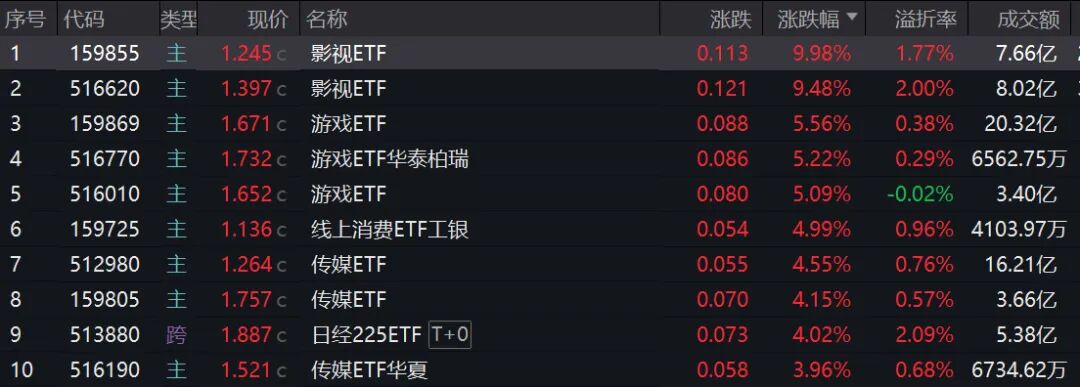
传媒概念股走强,传媒ETF涨超4%
Mei Ri Jing Ji Xin Wen· 2026-02-10 05:29
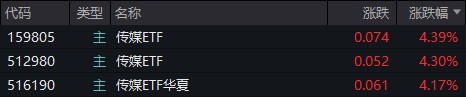
Group 1 - Media concept stocks have strengthened, with Light Media rising by 20%, Kaiying Network increasing by over 7%, and Shenzhou Taiyue up by over 4% [1] - The Media ETF has risen by over 4% due to market influences [1] Group 2 - According to brokerage firms, the media industry is expected to recover in terms of prosperity in the medium to long term, driven by the gradual recovery of content supply, deepening AI technology empowerment, policy support, and expectations of consumer recovery [2] - Companies with strong performance in sectors such as film and television theaters, gaming, and advertising marketing are recommended for attention, along with those involved in digital assets and AIGC-related technologies [2]



AI应用持续火热,影视ETF涨停,游戏ETF涨超6%,传媒ETF涨超5%
Sou Hu Cai Jing· 2026-02-10 04:17
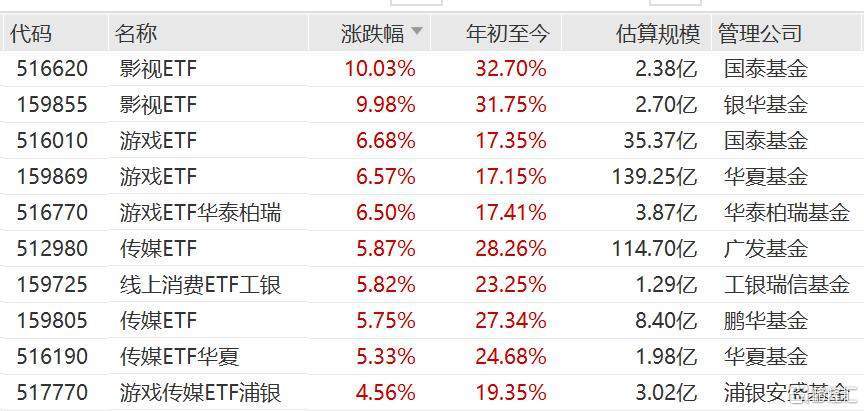
Core Insights - The AI application in the media and gaming sectors is driving significant market activity, with various ETFs experiencing substantial gains, particularly the Film ETF which saw a limit-up increase [1] - ByteDance's launch of the AI video generation model Seedance 2.0 has sparked interest in AI-related stocks, although the model's ability to reference real human materials has been temporarily suspended for optimization [2] - The domestic gaming market is projected to continue its growth, with a notable increase in the number of game licenses issued, indicating a robust pipeline for future products [3] Group 1: ETF Performance - The Film ETF has increased by 10.03% year-to-date, with an estimated scale of 238 million [2] - The Gaming ETF has seen a rise of 6.68% year-to-date, with an estimated scale of 3.537 billion [2] - The Media ETF has grown by 5.87% year-to-date, with an estimated scale of 11.47 billion [2] Group 2: Market Trends - The pre-sale box office for new films during the 2026 Spring Festival has exceeded 86 million, indicating strong consumer interest [3] - The number of domestic game licenses issued in January increased by 33 compared to the previous month, and by 54 compared to the same period last year, suggesting improved approval processes [3] - The actual sales revenue of the domestic gaming market is projected to reach 350.79 billion in 2025, a year-on-year increase of 7.68% [3] Group 3: Industry Analysis - The gaming sector is expected to maintain a high growth trajectory, with the mobile gaming market projected to generate 257.08 billion in revenue, up 7.92% year-on-year [3] - The SW Media sector's allocation has shifted, with the gaming segment seeing an increase in overweight positions to 40.26% [4] - The revival of PC gaming and the increasing budget for mobile game development are expected to enhance the market's product offerings [5]




惊了,1月基金新开户54.63万户~2026年2月9日 市场温度
Xin Lang Cai Jing· 2026-02-09 13:07
Group 1 - The estimated profit for today is +70,000 (assets of 5.5 million), with a total profit of +119,000 across two accounts, resulting in a profit-loss ratio of +1.49% [1] - The Hang Seng Technology index has rebounded after a 20% correction from its peak, indicating a potential upward trend [1] - The recent surge in AI applications has led to significant gains, with the Media ETF rising over 4% and the Software ETF increasing over 3% [5] Group 2 - In January, there were 546,300 new fund accounts opened, representing a month-on-month increase of 123.8% and a year-on-year increase of 168.72% [6][9] - The increase in new fund accounts suggests a significant influx of retail investor capital into public funds [6] - The actual increase in fund shares will be assessed when the fund association releases data at the end of February [7][9] Group 3 - The surge in new fund accounts may be influenced by short-term arbitrage opportunities, particularly related to silver LOF [8] - If new account openings continue to rise in February, it would indicate a shift of household savings into financial products [9] - Conversely, a decline in new account openings would suggest that many new accounts were opened for short-term trading rather than long-term investment [9] Group 4 - The A-share market temperature is at 71.36, up 1.6 degrees from the previous trading day, while the Hong Kong market temperature is at 54.41, up 1.9 degrees [10][11] - The MACD golden cross signal has formed, indicating a positive trend for certain stocks [11]