
燃气及水的生产和供应业

Search documents
电能实业(0006.HK):多个资产迎来回报率上调窗口期
Ge Long Hui· 2026-03-19 21:42
Core Viewpoint - The company reported a revenue of HKD 771 million for 2025, a year-on-year decrease of 16.1%, primarily due to a reduction in interest income from loans to joint ventures [1] - The net profit attributable to shareholders was HKD 6.236 billion, reflecting a year-on-year increase of 1.9%, which is in line with expectations [1] - The company maintains a "buy" rating, supported by strong risk resilience and upcoming opportunities for return rate adjustments in 2026 [1] Financial Performance - The company declared a dividend per share (DPS) of HKD 2.82 for 2025, unchanged from 2024, with a dividend yield of 4.5% [1] - Total dividends for the year amounted to HKD 6.01 billion, representing 96% of net profit attributable to shareholders [1] Regional Contributions - The Australian business contributed a profit of HKD 1.461 billion in 2025, up 4% year-on-year, driven by regulatory changes allowing a return rate increase [2] - The Hong Kong business generated a profit of HKD 1.051 billion, reflecting a 1% year-on-year increase, supported by capital expenditure investments [2] - The UK business's profit contribution was HKD 3.210 billion, remaining stable year-on-year, with new acquisitions contributing to overall performance [2] Regulatory Changes and Future Outlook - Several regulated assets are expected to enter new regulatory periods in 2026, which will likely enhance return rates and support future earnings growth [3] - Specific regulatory approvals have been granted, allowing for return rate increases in various regions, including a 0.83% increase for Northumbrian Water and a 1.49% increase for Northern Gas Networks [3] Profit Forecast and Valuation - The company anticipates net profits of HKD 7.159 billion, HKD 7.264 billion, and HKD 7.561 billion for 2026-2028, reflecting increases from previous estimates [4] - The expected profit contribution from the completed sale of UK Rails is approximately HKD 300 million [4] - The target price for the company is set at HKD 77.60, based on a price-to-book ratio of 1.80x, reflecting confidence in the company's business model and growth potential [4]

去年山东规上工业增加值同比增7.6%,41个工业大类中36个行业正增长
Feng Huang Wang Cai Jing· 2026-01-29 00:13
Core Insights - In 2025, Shandong Province's industrial economy is expected to focus on the transformation and upgrading of traditional industries, achieving a stable and rapid growth in industrial production with an industrial added value growth of 7.6% compared to the previous year [1] Group 1: Industrial Growth - The industrial production in Shandong is characterized by a differentiated collaborative growth among the three major sectors: mining industry increased by 4.5%, manufacturing industry by 8.7%, and the production and supply of electricity, heat, gas, and water by 0.9% [1] - A total of 36 out of 41 industrial categories achieved positive growth, resulting in a growth coverage of 87.8%, indicating a broad recovery and improvement in the quality of the industrial economy [1] Group 2: Momentum Transformation - The equipment manufacturing industry is identified as a key driver of industrial growth, with an added value growth of 11.4%, surpassing the overall industrial growth by 3.8 percentage points [2] - Significant production increases were noted in high-end equipment products, with electric vehicles, lithium-ion batteries for vehicles, and industrial robots growing by 50.3%, 48.8%, and 26.6% respectively, showcasing advancements in high-end and green manufacturing [2] Group 3: Sales and Production Conditions - The industrial sales rate reached 95.7%, reflecting an improvement in the connection between production and sales, with notable performance in sectors such as non-ferrous metal smelting, automotive manufacturing, and textile and apparel, all exceeding the provincial average [2]
中国人工作时长结束9年连涨,但还远远不够
经济观察报· 2026-01-22 12:38
Core Viewpoint - The long working hours in China's labor market reflect low employment quality, and there is a need to adjust the minimum wage standards for full-time workers to an hourly basis to address this issue [1][4][28]. Group 1: Working Hours Trends - After nine consecutive years of growth, the average weekly working hours for employees in China have shown a slight decline in 2025, with all months except January reporting lower hours compared to the same period in 2024 [2][21]. - The average weekly working hours in China remain high, exceeding the legal standards of 8 hours per day and 44 hours per week, indicating a significant issue in the labor market [4][8]. - The proportion of urban employed individuals working over 48 hours per week increased from 50.2% in 2018 to 44.6% in 2022, highlighting the persistent issue of excessive working hours [14]. Group 2: Factors Influencing Working Hours - The increase in average working hours since 2016 is not solely explained by economic cycles, as China's GDP growth has been declining while working hours have continued to rise [8][9]. - Rising fixed costs for companies, including social insurance expenses, have led businesses to extend working hours instead of hiring more employees to maximize profits [9][10]. - The mismatch between actual working hours and workers' desired hours contributes to job dissatisfaction and reflects the low quality of employment [12]. Group 3: Structural Issues in Employment - The coexistence of long working hours and insufficient working hours in different sectors indicates structural contradictions in labor allocation in China [16]. - Competitive industries, such as hospitality and construction, tend to have longer working hours, while government sectors and individual businesses often experience insufficient working hours [17][19]. - The issue of insufficient working hours is particularly pronounced among women, low-educated individuals, and those in informal employment, leading to increased income inequality [19]. Group 4: Recommendations for Improvement - To address the issue of excessive working hours, it is essential to enhance macroeconomic demand by increasing the income of low- and middle-income groups, thereby boosting their consumption capacity [22]. - Reducing the social insurance burden on companies is crucial, as China's social insurance costs are among the highest globally [22]. - Adjusting the wage determination mechanism for full-time workers to an hourly basis, similar to non-full-time workers, is recommended to improve employment quality [23][24].


12月经济数据快报
Guo Tou Qi Huo· 2026-01-20 11:47
1. Report Industry Investment Rating - No relevant information provided 2. Core Viewpoints - In 2025, China's GDP was 1,401,879 billion yuan, a 5.0% increase from the previous year. The added value of the primary, secondary, and tertiary industries increased by 3.9%, 4.5%, and 5.4% respectively. Quarterly GDP growth rates were 5.4% in Q1, 5.2% in Q2, 4.8% in Q3, and 4.5% in Q4. The Q4 GDP had a 1.2% quarter - on - quarter growth [1] - In December 2025, the year - on - year growth of industrial added value above designated size was 5.2%, 0.4 percentage points higher than the previous value, and the month - on - month growth was 0.49%, 0.05 percentage points higher than the previous value. The growth rates of mining and production and supply of electricity, gas, and water declined, while the manufacturing growth rate accelerated [1] - From January to December 2025, the year - on - year decline of national fixed - asset investment was 3.8 percentage points, with a month - on - month decline of 1.13%. Manufacturing investment increased by 0.6%, narrow - sense infrastructure investment had a growth rate of - 1.48%, and real estate development investment decreased by 17.20% [1] - In December 2025, the year - on - year growth of total retail sales of consumer goods was 0.9%, lower than the previous value of 1.3%, and the month - on - month decline was 0.40% [1] 3. Summary by Relevant Indicators GDP - The GDP quarterly year - on - year growth rates in 2025 were 5.4% in Q1, 5.2% in Q2, 4.8% in Q3, and 4.5% in Q4. The quarterly GDP growth rates were 1.0% in Q2, 1.1% in Q3, and 1.2% in Q4. The cumulative year - on - year growth rates were 5.3% in Q2, 5.2% in Q3, and 5.0% in Q4 [1] Industrial Added Value - In December 2025, the year - on - year growth of industrial added value above designated size was 5.2%, and the month - on - month growth was 0.49%. The cumulative year - on - year growth from January to December was 5.9%. Among the three major sectors, the growth rates of mining and production and supply of electricity, gas, and water declined, while the manufacturing growth rate accelerated [1] Fixed - Asset Investment - From January to December 2025, the year - on - year decline of national fixed - asset investment was 3.8 percentage points, and the month - on - month decline was 1.13%. Manufacturing investment increased by 0.6%, narrow - sense infrastructure investment had a growth rate of - 1.48%, and real estate development investment decreased by 17.20% [1] Real Estate - The cumulative year - on - year decline of real estate development investment from January to December 2025 was 17.20%. The cumulative year - on - year decline of commercial housing sales area was 8.7%. The year - on - year declines of new housing starts, housing construction, housing completion, and real estate development funds in December were 19.3%, 47.14%, 18.36%, and 28.09% respectively [1] Social Retail Sales - In December 2025, the year - on - year growth of total retail sales of consumer goods was 0.9%, lower than the previous value of 1.3%, and the month - on - month decline was 0.40%. The cumulative year - on - year growth from January to December was 3.7% [1]
广安爱众股价涨5.45%,广发基金旗下1只基金位居十大流通股东,持有393.54万股浮盈赚取98.39万元
Xin Lang Cai Jing· 2025-11-25 01:59
Core Points - Guang'an Aizhong's stock price increased by 5.45% to 4.84 CNY per share, with a trading volume of 37.39 million CNY and a turnover rate of 0.64%, resulting in a total market capitalization of 6.106 billion CNY [1] Company Overview - Guang'an Aizhong Co., Ltd. is located in Guang'an District, Sichuan Province, established on March 23, 1999, and listed on September 6, 2004 [1] - The company's main business includes hydropower generation, electricity supply, natural gas supply, drinking water supply, and the calibration and installation of water, electricity, and gas meters [1] - Revenue composition: electricity sales 32.85%, electricity supply 25.07%, gas sales 18.11%, engineering construction 8.50%, power generation sales 7.78%, water sales 5.77%, and others 1.92% [1] Shareholder Information - The top circulating shareholder is Guangfa Fund, which increased its holdings in Guang'an Aizhong by 264,400 shares, totaling 3.9354 million shares, representing 0.32% of the circulating shares [2] - Guangfa Zhongzheng Electric Power ETF (159611) has a current scale of 3.627 billion CNY and has achieved a return of 2.8% this year, ranking 3930 out of 4206 in its category [2] Fund Management - The fund manager of Guangfa Zhongzheng Electric Power ETF is Lu Zhiming, who has a tenure of 14 years and 180 days, with total assets under management of 24.063 billion CNY [3] - The best fund return during Lu Zhiming's tenure is 119.61%, while the worst return is -63.28% [3]

1-10月第一、二产业固定资产投资完成额同比增速维持正增长 | 高频看宏观
Sou Hu Cai Jing· 2025-11-20 12:58
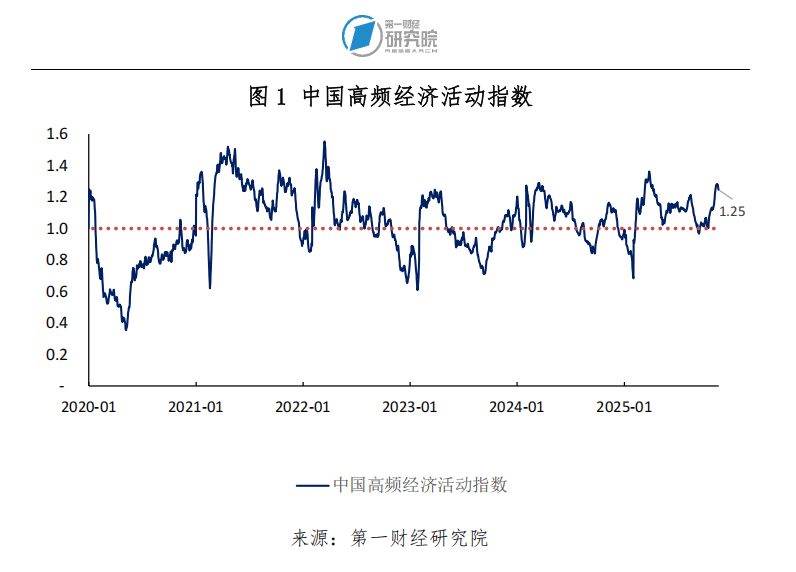
Economic Activity Index - The China High-Frequency Economic Activity Index (YHEI) as of November 18, 2025, is 1.25, a decrease of 0.03 from November 11 [1][3] - Industrial indicators such as the "coastal coal freight index" and "import dry bulk freight index" fell by 0.21 and 0.03 respectively, contributing to the decline in YHEI [1][3] Consumption and Retail - In October, the total retail sales of consumer goods reached 46,291.3 billion yuan, with a year-on-year growth of 2.9%, which is 0.1 percentage points lower than the previous month [25] - The growth rate of commodity retail sales decreased by 0.5 percentage points to 2.8%, marking five consecutive months of decline; however, catering revenue increased by 2.9 percentage points to 3.8%, the highest level since June [25] Foreign Trade - In October, the total import and export value was 520.632 billion USD, a year-on-year decrease of 0.3%, marking the first negative growth since March this year [25] - The import growth rate dropped from 7.4% in September to 1.0%, while the export growth rate fell from 8.3% to -1.1% [25] Industrial Production - The industrial added value for enterprises above designated size grew by 4.9% year-on-year in October, a decrease of 1.6 percentage points from the previous month [2][25] - The mining and manufacturing sectors saw their added value growth rates decline to 4.5% and 4.9% respectively, while the production and supply of electricity, gas, and water rebounded to 5.4% [2][25] Monetary Policy and Interest Rates - As of November 18, the central bank net injected 465.1 billion yuan through open market operations, with a 7-day reverse repurchase rate of 1.4% [6] - The overnight interbank rate rose by 3 basis points to 1.58%, and the 7-day repurchase rate increased by 2 basis points to 1.54% [8][10] Real Estate Market - New housing transaction areas in first and third-tier cities decreased by 1.31% and 12.7% respectively, while second-tier cities saw a significant increase of 39.19% [41][42] - The average daily transaction area for second-hand homes increased by 9.02%, 5.04%, and 15.21% in first, second, and third-tier cities respectively [44] Shipping and Logistics - The coastal bulk freight index rose by 14.65 points to 1250.56, while the Baltic Dry Index increased by 144 points to 2216 [37] - The container freight index for exports was 1094.03, up by 35.86 from November 7 [37] Global Economic Indicators - The US dollar index increased by 0.11 points to 99.59, and the RMB to USD exchange rate rose by 82 basis points to 7.1125 [50][52] - The VIX index rose by 7.41 points to 24.69, indicating increased market volatility [57]
广安爱众:刘波、罗晓霞辞去公司副总经理职务
Mei Ri Jing Ji Xin Wen· 2025-11-04 08:09
Company Summary - Guang'an Aizhong announced the resignation of two vice presidents, Liu Bo and Luo Xiaoxia, due to work reasons [1] - As of the latest report, Guang'an Aizhong's market capitalization stands at 6.2 billion yuan [1] Revenue Composition - For the year 2024, Guang'an Aizhong's revenue composition is as follows: - Electricity: 50.91% - Engineering construction and others: 24.99% - Natural gas: 22.68% - Tap water: 9.64% - Inter-segment elimination: -8.22% [1]
两口径基建为何背离?
一瑜中的· 2025-10-27 14:42
Group 1 - The article discusses two different measures of infrastructure investment: narrow infrastructure (excluding electricity) and broad infrastructure (including electricity, heat, gas, and water supply) [2][8] - The differences between the two measures include the inclusion of the electricity sector in broad infrastructure, while narrow infrastructure includes telecommunications and internet services [2][8] - In September, narrow infrastructure showed a slight improvement with a growth rate of -4.6%, while broad infrastructure declined further to -8% [3][11] Group 2 - The divergence in growth rates between the two measures can be attributed to several factors, including the performance of the electricity, heat, gas, and water sectors, which had a growth rate of -2% in September [11][12] - The internet and related services sector, which is included in narrow infrastructure but not in broad infrastructure, experienced a significant growth of 20.6% in the first three quarters [11][12] - The warehousing sector, which is included in broad infrastructure but not in narrow infrastructure, saw a sharp decline in investment from 4% to -23%, contributing to the weakness in broad infrastructure [12]

两口径基建为何背离?
Huachuang Securities· 2025-10-27 13:45
Group 1: Infrastructure Investment Definitions - Narrow infrastructure investment excludes electricity and includes telecommunications and internet services, while broad infrastructure includes electricity, heat, gas, water production, and supply[1][5] - In 2017, electricity, heat, gas, and water production accounted for approximately 17% of broad infrastructure investment, while warehousing accounted for about 4%[1][7] Group 2: Recent Trends and Discrepancies - In September, narrow infrastructure investment growth was -4.6%, improving from -5.9%, while broad infrastructure investment fell to -8% from -6.4%[2][8] - Excluding the impact of electricity, heat, gas, and water industries, broad infrastructure growth would decline further, exacerbating the discrepancy[2][8] - Internet and related services, included in narrow but not broad infrastructure, saw a 20.6% increase in investment, contributing to the divergence[2][8] Group 3: Impact of Specific Sectors - Warehousing investment dropped from 4% to -23% in September, significantly affecting broad infrastructure investment[3][9] - Estimated that warehousing accounted for about 3.9% of total infrastructure investment in September, contributing a -0.9 percentage point drag on broad infrastructure growth[3][9]
广安爱众:9月28日召开董事会会议
Mei Ri Jing Ji Xin Wen· 2025-09-28 09:38
Group 1 - The core point of the article is that Guang'an Aizhong (SH 600979) held its 32nd meeting of the 7th Board of Directors on September 28, 2025, via communication, discussing the proposal to waive the notification period for this meeting [1] - For the fiscal year 2024, Guang'an Aizhong's revenue composition is as follows: electricity accounts for 50.91%, engineering construction and others for 24.99%, natural gas for 22.68%, and tap water for 9.64%, with inter-segment eliminations at -8.22% [1] - As of the report date, Guang'an Aizhong has a market capitalization of 6.2 billion yuan [1]