
市场情绪降温

Search documents
华宝期货晨报煤焦-20260331
Hua Bao Qi Huo· 2026-03-31 04:40
Report Summary 1. Report Industry Investment Rating No information provided. 2. Core View of the Report - Short - term market bullish sentiment has cooled, and coking coal prices have fallen to repair the basis. Short - term fluctuations are large, with risk control emphasized and a wait - and - see approach recommended [3]. 3. Summary by Relevant Parts Market Situation - Yesterday, market sentiment gradually cooled, and prices continued to fluctuate and decline with relatively sharp overall fluctuations. On the spot side, some regional steel mills have successively accepted the coke price increase, which is planned to be implemented on April 1st. The price of coking coal in the producing areas continued a slight upward trend [2]. Supply - From January to February 2026, the cumulative domestic production of coking clean coal was 75.31 million tons, a year - on - year decrease of 0.5%. The cumulative import of coking coal from January to February was 19.8269 million tons, a year - on - year increase of 981,400 tons, an increase of 5.21%, which made up for the domestic supply reduction of coking coal. Among them, 11.0668 million tons were imported from Mongolia, a year - on - year increase of 71.8%; 5.5022 million tons were imported from Russia, a year - on - year increase of 4.0%. The two countries together accounted for about 84%. Other seaborne coal showed varying degrees of year - on - year decline. Affected by the inertia of import impulse since December last year, high - frequency data showed that the customs clearance of Mongolian coal in March continued to remain high. The average daily customs clearance volume at the Ganqimaodu Port was 185,000 tons, an increase of 23,000 tons compared with the average from January to February and an increase of 69,000 tons year - on - year. The inventory at the port exceeded 4.3 million tons, at a relatively high level [2]. Demand - Steel mills' blast furnaces are in the process of resuming production. However, recently, some areas in Hebei have been affected by environmental protection policies, and the resumption of production has been slightly hindered. The average daily pig iron output last week rebounded to 2.31 million tons, a year - on - year decrease of 53,000 tons. Currently, finished products have entered the inventory reduction cycle, and the characteristics of the peak season will continue, supporting the expected implementation of blast furnace resumption of production [2]. Later Concerns - Pay attention to changes in spot prices and the resumption of production of steel mills [3].
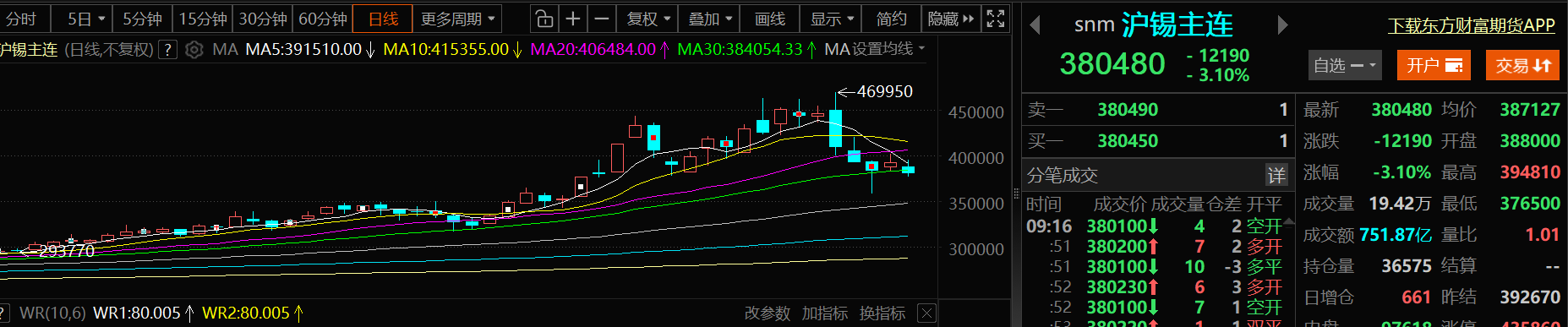
市场情绪降温 沪锡回落【盘中快讯】
Wen Hua Cai Jing· 2026-02-05 01:20
Group 1 - The core viewpoint of the article indicates that the tin market is experiencing a downturn, with the main contract falling over 2% due to weakened market sentiment [2] - The overall supply and demand in the tin market remain weak, with downstream processing enterprises facing low current orders, and high prices significantly suppressing actual consumption [2] - The fundamental changes in tin are limited, with recent price fluctuations primarily driven by macroeconomic sentiment and high levels of capital participation [2]

市场情绪整体降温,铂钯大幅回调
Zhong Xin Qi Huo· 2026-02-03 01:21
Report Industry Investment Rating - The report maintains a long - term view of a bullish trend for platinum and palladium, with a medium - to - long - term expectation of prices trending upwards in a volatile manner [2][3][4] Core View - The precious metals market sentiment was pressured, and prices significantly corrected due to Kevin Warsh's nomination as the Fed Chair and CME's increase in margin standards. As of February 2, 2026, the closing price of the GFEX platinum main contract was 552.15 yuan/gram, a decline of 16.0%, and the GFEX palladium main contract was 413.7 yuan/gram, also a 16.0% decline [1] - For platinum, although short - term factors pressure the price, the medium - to - long - term supply - demand and macro logic remain unchanged. It is recommended to wait for the price to stabilize and then consider low - buying opportunities, and also pay attention to internal - external positive arbitrage opportunities if the spread widens. The supply in South Africa has risks, and the demand in various fields is expanding [2] - For palladium, the short - term price corrected due to market sentiment cooling, and the long - term supply - demand is becoming looser, but the short - term price bottom is stable. It is advisable to wait for the market to stabilize before considering low - buying [4] Summary by Related Catalogs Platinum - **Price Movement**: The GFEX platinum main contract closed at 552.15 yuan/gram on February 2, 2026, with a 16.0% decline [1] - **Main Logic**: Kevin Warsh's nomination and CME's margin increase pressured the price. The medium - to - long - term supply - demand and macro logic remain unchanged. South Africa has supply risks, and demand in various fields is expanding [2] - **Operation Suggestion**: Short - term investors should wait and see. After the price stabilizes, consider low - buying. Also, pay attention to internal - external positive arbitrage opportunities if the spread widens [2] - **Outlook**: The price is expected to be volatile and upward - trending in the medium - to - long - term, and short - term fluctuations are affected by gold and silver trends [3] Palladium - **Price Movement**: The GFEX palladium main contract closed at 413.7 yuan/gram on February 2, 2026, with a 16.0% decline [1] - **Main Logic**: Short - term market sentiment decline led to price correction. Long - term supply - demand is becoming looser, but short - term price bottom is stable due to factors like tight spot supply [4] - **Operation Suggestion**: Wait for the market to stabilize before considering low - buying [4] - **Outlook**: The price is expected to be volatile and upward - trending in the medium - to - long - term, and short - term fluctuations are affected by gold and silver trends [4] Commodity Index - **Special Index**: The commodity index was 2420.95, down 3.75%; the commodity 20 index was 2773.66, down 4.55%; the industrial products index was 2312.70, down 2.62% on February 2, 2026 [51] Plate Index - **Non - ferrous Metals Index**: On February 2, 2026, the non - ferrous metals index was 2709.50, with a daily decline of 5.11%, a 5 - day decline of 4.88%, a 1 - month increase of 0.88%, and a year - to - date increase of 0.88% [53]
中信建投:预计市场短期面临情绪降温和指数回调压力
Mei Ri Jing Ji Xin Wen· 2026-02-02 00:31
Group 1 - The core viewpoint of the article indicates that due to significant fluctuations in international precious metal prices and large-scale sell-offs of broad-based ETFs in the A-share market, liquidity pressure has led to a noticeable decline in the sentiment index, signaling a right-side selling opportunity and testing the limits of exuberance [1] - The report anticipates that the market will face short-term pressure from a cooling sentiment and index correction, particularly with the seasonal effect of heightened risk aversion before the Spring Festival [1] - Despite the anticipated adjustments, the overall adjustment space for the full A-index is expected to be limited, with a potential stabilization before the Spring Festival and the emergence of a new upward trend post-holiday [1] Group 2 - The company is optimistic about the continuation of the spring market, expecting ample incremental capital in the first quarter, as the sell-off of broad-based ETFs gradually concludes, leading to a significant improvement in market liquidity [1] - Recent favorable policies, such as the new strategic investment system regulations and the introduction of national capacity electricity pricing policies, along with the emergence of highlights in AI large models, are seen as catalysts for the industry [1] - Historically, February has shown a higher winning rate and better profit effects, supporting the positive outlook for the upcoming market performance [1]

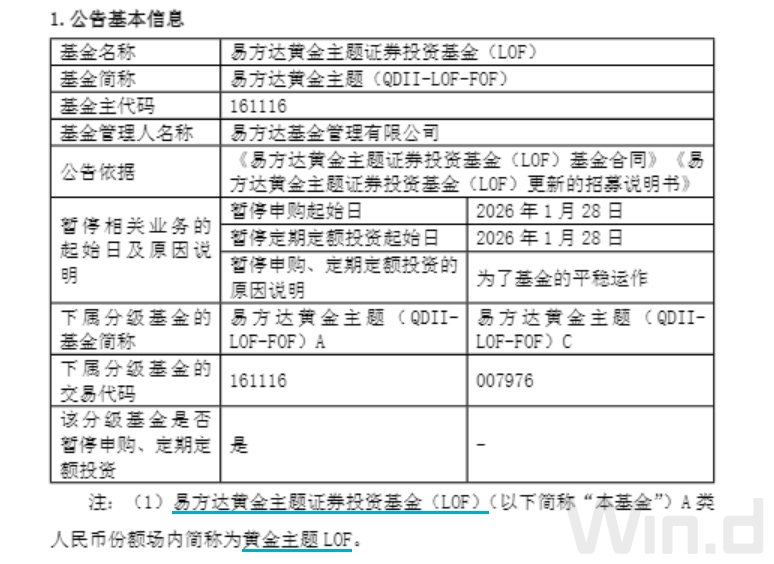
金价彻底爆了!历史首次!有基金公告:今天起暂停申购
Sou Hu Cai Jing· 2026-01-28 09:36
Group 1 - The core viewpoint of the articles indicates that gold and silver prices have surged significantly, with gold reaching a new high of $5220 per ounce and silver prices also increasing, leading to a rise in domestic jewelry prices [1][10] - The recent price increases have prompted major gold jewelry brands in China to raise their prices, with brands like Chow Sang Sang and Chow Tai Fook reporting prices of 1614 RMB and 1618 RMB per gram respectively [1] - Both E Fund's Gold LOF and Guotai Junan's Silver LOF have announced the suspension of subscription and regular investment services starting January 28, 2026, to ensure stable fund operations [3][7] Group 2 - The E Fund Gold LOF experienced a significant price increase of over 60% in 2025 and continued to rise by over 15% in 2026, but faced a market price correction with a drop of over 7% on January 22 [5][4] - The Guotai Junan Silver LOF also saw a high premium rate, with a closing price of 4.336 RMB and a premium rate exceeding 46.02% as of January 27 [9] - Analysts warn that both gold and silver markets may face short-term correction pressures due to rapid price increases, urging investors to remain rational and avoid chasing high prices [2][12]
市场情绪有所降温 沪镍期货或有回调压力
Jin Tou Wang· 2026-01-19 08:01
Group 1 - The domestic futures market for non-ferrous metals showed a significant decline, with the main contract for nickel futures closing at 142,320.00 yuan/ton, down 1.42% [1] - Macro factors include Trump's announcement of tariffs on eight European countries starting February 1, which may lead to retaliatory tariffs from multiple EU countries [2] - The Canadian Prime Minister announced a reduction in the import tax rate on 49,000 electric vehicles from China from 100% to 6.1% [2] Group 2 - Indonesia's Ministry of Energy and Mineral Resources plans to set the nickel production target for 2026 between 250 to 260 million tons, a significant reduction from the 379 million tons quota for 2025, though actual implementation remains to be seen [2] - Nickel ore prices are stabilizing as Indonesia cracks down on illegal mining, and the Philippines enters the rainy season, which may impact future nickel mining activities [2] - The stainless steel sector is experiencing upward pressure, with increased losses for downstream nickel-iron plants, leading to some high-cost nickel-iron plants in Indonesia halting production for maintenance [2] - The outlook for nickel prices suggests they will follow fluctuations in the non-ferrous market, with uncertainty regarding nickel ore quotas likely to persist, and a recommendation to buy on dips despite short-term cooling market sentiment [2]
多晶硅期价回落,背后的交易逻辑是……
Qi Huo Ri Bao· 2025-12-24 23:49
Core Viewpoint - The recent decline in polysilicon futures prices is attributed to a cooling market sentiment following strong expectations, leading to a return to fundamental trading dynamics [1][2]. Group 1: Market Dynamics - Polysilicon futures prices have experienced a high-level correction, with the main PS2605 contract price approaching 58,000 yuan/ton, closing at 59,225 yuan/ton, down 0.91% [1]. - Analysts indicate that the price drop reflects ongoing profit distribution struggles between upstream and downstream sectors, with downstream segments facing increasing non-silicon cost pressures due to rising prices of auxiliary materials like silver paste [1]. - Current cash profit margins for polysilicon, silicon wafers, battery cells, and modules are approximately 27.21%, -11.67%, -19.81%, and 1.34% respectively, indicating significant pressure on downstream profitability [1]. Group 2: Production and Capacity Outlook - It is projected that silicon wafer production will decrease by about 21.67% to 44.71 GW by December 2025, with further reductions expected in January 2026 [2]. - The domestic polysilicon capacity is anticipated to be reduced to approximately 1.89 million tons by 2026, as the industry focuses on eliminating outdated production capacity [2]. - Self-discipline in production and sales within the polysilicon sector is expected to continue into the next year, with an estimated annual production of around 1.16 million tons in 2026, aligning with market demand [2]. Group 3: Pricing Trends and Challenges - The current market is characterized by a "cost-price-inventory" struggle, with upstream polysilicon producers raising spot prices to 65,000 yuan/ton, while downstream companies resist these high prices [3]. - Despite a reduction in inventory in the silicon wafer segment, the actual transaction prices remain limited due to the reluctance of downstream battery cell manufacturers to accept rising costs [3][4]. - The increase in prices for silicon wafers and battery cells has been noted, with silicon wafer prices rising from 1.48 yuan/piece to a range of 1.05 to 1.53 yuan/piece, and battery cell prices increasing from 0.283 yuan/watt to 0.27 to 0.31 yuan/watt [4]. Group 4: Future Market Expectations - The market is expected to maintain a "upstream price increase, downstream observation" dynamic in the short term, with the acceptance of higher component prices by downstream entities being crucial for the sustainability of upstream price increases [5][6]. - The ability of the polysilicon market to rebound will depend on whether downstream prices can rise to around 0.8 yuan/watt, which would support a gradual increase in polysilicon spot prices [5][6]. - Analysts suggest that the core of price increases in polysilicon hinges on effective price transmission mechanisms throughout the supply chain, necessitating a consensus on "volume for price" across the entire industry [6].

黑色建材日报:市场情绪降温,双焦大幅下跌-20250729
Hua Tai Qi Huo· 2025-07-29 05:20
Report Industry Investment Rating No relevant content provided. Core Viewpoints - The market sentiment has cooled down, leading to significant declines in coking coal and coke prices, while steel, iron ore, and thermal coal prices are showing oscillatory trends [1][3][5][7] Summary by Related Catalogs Steel - **Market Analysis**: The rebar futures contract closed at 3,248 yuan/ton, and the hot-rolled coil main contract closed at 3,397 yuan/ton. The national building materials trading volume was 101,000 tons. Building materials production and sales are basically stable, with little change in inventory, and the overall performance is slightly better than the seasonal average. As costs continue to rise, building materials prices are increasing. Plate production has declined, and the fundamentals are better than the seasonal average, with exports significantly boosting plate consumption. Recently, a series of policies such as anti-involution, expanding domestic demand, and stabilizing growth have been intensively proposed, boosting market sentiment and causing the futures market to rise continuously. However, with the sharp decline in coking coal on Friday night, the market sentiment has cooled down to some extent. Overall, the current fundamentals of the steel market are still good [1] - **Strategy**: The unilateral strategy is to oscillate, while there are no strategies for inter - period, inter - variety, spot - futures, and options trading [2] Iron Ore - **Market Analysis**: Yesterday, the iron ore futures prices oscillated downward. The prices of mainstream imported iron ore varieties declined weakly. Traders' enthusiasm for quoting was average, and most quotes were adjusted according to the market. The total iron ore trading volume at major ports across the country was 1.125 million tons, a month - on - month increase of 12.61%. In terms of supply, the global iron ore shipments rebounded slightly this period, with a total shipment volume of 32.009 million tons, a month - on - month increase of 918,000 tons. The total arrival volume at 45 ports this period was 22.405 million tons, a month - on - month decrease of 1.307 million tons. In July, there is a seasonal decline in iron ore shipments, but due to the recent increase in iron ore prices, the supply support is stronger than in previous years. In terms of demand, the current hot metal production remains at a high level, and there are no large - scale maintenance plans for steel mills in the short term, so the consumption and demand for iron ore are resilient. In terms of inventory, there is no obvious increase in port inventory. Overall, the fundamentals of the iron ore market are good. In the short term, after the price increase, the market sentiment has cooled down to some extent. In the future, attention should be paid to changes in hot metal production and the floating volume of iron ore at sea [3] - **Strategy**: The unilateral strategy is to oscillate, while there are no strategies for inter - period, inter - variety, spot - futures, and options trading [4] Coking Coal and Coke - **Market Analysis**: Yesterday, the coking coal and coke futures were weak throughout the day, and the main contracts of both coking coal and coke hit the daily limit down. In terms of imported Mongolian coal, the customs clearance volume of Mongolian coal has gradually recovered to a high level recently, and there is an expectation of supply restoration. For coking coal, affected by safety and environmental inspections, there are still disruptions in mine - end supply, but the customs clearance volume of Mongolian coal has increased, and future supply restoration needs to be monitored. In terms of demand, the hot metal production remains at a high level, providing rigid support for coking coal. The price increase has attracted speculative demand and driven consumption. For coke, the third round of price increases has been implemented, compressing the profits of coking enterprises, but the demand remains stable supported by the high - level hot metal production. Currently, the market sentiment has subsided, black building materials prices have generally declined, and terminal demand has weakened due to seasonal factors [5][6] - **Strategy**: Both coking coal and coke are recommended to adopt an oscillating strategy, while there are no strategies for inter - period, inter - variety, spot - futures, and options trading [6] Thermal Coal - **Market Analysis**: In the production areas, increased rainfall has affected production and sales, resulting in mixed price changes and a cooling of the price - support sentiment. At ports, there is a structural shortage of coal. After the downstream's phased rigid - demand procurement is completed, as the high - temperature range gradually expands, the daily consumption is gradually increasing. Traders are optimistic about the peak - season market, and market quotes are rising. In terms of imports, the price of high - calorie Australian coal is inverted compared with the domestic winning bid price, resulting in low liquidity. Indonesian low - calorie coal has obvious cost - performance advantages, and there are many downstream tenders [7] - **Strategy**: No strategy is provided [7]
市场情绪降温,指数冲高回落
Hua Tai Qi Huo· 2025-07-24 02:52
Report Summary 1) Report Industry Investment Rating No relevant content provided. 2) Core View of the Report - Overseas, the trade agreement between the US and Japan and the positive negotiations with the EU boosted investor confidence, leading to a collective rise in the three major US stock indices. Domestically, the strong upward movement of the financial sector provided strong support for the index, but overall market sentiment tended to be cautious, with signs of profit - taking in previously strongly rebounding sectors. It is expected that the cautious market sentiment will continue today. Although the view of strategically bullish on stock indices in the medium - to - long term is maintained, short - term operations need to be cautious [1][2][3] 3) Summary by Relevant Catalogs Market Analysis - **International Trade**: The US and Japan reached a trade agreement. The "reciprocal tariff" rate imposed by the US on Japan will be reduced from 25% to 15%. Japan will increase the import of US rice under the "minimum access system" and commit to investing $550 billion in the US. Japan will purchase $8 billion worth of US goods. The EU and the US are moving towards an agreement that will set a 15% tariff rate for most products. China and the US will hold economic and trade talks in Sweden from July 27th to 30th [1] - **Stock Market**: In the domestic spot market, the three major A - share indices rose and then fell. The Shanghai Composite Index rose 0.01% to close at 3582.30 points, and the ChiNext Index fell 0.01%. Sector indices mostly declined, with non - bank finance, beauty care, and household appliances leading the gains, while building materials, national defense and military industry, machinery, and power equipment sectors leading the losses. The trading volume in the Shanghai and Shenzhen stock markets remained at 1.9 trillion yuan. In the overseas market, the three major US stock indices all closed higher, with the Dow Jones Industrial Average rising 1.14% to close at 45010.29 points [2] - **Futures Market**: In the futures market, the basis of stock index futures showed differentiation, with only the IM discount continuing to repair. In terms of trading volume and open interest, both the trading volume and open interest of stock index futures increased [2] Strategy - Overseas events boosted investor confidence, while domestic market sentiment was cautious. Although the medium - to - long - term view is bullish on stock indices, short - term operations should be cautious [3] Chart Summary - **Macroeconomic Charts**: Include charts showing the relationship between the US dollar index and A - share trends, US Treasury yields and A - share trends, RMB exchange rates and A - share trends, and US Treasury yields and A - share style trends [7][8][10] - **Spot Market Tracking Charts**: The table shows the daily performance of major domestic stock indices on July 23, 2025, and July 22, 2025, including the Shanghai Composite Index, Shenzhen Component Index, ChiNext Index, etc. There are also charts of the trading volume in the Shanghai and Shenzhen stock markets and margin trading balances [13][14] - **Stock Index Futures Tracking Charts**: Tables show the trading volume and open interest of stock index futures (IF, IH, IC, IM), the basis of stock index futures (including different contract periods), and the inter - period spreads of stock index futures. There are also corresponding charts for each item [18][40][50]
市场情绪逐渐降温 预计短期螺纹钢维持震荡偏弱
Jin Tou Wang· 2025-07-16 07:26
Market Overview - On Tuesday evening, rebar futures contract 10 experienced weak fluctuations, closing at 3107, down 0.45% [1] Fundamental Summary - Starting from July 16 at 9:30 AM, Shougang Changzhi has uniformly lowered the prices of rebar and ribbed steel by 20 CNY/ton, and for wire rod and line materials by 30 CNY/ton, while other varieties remain stable [2] - As of the week ending July 10, rebar production, social inventory, and apparent demand have shifted from increase to decrease, while factory inventory has shifted from decrease to increase. Rebar production was 2.1666 million tons, a decrease of 44,200 tons week-on-week, down 2%; apparent demand was 2.215 million tons, a decrease of 33,700 tons week-on-week, down 1.50% [2] - On July 15, domestic steel market prices showed mixed trends, with Tangshan Qian'an's ordinary square billet ex-factory price down 10 CNY, reported at 2950 CNY/ton. One steel mill raised the ex-factory price of construction steel by 50-80 CNY/ton. The average price of rebar in major cities nationwide was 3287 CNY/ton, down 4 CNY from the previous trading day [2] Institutional Perspectives - Guantong Futures stated that under the dual weakness of supply and demand, along with gradually cooling market sentiment, rebar prices are significantly under pressure, with limited rebound potential, and are expected to maintain a weak oscillating trend in the short term [3] - Ruida Futures noted that in the macro aspect, fixed asset investment grew by 2.8% in the first half of the year, with real estate development investment declining by 11.2%. In June, the industrial added value above designated size grew by 6.8% year-on-year, and retail sales of consumer goods grew by 4.8%. In terms of supply and demand, weekly rebar production was adjusted downwards, with a capacity utilization rate of 47.49%; factory inventory increased while social inventory decreased, with total inventory at 5.4037 million tons showing a slight decline again, and apparent demand down by 33,700 tons. Overall, the orderly exit of backward production capacity driven by anti-involution still supports the steel market, but weak real estate data drags down steel prices. Technically, the MACD indicator for RB2510 contract shows DIFF and DEA adjusting downwards, with green bars expanding. In terms of operations, short-term trading is suggested in the 3140-3090 range, with attention to risk control [3]