
市场流动性不足

Search documents
城道通环保科技股价近一周下跌近18%,成交额低迷
Jing Ji Guan Cha Wang· 2026-02-13 22:51
Group 1 - The stock price of Chengdao Environmental Technology (CDTG.OQ) experienced significant volatility, with a cumulative decline of 17.85% over the period from February 5 to February 11, 2026, and a fluctuation range of 13.03% [1] - The stock price drop is primarily attributed to insufficient market liquidity, with daily trading volumes consistently below $10,000, and the company's small market capitalization of approximately $0.04 billion influencing trading dynamics [1] - As of February 12, 2026, the stock closed at $0.29, reflecting a single-day decrease of 7.10%, with a trading volume of $12,493 and a turnover rate of 0.35% [1] Group 2 - The company's fundamental indicators show a trailing twelve months (TTM) price-to-earnings ratio of -2.40 and a price-to-book ratio of 0.09, indicating weak profitability [1] - During the same period, major U.S. stock indices experienced declines, with the Dow Jones down 1.34%, the Nasdaq down 2.03%, and the waste management sector overall declining by 2.79%, which negatively impacted individual stocks [1]
金生游乐股价近期波动显著,成交活跃度持续低迷
Jing Ji Guan Cha Wang· 2026-02-13 21:51
Core Viewpoint - The stock price of Gold Life Entertainment (GDHG.OQ) has experienced significant volatility over the past seven trading days, reflecting weak fundamentals and market conditions [1] Group 1: Stock Performance - The stock price fluctuated from a closing price of $2.12 on February 9 to $2.06 on February 13, resulting in a decline of 5.50% [1] - The stock exhibited a volatility range of 16.51% during this period [1] Group 2: Trading Activity - Trading activity remains low, with a total trading volume of only $45,970 over the last five trading days [1] - The average turnover rate is less than 0.04% per day, indicating severe liquidity issues in the market [1] Group 3: Financial Performance - For the fiscal year 2025, the company's revenue decreased by 31.55% year-on-year [1] - The net loss expanded to $8.593 million, highlighting deteriorating financial health [1]
城道通环保科技股价近期大幅下跌,市场流动性不足成主因
Jing Ji Guan Cha Wang· 2026-02-12 23:01
Group 1 - The stock price of Chengdao Environmental Technology (CDTG.OQ) experienced significant volatility, with a cumulative decline of 17.85% over the past week from February 5 to February 11, 2026, and a fluctuation range of 13.03% [1][2] - The stock price movement was primarily influenced by insufficient market liquidity, with daily trading volumes consistently below $10,000, and the company's small market capitalization of approximately $0.04 billion [1][2] - As of February 12, 2026, the stock closed at $0.29, reflecting a single-day drop of 7.10%, with a trading volume of $12,493 and a turnover rate of 0.35% [1][2] Group 2 - Fundamental indicators show that the company's price-to-earnings ratio (TTM) is -2.40, and the price-to-book ratio is 0.09, indicating weak profitability [1][2] - During the same period, major U.S. stock indices experienced declines, with the Dow Jones down 1.34%, the Nasdaq down 2.03%, and the waste management sector overall declining by 2.79%, which negatively impacted individual stocks [1][2]
突发暴跌!全线跳水
Zheng Quan Shi Bao· 2025-12-31 06:25
Group 1 - The international precious metals market experienced a significant decline, with multiple commodities such as spot silver, COMEX silver, spot platinum, and spot palladium seeing substantial drops [1][2] - On December 29, precious metals faced a sharp downturn, with COMEX gold futures falling by 4.45%, COMEX silver futures plummeting by 7.2%, spot gold dropping over 4%, spot silver crashing over 9%, spot palladium declining over 15%, and spot platinum decreasing over 14% [2] - Following the downturn, there was a brief rebound on December 30, with COMEX gold futures rising by 0.2%, spot gold increasing by 0.17%, COMEX silver futures gaining 7.88%, spot silver up by 5.66%, and NYMEX platinum futures closing up by 4% [2] Group 2 - UBS warned that the rapid increase in precious metal prices is largely due to insufficient market liquidity, indicating a potential for a swift decline [2] - Analysts from Capital Economics stated that precious metal prices have risen to levels that are difficult to justify based on fundamentals, predicting that silver prices may fall to around $42 per ounce by the end of next year [2] - Huolong Futures noted that silver is currently outperforming gold, with greater short-term volatility and amplitude, and advised against ordinary investors participating in the market due to increasing risks of a correction [3]
突然暴跌!贵金属市场全线跳水
Zheng Quan Shi Bao· 2025-12-31 06:22
Group 1 - The international precious metals market experienced a significant decline, with multiple commodities such as spot silver, COMEX silver, spot platinum, and spot palladium showing substantial drops [1][10] - On December 29, precious metals saw a sharp decline, with COMEX gold futures falling by 4.45%, COMEX silver futures plummeting by 7.2%, spot gold dropping over 4%, spot silver crashing over 9%, spot palladium plunging over 15%, and spot platinum decreasing over 14% [10] - Following the decline, there was a rebound on December 30, with COMEX gold futures rising by 0.2%, spot gold increasing by 0.17%, COMEX silver futures gaining 7.88%, spot silver up by 5.66%, and NYMEX platinum futures rising by 4% [10] Group 2 - UBS warned that the rapid increase in precious metal prices is largely due to insufficient market liquidity, indicating a potential for a swift decline [10] - Analysts from Capital Economics stated that precious metal prices have risen to levels that are difficult to justify based on fundamentals, predicting that silver prices may drop to around $42 per ounce by the end of next year [10] - Huolong Futures noted that silver is currently outperforming gold, with greater short-term volatility and amplitude, and advised against ordinary investors participating in the market due to the ongoing "frenzy phase" [10]

新年行情告终?投资者“获利了结”,金银重挫
美股IPO· 2025-12-30 04:48
Core Viewpoint - The article discusses the significant decline in gold and silver prices, with gold dropping 5% and silver plummeting 11%, marking the largest single-day declines since September 2020. This downturn follows a period of strong seasonal performance for precious metals, typically characterized by gains of approximately 4% for gold and nearly 7% for silver during the year-end period. The recent price corrections are attributed to profit-taking by investors and a lack of market liquidity [1][3][6]. Group 1: Market Performance - Gold experienced a maximum intraday drop of 5%, the largest single-day decline since October 21, and this marks the second occurrence of such a significant drop this year [4]. - Silver's decline was even more severe, with an intraday drop of 11%, the largest single-day decline since September 2020 [5]. - Both metals have retreated significantly from their recent historical highs, raising concerns about an overheated market [6]. Group 2: Investor Behavior and Market Dynamics - Following a strong year-end rebound, the gold and silver markets faced severe sell-offs due to thin market liquidity, leading traders to take profits and ending a recent upward trend [3]. - Michael Haigh from Societe Generale noted that the year-end period typically sees extreme liquidity shortages, which can exacerbate price volatility. He emphasized that the recent declines were primarily driven by profit-taking after a strong seasonal rebound [7]. - Technical indicators, such as the 14-day Relative Strength Index (RSI), indicated that gold had been in an overbought territory, suggesting a potential correction was imminent. Silver's situation was more extreme, with a rise of over 25% since mid-December, pushing its RSI well above 70, indicating excessive buying pressure [7]. Group 3: Speculation and Margin Adjustments - The reversal in silver prices occurred shortly after they surged above $84 per ounce, driven by strong investment demand from China, which led to a record premium of over $8 per ounce for Shanghai spot silver compared to London prices [8]. - Analysts highlighted a highly speculative atmosphere in the market, with current conditions being described as extreme due to tight spot supply [9]. - To mitigate risks, exchanges have begun to take action, with CME Group announcing an increase in margin requirements for certain Comex silver futures contracts. This move requires traders to deposit more cash to maintain their positions, potentially forcing undercapitalized speculators to reduce or close their positions [12]. Group 4: Market Pressures and Inventory Status - The recent volatility in silver prices has drawn attention to the severely pressured spot market, with the latest rebound occurring just two months after a comprehensive short squeeze in the London silver market [14]. - Despite significant inflows into London vaults since then, most available silver remains in New York, as traders await the results of a U.S. investigation that could lead to tariffs or other trade restrictions [14].
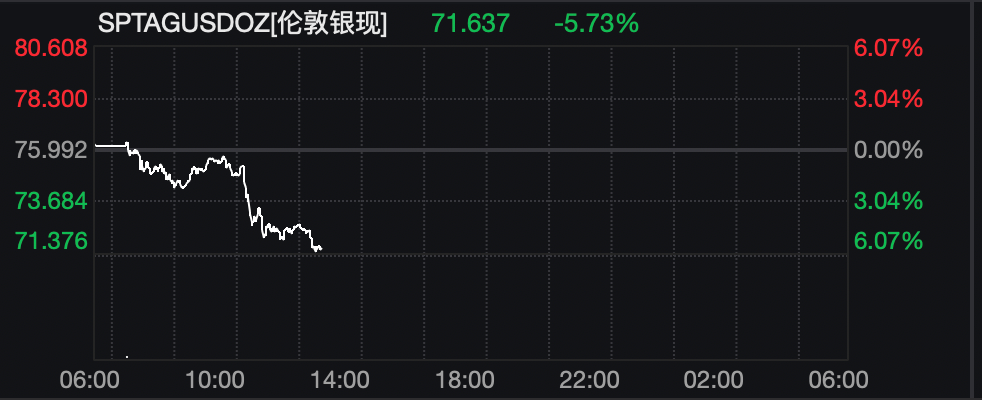
涨6%→跌6%,白银大跳水
Zheng Quan Shi Bao· 2025-12-29 13:27
Group 1 - Silver experienced a significant drop, falling over 6% after reaching a historical high earlier in the day, with a current decline of 5.67% [1] - COMEX silver fell approximately 4%, while other precious metals like gold and palladium also saw declines of nearly 2% and 12% respectively [2] - The global silver market is projected to have a supply-demand gap exceeding 100 million ounces by 2025, marking the fifth consecutive year of supply shortages [3] Group 2 - The largest silver ETF, SLV, reported a holding of 16,400 tons as of December 26, 2025, reflecting a week-on-week increase of 2% [3] - LBMA silver inventory has dropped to a historical low of about 27,000 tons, with most being linked to ETFs and not freely tradable, indicating tight liquidity [3] - UBS warned that the rapid increase in precious metal prices is largely due to insufficient market liquidity, suggesting a potential for a swift decline [3] Group 3 - Current silver trends are outperforming gold, with significant volatility and a "frenzy phase" in the market, leading to caution for ordinary investors [4] - The rapid price increases in silver, platinum, and palladium have created overheating market sentiments, with the gold-silver ratio dropping below historical averages, indicating accumulating risks [4] - The financial and industrial attributes of silver, platinum, and palladium mean that irrational price surges could suppress actual demand [4] Group 4 - Analysts noted that speculative levels in nickel and palladium have exceeded 65%, indicating extreme market sensitivity to changes [5] - The ongoing geopolitical uncertainties and monetary policy shifts are providing support for precious metals, but the rapid price increases are diverging from actual consumption [4]

涨6%→跌6%!白银,大跳水
证券时报· 2025-12-29 12:40
Group 1 - The article highlights a significant volatility in silver prices, with a sharp drop of over 6% after reaching a historical high, indicating a turbulent market environment for precious metals [1][3]. - According to the World Silver Institute, the global silver market is expected to face a supply-demand gap exceeding 100 million ounces by 2025, marking the fifth consecutive year of supply shortages [3]. - The largest silver ETF, SLV, reported a holding of 16,400 tons as of December 26, 2025, reflecting a week-on-week increase of 2%, while LBMA silver inventories have fallen to historical lows of approximately 27,000 tons [3]. Group 2 - Analysts from Huolong Futures suggest that silver is currently outperforming gold, with increased volatility and a potential "frenzy phase" in the market, advising caution for ordinary investors [4]. - The rapid price increases in silver, platinum, and palladium have led to overheating market sentiments, with the gold-silver ratio dropping below the historical average, indicating accumulating risks [4]. - The chief analyst from Guoxin Futures notes that while geopolitical uncertainties and monetary policy shifts support precious metals, the rapid price increases have diverged significantly from actual industrial consumption [4]. Group 3 - The speculative levels in nickel and palladium have reached high percentiles, exceeding 65%, suggesting that market sentiment is in a highly sensitive zone, where minor changes could trigger significant reactions [5].

流动性压力初现美国金融市场迎来调整期,巴菲特投资组合有何启示
2 1 Shi Ji Jing Ji Bao Dao· 2025-11-18 11:13
Core Viewpoint - The recent decline in U.S. tech stocks, particularly Nvidia, has raised concerns about overvaluation in the AI sector, leading to a shift in investor sentiment and potential market adjustments [1][2]. Group 1: Market Performance - On November 17, major U.S. stock indices experienced significant declines, with the Dow Jones dropping 556.99 points (1.18%), the S&P 500 down 61.61 points (0.91%), and the Nasdaq falling 192.51 points (0.84%) [1]. - Nvidia's market capitalization has decreased by 4.42 trillion yuan over 14 trading days, reflecting growing fears of an AI stock bubble [1]. Group 2: Investor Sentiment - Investors are increasingly uneasy about the high valuations of AI stocks, with the S&P 500 index up 13.66% this year, driven largely by tech stocks [2]. - The average P/E ratio of the S&P 500 is 30.42, with many major tech stocks, including Nvidia and Tesla, significantly exceeding this average [2]. Group 3: Energy Costs and AI - The rapid growth of AI has led to a surge in electricity demand, contributing to rising energy prices, with residential electricity costs increasing by 6% year-over-year as of August [2]. - States with high data center density, such as Virginia, Illinois, and Ohio, have seen electricity price increases of 13%, 16%, and 12%, respectively [3]. Group 4: Treasury Market and Interest Rates - The U.S. Treasury issued $694 billion in bonds over a three-day period, reflecting ongoing pressures in the short-term financing market [4]. - Following the Federal Reserve's October meeting, long-term interest rates have remained stable, indicating a cooling of rate cut expectations [4]. Group 5: Liquidity Concerns - There are signs of liquidity pressure in the short-term financing market, with higher borrowing costs for institutions seeking short-term financing [5]. - The Federal Reserve has suggested that market participants utilize standing repo facilities to manage liquidity [5]. Group 6: Investment Strategies - Warren Buffett's investment portfolio, valued at $267.2 billion, reflects a strategy of patience and value investing, with significant adjustments made in the third quarter [6]. - New investments in stocks like Google, which has a lower P/E ratio than the S&P 500 average, indicate a focus on growth potential and risk resilience [6]. Group 7: Economic Outlook - Upcoming economic reports are expected to influence market sentiment, particularly regarding inflation and employment data [7]. - If inflation remains around 3% with a deteriorating job market, the Fed may consider further rate cuts, while higher inflation could lead to a more cautious approach [7].

白银飙涨创历史纪录!已无可用的流动性!
Sou Hu Cai Jing· 2025-10-14 06:02
Core Viewpoint - The price of spot silver has surged significantly, breaking the $50 per ounce mark in early October and reaching over $53 per ounce by October 14, marking a historic high and surpassing levels seen during the Hunt brothers' attempt to corner the silver market in the 1980s [1] Supply Shortage - The current surge in silver prices is driven by both its financial and industrial attributes [2] - The financial aspect is influenced by the onset of a Federal Reserve rate cut cycle and ongoing geopolitical risks, enhancing silver's role as a currency and safe-haven asset [3] - On the industrial side, the explosive growth of the solar energy sector has significantly increased demand for silver in photovoltaic applications, contributing to a persistent global supply shortage over the past five years [3] Market Dynamics - As of the end of September, the London silver vault held 24,581 tons of silver, a 0.3% decrease from August, valued at $36.5 billion [3] - The surge in silver prices has led to a historic short squeeze in the London market, causing liquidity to nearly dry up and pushing the premium of London silver over New York silver from the usual 3 cents to over 20 cents [3] - The overnight borrowing rate for silver in London has increased by over 100%, raising the cost of short covering [3] Transportation and Logistics - In response to the tight supply in the London market, traders have taken extreme measures, including airlifting silver from the New York Mercantile Exchange to London, with estimates of 15 to 30 million ounces being transported [4] - Some traders have even booked cargo space on transatlantic flights for transporting large silver bars, a method typically reserved for gold [4] Market Outlook - Analysts have differing views on the future of silver prices. Citigroup has raised its silver price forecast from $45 to $55 per ounce, citing structural and cyclical tailwinds [6] - Bank of America has increased its 2026 silver price target from $44 to $65 per ounce, driven by ongoing supply gaps and high fiscal deficits [6] - Conversely, Goldman Sachs has warned investors to be cautious, citing greater volatility and downside risks for silver compared to gold, which benefits from structural central bank buying support [6][7] Investment Characteristics - Silver lacks the institutional and economic support that gold has, as it is not included in the International Monetary Fund's reserve framework and is not significantly held by modern central banks [7] - The absence of central bank buying support means that even a temporary reduction in investment inflows could lead to disproportionate price corrections for silver [7] - Overall, while gold is seen as a better option for portfolio diversification, silver's volatility makes it more suitable for speculative scenarios [7]