
逼仓行情

Search documents
贵金属的顶在哪里
2026-01-30 03:12
Summary of Key Points from Conference Call on Precious Metals Industry Overview - The discussion revolves around the precious metals market, particularly focusing on gold and silver prices, influenced by macroeconomic factors and geopolitical uncertainties [1][2][3]. Core Insights and Arguments - Since 2019, the persistent dollar easing environment and uncertainties surrounding Trump's 2.0 policies have increased market demand for safe-haven assets, driving gold prices up over 65% and silver prices up over 150% by 2025 [1][3]. - Speculation about high tariffs on strategic metals by the U.S. has led to a shift in global silver inventories, with a decrease in London stocks and an increase in New York stocks, supporting silver prices [1][3]. - Geopolitical shocks and inventory pressures are significant factors affecting silver prices, with Trump's policies impacting the global monetary system and market sentiment [1][4]. - While demand driven by AI narratives exists, geopolitical shocks and inventory pressures have a more substantial impact on current silver market dynamics [4]. - The decline in inventory has created some delivery pressure, but it is not as severe as some reports suggest; real delivery pressure stems from tightness in the physical market rather than excessive open interest [5][6]. Important but Overlooked Content - Historical context is provided through the reference to the Hunt brothers' failed silver squeeze, highlighting the interaction between price movements and market behavior [7]. - The current bull market for precious metals is entering its latter stages, with silver outperforming gold recently, indicating a potential continuation of the bull market depending on U.S. economic conditions [10]. - Predictions for 2026 suggest that the trajectory of gold and silver prices will heavily depend on the U.S. economy's performance, with scenarios ranging from hard landing (continuing the bull market) to soft landing or rate hikes (potentially weakening the bull market) [11][13]. - The uncertainty surrounding Trump's policies complicates traditional forecasting methods, making it challenging to predict price peaks accurately [12][14]. - The sentiment among retail and institutional investors is rising, with many confused by the rapid price increases, which have exceeded previous forecasts significantly [17]. Future Outlook - The outlook for silver prices in 2026 will depend on the resolution of geopolitical uncertainties and the economic direction of the U.S., particularly regarding Trump's policies and their implications for the market [11][18]. - The potential for a squeeze in gold is less likely due to ample inventory and the complexities involved in forcing a squeeze compared to other commodities [16].
首创期货:白银价格大涨,金银均破位
Jin Rong Jie· 2026-01-26 06:35
Core Viewpoint - Silver prices surged last week, breaking the $100 mark, while gold prices also surpassed the $5000 threshold. Recent geopolitical changes, particularly in the Middle East and U.S.-China relations, have influenced market dynamics, although fundamental factors are not the primary drivers at this time [1] Group 1 - Silver market is experiencing a short-term uncertainty due to a squeeze situation, making it less advisable to enter the market currently [1] - Existing long positions in silver can be maintained despite the market volatility [1]
特朗普抨击盟友、美联储政策双重推动金属上涨 铜价逼近每吨13000美元
Xin Lang Cai Jing· 2026-01-23 13:49
Core Viewpoint - The surge in copper prices to around $13,000 per ton is driven by a significant shift of investors from foreign exchange and sovereign bond markets to the metal market, with other metal prices also rising in tandem [2][4]. Group 1: Market Dynamics - Copper prices have seen a maximum increase of 1.8%, while nickel and tin have risen over 3% [2][4]. - The geopolitical reshaping by U.S. President Donald Trump and renewed criticism of the Federal Reserve are prompting a market influx into safe-haven assets, which has recently extended to base metals [2][4]. - Since mid-last year, copper prices have been on a steady rise due to large copper mine supply disruptions, a surge in demand driven by electrification processes, and a spike in copper exports ahead of potential U.S. tariffs [2][4]. Group 2: Supply and Inventory - Despite the rise in benchmark copper prices, the price spread between different copper futures contracts on the London Metal Exchange has been narrowing [2][4]. - Following a severe short squeeze earlier in the week, the delivery volume of copper inventory in U.S. and Asian exchange warehouses has increased, alleviating purchasing pressure for buyers [2][4]. - As of Thursday, the spot copper price on the London Metal Exchange was at a discount of $82.84 per ton compared to the three-month futures contract, indicating an improving supply situation [2][4]. - This contrasts sharply with the market conditions earlier in the week when spot copper was at a premium of over $100 per ton, reflecting tight supply [2][4]. Group 3: Future Expectations - Traders indicate that although the current arbitrage window has closed, more copper inventory is expected to flow into exchange warehouses in the coming weeks [3][5].


突发暴跌!全线跳水
Zheng Quan Shi Bao· 2025-12-31 06:25
Group 1 - The international precious metals market experienced a significant decline, with multiple commodities such as spot silver, COMEX silver, spot platinum, and spot palladium seeing substantial drops [1][2] - On December 29, precious metals faced a sharp downturn, with COMEX gold futures falling by 4.45%, COMEX silver futures plummeting by 7.2%, spot gold dropping over 4%, spot silver crashing over 9%, spot palladium declining over 15%, and spot platinum decreasing over 14% [2] - Following the downturn, there was a brief rebound on December 30, with COMEX gold futures rising by 0.2%, spot gold increasing by 0.17%, COMEX silver futures gaining 7.88%, spot silver up by 5.66%, and NYMEX platinum futures closing up by 4% [2] Group 2 - UBS warned that the rapid increase in precious metal prices is largely due to insufficient market liquidity, indicating a potential for a swift decline [2] - Analysts from Capital Economics stated that precious metal prices have risen to levels that are difficult to justify based on fundamentals, predicting that silver prices may fall to around $42 per ounce by the end of next year [2] - Huolong Futures noted that silver is currently outperforming gold, with greater short-term volatility and amplitude, and advised against ordinary investors participating in the market due to increasing risks of a correction [3]
突然暴跌!贵金属市场全线跳水
Zheng Quan Shi Bao· 2025-12-31 06:22
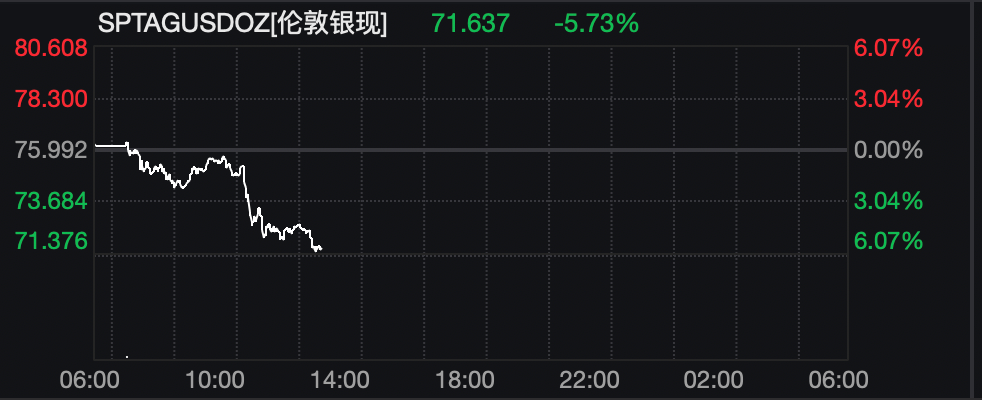
Group 1 - The international precious metals market experienced a significant decline, with multiple commodities such as spot silver, COMEX silver, spot platinum, and spot palladium showing substantial drops [1][10] - On December 29, precious metals saw a sharp decline, with COMEX gold futures falling by 4.45%, COMEX silver futures plummeting by 7.2%, spot gold dropping over 4%, spot silver crashing over 9%, spot palladium plunging over 15%, and spot platinum decreasing over 14% [10] - Following the decline, there was a rebound on December 30, with COMEX gold futures rising by 0.2%, spot gold increasing by 0.17%, COMEX silver futures gaining 7.88%, spot silver up by 5.66%, and NYMEX platinum futures rising by 4% [10] Group 2 - UBS warned that the rapid increase in precious metal prices is largely due to insufficient market liquidity, indicating a potential for a swift decline [10] - Analysts from Capital Economics stated that precious metal prices have risen to levels that are difficult to justify based on fundamentals, predicting that silver prices may drop to around $42 per ounce by the end of next year [10] - Huolong Futures noted that silver is currently outperforming gold, with greater short-term volatility and amplitude, and advised against ordinary investors participating in the market due to the ongoing "frenzy phase" [10]
突发暴跌!贵金属市场全线跳水
Zheng Quan Shi Bao· 2025-12-31 06:00
Core Viewpoint - The international precious metals market experienced significant declines, with various metals such as silver, platinum, and palladium seeing sharp drops in prices [1][5]. Group 1: Market Performance - On December 29, precious metals faced a severe downturn, with COMEX gold futures dropping by 4.45%, COMEX silver futures plummeting by 7.2%, spot gold falling over 4%, spot silver crashing over 9%, spot palladium declining over 15%, and spot platinum decreasing over 14% [5]. - The following day, December 30, the market saw a general rebound, with COMEX gold futures rising by 0.2%, spot gold increasing by 0.17%, COMEX silver futures gaining 7.88%, spot silver up by 5.66%, and NYMEX platinum futures rising by 4% [5]. Group 2: Future Outlook - UBS warned that the rapid increase in precious metal prices is largely due to insufficient market liquidity, indicating a potential for a swift decline [5]. - Analysts from Capital Economics stated that the current prices of precious metals have risen to levels that are difficult to justify based on fundamentals, predicting that silver prices may drop to around $42 per ounce by the end of next year [5]. - Huolong Futures noted that silver is currently outperforming gold, with greater short-term volatility and amplitude. They cautioned that the ongoing bullish trend in silver may be entering a "frenzy stage," advising ordinary investors against hasty participation [5].
涨6%→跌6%!白银,大跳水
证券时报· 2025-12-29 12:40
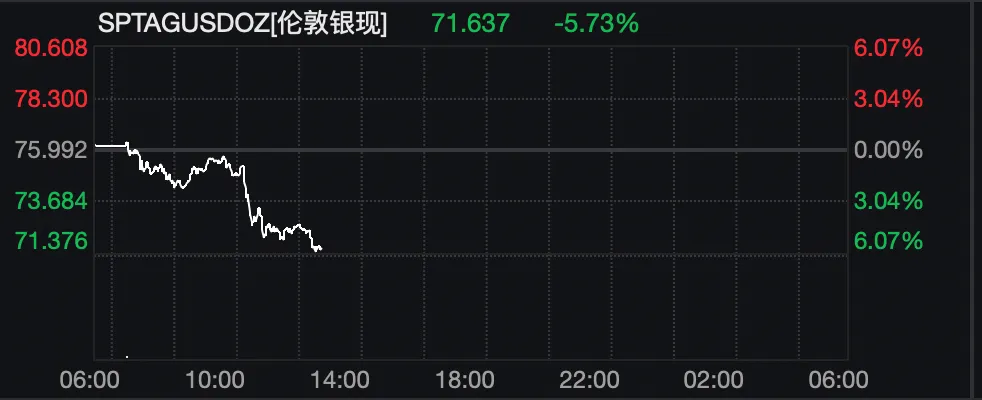
Group 1 - The article highlights a significant volatility in silver prices, with a sharp drop of over 6% after reaching a historical high, indicating a turbulent market environment for precious metals [1][3]. - According to the World Silver Institute, the global silver market is expected to face a supply-demand gap exceeding 100 million ounces by 2025, marking the fifth consecutive year of supply shortages [3]. - The largest silver ETF, SLV, reported a holding of 16,400 tons as of December 26, 2025, reflecting a week-on-week increase of 2%, while LBMA silver inventories have fallen to historical lows of approximately 27,000 tons [3]. Group 2 - Analysts from Huolong Futures suggest that silver is currently outperforming gold, with increased volatility and a potential "frenzy phase" in the market, advising caution for ordinary investors [4]. - The rapid price increases in silver, platinum, and palladium have led to overheating market sentiments, with the gold-silver ratio dropping below the historical average, indicating accumulating risks [4]. - The chief analyst from Guoxin Futures notes that while geopolitical uncertainties and monetary policy shifts support precious metals, the rapid price increases have diverged significantly from actual industrial consumption [4]. Group 3 - The speculative levels in nickel and palladium have reached high percentiles, exceeding 65%, suggesting that market sentiment is in a highly sensitive zone, where minor changes could trigger significant reactions [5].

俄乌“和平计划”中关键的领土问题就尚未达成一致
Dong Zheng Qi Huo· 2025-12-29 00:41
1. Report Industry Investment Ratings No relevant content provided in the given text. 2. Core Views of the Report - The geopolitical situation, especially the Russia - Ukraine conflict, continues to impact various markets, causing uncertainties and fluctuations in financial and commodity markets [1][11][18]. - Market sentiment and trading volumes are affected by holidays such as Christmas and New Year, leading to relatively light trading and narrow - range fluctuations in some markets [1][2]. - Different industries show different trends. For example, some commodities are expected to be affected by supply - demand changes, policy adjustments, and cost factors, resulting in price fluctuations and investment opportunities [25][36][45]. 3. Summary by Relevant Catalogs 3.1 Financial News and Reviews 3.1.1 Macro Strategy (Gold) - Key issue in the Russia - Ukraine "peace plan" regarding territory remains unresolved. After Christmas, overseas market trading is light. On Friday, gold price rose 1%, and silver price soared 10% due to a short - squeeze. The short - squeeze may be nearing its end. With the New Year's holiday approaching and the exchange increasing margin requirements, short - term market volatility is expected to intensify. It is recommended to hold a light position during the holiday [1][11]. 3.1.2 Macro Strategy (Foreign Exchange Futures - US Dollar Index) - The Russia - Ukraine conflict is likely to continue as the territorial issue remains unresolved, and the US dollar index is expected to remain volatile [15][16][17]. 3.1.3 Macro Strategy (US Stock Index Futures) - Ukraine attacked a Russian refinery, increasing geopolitical risks. Although the market is trading lightly, the year - end seasonal performance of US stocks is strong, and the market risk appetite remains high. US stocks are expected to oscillate with an upward bias [18][19]. 3.1.4 Macro Strategy (Treasury Bond Futures) - The central bank conducted 93 billion yuan of 7 - day reverse repurchase operations, with a net injection of 36.8 billion yuan. The problem of fragile institutional trading behavior is being alleviated, and long - term bonds are in the process of bottom - building. It is not recommended to chase short - term varieties. Long - term varieties are suitable for allocation when interest rates rise, and trading positions can buy on dips and exit quickly [20][21]. 3.1.5 Macro Strategy (Stock Index Futures) - The A - share market has shown a strong performance, with the Shanghai Composite Index achieving an 8 - day consecutive increase. The market sentiment is positive, and it is recommended to allocate evenly in long positions of each stock index [23][24]. 3.2 Commodity News and Reviews 3.2.1 Agricultural Products (Soybean Oil/Rapeseed Oil/Palm Oil) - In the week of December 20 - 26, 2025, the actual soybean crushing volume in domestic oil mills decreased. In December, the production of Malaysian palm oil decreased, and exports increased. Although palm oil is expected to accumulate inventory in December, the supply pressure is gradually easing. It is recommended to wait for further signals of supply pressure release before going long on palm oil. For international and domestic soybean oil, there are potential factors for price increases, but the impact may be limited due to sufficient inventory [25][26]. 3.2.2 Agricultural Products (Soybean Meal) - The estimated soybean crushing volume in domestic oil mills in January 2026 is expected to increase year - on - year. The domestic market is mainly affected by customs policies and national reserves. It is necessary to continue to pay attention to these two factors, which will mainly affect the unilateral trend of the March contract and the 3 - 5 spread [27][29]. 3.2.3 Agricultural Products (Sugar) - Brazil's sugar production in the 26/27 season is expected to decrease by 5%. Thailand's sugar production progress is slow, and the international sugar market's supply - demand may tighten in the first quarter. However, the overall supply surplus expectation limits the upward driving force. Domestically, new sugar production is accelerating, and the upward space of the market is limited. It is necessary to pay attention to the overseas market's driving effect and the terminal's stocking demand [31][33]. 3.2.4 Agricultural Products (Cotton) - In November 2025, Japan's clothing imports entered the off - season. As of December 11, the weekly signing data of US upland cotton was strong, but the export signing progress for the 25/26 season still lags. Zhengzhou cotton has increased in position and broken through previous highs, mainly due to speculation on the expected reduction of cotton - planting area in Xinjiang and the rise of chemical fiber futures prices. It is necessary to pay attention to the downstream transmission situation and the risk of a decline due to capital withdrawal [34][36][38]. 3.2.5 Black Metals (Rebar/Hot - Rolled Coil) - Before the New Year's Day holiday, steel prices are expected to continue to oscillate. The de - stocking speed of the five major steel products has not changed significantly, and the finished products have not yet entered the inventory - accumulation stage. It is necessary to pay attention to the export policy changes at the beginning of the year. It is recommended to adopt an oscillating trading strategy [41][42]. 3.2.6 Non - ferrous Metals (Copper) - Macro and capital factors continue to drive copper prices up, and the short - term upward momentum is not weak. The fundamental situation deviates from the capital situation. Copper prices are expected to remain strong in the short term, and a long - term bullish strategy is recommended for the medium - term [45]. 3.2.7 Non - ferrous Metals (Polysilicon) - The spot price of polysilicon has increased, and the inventory is rising. In the off - season of demand from January to February, polysilicon may be "priced but not traded", but the peak - season expectation cannot be falsified. It is recommended to pay attention to the opportunity to go long on dips and hold positions carefully [47][48]. 3.2.8 Non - ferrous Metals (Industrial Silicon) - The production of industrial silicon in some regions has changed slightly, and the inventory is increasing. The current production reduction scale is not enough to reverse the inventory - accumulation pattern. It is recommended to pay attention to the opportunity to sell short on rebounds [50]. 3.2.9 Non - ferrous Metals (Lead) - The spot price difference of lead is in a discount state. The supply of recycled lead may be tightened due to environmental protection. The terminal demand is differentiated, and the inventory is declining. It is recommended to adopt an oscillating trading strategy [53]. 3.2.10 Non - ferrous Metals (Zinc) - The raw material inventory of smelters has increased, and the demand has recovered slightly. The domestic social inventory has decreased, and there is a possibility of inventory accumulation in January. Zinc prices are expected to be volatile in the short term and easy to rise but difficult to fall in the medium - term. It is recommended to pay attention to the opportunity to buy on dips [56][57]. 3.2.11 Non - ferrous Metals (Nickel) - A company has terminated a nickel project. The Indonesian government plans to adjust the nickel production quota and the tax - calculation formula, which may increase the smelting cost. The nickel market is currently in surplus, and it is recommended that the previous long - positions track and stop profits and pay attention to the implementation of Indonesian policies [59][61]. 3.2.12 Non - ferrous Metals (Lithium Carbonate) - The price of lithium carbonate has risen sharply, and the inventory is decreasing. The supply may decline slightly in January, and the demand side has many production - reduction and maintenance news. It is recommended that the previous long - positions track and stop profits, not chase the high, and pay attention to the opportunity to go long on dips in the medium - term [64][65]. 3.2.13 Energy Chemicals (Carbon Emissions) - The EU carbon price has been oscillating. The expected reduction of quota supply in 2026 is expected to support the price in the long - term, but short - term profit - taking by some investors may suppress the upward momentum. The price is expected to oscillate in the short term [66][67]. 3.2.14 Energy Chemicals (Crude Oil) - Russia has extended the export ban on gasoline and diesel to February 2026. Geopolitical conflicts and supply - surplus expectations are disturbing the market. Oil prices are expected to oscillate and find the bottom in the process of verifying the surplus [68][69][70]. 3.2.15 Energy Chemicals (Bottle Chips) - The export prices of polyester bottle chips have risen, and the market trading atmosphere is good. With the commissioning of new devices and the restart of previously overhauled devices, the processing cost pressure may increase. The bottle - chip market is expected to follow the rise of polyester raw materials [71][73].
白银比黄金涨势更凶猛,背后逻辑是什么?
Zhong Guo Jing Ying Bao· 2025-12-22 00:06
Core Viewpoint - Silver prices have surged significantly, with the London spot silver price exceeding $66 per ounce, marking a daily increase of over 3.5% as of December 17, and a total increase of over 32% since November 24 [1][2] Group 1: Market Dynamics - The recent surge in silver prices has led to a decline in the gold-silver ratio, reaching a four-year low [2] - Key drivers for silver's stronger performance compared to gold include macro liquidity easing, intensified supply-demand imbalances, and increased investment demand [2] - The Federal Reserve's three interest rate cuts in 2023 and expectations for further cuts in 2026 have contributed to a decline in the 10-year U.S. Treasury yield to 4.16%, enhancing the appeal of non-yielding assets like silver [2] Group 2: Supply and Demand Factors - The global silver market has experienced structural shortages for several years, with industrial demand from sectors like photovoltaics and AI growing rapidly, while mineral supply remains constrained [2] - It is projected that the silver market will face a shortfall of 3,660 tons by 2025, with over 50% of demand driven by industries such as photovoltaics and electric vehicles [2] - The tight supply situation is exacerbated by the fact that 72% of mined silver is sourced from copper, lead, and zinc by-products [2] Group 3: Market Behavior and Risks - The COMEX futures market is currently facing significant physical delivery demands, leading to a "short squeeze" that amplifies price increases [3] - Analysts caution about potential short-term pullback risks due to the rapid price increase, with concerns that the market may enter an overbought territory [3] - The RSI indicator for silver is above 85, indicating severe overbought conditions, and the non-commercial net long positions in COMEX silver have reached a record high since 2020, suggesting accumulated profit-taking pressure [3]
银价破66美元历史高位!分析师呼吁:警惕短期回调风险
Zhong Guo Jing Ying Bao· 2025-12-17 11:44
Core Viewpoint - Silver prices have surged significantly, with the London spot silver price exceeding $66 per ounce, marking a daily increase of over 3.5% as of December 17. The price has risen more than 32% since hitting a low on November 24, driven by macroeconomic liquidity, supply-demand imbalances, and strong investment demand [1][2]. Group 1: Price Movement and Market Dynamics - As of December 17, the London spot silver price reached a high of $66.51 per ounce, reflecting a robust upward trend in the past two months [1]. - The gold-silver ratio has fallen to a four-year low due to the significant rise in silver prices [1]. - The global silver market has experienced structural shortages for five consecutive years, with an expected shortfall of 3,660 tons by 2025, driven by industrial demand from sectors like photovoltaics and electric vehicles [2]. Group 2: Supply and Demand Factors - Industrial demand, particularly from the photovoltaic sector, has surged, with a 17% annual increase in installed capacity driving silver paste demand [2]. - The supply of silver is constrained, with 72% of mined silver coming from copper, lead, and zinc by-products, exacerbating the supply-demand imbalance [2]. - High leasing rates for London silver and the return of inventories to European markets have contributed to upward price pressure [2]. Group 3: Market Sentiment and Risks - Analysts caution about potential short-term price corrections due to overbought conditions, with the RSI indicator for silver exceeding 85, indicating severe overbought status [3]. - The COMEX silver market is facing significant physical delivery demands, leading to a "short squeeze" scenario that amplifies price increases [2][3]. - There is a growing concern that high prices may lead to reduced industrial demand, and any unexpected monetary policy changes, such as interest rate hikes from the Bank of Japan, could impact global liquidity and market dynamics [3].