市场重构

Search documents
原料 | 震荡与重构:伦敦金属交易所金属市场年度回顾七图解析
Xin Lang Cai Jing· 2025-12-24 05:06
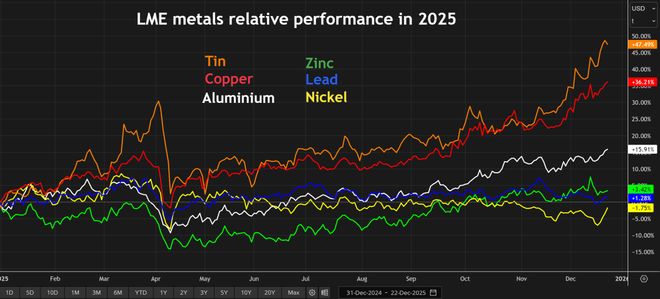
Group 1 - The core theme defining the LME base metals market this year is the market restructuring caused by supply disruptions and trade tariffs [1] - Despite a challenging demand outlook, supply chain pressures have driven the LME index for six base metal futures contracts to its highest level since the historical peak in 2022, the year the Russia-Ukraine conflict began [1] - The market turmoil this year is also attributed to the unpredictable tariff policies of former U.S. President Donald Trump, which have led to structural changes in global metal trade [1] Group 2 - Copper prices on the LME have reached historical highs, approaching $12,000 per ton, driven by expectations of potential tariffs on refined copper imports [3] - The threat of tariffs has caused significant market disturbances, comparable to the actual impact of the tariffs themselves [3] - Tin has emerged as a "star commodity" this year, facing multiple supply threats due to its concentrated global supply from high-risk regions [5] Group 3 - The aluminum market is experiencing a supply ceiling as China's production capacity has reached government-imposed limits, leading to heightened market awareness of new aluminum smelting projects outside China [7][8] - The U.S. aluminum market is facing a supply shortage, with spot prices significantly above LME benchmark prices, indicating a critical supply gap [9] - Zinc has encountered a dramatic market situation with low inventories, leading to record premiums for spot zinc over three-month futures [10] Group 4 - The lead market remains oversupplied, with no immediate changes expected in this situation, as traders prefer storage arbitrage over spot sales [16] - Nickel supply is increasing significantly due to rising production in Indonesia, outpacing demand growth, although there are indications of strategic stockpiling in China [17]

“黑五”跨境电商变局:当消费者不再只为低价买单,亚马逊、天猫国际、京东如何破局?
Mei Ri Jing Ji Xin Wen· 2025-11-27 15:53
Core Insights - The article highlights the transformation of cross-border e-commerce in China, shifting from a focus on low prices to an emphasis on quality and experience, driven by changing consumer preferences [2][4]. Group 1: Market Trends - Cross-border e-commerce imports in China grew by 5.9% year-on-year in the first three quarters of 2025, indicating strong demand for overseas quality products despite a slowdown in overall e-commerce growth [1]. - The "Black Friday" shopping season has seen major players like Tmall and Amazon ramping up their global offerings, with Tmall International launching a 100-hour global live-streaming event featuring over 1,700 global buyers [1][5]. - Consumers are increasingly seeking niche and personalized products, moving away from mass-market options, with outdoor gear and unique accessories gaining popularity [3][4]. Group 2: Consumer Behavior - Younger consumers are driving a shift towards unique gifts that reflect overseas cultural elements, such as collectible items and innovative gadgets, contrasting with older generations' preference for health products [4]. - Health-related products are becoming more popular among younger demographics, with items like joint care supplements and protein powders seeing increased sales [4]. Group 3: Logistics and Experience - The article emphasizes the importance of logistics efficiency in enhancing the cross-border shopping experience, with Amazon's overseas purchase service reducing delivery times significantly [5]. - Domestic logistics providers are also improving their capabilities, with Alibaba's Cainiao increasing order processing capacity by nearly three times during the "Black Friday" promotions [5]. - Innovations in online and offline integration, such as Tmall's global price comparison and JD's direct shipping from bonded warehouses, are enhancing consumer engagement [6]. Group 4: Future Outlook - The ongoing policy benefits and continuous consumer upgrades are expected to create more opportunities for the cross-border e-commerce sector in China [6]. - Companies are focusing on differentiating their services through product variety, price transparency, logistics efficiency, and user experience to remain competitive in the rapidly evolving market [6].
【致同国际商业报告】关税变局下的生存之道
Sou Hu Cai Jing· 2025-07-27 13:02
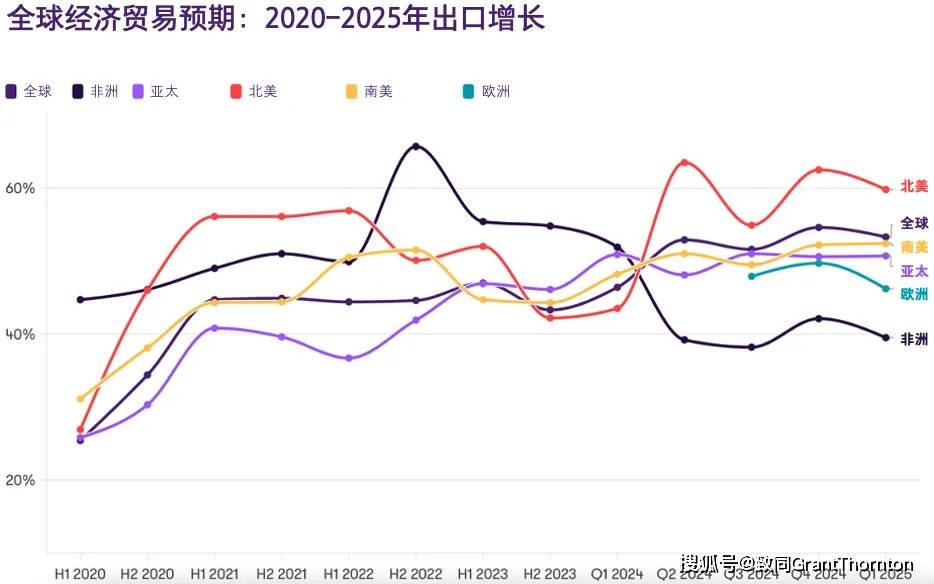
Group 1 - The core viewpoint of the articles highlights the significant impact of tariff policies on mid-market enterprises, indicating a decline in market optimism and the need for strategic adaptation [1][3][4] - The OECD warns that the current tariff policy turmoil may lead to substantial drag on global economic growth, evolving into a complex new global trade system characterized by unpredictability [3][4] - Mid-market companies are urged to recognize the structural changes in traditional export markets and adapt their strategies to focus on local market value and regional business matrices [4][5] Group 2 - Key survival traits for mid-market enterprises include business focus, decision-making agility, and strategic leadership, which are essential for navigating the current environment [5][6] - Companies are facing tough decisions regarding market exits where tariff costs outweigh benefits, necessitating a reconfiguration of traditional trade terms and supply chain networks [6][8] - In addition to tariffs, mid-market enterprises are under pressure from four transformation challenges: AI industrialization, cybersecurity threats, carbon neutrality regulations, and demographic changes [8]
【MACRO 时势】黄金走强背后:财政风险、政策博弈与市场重构的多重驱动
Sou Hu Cai Jing· 2025-07-10 10:05
Group 1: Core Logic Supporting Gold Prices - The increasing fiscal situation in the U.S. is a fundamental factor supporting gold prices, with the potential addition of $3.4 trillion in debt over the next decade due to the "Build Back Better" plan, and a debt ceiling increase of $5 trillion, exacerbating the current $36.2 trillion debt level [3][6] - The dual accumulation of fiscal and political risks has triggered a global capital reallocation, influenced by the rising political atmosphere following Musk's announcement of forming the "American Party" [3][6] Group 2: Trade Frictions and Policy Volatility - Trump's trade policies, including a recent 50% tariff on copper imports, have stirred market sentiment and raised concerns about global economic slowdown, leading to increased inflows of safe-haven funds into the gold market [7][9] - The uncertainty in trade policies is impacting consumer confidence and business investment, prompting a reallocation of global capital away from U.S. assets towards gold as an alternative safe-haven [9] Group 3: Federal Reserve Policies and Interest Rate Dynamics - The traditional inverse relationship between interest rates and gold prices is being restructured, as gold prices have risen despite actual U.S. interest rates exceeding 2% [10][13] - Market expectations regarding the Federal Reserve's potential shift in policy, including possible interest rate cuts due to inflation concerns, are contributing to the current dynamics where both gold and interest rates may rise simultaneously [10][13] Group 4: Central Bank Gold Purchases and Market Structure - Continuous gold purchases by central banks, particularly in emerging markets, are becoming a significant support for gold prices, driven by motives such as diversification of foreign exchange reserves and hedging against geopolitical risks [13] - The shift in demand from private investors to official institutions marks a structural change in the gold market, reflecting a trend of "de-dollarization" in response to U.S. fiscal deficits [13] Group 5: Short-term Volatility and Long-term Trends - Short-term fluctuations in gold prices are influenced by technical and sentiment factors, with current prices nearing key resistance levels around $3,335 per ounce [14] - Long-term drivers for gold remain rooted in structural uncertainties in the global economy and politics, including ongoing U.S. fiscal deficits and fluctuating trade policies, reinforcing gold's role as a "backup safe-haven asset" [17]

美对华海运业发动“301条款”,或导向一个讽刺性局面
Hu Xiu· 2025-04-24 02:35
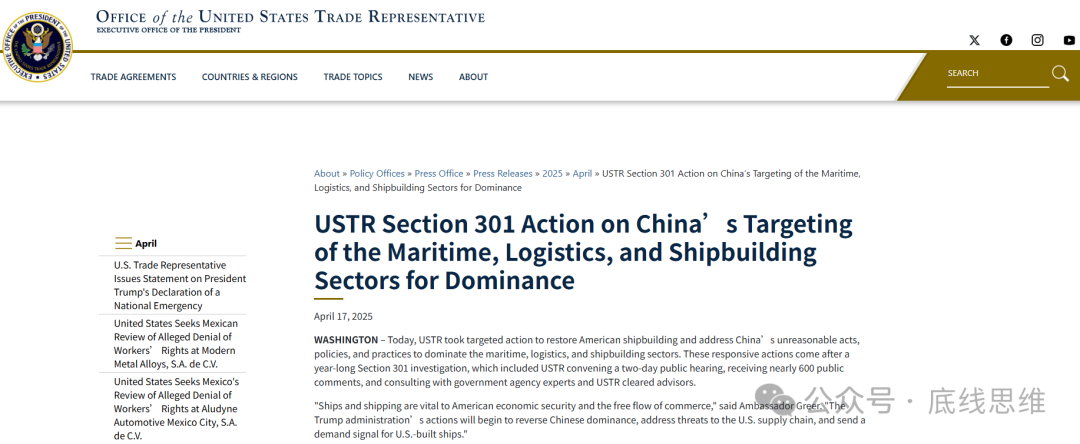
Core Points - The U.S. Trade Representative (USTR) announced the results of the 301 investigation into China's shipping, logistics, and shipbuilding industries, detailing new fee structures for Chinese shipping companies and vessels built in China [1][3]. Implementation Details - The implementation of the new measures will occur in two phases: the first phase will take effect in 180 days, imposing fees on Chinese shipowners and operators, as well as on non-U.S. shipping companies using vessels built in China. The fee structure will vary based on the type of vessel, calculated by net tonnage, with a maximum of five charges per year [3][4]. - The second phase, effective in three years, will impose fees on non-U.S. liquefied natural gas (LNG) vessels docking at U.S. ports, with rates increasing annually. The latest version of the proposal includes a 180-day buffer and narrows the scope of applicable vessels, enhancing the focus on China [4][5]. Industry Reactions - Industry leaders, such as Andrew Abbott, CEO of Atlantic Container Line (ACL), have expressed strong opposition to the legislation, indicating that it could force their company to exit the U.S. market due to the predominance of Chinese-built vessels in their fleet [5][6]. - Despite ACL's unique situation, the overall share of Chinese-built vessels in the global fleet is relatively low, with only 23% of the current fleet being constructed in China [6][7]. Market Statistics - According to Clarkson's data, Chinese-built container ships account for 39% of the global container fleet, while the order book for container ships in 2024 shows China with a 69% share, indicating a significant increase in new orders [7][9]. - The U.S. container shipping market exports approximately 13.9 million TEUs annually and imports 34 million TEUs, representing about 22.5% of global container shipping trade [12]. Cost Implications - If the new fees are implemented, the cost per container for routes from the U.S. West Coast could increase by $450 to $550, while East Coast routes may see increases of $200 to $300, representing significant percentages of current freight rates [13][17]. - Historical trends suggest that shipping companies are likely to pass these additional costs onto consumers, potentially leading to a market environment similar to that experienced during the pandemic [17]. Comparative Analysis - The U.S. container shipping market's dynamics are compared to the Russian market, which has faced similar external pressures. The U.S. market is expected to maintain supply levels, unlike the drastic changes seen in Russia following the Ukraine conflict [19][21]. - The differences in market size and operational structures between the U.S. and Russia highlight the potential for U.S. shipping companies to adapt rather than exit the market entirely [20][23]. Strategic Opportunities - The 301 legislation may inadvertently create strategic opportunities for Chinese shipping and shipbuilding industries, as market gaps left by exiting foreign companies could be filled by domestic firms [35][36]. - The potential restructuring of the U.S. shipping market could lead to increased market share for Chinese companies, particularly in logistics and shipping services [38][39]. Regulatory Implications - The legislation highlights the inefficacy of current international shipping governance systems, as it may lead to a decrease in the competitiveness of Chinese-built vessels in the global market [40][41]. - China is encouraged to develop its own regulatory framework to counteract the effects of the U.S. legislation, focusing on establishing standards that could enhance its competitive position in the shipping and shipbuilding sectors [43][44].
跨境电商“突围”战:关税风暴中寻找第二增长曲线
Bei Ke Cai Jing· 2025-04-18 01:20
Core Viewpoint - The article discusses the impact of the recent U.S. tariff policy on Chinese cross-border e-commerce, highlighting both challenges and opportunities for businesses in the sector as they adapt to changing market conditions and explore new markets [4][16]. Group 1: Tariff Impact and Business Adaptation - The U.S. "reciprocal tariff" policy has officially taken effect, leading to potential tariffs as high as 245% on Chinese goods, causing significant concern among cross-border e-commerce operators [4][5]. - Despite the tariff increases, businesses are employing strategies such as price adjustments and market diversification to mitigate the impact, with some sellers reporting only minor increases in product costs [5][6]. - Smaller sellers are experiencing less pressure from tariffs, with cost increases being manageable, allowing them to maintain consumer interest [5][7]. Group 2: Market Diversification Strategies - Many cross-border e-commerce businesses are shifting focus from the U.S. market to more favorable regions such as Central Asia and Europe, driven by the need to reduce reliance on the U.S. amid tariff uncertainties [9][10]. - Sellers are increasingly adopting a multi-market strategy, leveraging the global market potential of approximately 8 billion people, with significant growth observed in European markets [10][11]. - The establishment of new partnerships and networks in emerging markets is being prioritized to facilitate smoother trade and market entry [11][16]. Group 3: Industry Restructuring and Compliance - The tariff situation is prompting a restructuring within the industry, where businesses with strong supply chain and logistics capabilities are likely to thrive, while smaller, less resourceful sellers face greater challenges [13][14]. - Compliance with international trade regulations is becoming increasingly critical, as businesses must navigate not only tariff costs but also legal risks associated with being a Chinese entity in foreign markets [14][15]. - Companies are encouraged to build robust compliance frameworks and explore second markets to ensure long-term sustainability and growth in the face of evolving trade policies [15][16].