
产能天花板

Search documents
为什么要配电解铝-26年电解铝年度策略
2026-01-13 01:10
Summary of the Electrolytic Aluminum Industry Conference Call Industry Overview - The electrolytic aluminum industry is facing a production capacity ceiling, with China's capacity capped at 45.4 million tons, expected to reach this limit by 2027. [1] - New production capacity overseas is constrained by power supply issues, making rapid increases in output unlikely in the short term. [1] - Global electrolytic aluminum production is projected to increase by approximately 1.3 million tons in 2026, with a supply growth rate of about 1.7%. [1][7] - Demand is expected to grow at around 2%, benefiting from loose monetary policies. [1] Key Insights and Arguments - The supply-demand balance is expected to remain tight and may lead to shortages, with aluminum prices potentially rising significantly, averaging around 25,000 RMB/ton. [1][8] - The EPS growth for electrolytic aluminum companies is supported by stable raw material prices, with industry valuations likely to rise from 8-10 times to 12-15 times. [1][9] - Systematic investment opportunities exist in the electrolytic aluminum sector, with recommendations for specific stocks such as Yun Aluminum, Shenhuo Co., and Zhongfu Industrial. [1][10] Supply Side Changes - The electrolytic aluminum supply side is facing its first historical capacity ceiling, with production nearing the 45.4 million tons limit established in 2017. [3] - New production capacity in 2026 is expected to be around 500,000 to 600,000 tons, with the likelihood of reaching the ceiling by 2027. [3] - Global new projects are primarily set to release production in the second half of the year, requiring a ramp-up period. [3][6] Overseas Project Developments - Key overseas projects include Adaro and Lichin in Indonesia, and projects by Xinfa and Nanshan Group, with varying completion timelines. [4][5] - The Adaro and Lichin project plans for 1.5 million tons in three phases, while Xinfa's small K Island project is expected to be completed in Q2 this year. [4][5] Demand Projections - Global electrolytic aluminum demand is projected to grow at around 2% in 2026, with domestic demand growth expected between 2.2% and 2.3%, and overseas demand at approximately 1.5%. [7] - The overall demand growth is supported by favorable macroeconomic conditions, including fiscal and monetary policy easing in major economies. [7] Price Impact and Market Outlook - The market is expected to experience a tight balance leading to potential price surges, with aluminum prices anticipated to exceed 25,000 RMB/ton. [8] - The fragile supply-demand balance means that any supply disruptions or unexpected demand increases could trigger explosive price increases. [8] Investment Strategy - The electrolytic aluminum sector presents systematic investment opportunities, with a focus on both pure-play and flexible stocks. [9][10] - Recommended stocks include Tianshan Aluminum for its significant production growth, along with Nanshan Innovation, Hongchuang Holdings, and China Hongqiao. [10]
氧化铝有必要设置产能天花板吗?
Xin Lang Cai Jing· 2026-01-04 01:29
Core Viewpoint - China's aluminum oxide industry is facing a significant challenge of overcapacity, despite being the largest producer globally, with major companies dominating the market [1][8]. Group 1: Current Capacity and Demand - China's aluminum oxide production capacity has reached 110.85 million tons, a 66.82% increase since 2015, and is expected to see an additional 10 million tons by 2026, exacerbating the overcapacity issue [2][9]. - Approximately 95% of aluminum oxide is used for producing electrolytic aluminum, with a theoretical maximum demand of about 86.63 million tons based on a consumption rate of 1.925 tons of aluminum oxide per ton of electrolytic aluminum [4][11]. - The current overcapacity stands at approximately 2.42 million tons, leading to an expected operating rate of 81% in 2024, indicating that nearly 20% of the capacity will remain idle [4][11]. Group 2: Historical Context and Policy - The historical development of China's electrolytic aluminum industry has seen significant growth, with a production increase from 342,000 tons in 2001 to a controlled capacity of around 4.5 million tons due to government policies aimed at curbing overcapacity [5][12]. - The introduction of policies in 2013 and subsequent years established a capacity ceiling for electrolytic aluminum, effectively controlling the expansion of production and ensuring a more stable industry environment [6][12]. Group 3: Industry Response and Future Considerations - There is a call for intervention in the aluminum oxide sector to prevent blind investments and promote consolidation among major enterprises to enhance competitiveness [13]. - However, the necessity of establishing a capacity ceiling for aluminum oxide is debated, as the existing demand already reflects a "hidden" ceiling based on electrolytic aluminum production needs [13][14].


南华期货2026年铝产业链年度展望:冰火两重天
Nan Hua Qi Huo· 2025-12-31 11:46
Report Industry Investment Rating No relevant content provided. Core Views of the Report Alumina - The core contradiction in alumina prices lies in the supply side. In 2026, the oversupply situation may continue, and the cost line may become the price game line. The price center of alumina is expected to shift downward compared to this year [2]. - It is recommended to pay attention to news related to alumina enterprise maintenance and production, and adopt a short - selling approach when the fundamentals remain unchanged [2]. Electrolytic Aluminum - In 2026, macro and supply conditions will be important factors affecting electrolytic aluminum prices. The macro environment is expected to remain loose, highlighting the anti - depreciation financial attribute of aluminum. With limited domestic supply increment and uncertain overseas supply, aluminum prices are expected to remain strong [3]. - It is recommended to go long on dips [3]. Summary by Relevant Catalogs Chapter 2: Market Review Alumina - In 2025, the actual supply increase of alumina exceeded expectations, while the demand increment was limited. The price first declined, then rebounded due to supply disruptions, and finally returned to a weak trend [5]. Electrolytic Aluminum - In 2025, the electrolytic aluminum market showed a pattern of "oscillating upward and rising center of gravity", reaching a new high since 2022 at the end of the year [7]. Chapter 3: Core Focus Points Alumina - Bauxite: In 2025, bauxite supply was sufficient, with high imports and inventory accumulation, and weak prices. In 2026, the supply is expected to remain abundant, and the price may continue to be weak, with a trading range of 60 - 75 dollars/ton [11][13]. - Alumina: In 2025, global alumina supply expanded significantly, and the oversupply situation continued. In 2026, there are many planned new production increments at home and abroad, and the average industry cost may decline [15][17]. Electrolytic Aluminum - China's supply: China's electrolytic aluminum is subject to a 45 - million - ton/year capacity ceiling. In 2025, production mainly came from the resumption of previous - reduced production capacity. In 2026, the capacity increment is small, and the import of Russian aluminum is expected to continue [21][25]. - Overseas supply: In 2025, overseas electrolytic aluminum had both production increases and decreases. In 2026, the supply is expected to be in a state of slow recovery and limited expansion, with Indonesia being the main source of new capacity, but there are uncertainties in power supply [27][29]. - Macro environment: In 2026, the macro environment is expected to remain loose, and the financial attribute of aluminum against depreciation will be prominent, providing upward momentum for aluminum prices [33]. Chapter 4: Supply - Demand Outlook Alumina - Supply: Bauxite supply is expected to remain abundant in 2026, and the oversupply of alumina is predictable, with new production capacity concentrated in Indonesia, India, and southern China [35]. - Demand: The downstream demand for alumina is mainly for electrolytic aluminum smelting. With limited supply increment of domestic electrolytic aluminum, the demand for alumina is difficult to find bright spots [36]. Electrolytic Aluminum - Supply: Domestic supply increment is limited due to the capacity ceiling, and overseas supply is in a state of slow recovery and limited expansion, with uncertainties in new production capacity and possible production cuts [36][37]. - Demand: - Real estate: The drag on aluminum consumption from real estate is expected to slow down in 2026, with a narrowing decline in the completion side [38]. - New energy vehicles: Although the growth rate of the new energy vehicle market may slow down in 2026, the future aluminum consumption increment is still considerable [40]. - Power grid investment: Power grid investment is expected to maintain stable growth during the 15th Five - Year Plan period [42]. - Photovoltaic: Photovoltaic installation is expected to experience negative growth in 2026, dragging down aluminum consumption [44].
原料 | 震荡与重构:伦敦金属交易所金属市场年度回顾七图解析
Xin Lang Cai Jing· 2025-12-24 05:06
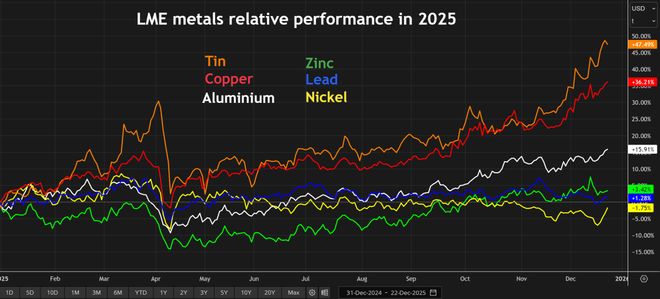
Group 1 - The core theme defining the LME base metals market this year is the market restructuring caused by supply disruptions and trade tariffs [1] - Despite a challenging demand outlook, supply chain pressures have driven the LME index for six base metal futures contracts to its highest level since the historical peak in 2022, the year the Russia-Ukraine conflict began [1] - The market turmoil this year is also attributed to the unpredictable tariff policies of former U.S. President Donald Trump, which have led to structural changes in global metal trade [1] Group 2 - Copper prices on the LME have reached historical highs, approaching $12,000 per ton, driven by expectations of potential tariffs on refined copper imports [3] - The threat of tariffs has caused significant market disturbances, comparable to the actual impact of the tariffs themselves [3] - Tin has emerged as a "star commodity" this year, facing multiple supply threats due to its concentrated global supply from high-risk regions [5] Group 3 - The aluminum market is experiencing a supply ceiling as China's production capacity has reached government-imposed limits, leading to heightened market awareness of new aluminum smelting projects outside China [7][8] - The U.S. aluminum market is facing a supply shortage, with spot prices significantly above LME benchmark prices, indicating a critical supply gap [9] - Zinc has encountered a dramatic market situation with low inventories, leading to record premiums for spot zinc over three-month futures [10] Group 4 - The lead market remains oversupplied, with no immediate changes expected in this situation, as traders prefer storage arbitrage over spot sales [16] - Nickel supply is increasing significantly due to rising production in Indonesia, outpacing demand growth, although there are indications of strategic stockpiling in China [17]
铝2026年策略:经济复苏叠加产能天花板,铝价重心向上
Chang Jiang Qi Huo· 2025-12-08 05:25
1. Report Industry Investment Rating No information provided in the content. 2. Core Viewpoints - In 2026, alumina prices are expected to decline with reduced volatility due to a more relaxed ore supply and a slightly oversupplied production capacity [1][29][92] - The growth rate of domestic electrolytic aluminum production will slow down significantly as the operating capacity approaches the ceiling, and imports are expected to increase to offset the supply - demand gap. The downstream demand for aluminum is undergoing a structural transformation [2][45][92] - The price of aluminum alloy will still be pegged to the price of aluminum in 2026, but its seasonal performance will be weaker than before [3][53][93] - The price of aluminum and aluminum alloy is expected to show an upward trend in 2026, driven by factors such as global economic recovery, new - energy transformation, and power construction [3][93] 3. Summary by Relevant Catalog 3.1 2025 Market Review - In 2025, aluminum prices showed a trend of oscillating upward breakthrough, divided into three stages: oscillating upward from January to mid - March, oscillating downward from mid - March to early April, and oscillating upward from early April to November. The price fluctuations were affected by various factors such as policies, tariffs, inventory changes, and macro - events [6][7][8] 3.2 Supply Side 3.2.1 Bauxite - Domestic bauxite production increased slightly in 2025, with a growth rate of 5.2% from January to November. However, production was restricted in some areas due to safety and environmental regulations. Imported bauxite increased significantly, with imports from January to October reaching 171 million tons, a year - on - year increase of 30.4%. The price of imported bauxite decreased due to increased supply. There were some disturbances in the supply from Guinea, and the political situation in Guinea may affect future supply policies [14][16][18] 3.2.2 Alumina - In 2025, alumina production increased, with output from January to October reaching 78.222 million tons, a year - on - year increase of 9.56%. The price first declined, then rebounded, and then fell again. New production capacity was limited in 2025, mainly from Guangxi Huasheng Phase II, Shandong Chuangyuan New Materials, and Hebei Wenfeng. In 2026, new overseas production capacity will be mainly in India, Indonesia, and Vietnam. Alumina production capacity is expected to be slightly oversupplied in 2026, and prices will be determined by cost, showing an oscillating downward trend [22][24][29] 3.2.3 Electrolytic Aluminum - In 2025, the built - in and operating capacity of domestic electrolytic aluminum increased slightly, with production from January to October reaching 36.8908 million tons, a year - on - year increase of 2.57%. Many enterprises resumed production due to improved profitability, while some enterprises carried out technical upgrades and maintenance, resulting in production cuts. New production capacity mainly came from Shuangyuan Aluminum, Chalco Qinghai, and others. In 2026, new domestic production capacity will mainly come from Huomeihongjun Zhalv Phase II and Tianshan Aluminum. Overseas production capacity increased in 2025, mainly in Indonesia, Russia, and other countries, and is expected to increase by 1.8 million tons in 2026. The growth rate of domestic electrolytic aluminum production will slow down significantly in 2026, and imports are expected to increase [30][35][45] 3.2.4 Aluminum Alloy - Although the import of scrap aluminum was liberalized in 2024, there was no significant increase in 2025 due to factors such as the cancellation of export tax rebates, tariff differences, and tightened trade policies in some countries. The production of recycled aluminum alloy increased steadily, and the listing of aluminum alloy futures promoted production. After the listing of the futures, the production of cast aluminum alloy increased significantly, suppressing the price difference between ADC12 and A00, and the seasonal effect was weakened [48][50][52] 3.3 Demand Side 3.3.1 Real Estate - In 2025, the real estate market continued to decline. In 2026, the real estate market is expected to continue to bottom out, and the demand for aluminum in the real estate sector will continue to decrease. However, urban renewal and affordable rental housing will support part of the aluminum demand [54][56][58] 3.3.2 Infrastructure - In 2025, the issuance of local government special bonds increased, but part of the funds was used for debt repayment, resulting in a slowdown in infrastructure investment growth. The investment in the power grid reached a new high. In 2026, with the increase in special bond quotas and the promotion of power grid construction, the demand for aluminum in infrastructure is expected to increase by 5% [59][61][69] 3.3.3 Automobile - In 2025, the automobile market had good production and sales performance, with new - energy vehicle penetration exceeding 50%. In 2026, although consumption policies are expected to be strengthened and export demand is optimistic, factors such as the reduction of new - energy vehicle purchase tax exemption and the implementation of new battery standards may lead to flat demand for aluminum in the automobile industry [70][72][75] 3.3.4 Photovoltaic - In 2025, the new installed capacity of photovoltaic increased significantly in the first half of the year but decreased sharply after June due to the "430 New Policy" and "531 New Policy". In 2026, the new installed capacity of domestic photovoltaic is expected to decline significantly, and although the overseas new installed capacity is expected to grow at a rate of 25%, the overall demand for aluminum in the photovoltaic industry is expected to decrease [76][79][82] 3.3.5 Aluminum and Aluminum Product Exports - In 2025, the net export of aluminum products decreased, mainly due to the cancellation of export tax rebates and the imposition of tariffs. The export of aluminum products increased. In 2026, due to the continuation of policies and the strengthening of the domestic aluminum price, the net export of aluminum and aluminum products is expected to decline [83][85][86] 3.4 Inventory and Supply - Demand Balance - In the first half of 2025, aluminum inventories decreased significantly, while in the second half, they increased seasonally. In 2026, the domestic electrolytic aluminum market is expected to have a shortage of 100,000 tons [88][90][91] 3.5 2026 Outlook - Alumina prices are expected to decline with reduced volatility; the growth rate of domestic electrolytic aluminum production will slow down, imports will increase, and downstream demand will transform; the price of aluminum alloy will be pegged to aluminum with weaker seasonality; the price of aluminum and aluminum alloy is expected to rise [92][93]
有色金属行业:“低TC”时代来临:铜冶炼企业的突围与重塑
Minmetals Securities· 2025-11-25 07:25
Investment Rating - The investment rating for the non-ferrous metals industry is optimistic [1]. Core Insights - The industry is entering a "low TC" era, with copper smelting enterprises facing significant challenges and the need for transformation [2]. - The report highlights that TC/RC has dropped to negative levels, indicating a tightening supply of copper concentrate [8][12]. - The report discusses the impact of recent production cuts from major copper mines, which have led to a significant reduction in supply [12][18]. - The profitability of smelting enterprises is under pressure, with many operating at a loss, relying on by-product revenues for survival [15][18]. - Future policies are expected to focus on controlling copper smelting capacity to prevent excessive competition and promote industry consolidation [22][23]. Summary by Sections Section 1: TC at a Decade Low - TC/RC has reached negative values, with imported copper concentrate TC around -42 USD/dry ton as of November 2025 [8]. - Major copper mines have experienced production cuts, leading to a total reduction of 570,000 tons in supply [12]. - Smelting enterprises are currently facing losses, with by-products like sulfuric acid becoming crucial for profitability [15][18]. Section 2: Future Outlook on TC - The report anticipates that TC will remain low over the next two years, with a projected supply gap of around 500,000 tons in 2026 [29]. - Policies are being developed to set a "capacity ceiling" for copper smelting to enhance industry structure and efficiency [22][23]. - The pricing model for copper smelting may shift, with companies like Freeport considering individual contract pricing to maintain profitability [25]. Section 3: Strategies for Smelting Enterprises - Smelting enterprises are encouraged to extend their supply chains and reduce costs through technological advancements and operational efficiencies [36][41]. - The report emphasizes the importance of increasing the recycling of copper and optimizing the use of by-products to enhance profitability [41][42].
金属、新材料行业周报:降息预期短期压制,板块高景气趋势不变-20251123
Shenwan Hongyuan Securities· 2025-11-23 08:13
Investment Rating - The report maintains a positive outlook on the metals and new materials industry, despite short-term interest rate cut expectations suppressing market performance [3]. Core Views - The report highlights that the high prosperity trend in the sector remains unchanged, with a focus on the recovery potential of precious metals and stable supply-demand dynamics in industrial metals [4][5]. Weekly Market Review - The Shanghai Composite Index fell by 3.90%, while the Shenzhen Component Index dropped by 5.13%. The non-ferrous metals index decreased by 6.75%, underperforming the CSI 300 Index by 2.98 percentage points [5][6]. - Year-to-date, the non-ferrous metals index has risen by 65.71%, outperforming the CSI 300 Index by 52.53 percentage points [7]. Price Changes - Industrial metals and precious metals saw price fluctuations, with LME copper down by 0.69% and COMEX gold down by 0.53% [4][14]. - Lithium prices increased significantly, with lithium spodumene up by 17.84% and battery-grade lithium carbonate up by 6.90% [4][16]. Precious Metals - The report notes that the U.S. non-farm payrolls exceeded expectations, impacting gold prices. The long-term outlook for gold remains positive due to ongoing central bank purchases and a low current gold reserve in China [4][19]. - The report suggests focusing on companies like Shandong Gold, Zhaojin Mining, and Zijin Mining for potential investment opportunities in the precious metals sector [4][17]. Industrial Metals - Copper demand is expected to remain strong, with supply disruptions anticipated due to a recent landslide at Freeport's Grasberg mine, potentially reducing global copper supply by about 2.2% [4][29]. - The report recommends关注 companies such as Zijin Mining, Luoyang Molybdenum, and Tongling Nonferrous Metals for copper investments [4][17]. Aluminum - The aluminum sector is expected to see a tightening supply-demand balance, with domestic production capacity constraints. The report suggests关注 companies like China Aluminum and Xinjiang Zhonghe for investment [4][42]. - The report indicates that the average profit in the electrolytic aluminum industry is approximately 5,489 yuan per ton, with costs decreasing slightly [4][44]. Steel - The steel production is on the rise, with a decrease in inventory levels. The report highlights the importance of monitoring supply adjustments and export demand [4][18]. - Companies like Baosteel and Shagang Group are identified as stable dividend-paying stocks worth关注 [4][18]. Key Company Valuations - The report provides detailed valuations for key companies in the non-ferrous metals and steel sectors, indicating potential investment opportunities based on their earnings and price-to-earnings ratios [4][17][18].



金属、新材料行业周报:降息预期进一步抬升,重视黄金板块表现-20250907
Shenwan Hongyuan Securities· 2025-09-07 12:44
Investment Rating - The report maintains a positive outlook on the metals and new materials industry, particularly highlighting the performance of the gold sector [3][4]. Core Insights - The report indicates that the gold sector is expected to benefit from rising interest rate cut expectations, with a long-term trend of central bank gold purchases anticipated due to low current gold reserves in China [4][23]. - The industrial metals segment shows a mixed performance, with copper prices expected to remain strong due to supply constraints and increasing demand from sectors like home appliances and power grid investments [4][36]. - The aluminum market is projected to experience a long-term upward trend in prices, supported by tightening supply-demand dynamics and potential policy support [4][49]. Weekly Market Review - The Shanghai Composite Index fell by 1.18%, while the non-ferrous metals index rose by 2.12%, outperforming the Shanghai Composite by 2.93 percentage points [5][11]. - Precious metals saw a significant increase, with gold prices rising by 3.52% and silver by 1.87% [4][17]. - Year-to-date performance shows precious metals up by 60.89%, aluminum by 23.36%, and copper by 60.11% [11][12]. Price Changes and Key Company Valuations - The report details price changes for various metals, with copper at $9,898 per ton, aluminum at $2,601 per ton, and gold at $3,640 per ounce [17][20]. - Key companies in the sector include Zijin Mining, Shandong Gold, and Huayou Cobalt, with respective valuations and earnings projections provided [20][21]. Supply and Demand Analysis - Copper supply is tightening, with domestic social inventory increasing to 141,000 tons, while demand remains robust with operating rates for copper products showing slight increases [36][49]. - The aluminum sector is experiencing a rise in downstream processing rates, with a current operating rate of 61.70% [49][51]. - Steel production is affected by short-term production limits in Hebei, leading to a decrease in output and an increase in steel prices [4][73].



氧化铝产能需设“天花板”以稳定市场
news flash· 2025-08-04 02:00
Core Viewpoint - The rapid expansion of alumina production capacity has led to significant industry challenges, including supply-demand imbalance, price declines, and resource dependency, necessitating the establishment of a production capacity "ceiling" for alumina to ensure market stability and sustainable development [1] Group 1: Industry Challenges - The alumina industry is facing severe overcapacity issues due to rapid production capacity expansion [1] - This overcapacity has resulted in supply-demand imbalances and declining prices within the industry [1] - The industry is also grappling with increased resource dependency as a consequence of these challenges [1] Group 2: Proposed Solutions - It is recommended to draw lessons from the successful experiences of the electrolytic aluminum industry [1] - Establishing a scientifically planned production capacity ceiling is suggested to control alumina output [1] - Strengthening policy regulation and promoting industrial structure optimization are essential for addressing these challenges [1] - The establishment of an exit mechanism is proposed to rationally manage alumina production capacity [1] - These measures aim to ensure market stability and support the green and sustainable development of the industry [1]
新能源及有色金属日报:海外氧化铝价格出现松动-20250704
Hua Tai Qi Huo· 2025-07-04 03:32
Report Industry Investment Ratings - Aluminum: Neutral [7] - Alumina: Cautiously Bearish [7] - Aluminum Alloy: Neutral [7] Core Views - The further rise of aluminum prices requires the resonance of macro - improvement and strong micro - consumption. In the current off - season, there is a slight increase in social inventory, with a small accumulation expected in July. Long - term attention should be paid to the price increase driven by stronger - than - expected consumption under the background of supply constraints [4]. - For alumina, the supply pressure at home and abroad remains unchanged in the long term. Although the delivery risk has been alleviated, it still needs to be vigilant [6]. - For aluminum alloy, it is in the off - season, and the price increase space in the spot market is limited. Attention should be paid to cross - variety arbitrage opportunities [6]. Summary by Related Content Aluminum - **Price and Inventory Data**: On July 3, 2025, the Yangtze River A00 aluminum price was 20,860 yuan/ton, up 50 yuan/ton from the previous trading day. The SHFE aluminum main contract closed at 20,680 yuan/ton, up 15 yuan/ton, with a trading volume of 114,240 lots and a position of 281,092 lots. As of July 3, 2025, the domestic electrolytic aluminum ingot social inventory was 474,000 tons, and the LME aluminum inventory was 356,975 tons, up 350 tons from the previous day [2]. - **Market Analysis**: The spot market transaction premium is still falling, and social inventory shows signs of accumulation. The supply of the electrolytic aluminum industry is limited by the production capacity ceiling, and the industry profit is rich. The smelting profit has expanded to 4,000 yuan/ton in the off - season. In the short term, beware of price drops due to inventory accumulation; in the long term, pay attention to price increases driven by stronger - than - expected consumption [4]. Alumina - **Price and Inventory Data**: On July 3, 2025, the SMM alumina price in Shanxi was 3,080 yuan/ton, in Shandong was 3,080 yuan/ton, and in Guangxi was 3,180 yuan/ton. The Australian alumina FOB price was 361.6 US dollars/ton. The alumina main contract closed at 3,026 yuan/ton, up 28 yuan/ton, with a trading volume of 336,450 lots and a position of 279,051 lots. The alumina warehouse receipt was 21,000 tons [2][3]. - **Market Analysis**: The cost side remains stable, and the new project of Guangtou is about to be put into production. The supply pressure at home and abroad remains unchanged in the long term. Although the delivery risk has been alleviated, it still needs to be vigilant [5][6]. Aluminum Alloy - **Price and Inventory Data**: On July 3, 2025, the purchase price of Baotai civil aluminum scrap was 15,300 yuan/ton, and the purchase price of mechanical aluminum scrap was 15,400 yuan/ton, both unchanged from the previous day. The total inventory of aluminum alloy was 108,800 tons, up 2,100 tons week - on - week [3]. - **Market Analysis**: It is in the off - season, and the price increase space in the spot market is limited. The cost side supports the price, and attention should be paid to cross - variety arbitrage opportunities [6].