
影子银行体系

Search documents
从软件股暴跌到金融踩踏:私人信贷的“影子风险”浮出水面
美股研究社· 2026-02-28 11:38
Core Viewpoint - The recent downturn in the U.S. stock market, particularly in the financial sector, highlights the risks associated with leveraged positions backed by overvalued assets, as evidenced by the bankruptcy of Market Financial Solutions (MFS) [2][4]. Group 1: Market Dynamics - The bankruptcy of MFS, a UK mortgage lender, triggered widespread panic in the financial sector, leading to significant declines in bank ETFs and regional bank stocks [2][4]. - The event is not merely a localized financial issue but serves as a risk transmission test, revealing that substantial financial risks remain hidden within complex credit structures, particularly in the context of the AI bull market and high interest rates [4][8]. Group 2: Private Credit Risks - The private credit market has rapidly expanded in recent years, filling the gap left by traditional banks constrained by capital requirements and regulatory demands. This has led to a proliferation of high-risk loans packaged in private funds and customized structured products [7][10]. - The decline in software stock valuations may trigger a liquidity crisis in private credit, as the value of collateral diminishes, leading to margin calls and potential defaults [6][8]. Group 3: Systemic Risk Assessment - Unlike the 2008 financial crisis, current risks are more concentrated in the non-bank financial system, with private credit markets now valued in the trillions of dollars, posing a significant threat to financial stability [10][11]. - The collective decline in financial stocks reflects investor concerns about the systemic underestimation of risks associated with private credit, as many seemingly stable credit products are tied to volatile tech stocks [8][10]. Group 4: Investment Outlook - The market faces three potential paths regarding the implications of MFS's bankruptcy: a localized liquidity event, a gradual rise in private credit defaults absorbed by profits and capital buffers, or a broader risk asset revaluation triggered by credit risk transmission [12][13]. - Key variables influencing the market include the stability of tech stock valuations and the potential for increased redemption pressures on private credit funds, which could exacerbate liquidity issues [13][14]. Group 5: Conclusion - The situation underscores the need for a fundamental shift in investment logic, emphasizing the health of balance sheets and the stability of liabilities over mere profit growth [14]. - The bankruptcy of MFS may signal the beginning of a broader reassessment of risk in the financial markets, particularly as high valuations become collateral, making volatility a critical concern [14].


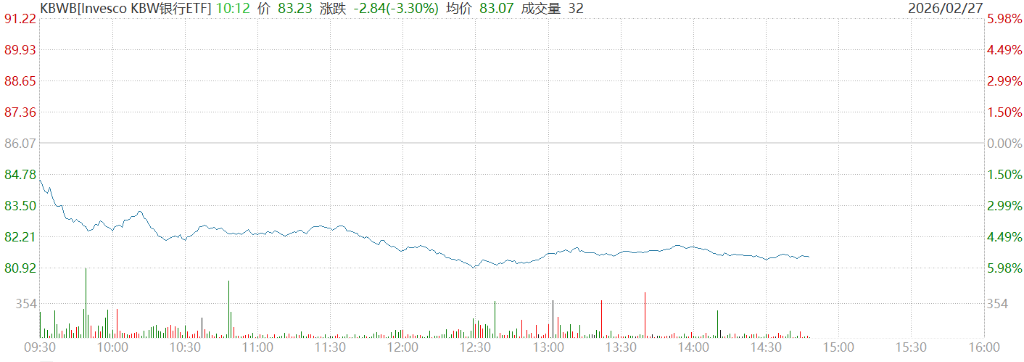
“蟑螂出没”,私人信贷问题叠加AI担忧冲击,银行股指暴跌6%
Hua Er Jie Jian Wen· 2026-02-27 21:14
Core Insights - The KBW Bank Index experienced a significant drop of 6% during intraday trading on February 27, with all 23 constituent stocks declining by over 2.9%, marking the largest single-day drop since April's market turmoil [1] - The investment-grade bond market, previously seen as a safe haven during AI-induced market volatility, has seen a widening of global comparable investment-grade bond spreads by nearly 4 basis points this week, the largest weekly fluctuation since November [3] - Concerns over the private lending sector have intensified following the bankruptcy of Market Financial Solutions, a UK mortgage institution, and liquidity issues faced by several private credit funds [3][13] Financial Sector Performance - The financial sector's downturn can be traced back to early February, with wealth management-related stocks being the first to suffer due to the launch of a tool by Altruist aimed at personalizing client strategies [6] - Following this, an online platform introduced an auto insurance comparison application based on OpenAI's ChatGPT, leading to a sell-off in insurance brokerage stocks [7] - The release of a new model by Anthropic for automating financial research and legal services has caused significant disruptions in related stocks, with Block announcing layoffs of nearly half its workforce, further heightening fears about AI's impact on financial jobs [7] Credit Market Concerns - Analysts warn that banks are entering a period of increased volatility, with the pace of AI adoption and disruption remaining uncertain [8] - Professional investors are particularly focused on American Express due to the direct impact of rising white-collar unemployment on its business [9] - The private credit market is showing signs of systemic risk, with warnings from creditors about a $1.3 billion shortfall in collateral for MFS loans and significant stock price declines for BlackRock's private debt fund [13] Alternative Asset Management - Apollo Global Management's stock plummeted by 9%, while KKR and Ares Management saw declines exceeding 6% [11] - The collapse of Market Financial Solutions has had ripple effects on institutions like Apollo Group and Jefferies, raising concerns about the potential for negative sentiment to spread within the credit market [13]
格林大华期货早盘提示-20251222
Ge Lin Qi Huo· 2025-12-21 23:30
1. Report Industry Investment Rating - No relevant content provided 2. Core Viewpoints of the Report - On Friday, driven by external markets, the major indices of the two markets in China showed strong performance, with growth - style indices rebounding more strongly. Global investors are regaining confidence in China's long - term growth due to China's technological breakthroughs, cost advantages in AI and other fields, and its resilience in the face of external pressures. In 2026, factors such as incremental macro - policies, declining risk - free rates, the transfer of household savings to the stock market, and continuous inflow of long - term funds will boost the valuation of the A - share market. Global funds are re - increasing their positions in the Chinese stock market, and the Chinese technology sector is becoming a new destination for global funds to layout AI. The risk of a significant rise in the Chinese stock market in 2026 is much higher than that of a significant decline [1][2][3] 3. Summary by Relevant Catalogs 3.1 Market Review - On Friday, the major indices of the two markets ran strongly, with the CSI 500 up 0.97%, the CSI 300 up 0.34%, the CSI 1000 up 0.79%, and the SSE 50 up 0.19%. The trading volume of the two markets was 1.72 trillion yuan, showing a slight increase. Among industry and theme ETFs, tourism, aerospace, intelligent connected vehicle, industrial non - ferrous, and grain ETFs led the gains, while energy, science and technology innovation board artificial intelligence, and chip equipment ETFs led the losses. Among sector indices, Hainan Free Trade, general retail, sports, planting, and duty - free concept indices led the gains, while forestry, components, glass fiber, national banks, and oil and gas exploration indices led the losses. The CSI 500, CSI 300, CSI 1000, and SSE 50 index futures saw net inflows of 37, 31, 24, and 14 billion yuan respectively [1] 3.2 Important News - The Academic Committee of the China Capital Market Society was established to provide theoretical support for the construction of a strong capital market. From December 12th to 18th, the daily trading volume of the A500ETF in the entire market exceeded 40 billion yuan for five consecutive trading days. On December 17th, the total net inflow of stock ETFs was 16.29 billion yuan, with 45 A500ETFs attracting 11.159 billion yuan, accounting for 68.5%. On December 18th, the "investment gold price" display in Shuibei disappeared, and the gold price was shown as the "jewelry gold price". The Bank of Japan Governor said that if the economic outlook is achieved, the Bank of Japan will raise interest rates. According to a Deutsche Bank survey, 57% of respondents listed the burst of the technology bubble as the top risk. European Central Bank officials expect the current interest - rate cut cycle to end. The White House economic advisor said that the CPI report was excellent, and the Fed has room to cut interest rates. OpenAI is planning a new round of up to $100 billion in financing. Meta is developing new AI models. The $63 trillion shadow banking system and the $1.8 trillion private credit market are potential risks to the global financial market. Major oilfield service companies are entering the data center field. In October, foreign holdings of US Treasury bonds decreased by $5.8 billion. The US state of Michigan approved power support for data center projects of Oracle and OpenAI [1][2] 3.3 Market Logic - Driven by external markets, the major indices of the two markets in China showed strong performance. Global investors are regaining confidence in China's long - term growth. The social security fund will carry out asset allocation scientifically. In 2025, the stock market had a net inflow of 2.26 trillion yuan. In 2026, insurance, wealth management, and pension funds will be the three major sources of incremental funds, with institutional incremental funds reaching 3.1 trillion yuan. The scale of public fixed - income + products will at least double. International funds are turning to the AI track outside the US, and the Chinese technology sector is becoming a new destination for global funds to layout AI [1][2][3] 3.4 Market Outlook - Driven by external markets, the major indices of the two markets in China showed strong performance. The social security fund will play the role of long - term funds. Global funds are re - increasing their positions in the Chinese stock market. The risk of a significant rise in the Chinese stock market in 2026 is much higher than that of a significant decline. Google plans to increase AI computing power. The US's return to the Monroe Doctrine will accelerate the flow of global funds to the Chinese capital market. The Fed will cut interest rates and expand its balance sheet. The major indices of the two markets were strongly sorted on Friday, and the main funds protected the market at the 3800 - point level of the Shanghai Composite Index. The market is expected to enter a sideways - shock phase to wait for new opportunities [1][2][3] 3.5 Trading Strategies - For stock index futures directional trading, the market is expected to enter a sideways - shock phase to wait for new opportunities. For stock index option trading, as the market is expected to enter a sideways - shock phase, do not participate in stock index call options for the time being [3]
突发!2.4万亿资金突然“消失”!黑天鹅来袭?
天天基金网· 2025-12-19 01:06
Core Viewpoint - The article discusses the ongoing liquidity tightening in the global financial system, highlighting Morgan Stanley's significant cash withdrawal from the Federal Reserve to invest in U.S. government bonds as a strategy to lock in yields before potential interest rate cuts [2][3]. Group 1: Morgan Stanley's Actions - Since 2023, Morgan Stanley has withdrawn nearly $350 billion from its Federal Reserve account, primarily investing in U.S. government bonds to protect against profit erosion from potential interest rate cuts [3]. - Morgan Stanley's deposits at the Federal Reserve have decreased from $409 billion at the end of 2023 to approximately $63 billion by the third quarter of 2024, while its holdings of U.S. Treasury bonds have increased from $231 billion to $450 billion [3][5]. - The bank's actions reflect a preparation for the end of a profitable period, where it previously earned interest on cash held at the Federal Reserve while paying minimal interest to depositors [3][4]. Group 2: Shadow Banking System Risks - The shadow banking system, valued at $63 trillion, is becoming a potential source of instability in global financial markets, particularly in a high-interest rate environment [6]. - Private credit markets, currently around $1.8 trillion, pose another risk, as a significant portion of these funds is committed to illiquid long-term assets, which could lead to liquidity gaps under pressure [6]. - Recent trends in the credit market, including rising yields and falling prices for high-yield bonds, indicate investor concerns regarding non-traditional financing models and high-leverage capital structures [7]. Group 3: Federal Reserve's Response - The Federal Reserve has initiated a Reserve Management Purchase (RMP) program, purchasing $40 billion in short-term government bonds monthly to provide additional liquidity to the market [7]. - Historical patterns show that liquidity stress in the shadow banking sector often precedes broader financial market pressures, as seen during the 2008 financial crisis and the 2020 pandemic [7].


大摩2.4万亿转投美债引流动性担忧
Sou Hu Cai Jing· 2025-12-19 00:59
Group 1 - The core viewpoint of the article highlights that JPMorgan is reallocating $350 billion (over 2.4 trillion RMB) from its Federal Reserve account to U.S. Treasury bonds to lock in yields before potential interest rate cuts [1] - The article notes that the recent liquidity tightening in the financial system is showing signs of strengthening, despite the Federal Reserve's indication of quantitative easing (QE) [1] - The shadow banking system, valued at $63 trillion, is identified as a potential source of instability in the global financial market, with the private credit market, currently around $1.8 trillion, also seen as a risk factor [1] Group 2 - Analysts suggest that JPMorgan's large-scale operation could significantly impact the liquidity of the entire financial system [1]

突发!2.4万亿资金突然“消失”!黑天鹅来袭?
Zheng Quan Shi Bao Wang· 2025-12-19 00:37
Group 1 - The core viewpoint of the articles highlights the ongoing liquidity tightening in the global financial system, with JPMorgan Chase transferring $350 billion from its Federal Reserve account to U.S. Treasury bonds to lock in yields before potential interest rate cuts [1][2][3] - JPMorgan has significantly reduced its deposits at the Federal Reserve from $409 billion at the end of 2022 to $63 billion by the third quarter of 2023, while increasing its U.S. Treasury holdings from $231 billion to $450 billion during the same period [2][3] - The actions of JPMorgan are seen as a preparation for a potential end to a profitable period, as the bank aims to secure higher yields amidst a declining interest rate environment [2][3] Group 2 - The shadow banking system, valued at $63 trillion, is emerging as a potential source of instability in global financial markets, particularly in a high-interest rate environment [4][5] - The private credit market, currently around $1.8 trillion, poses risks due to liquidity mismatches and a concentration of funds in less liquid assets, which could lead to liquidity gaps during market stress [4][5] - Recent trends in the credit market indicate rising concerns, with high-yield bonds experiencing price declines and increasing yields, signaling a reassessment of non-traditional financing models and high-leverage capital structures [5]