
战略主动

Search documents
赵伟:扩内需看服务消费 增活力靠服务业开放
Xin Lang Cai Jing· 2026-02-06 16:48
Group 1 - The core viewpoint emphasizes the need to understand the economy in 2026 through the dual guidance of "consolidating the foundation" and "comprehensive efforts" [2][3] - "Consolidating the foundation" refers to the deepening and solidification of the industrial system, market foundation, and institutional framework established during the 14th Five-Year Plan [3] - "Comprehensive efforts" indicates an acceleration in policy implementation and advancement in development and reform-related areas [3] Group 2 - The three key directions for investment include continuous investment in emerging industries, "new" infrastructure, and green transformation [4][5] - Continuous investment in emerging industries such as artificial intelligence, commercial aerospace, high-end equipment, and biomanufacturing is expected to bring new growth points [5] - "New" infrastructure focuses on enhancing economic system efficiency, including digitalization to reduce logistics costs and improving transportation hubs [5] Group 3 - The release of service consumption is crucial, especially as per capita GDP surpasses $10,000, leading to a shift from goods consumption to service consumption [4][6] - The government has been increasing budget expenditures in public service areas since 2025, creating foundational conditions for service consumption [6] - The opening of the service industry is expected to stimulate consumption, drive investment, promote employment, and foster innovation [6] Group 4 - The aging population creates a significant demand for services related to healthcare, elderly care, and companionship, while younger generations seek quality life experiences [6]


赵伟:扩内需看服务消费 增活力靠服务业开放
赵伟宏观探索· 2026-02-06 16:04
Core Viewpoint - Understanding the economy in 2026 requires grasping the three guiding principles of "solidifying the foundation, comprehensive efforts, and strategic initiative" [2] Group 1: Solidifying the Foundation and Comprehensive Efforts - "Solidifying the foundation" refers to consolidating and deepening the industrial system, market foundation, and institutional framework established since the 14th Five-Year Plan [3] - "Comprehensive efforts" indicates an acceleration in policy implementation and advancement in development and reform-related areas [3] - The strategic initiative will enhance the country's proactive stance in economic work and international trade, with a focus on two aspects: coordinating domestic economic work with international trade struggles and increasing openness in relevant fields [3] Group 2: Service Consumption and Emerging Investments - The two main supports for economic growth in 2026 are the continuous release of service consumption demand and the intensified push for "new" infrastructure and green transformation investments [4] - Service consumption is expected to grow as GDP per capita surpasses $10,000, leading to a shift from goods consumption to service consumption [4] - Investment in three key areas is crucial: 1. Continuous investment in emerging industries such as artificial intelligence, commercial aerospace, high-end equipment, and biomanufacturing, where China has established global advantages [5] 2. "New" infrastructure focusing on enhancing economic system efficiency, such as digitalization to reduce logistics costs and improving transportation hubs [5] 3. Green transformation investments aligned with carbon neutrality goals, including carbon tracking and upgrades to power grids for renewable energy [5] Group 3: Opportunities from Service Sector Opening - The service sector is becoming a significant "investment blue ocean" and innovation platform, distinct from goods consumption due to its need for face-to-face interactions [6] - The government is increasing budget expenditures in public services, which will create foundational conditions for service consumption [6] - The opening of the service sector is expected to stimulate consumption, drive investment, promote employment, and foster innovation, particularly in areas addressing basic human needs such as healthcare and quality of life experiences [6]

赵伟:扩内需看服务消费 增活力靠服务业开放
申万宏源宏观· 2026-02-05 16:03
Core Viewpoint - Understanding the economy in 2026 requires grasping the three guiding principles of "solidifying the foundation, comprehensive efforts, and strategic initiative" [2] Group 1: Solidifying the Foundation and Comprehensive Efforts - The term "solidifying the foundation" refers to the consolidation and deepening of the industrial system, market foundation, and institutional framework established since the 14th Five-Year Plan [3] - "Comprehensive efforts" indicates an acceleration in the implementation of policies related to development and reform [3] - The strategic initiative will enhance the proactive nature of national policies, particularly in coordinating domestic economic work with international trade dynamics and increasing openness in relevant fields [3] Group 2: Service Consumption and Emerging Investments - The two main supports for economic growth in 2026 are the continuous release of service demand on the consumption side and the acceleration of "new" infrastructure and green transformation investments on the investment side [4] - Service consumption is expected to expand significantly as GDP per capita surpasses $10,000, leading to a shift from goods consumption to service consumption [4] - Investment in three key areas is crucial: 1. Continuous investment in emerging industries such as artificial intelligence, commercial aerospace, high-end equipment, and biomanufacturing, where China has established global advantages [5] 2. "New" infrastructure focusing on enhancing economic system efficiency, such as digitalization to reduce logistics costs and improving transportation hubs [5] 3. Green transformation investments aligned with carbon neutrality goals, including carbon tracking and upgrades to power grids to adapt to new energy systems [5] Group 3: Opportunities from Service Sector Opening - The service sector is not only a growth engine but also a vast "investment blue ocean" and innovation platform [6] - The release of service consumption requires physical scene support, with significant room for improvement in public facilities like sports and cultural venues [6] - The opening of the service sector can stimulate consumption, drive investment, promote employment, and foster innovation, particularly among the younger generation [6] - Specific industry opportunities include addressing the needs arising from demographic changes, such as healthcare and wellness services for the elderly and quality lifestyle experiences for the younger generation [6]

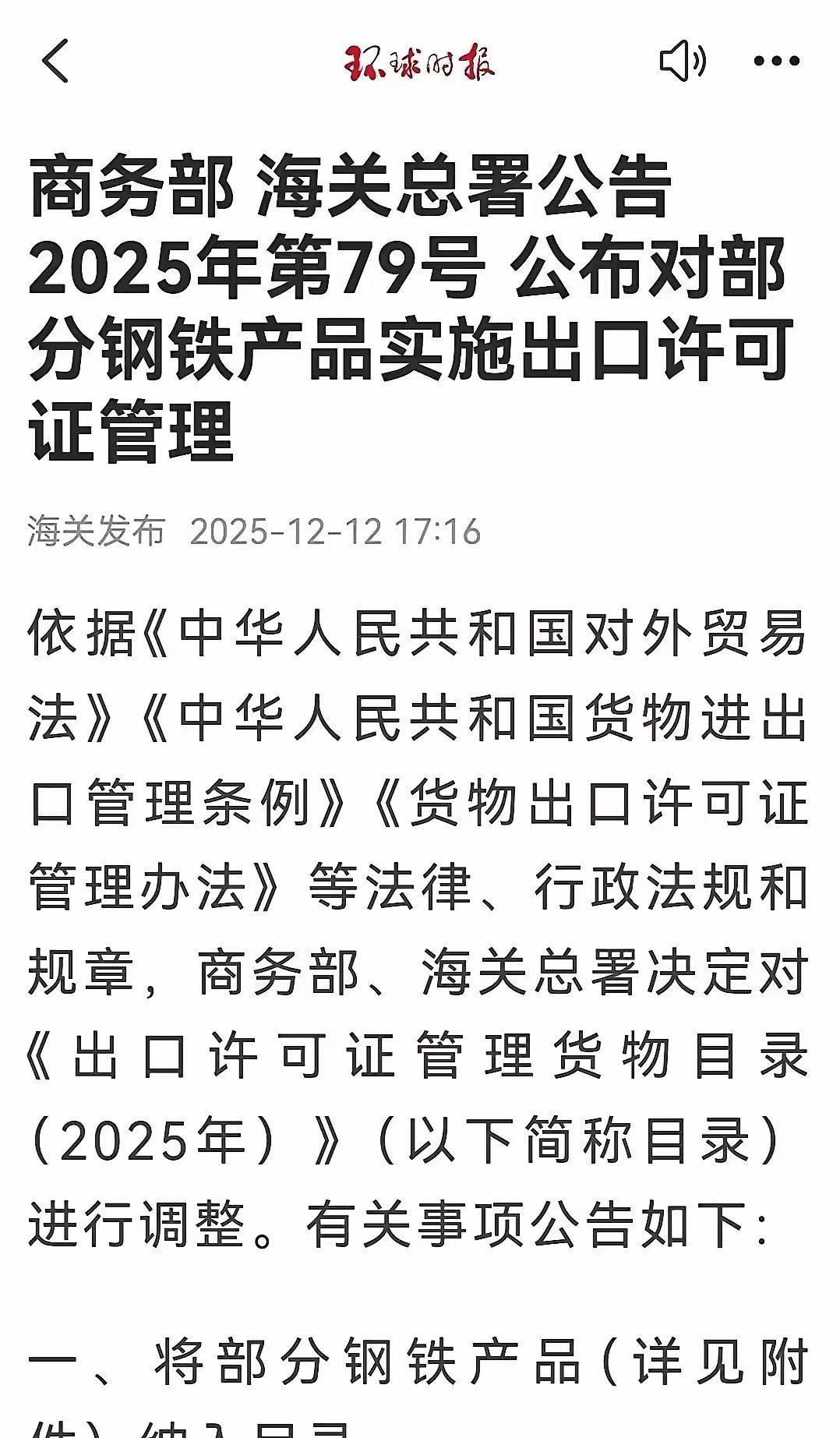
稀土牌还没打完,又要打钢铁牌?商务部:中国对部分钢铁产品实行出口许可管理!
Sou Hu Cai Jing· 2025-12-15 03:12
Core Viewpoint - The Chinese government has announced export licensing management for certain steel products, indicating a strategic shift to limit steel exports while focusing on higher value-added products [1][3]. Group 1: Export Management - China produces over half of the world's steel, with crude steel production exceeding 1 billion tons last year and steel exports nearing 80 million tons [3]. - The export licensing management is not a complete halt on exports but aims to smartly manage exports, focusing on high-value products while regulating low-efficiency crude steel [3][6]. - The international market has reacted with rising steel prices in Europe and the U.S., highlighting the dependency on Chinese steel for infrastructure and manufacturing [3][6]. Group 2: Industry Transformation - Domestic steel manufacturers are encouraged to shift their focus from relying on export tax rebates to enhancing technological capabilities, with a future emphasis on specialty steel and high-end plates [3][6]. - The steel industry accounts for over 15% of national carbon emissions, and reducing low-end exports contributes to environmental protection efforts [6]. Group 3: Strategic Positioning - The global economic landscape is changing, and China aims to move beyond being the world's factory, seeking to gain control over core resources like steel [7]. - This strategic move is seen as a multi-faceted approach to achieve industrial upgrading, environmental sustainability, and strategic autonomy [7].
生态环境部副部长李高:在气候变化面前,中国不能独善其身
Xin Lang Cai Jing· 2025-12-03 06:47
Core Viewpoint - China cannot remain isolated in the face of climate change, as it significantly impacts water security, food security, energy security, economic security, financial security, infrastructure security, and the safety of people's lives and property [1][2]. Group 1 - The importance of adopting a proactive and constructive attitude to unite the Global South is emphasized, which is crucial for gaining strategic initiative amid significant global changes [1][2].
“十五五”建议稿:哪些新热度?
Minsheng Securities· 2025-10-28 13:19
Group 1: Economic Strategy - The "15th Five-Year Plan" emphasizes "strategic initiative" and "major breakthroughs" in five areas: industry, consumption, technology, finance, and openness[1] - The plan prioritizes traditional industries alongside emerging and future industries, indicating a need to solidify the foundation of traditional manufacturing[1][2] - A significant goal is to increase the resident consumption rate, which currently lags behind major global economies, with a potential increase of 14 percentage points by 2035[2] Group 2: Consumption and Financial Development - The plan aims for an average annual consumption growth rate of over 7% in the next decade, leveraging the gap in consumption rates compared to developed economies[2] - Measures to stimulate consumer willingness include removing unreasonable restrictions on car and housing purchases and optimizing consumption scenarios[3] - The "Financial Power" strategy is highlighted, aiming to enhance pricing power and wealth effects, which could boost consumer confidence and spending[3] Group 3: International Engagement and Risks - The plan calls for a significant elevation in "high-level openness," shifting from basic implementation to proactive expansion, which is crucial for navigating complex international environments[5] - Risks include potential policy shortcomings, unexpected domestic economic changes, and fluctuations in exports[5]