战略性矿产资源

Search documents
2025年中国锑行业龙头企业分析 湖南黄金独占鳌头【组图】
Qian Zhan Wang· 2026-02-24 09:11
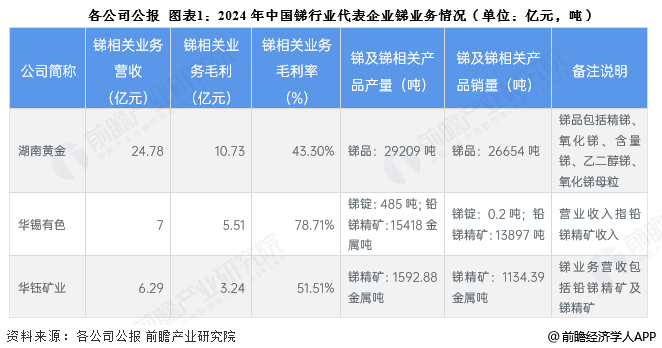
Core Insights - The article discusses the strategic importance of antimony in industrial applications and highlights the leading position of Hunan Gold in the antimony industry, both in terms of production and revenue [1][5]. Industry Overview - Antimony, known as "industrial monosodium glutamate," is a rare strategic mineral resource with limited storage and high demand in industrial production [1]. - The antimony industry in China has many companies, but there are fewer upstream mining and smelting enterprises [1]. Company Performance - Hunan Gold is the leading company in the antimony sector, with the highest production, sales, and revenue in the industry [1]. - In 2024, Hunan Gold plans to produce 46,223 tons of antimony raw materials, a 13.1% increase year-on-year, and 66,534 tons of antimony ingots, a 0.5% increase year-on-year [5]. - The company reported a revenue of 24.78 billion yuan from antimony-related businesses, with a gross profit of 10.73 billion yuan and a gross margin of 43.30% [2]. Research and Development - Hunan Gold invests heavily in research and development, with a planned R&D expenditure of 324 million yuan in 2024, the highest among listed companies in the antimony smelting and processing sector [6]. - The company is focused on advancing technology for real-time monitoring of deep pressure in gold-antimony mines to ensure safety and optimize extraction methods [9]. Future Plans - Hunan Gold aims to produce 39,500 tons of antimony products by 2025 and is committed to sustainable development through energy conservation and the promotion of green mining practices [9].


杨贵生等:论中国企业海外权益矿投资与国内勘查开发的协同关系
Sou Hu Cai Jing· 2026-02-09 07:47
Core Viewpoint - The commencement of commercial production at the Simandou iron ore project in Guinea in 2025 marks a historic breakthrough for Chinese enterprises in securing high-grade iron ore resources overseas, alleviating China's heavy reliance on iron ore imports and highlighting the strategic importance of overseas equity mines in national resource security [2][5][6]. Group 1: Project Overview - The Simandou iron ore project has proven reserves exceeding 4.4 billion tons with an average iron content (TFe) of over 65%, making it one of the largest and highest-quality undeveloped iron ore mines globally [2]. - Chinese capital holds over 50% of the rights to the Simandou iron ore resources, with the southern section developed by SimFer and the northern section by a consortium led by WCS [3]. - The project includes over 600 kilometers of railway and supporting port facilities, enhancing the logistics for iron ore extraction and export [3]. Group 2: Strategic Importance - The project is expected to reach an annual production capacity of 12 million tons by around 2030, which would account for approximately 10% of China's iron ore imports in 2024 [5]. - The successful launch of the Simandou project represents a significant achievement for Chinese enterprises in acquiring quality iron ore resources and challenges the long-standing dominance of international mining giants [6]. Group 3: Supply Chain Security - The Simandou project improves the diversification of China's iron ore import sources, which have been heavily reliant on Australia and Brazil, previously accounting for over 80% of imports [13]. - The integrated development model of "mine-railway-port" enhances supply reliability and mitigates traditional issues of merely holding equity without controlling the supply chain [13]. Group 4: Legal and Regulatory Challenges - Domestic iron ore exploration and development face legal and policy constraints, including strict ecological protection laws and complex approval processes, which hinder investment [9][12]. - Overseas investments, while technically advantageous, encounter legal uncertainties and political risks, particularly in Guinea, where the mining law allows for government equity stakes and requires community consultations [10][11]. Group 5: Policy Recommendations - It is recommended that a specialized planning framework for iron ore resource supply security be established, focusing on the synergy between domestic exploration and overseas investment [19]. - The establishment of a strategic reserve system for iron ore, as well as optimizing legal and risk management mechanisms for overseas investments, is crucial [20]. - Encouraging a collaborative supply chain model that integrates domestic mines, overseas equity mines, long-term agreements, and strategic reserves is essential for enhancing supply chain resilience [21].


我国“十五五”时期将聚焦构建战略矿产体系
Yang Guang Wang· 2026-01-08 02:19
Group 1 - The core viewpoint of the article highlights the successful completion of China's mineral exploration goals during the "14th Five-Year Plan" period, marking significant advancements in mineral resource discovery [1][2] - The Ministry of Natural Resources reported the discovery of 10 large oil fields and 19 large gas fields, along with substantial increases in uranium, copper, gold, lithium, and potassium salt resources [2] - Notably, the Dadonggou gold mine in Liaoning Province has been identified as the first thousand-ton low-grade super-large gold deposit in China, with a confirmed gold reserve of 1,444.49 tons, making it the largest single gold deposit discovered since the founding of New China [2] Group 2 - The Ministry of Natural Resources plans to continue a new round of strategic mineral exploration actions by 2026, focusing on enhancing basic geological surveys and improving support policies for mineral exploration breakthroughs [2] - The ministry will promote green exploration and the construction of green mines, while also implementing strict measures against illegal mining of strategic mineral resources [2] - During the "15th Five-Year Plan" period, the ministry aims to improve the coordination and connection of exploration, production, supply, storage, and sales of strategic mineral resources, as well as enhance safety risk monitoring and early warning systems [2]
2025中国矿业十大新闻发布
Zhong Guo Xin Wen Wang· 2025-12-30 09:11
Core Viewpoint - The China Mining Association released the "Top Ten Mining News of 2025," highlighting significant developments in the mining sector, including legislative changes, major discoveries, and advancements in technology. Group 1: Legislative and Regulatory Developments - The revised "Mineral Resources Law of the People's Republic of China" will take effect on July 1, focusing on enhancing support for strategic mineral resources exploration and extraction, and ensuring competitive bidding for mining rights [2] - The Ministry of Natural Resources clarified the rules for the minimum price for mining rights transfer, ensuring that the pricing follows market principles and remains confidential until the end of the transaction [8] Group 2: Major Discoveries and Achievements - The first domestic thousand-ton gold mine was discovered in China, with a total gold metal amount of 1,444.49 tons located in the Dadonggou gold mine in Liaoning Province [3] - New copper resources exceeding 20 million tons were discovered in the Qinghai-Tibet Plateau, forming four major copper resource bases with a potential forecast of 150 million tons [5] - China's lithium reserves have increased significantly, rising from 6% to 16.5% of the global total, making it the second-largest lithium reserve holder in the world [9] Group 3: Industry Events and Recognitions - The 27th China International Mining Conference was held on October 23, attracting professionals from over 40 countries [4] - Zijin Mining ranked fourth among Chinese companies and first among global metal mining companies in terms of return on net assets, as reported in the 2025 Fortune Global 500 list [6] - The successful launch of China's first geological hyperspectral remote sensing satellite, "Geology No. 1," on May 17, represents a significant technological advancement in geological information acquisition [7] Group 4: Production Milestones - In 2025, China's crude oil production is expected to reach approximately 215 million tons, and natural gas production is projected to exceed 260 billion cubic meters, both setting historical records [11]
盛龙股份深交所主板IPO过会 2024年钼金属产量1.06万吨
智通财经网· 2025-12-23 11:41
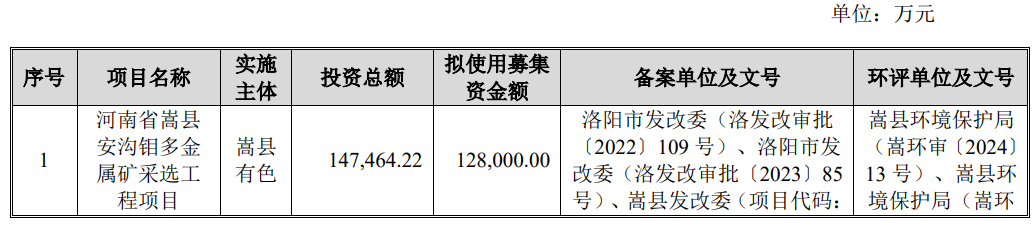
Core Viewpoint - Shenglong Mining Group Co., Ltd. has received approval for its IPO on the Shenzhen Stock Exchange, aiming to raise 1.53 billion yuan, positioning itself as a leading player in the molybdenum industry in China [1] Group 1: Company Overview - Shenglong Mining is a major player in the molybdenum sector, focusing on the production, processing, and sales of molybdenum-related products, including molybdenum concentrate and ferromolybdenum [1][2] - The company holds a significant position in China's molybdenum supply chain, with a projected molybdenum metal production of 10,600 tons in 2024, accounting for 9.64% of the national output [2] - Shenglong Mining's mining assets include the Nanni Lake Molybdenum Mine, the largest operating molybdenum mine in China, with a production capacity of 16.5 million tons per year [2][3] Group 2: Resource and Production Capacity - As of the end of 2024, Shenglong Mining possesses 710,500 tons of molybdenum metal, representing approximately 9.10% of the national molybdenum resource reserves [3] - The company is expanding its production capabilities, with ongoing projects expected to achieve a daily molybdenum mining capacity of 55,000 tons [2] - The company’s products are recognized for their high quality and low impurity levels, with major clients including China Baowu Steel, Shandong Steel, and others [3] Group 3: Financial Performance - Shenglong Mining's revenue for 2022, 2023, and projected for 2024 is approximately 1.911 billion yuan, 1.957 billion yuan, and 2.864 billion yuan respectively, with net profits of 452 million yuan, 725 million yuan, and 754 million yuan [4] - The total assets of the company have increased from approximately 4.83 billion yuan in 2022 to an estimated 6.89 billion yuan by the end of 2024 [5] - The company’s debt-to-asset ratio has improved significantly, decreasing from 30.26% in 2022 to 9.34% in 2024 [5]
宝城期货资讯早班车-20251125
Bao Cheng Qi Huo· 2025-11-25 02:27
1. Macroeconomic Data Overview - GDP growth rate in Q3 2025 was 4.8% year-on-year, down from 5.2% in the previous quarter but up from 4.6% in the same period last year [1] - In October 2025, the manufacturing PMI was 49.0%, down from 49.8% in the previous month and 50.1% in the same period last year [1] - The non-manufacturing PMI for business activities in October 2025 was 50.1%, up from 50.0% in the previous month but down from 50.2% in the same period last year [1] - The incremental social financing scale in October 2025 was 816.1 billion yuan, down from 3.5299 trillion yuan in the previous month and 1.412 trillion yuan in the same period last year [1] - In October 2025, the year-on-year growth rates of M0, M1, and M2 were 10.6%, 6.2%, and 8.2% respectively, showing a downward trend compared to the previous month [1] - New RMB loans in October 2025 were 220 billion yuan, down from 1.29 trillion yuan in the previous month and 500 billion yuan in the same period last year [1] - In October 2025, the year-on-year growth rates of CPI and PPI were 0.2% and -2.1% respectively [1] - The cumulative year-on-year growth rate of fixed asset investment (excluding rural households) from January to October 2025 was -1.7%, showing a decline [1] - The cumulative year-on-year growth rate of total retail sales of consumer goods from January to October 2025 was 4.28%, slightly down from the previous month but up from the same period last year [1] - In October 2025, the year-on-year growth rates of export and import values were -1.1% and 1.0% respectively, showing a significant change compared to the previous month [1] 2. Commodity Investment Reference Comprehensive - On the evening of November 24th, Chinese President Xi Jinping had a phone call with US President Trump, emphasizing the importance of Sino-US cooperation and clarifying China's stance on the Taiwan issue [2] - The National Development and Reform Commission issued a notice on the special management measures for central budgetary investment in rural revitalization, with different investment amounts allocated according to the rural population of each county [3] - Li Muchun, a member of the Party Committee and Deputy General Manager of the Guangzhou Futures Exchange, announced three key development directions, including enriching the variety system, strengthening market services and training, and promoting high-level opening-up [3] - On November 24th, 43 domestic commodity varieties had positive basis, while 24 had negative basis. Among them, Shanghai nickel, Zhengzhou cotton, and cast aluminum alloy had the largest basis, while butadiene rubber, apples, and strong wheat had the smallest [4][5] - San Francisco Fed President Daly supported a rate cut in December, and Fed Governor Waller's remarks alleviated market concerns about inflation, jointly boosting market expectations of a Fed policy shift [5] Metals - The Shenzhen Financial Commission warned the public about illegal gold investment activities [6] - On November 24th, international precious metal futures generally closed higher due to the Fed's monetary policy signals [6] - The Thai central bank plans to tighten gold trading reporting regulations [6] - According to LME inventory data on November 21st, lead and copper inventories increased, while aluminum, nickel, and tin inventories decreased [7][8] - Bank of America predicted that the gold price could reach $5000 per ounce by 2026 [8] - As of November 24th, the holdings of the SPDR Gold Trust increased by 0.03% [8] Coking Coal, Steel, and Minerals - As of mid-November, the prices of coke and coking coal increased month-on-month [9] - The fourth round of coke price hikes was implemented, squeezing steel mills' profits. Coke prices may face downward pressure at the end of the month or early December [9] - The US Commerce Secretary demanded that the EU change digital regulations to reduce steel and aluminum tariffs, but the EU refused [9] - From April to October, India's finished steel imports decreased year-on-year, and steel prices faced downward pressure in October [9] - BHP's acquisition offer for Anglo American Resources indicates intensifying competition in the global copper mining market [9] Energy and Chemicals - From November 10th to 21st, international oil prices fluctuated downward, and domestic gasoline and diesel prices were lowered on November 24th [10][11] - As of the end of October 2025, the cumulative proven geological reserves of coalbed methane in China exceeded 700 billion cubic meters [11] - As of the end of October, China's total installed power generation capacity was 3.75 billion kilowatts, with significant growth in solar and wind power [11] - Goldman Sachs predicted a decline in Dutch TTF natural gas prices from 2026 to 2027 and recommended shorting the Q3 2027 futures [11] - JPMorgan maintained its 2026 oil price forecast, with a target of $58 for Brent crude and $54 for WTI crude [11] Agricultural Products - In 2025, the domestic pig market was sluggish, with prices declining and supply increasing due to higher sow存栏 and production efficiency. Terminal demand was weak, and secondary fattening decreased [12] - From January to October, Russia's corn exports to China increased significantly, and in September, Russian corn accounted for about 34% of China's total corn imports [12] 3. Financial News Compilation Open Market - On November 24th, the central bank conducted 338.7 billion yuan of 7-day reverse repurchase operations, with a net investment of 55.7 billion yuan [14] - The central bank announced a 1 trillion yuan MLF operation on November 25th, with a net investment of 100 billion yuan for the month [14] - The central bank issued 45 billion yuan of RMB central bank bills in Hong Kong [14] - The Ministry of Finance and the central bank conducted treasury cash management commercial bank time deposit tenders, with a total winning amount of 200 billion yuan [15] Key News - President Xi Jinping emphasized the importance of Sino-US cooperation in a phone call with US President Trump [16] - China's Ministry of Foreign Affairs responded to Japan's proposal for a China-Japan-South Korea leaders' meeting, citing issues with the current conditions [16][17] - Chinese Vice Premier He Lifeng held a video call with French Minister of Economy, Finance, Industry, Energy, and Digital Sovereignty, expressing willingness to deepen economic and financial cooperation [17] - The National Development and Reform Commission issued a notice on central budgetary investment in rural revitalization [17] - In the first three quarters of this year, China's total foreign direct investment increased by 4.4% year-on-year, with investment in 151 countries and regions [18] - In October, China's new productive forces continued to grow, with high-tech industries showing double-digit growth [18] - As of the end of October, China's total installed power generation capacity increased by 17.3% year-on-year [18] - The Inner Mongolia Autonomous Region plans to resolve hidden debts and other risks [19] - The issuance of interbank science and technology innovation bonds exceeded 530 billion yuan, with increased participation from private enterprises [20] - The use of risk-sharing tools for science and technology innovation bonds is expanding, and new bonds are about to be issued [20] - The Shanghai Bill Exchange's comprehensive service platform was launched, and the first bill discounting business was completed [20] - Four private equity investment institutions plan to issue 930 million yuan of science and technology innovation bonds [21] - Inner Mongolia will issue 10.4 billion yuan of refinancing bonds on December 1st [21] - Fed Governor Waller and San Francisco Fed President Daly supported a rate cut in December [21] - Several companies had major bond events, including overdue debts, management changes, and regulatory measures [21][22] - Moody's and Fitch issued credit ratings for multiple companies [22] Bond Market Summary - China's bond market fluctuated narrowly, with bond futures rising and the money market easing [23] - Some bonds in the exchange market rose, while others fell. The real estate bond and high-yield urban investment bond indices increased slightly [23] - The CSI Convertible Bond Index rose by 0.22%, and some convertible bonds had significant price changes [24][25] - Money market interest rates showed mixed trends, with some rising and some falling [25] - Treasury bond and financial bond auctions had different winning yields and multiples [26] - European and US bond yields generally declined [27][28] Foreign Exchange Market - The onshore RMB against the US dollar rose by 47 points, and the central parity rate was raised by 28 points [29] - The US dollar index rose slightly, and most non-US currencies had mixed performance [29] Research Report Highlights - Yangtze River Fixed Income believed that the bond market may decline due to "fixed income +" fund redemptions but could rebound with rate cut expectations [30] - Xingzheng Fixed Income suggested focusing on credit bond liquidity and medium-term credit bonds [30] - Xingzheng Fixed Income analyzed the situation of treasury bond futures and provided trading strategies [30] - Huatai Fixed Income attributed the weak bond market to multiple factors and recommended trading strategies [31][32] - Huatai Fixed Income was cautious about convertible bonds in the short term and had a positive outlook in the medium term [32] - CITIC Securities analyzed the reasons for the simultaneous decline of stocks and bonds and predicted the range of the 10-year treasury bond yield [32] - CICC believed that the trend of household deposits moving to the market would support the A-share market [33] Today's Reminders - On November 25th, 220 bonds will be listed, 179 bonds will be issued, 108 bonds will be paid, and 242 bonds will have principal and interest repaid [34] 4. Stock Market News - The A-share market rose slightly, with military, AI, and other concepts performing well, while lithium mines declined. The trading volume reached 1.74 trillion yuan [35] - The Hong Kong Hang Seng Index rose by 1.97%, and the Hang Seng Technology Index soared by 2.78%. Southbound funds had a net purchase of 8.571 billion Hong Kong dollars [35] - As of November 24th, 800 listed companies received significant shareholder increases, with a total increase of 115.821 billion yuan, a year-on-year increase of 44.69% [35]
四川战略性矿产找矿突破显著 钒钛新材料产业成全球重要发展极核
Zhong Guo Xin Wen Wang· 2025-10-28 21:37
Core Insights - Sichuan Province has made significant breakthroughs in the exploration of strategic mineral resources, with notable reserves of vanadium and titanium leading the nation, and the Panzhihua-Xichang strategic resource innovation development experimental zone becoming a key global hub for vanadium-titanium new materials [1][2] Group 1: Resource Discovery and Investment - Since the "14th Five-Year Plan," Sichuan has increased funding for mineral exploration, with social capital investment exceeding 2 billion yuan, leading to the discovery of three large graphite mines and six medium to large phosphate mines, along with substantial increases in lithium, rare earth, gold, and oil and gas reserves [1][2] - The provincial geological exploration investment has quadrupled compared to the "13th Five-Year Plan," successfully addressing the issue of zero investment from municipal and county finances, with a total social capital investment of 2.084 billion yuan [2] Group 2: Production and Utilization - The Panzhihua experimental zone produces approximately 80% of the nation's titanium concentrate, 60% of vanadium products, and 20% of hard rock rare earths, establishing itself as the largest vanadium product base and the largest titanium raw material base globally [2] - The comprehensive utilization rates of vanadium and titanium resources have improved to 50% and 35%, respectively, with high-end titanium alloys being supplied in bulk and a 40% market share in domestic high-speed rail steel tracks [2] Group 3: Future Development Plans - The Sichuan Economic and Information Technology Department plans to enhance the vanadium-titanium new materials manufacturing cluster, promote the deep integration of the "vanadium-titanium + steel" industry, and support innovation in key technologies such as intelligent steelmaking and high-end titanium alloy wire [3] - There is a focus on building a strategic base for the supply of important primary products and creating an integrated layout for the entire vanadium-titanium-steel industry chain to strengthen the supply capacity of strategic resources [3]
从实验室到无人区:第三代便携式锂钾分析仪,走出“为国找矿”的实战之路
仪器信息网· 2025-09-29 04:02
Core Viewpoint - The portable lithium-potassium analyzer developed by the National Geological Experiment and Testing Center has evolved into its third generation, marking a significant transition from productization to industrialization, addressing the critical need for lithium and potassium resource exploration in China [1][10][20]. Group 1: Product Development and Features - The third-generation portable lithium-potassium analyzer (Li-K Analyzer III) has been showcased at BCEIA2025, attracting significant attention from users [2][4]. - The analyzer has undergone over ten years of development, with the first generation validating the feasibility of its detection technology, and the second generation optimizing stability for field conditions [10][11]. - Key technological breakthroughs in the third generation include improved sensitivity, reduced detection limits, and enhanced analysis efficiency, making it suitable for high-altitude and remote exploration [14][18]. Group 2: Strategic Importance of Lithium and Potassium - Lithium and potassium are critical strategic minerals for China, with lithium being essential for the new energy industry and potassium being vital for agricultural productivity [9][10]. - The domestic self-sufficiency rate for potassium salts is only about 50%, indicating a heavy reliance on imports, which poses risks to food security [9]. Group 3: Applications and Future Prospects - The portable analyzer is expected to play a crucial role in the new round of mineral exploration strategies, with its technology already included in national standards [15][20]. - Beyond geological exploration, the analyzer has potential applications in environmental monitoring and healthcare, such as detecting lithium levels in water and blood [23]. - The commercialization of the analyzer is anticipated by 2026, with confidence in its market performance and long-term development [23].

中国有新发现!高超音速竞赛中或再无“阿喀琉斯之踵”
Guan Cha Zhe Wang· 2025-07-28 02:57
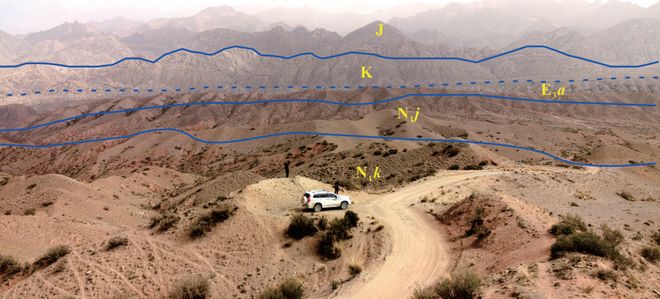
Core Viewpoint - The recent discovery of a giant zirconium mine in the Kupei Basin of the Tarim Basin, Xinjiang, may significantly boost China's high-tech military development and reshape the global strategic mineral supply landscape [1] Group 1: Discovery and Characteristics - The newly discovered zirconium deposit is the first super-large scale ancient river-lake zircon sand deposit found in a continental sedimentary basin in China [1] - The potential mineral quantity of zircon in this deposit exceeds 2 million tons, which is four times the current total reserves in China [1] - The deposit features advantages such as large reserves, favorable exploration prospects, low mining and transportation costs, mature beneficiation processes, and abundant associated resources [1][2] Group 2: Strategic Importance - Zirconium alloys are highly valued for their excellent heat resistance, corrosion resistance, and neutron absorption capabilities, making them essential materials for manufacturing hypersonic engine combustion chambers, thermal protection tiles, warhead cones, and guidance components [1] - The control over zircon supply chains has become as crucial as securing rare earth elements amid the global competition for deployable hypersonic glide vehicles and cruise missiles [1] Group 3: Current Resource Landscape - China's zircon resource reserves are approximately 500,000 tons, accounting for less than 0.6% of global reserves, while the country consumes about 53% of the global zircon demand, making it the largest consumer [4] - The reliance on foreign zircon resources is as high as 90%, with Australia holding over 70% of global zircon reserves and being China's largest supplier [4] - Zircon is considered one of China's most critical strategic rare metal minerals, with applications in ceramics, refractory materials, nuclear energy, and military industries [4] Group 4: Implications of the Discovery - The discovery of this new deposit significantly enhances China's zircon resource reserves, helping to alleviate foreign dependency and potentially reshape the domestic zircon supply landscape [5] - This finding also breaks through traditional geological frameworks for zircon deposits, opening new directions for zircon exploration [7] Group 5: Broader Mining Developments - Recent breakthroughs in mineral exploration have been reported, with 38 new mineral sites discovered nationwide in the first half of the year, a 31% increase year-on-year, including 25 medium to large-sized sites [8]
印尼搅动全球镍矿江湖|深度
24潮· 2025-07-02 22:57
Core Viewpoint - The rise of the new energy industry has made strategic mineral resources, particularly nickel, a new bargaining chip in international competition. Nickel is essential for various applications, especially in the electric vehicle and battery sectors, with demand expected to exceed 60% by 2030 [1][2][3]. Group 1: Nickel Demand and Supply Dynamics - Nickel is primarily used in stainless steel production, with approximately 65% globally and 85% in China dedicated to this application. The demand for nickel in the battery sector has increased from 3% in 2010 to about 13% in 2023 [2]. - By 2030, the demand for nickel in new energy vehicles, energy storage batteries, and aerospace is projected to account for over 60% of total demand, with the market size for high-nickel ternary battery materials expected to exceed 200 billion yuan [1]. - Indonesia is the largest producer of nickel, holding 42% of global reserves, and is expected to produce 2.32 million tons of nickel by 2025, representing a 6.9% increase year-on-year [13][25]. Group 2: Global Nickel Market Trends - The global nickel market has experienced significant price volatility due to changes in supply and demand dynamics, influenced by geopolitical factors and the rapid growth of the electric vehicle industry [9][11]. - The nickel market is currently undergoing a restructuring phase, with strong companies increasing their resource and downstream investments, while weaker firms are likely to be eliminated [11][12]. - Indonesia's policies, including the ban on nickel ore exports, have transformed it from a raw material supplier to a key player in the nickel processing industry, significantly impacting global supply chains [25][36]. Group 3: Future Outlook and Challenges - The future of nickel prices is closely tied to supply-demand relationships, with current oversupply issues expected to persist in the short term. However, long-term trends will depend on the balance between production and consumption [12][65]. - Indonesia's nickel production policies are expected to continue influencing global nickel prices, with potential increases in production costs due to regulatory changes [68][70]. - The nickel industry faces challenges such as declining ore grades and increasing environmental standards, which may affect production costs and market dynamics in the future [69][70].