扩大开放

Search documents
国家发改委推出新一批重大外资项目,首次将物流纳入清单
第一财经· 2026-03-18 03:01
Core Viewpoint - The National Development and Reform Commission (NDRC) has launched a new batch of 13 major foreign investment projects with a planned investment of $13.4 billion, focusing on manufacturing and service sectors, signaling a strong commitment to attract foreign investment and enhance the integration of modern services with advanced manufacturing [3][4]. Group 1: Major Foreign Investment Projects - The newly selected projects are primarily concentrated in manufacturing sectors such as electronics, chemicals, automotive, and electrical machinery, aimed at accelerating the development of industrial clusters [4]. - The NDRC has emphasized the importance of tracking and servicing these major foreign investment projects, indicating a proactive approach to address the needs of foreign enterprises [4]. - Cumulatively, the major foreign investment projects have completed investments totaling $108 billion, demonstrating significant引资示范带动效应 [4]. Group 2: Policy and Regulatory Framework - The government work report for this year highlights the expansion of bilateral investment cooperation and the reform of foreign investment promotion mechanisms, ensuring national treatment for foreign enterprises [5]. - The revised "Encouraging Foreign Investment Industry Catalog (2025 Edition)" will take effect from February 1, 2026, aiming to guide more foreign investment into advanced manufacturing, modern services, high-tech, and energy-saving sectors [5]. - The ongoing policies to stabilize foreign investment have been reinforced, with a focus on leveraging China's large and unified market to attract foreign capital [5][6]. Group 3: Service Sector Focus - The Ministry of Commerce has stated that this year will prioritize the service sector, expanding market access and opening up areas such as telecommunications, healthcare, and education [6]. - The NDRC plans to continuously optimize the foreign investment environment and ensure the national treatment of foreign enterprises, welcoming more foreign investments in various high-growth sectors [6]. - Local governments, including Jiangsu and Zhejiang, are implementing initiatives to enhance their investment brands and attract more multinational companies and R&D institutions [7].

中央财办分管日常工作的副主任、中央农办主任韩文秀,发表署名文章
Zhong Guo Ji Jin Bao· 2026-02-16 05:31
Core Viewpoint - The article emphasizes the importance of maintaining stability while seeking progress and improving quality in economic work, aiming for a good start to the "15th Five-Year Plan" [3][4]. Group 1: International and Domestic Situations - In 2025, the economic work will be reviewed, highlighting achievements during the "14th Five-Year Plan" and analyzing both international and domestic challenges [3][4]. - Internationally, geopolitical tensions and economic instability are increasing, with predictions of a decline in global trade growth from 2.4% in 2025 to 0.5% in 2026 [5]. - Domestically, there are significant challenges such as weak consumer demand and investment growth, with per capita consumer spending growth lagging behind disposable income growth [6]. Group 2: Economic Support and Reform - The article outlines five essential principles for economic work, including fully tapping economic potential and combining policy support with reform innovation [8][9]. - It stresses the need for a balanced approach between market freedom and government regulation to foster a healthy economic environment [10]. Group 3: Investment and Human Capital - There is a call for a dual focus on investing in physical assets and human capital, emphasizing the importance of improving living standards and developing human resources [11][12]. - The need for investment in education, healthcare, and skills training is highlighted to enhance overall productivity and economic resilience [12]. Group 4: Key Economic Tasks for 2026 - The article outlines key tasks for 2026, including expanding domestic demand, promoting technological and industrial innovation, and deepening reforms to stimulate high-quality development [13][14][15]. - It emphasizes the importance of improving the business environment and enhancing cooperation in international trade [16]. Group 5: Social Welfare and Risk Management - There is a strong focus on improving people's livelihoods, with policies aimed at stabilizing employment and enhancing social services [17]. - The article also addresses the need for effective risk management in key sectors, particularly in real estate and local government debt [18].
内蒙古三个口岸进境免税店获批
Xin Lang Cai Jing· 2026-02-15 20:08
Core Viewpoint - The approval of three duty-free shops at the Manzhouli, Erenhot, and Ganqimaodu ports marks a significant step for Inner Mongolia in enhancing port service functions and promoting cross-border consumption, contributing positively to the region's role as a key gateway for northern China's opening-up [1][2] Group 1 - The three approved duty-free shops are located at critical nodes for the region's foreign trade, which will enrich shopping options for inbound travelers and improve their customs experience and satisfaction [1] - Establishing these duty-free shops is part of the national strategy to expand openness and stimulate consumption recovery, which will help attract consumer spending back to the region and upgrade port trade [1][2] - The initiative aims to transform the "channel economy" into a "landed economy," further strengthening Inner Mongolia's role in connecting domestic and international trade logistics and promoting consumption aggregation [1] Group 2 - The Inner Mongolia Finance Department has been assisting local governments in applying for duty-free shops for many years, which contributed to the successful approval of the three shops [2] - In preparation for the 2025 duty-free shop application process, the Finance Department collaborated with the Ministry of Finance to study application requirements and standards, ultimately selecting the three ports based on their solid foundations and significant potential [2] - The Finance Department will guide local governments in expediting the bidding process for the duty-free shops, ensuring that the benefits of the duty-free policy are fully realized and converted into strong momentum for high-quality development and northern opening-up [2]
上海将采取哪些更具针对性的稳外资举措?市商务委回应
Xin Lang Cai Jing· 2026-02-07 07:23
Core Insights - Shanghai has prioritized stabilizing foreign investment for two consecutive years, yet actual foreign investment has not shown improvement, prompting the government to consider more targeted measures [1][2] Group 1: Foreign Investment Characteristics - The scale of foreign investment in Shanghai is stable, with a projected actual foreign investment of $16.06 billion by 2025, a single-digit decline, and an increase in the national share to 15.3%, ranking second in the country [1] - The quality of foreign investment has improved, with high-tech industries accounting for 33% of actual foreign investment during the 14th Five-Year Plan, a 10 percentage point increase from the previous plan [2] - The momentum for foreign investment remains strong, with over 6,300 new foreign enterprises expected to be established by 2025, representing a growth of 6.8%, and contracted foreign investment exceeding $18 billion, a nearly 20% increase [2] Group 2: Future Measures for Stabilizing Foreign Investment - Shanghai aims to expand high-level opening-up by aligning with international trade rules, gradually increasing institutional openness, and promoting key pilot projects in telecommunications, healthcare, education, and finance [2] - The city will support the transformation and upgrading of foreign investment by implementing a new encouraged foreign investment industry catalog, guiding investments towards advanced manufacturing, modern services, high-tech, and energy-saving industries [2] - Continuous efforts will be made to create a world-class business environment, enhancing service guarantees for foreign enterprises and transforming their needs into a service checklist [2]
刚刚,商务部回应热点问题!
Jin Rong Shi Bao· 2026-02-05 13:17
Group 1 - The core viewpoint emphasizes the dual approach of "policy + activities" to better unleash China's market potential, focusing on expanding imports and enhancing trade facilitation [2] - Key measures include signing partnership agreements, implementing zero tariffs for 100% of tax items for 53 African countries, and promoting or upgrading free trade agreements to expand market access [2] - The government aims to optimize the structure of imported goods and enhance the interaction between imports, investment, and consumption through specialized policies [2] Group 2 - There has been a notable increase in foreign investment from countries like South Korea (14.1% growth), Canada (11.7% growth), Finland (21.7% growth), and the UK (15.9% growth) in 2025, indicating strong confidence in investing in China [3] - Multinational companies continue to view China as a primary investment destination, with ongoing efforts to deepen foreign investment promotion and improve the business environment [3] - The government plans to maintain high-level opening up and strengthen mutually beneficial economic relations with various countries, providing a favorable outlook for foreign enterprises in China [3] Group 3 - The response to the WTO ruling on the U.S. Inflation Reduction Act highlights the need for the U.S. to respect WTO decisions and adhere to international trade rules [4] - The current international economic order faces significant challenges from unilateralism and protectionism, and maintaining a multilateral trade system centered around the WTO is deemed a collective responsibility [4] - The government urges the U.S. to correct its violations of WTO rules and to take actions that support a rules-based multilateral trade order [4] Group 4 - China aims to be a stabilizing force in the current uncertain global economic environment, promoting cooperation and ensuring stability in global economic interactions [5]
促消费、稳外贸、扩开放,“十五五”开局之年这样干
Sou Hu Cai Jing· 2026-01-28 07:15
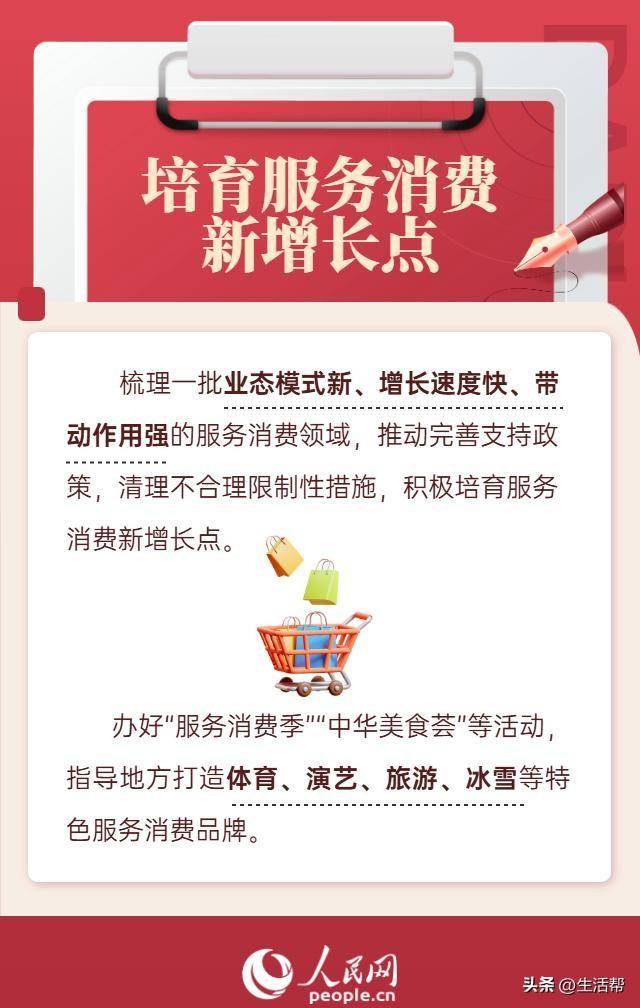
Group 1: Core Economic Strategies - The "15th Five-Year Plan" emphasizes boosting consumption, expanding autonomous openness, and promoting innovative trade development [1] - The Central Economic Work Conference highlights the importance of domestic demand and building a strong domestic market while maintaining openness for multi-field cooperation [1] Group 2: Service Consumption Growth - A focus on new service consumption models with fast growth and strong driving effects is outlined, along with the need to improve supportive policies and eliminate unreasonable restrictions [2] - Events like "Service Consumption Season" and "Chinese Cuisine Fair" are planned to guide localities in creating distinctive service consumption brands in sports, performing arts, tourism, and winter sports [2] Group 3: Consumer Market Development - The lower-tier markets, represented by third and fourth-tier cities and counties, account for 70% of the population and 60% of total retail sales of consumer goods, making them key areas for consumption growth [6] - Strategies will include enhancing circulation facilities, optimizing market environments, and enriching consumption scenarios to activate this potential "blue ocean" [6] Group 4: Trade Promotion Initiatives - Important trade fairs like the Canton Fair will be organized to attract more overseas buyers, with increased support for enterprises participating in overseas exhibitions [9] - The government aims to optimize public services and promote healthy development of new foreign trade models such as cross-border e-commerce [9] Group 5: Import and Export Strategies - Efforts will be made to expand the influence of the "Export China" brand through various matching activities and targeted procurement [11] - Utilizing trade promotion platforms like the China International Import Expo will enhance the convenience of import trade and optimize the structure of imported goods [13] Group 6: Service Trade Development - The development of service trade will follow a "one industry, one policy" approach, with policies aimed at accelerating the export of productive services and enhancing international service capabilities [15] - Emphasis will be placed on leveraging innovations in artificial intelligence, digital economy, and biomedicine to expand emerging service exports [15] Group 7: Autonomous Opening Up - Gradual expansion of autonomous opening in sectors like value-added telecommunications and biotechnology is planned, along with the implementation of zero-tariff measures for all tax items with African countries [19] - The operational policies for the Hainan Free Trade Port will be actively promoted to ensure effectiveness [19] Group 8: Global Supply Chain Cooperation - The strategy includes promoting reasonable and orderly cross-border layout of industrial and supply chains, enhancing cooperation in green development, digital economy, and new energy sectors [21] - The establishment of a comprehensive overseas service system and the promotion of a collaborative service ecosystem for international market expansion are also key objectives [21]
出政策办活动优场景 促消费今年继续加力
Ren Min Ri Bao· 2026-01-27 01:36
Core Viewpoint - The Chinese government is focusing on boosting consumption and expanding investment in 2026, following a stable performance in 2025, with a target to enhance consumer spending and improve the business environment [2][3]. Group 1: Consumption Promotion - In 2025, the total retail sales of consumer goods reached 50.1 trillion yuan, a year-on-year increase of 3.7%, with consumption contributing 52% to economic growth, up by 5 percentage points [3]. - The government plans to implement policies and activities to enhance consumer spending, including optimizing the "trade-in" program for durable goods like automobiles and home appliances [4]. - The service sector saw a retail sales growth of 5.5%, with significant increases in cultural, recreational, and travel services, indicating a strong demand for service consumption [4]. Group 2: Investment and Trade - In 2025, foreign trade maintained resilience, with total imports and exports reaching 45.47 trillion yuan, a 3.8% increase year-on-year, and over 780,000 enterprises engaged in foreign trade [5]. - The number of newly established foreign enterprises exceeded 70,000, marking a 19.1% increase, with foreign investment absorption reaching 747.69 billion yuan, of which high-tech industries accounted for 32.3% [5]. - The government aims to enhance foreign investment policies and support foreign enterprises in participating in consumption and procurement activities [6]. Group 3: International Cooperation - China signed 24 free trade agreements with 31 countries and regions, covering 45% of total goods trade, and is actively participating in global trade discussions [7][9]. - The Belt and Road Initiative saw trade with partner countries reach 23.6 trillion yuan, a 6.3% increase, with significant investments in various sectors [7]. - China is committed to deepening cooperation with developing countries and enhancing participation in international economic negotiations [8].
2025年消费对经济增长的贡献率提高5个百分点 出政策办活动优场景,促消费今年继续加力(权威发布)
Ren Min Ri Bao· 2026-01-26 23:08
Core Insights - The Chinese government is focusing on boosting consumption and expanding two-way investment in 2026, following a stable performance in 2025 where retail sales exceeded 50 trillion yuan for the first time, reaching 50.1 trillion yuan, a 3.7% year-on-year increase [2][3]. Group 1: Consumption and Economic Growth - The Ministry of Commerce aims to enhance the supply levels in cultural entertainment, tourism, dining, sports events, and healthcare sectors, with a dual approach of "policy + activities" to stimulate consumption [2]. - In 2025, the contribution of consumption to economic growth increased by 5 percentage points to 52%, with retail sales of consumer goods reaching 50.1 trillion yuan [2]. - The service retail sector saw a year-on-year growth of 5.5%, with significant increases in leisure, tourism, and transportation services [2][3]. Group 2: Policy Initiatives for 2026 - The Ministry of Commerce plans to implement policies to promote the replacement of old consumer goods, particularly in automobiles and electronics, and to support the automotive consumption potential [3]. - Over 20 "Buy in China" themed activities will be organized in 2026, focusing on product and service consumption [3]. - The government will accelerate the development of international consumption centers and improve the consumption environment through new business models and scenarios [3]. Group 3: Foreign Trade and Investment - In 2025, China's total goods import and export reached 45.47 trillion yuan, a 3.8% increase, with over 780,000 active trading entities, of which private enterprises accounted for 57.3% of total foreign trade [4][5]. - The number of newly established foreign enterprises exceeded 70,000, a 19.1% increase, with foreign investment amounting to 747.69 billion yuan, 32.3% of which was in high-tech industries [4][6]. - China is enhancing its foreign investment support policies and promoting equal participation of foreign enterprises in government procurement and bidding activities [6]. Group 4: International Cooperation and Trade Agreements - China signed 24 free trade agreements with 31 countries and regions, covering 45% of its total goods trade, and is actively participating in global trade discussions [7][9]. - The Belt and Road Initiative saw trade with partner countries reach 23.6 trillion yuan, a 6.3% increase, contributing to a growing number of cooperative agreements in various sectors [7][8]. - China is committed to providing more global public goods and enhancing cooperation with developing countries, particularly in the context of the World Trade Organization [8].
购在中国、出口中国、投资中国 打好政策“组合拳” 提振消费做大市场
Yang Shi Wang· 2026-01-12 07:08
Core Viewpoint - In the opening year of the "14th Five-Year Plan," consumption is further strengthening its role as the "main engine" driving economic growth, with a focus on boosting domestic markets and enhancing trade innovation [1][9]. Group 1: Consumption Initiatives - The "Deeply Implementing Special Actions to Boost Consumption" is prioritized, aiming to create the "Buy in China" brand and cultivate new growth points in service consumption [3][7]. - Policies will be optimized to promote the replacement of old consumer goods, expand and upgrade product consumption, and develop an international consumption environment [3][7]. - There will be a focus on digital, green, and health consumption to stimulate market vitality, alongside innovations in retail and the establishment of a modern market and circulation system [3][7]. Group 2: Domestic Market and Trade Development - The construction of a strong domestic market is paired with measures to expand high-level opening-up, including promoting trade innovation and enhancing the "Export China" brand [9]. - The system will optimize and upgrade goods trade, develop service trade, and promote the integration of trade and investment [9]. - Efforts will be made to attract foreign investment, enhance the "Invest in China" brand, and improve the foreign investment service guarantee system [9]. Group 3: Economic Growth and Policy Synergy - The combination of policies aims to stabilize the basic consumer market while promoting growth in service and digital consumption sectors, aligning with changes in consumption structure [7]. - Building a strong domestic market alongside a unified national market and modern circulation system will help streamline supply and demand cycles and reduce institutional transaction costs [7][9]. - These initiatives are expected to create a sustained consumption-driven effect, solidifying the internal momentum for economic growth [7].
保障民生 助推升级——看2026年关税调整新亮点
Xin Hua She· 2025-12-31 22:52
Group 1 - The core viewpoint of the news is the announcement of the 2026 tariff adjustment plan by the State Council Tariff Commission, which will implement provisional import tariffs lower than the most-favored-nation rate on 935 items starting January 1, 2026 [1][6]. - The adjustment plan aims to lower tariffs on key components, advanced materials, and energy resources, which is expected to reduce costs for enterprises and promote technological self-reliance and modernization of the industrial system [6][10]. - The plan includes a focus on improving people's livelihoods by reducing tariffs on medical products such as artificial blood vessels and diagnostic kits, contributing to the health of the population and the construction of a healthy China [8][10]. Group 2 - The adjustment will also optimize tariff categories and annotations, increasing the total number of tariff items to 8,972, which is expected to promote the development of strategic emerging industries and enhance import-export management [10]. - China will continue to implement preferential tariff rates for certain imported goods from 34 trade partners under 24 free trade agreements, as well as maintain zero-tariff treatment for 100% of products from 43 least developed countries [10]. - The proactive approach in expanding high-standard free trade networks demonstrates China's commitment to global development amidst rising trade protectionism [10].