扭曲操作

Search documents
日债风暴暂歇但警报未除,市场盯紧五大维稳选项!
Jin Shi Shu Ju· 2026-01-22 08:56
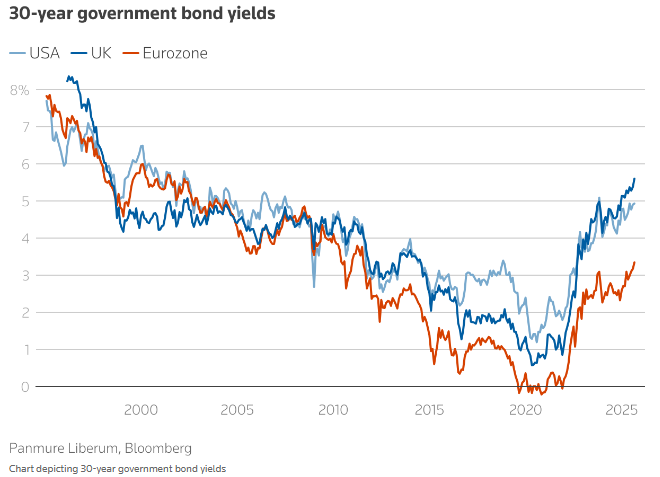
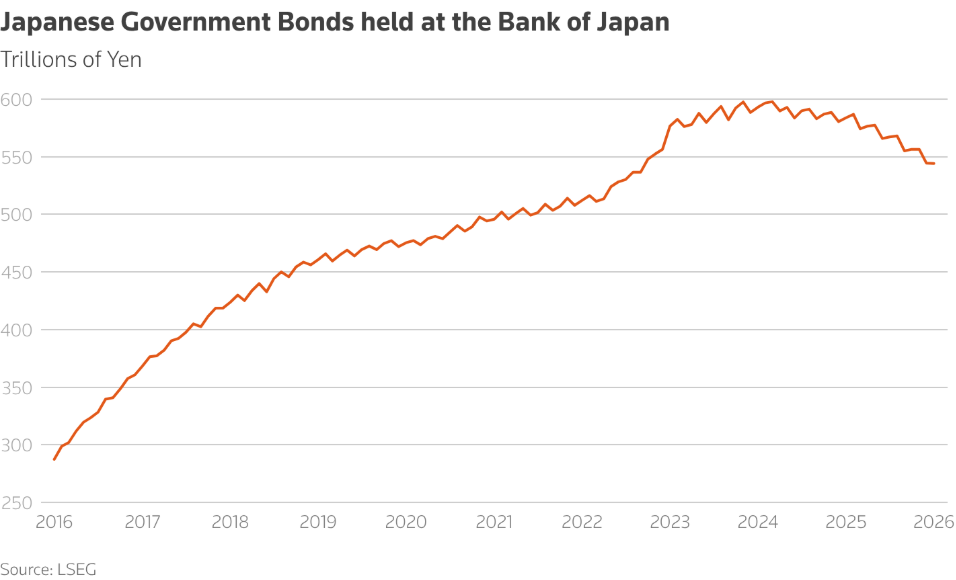
Core Viewpoint - Recent volatility in Japanese government bonds, traditionally seen as stable investments, has raised concerns among investors following Prime Minister Sanae Takaichi's announcement of early elections and tax cuts, leading to a significant rise in bond yields [1] Group 1: Market Reactions - The yield on 30-year Japanese government bonds surged by 27 basis points to a historic high of 3.88%, while the 40-year bond yield exceeded 4% for the first time [1] - Following the spike in yields, Japan's Finance Minister urged the market to remain calm, resulting in a slight rebound in bond yields, although market sentiment remains fearful with low trading volumes [1] Group 2: Potential Policy Responses - The Bank of Japan (BOJ) may intervene by purchasing bonds to stabilize the market, which would increase bond prices and lower yields, as the BOJ is a major net buyer of Japanese government bonds under its yield curve control policy [1] - The BOJ's current holdings account for over half of the total market, but it is attempting to gradually reduce its bond purchases [1] Group 3: Adjustments to Bond Purchase Plans - The BOJ had planned to reduce its monthly bond purchases by 400 billion yen (approximately $2.5 billion) quarterly starting July 2024, but this plan may be postponed due to increased caution stemming from trade and geopolitical risks [5] - There are suggestions from political figures to delay the reduction of bond purchases, which could further pressure the yen [5] Group 4: Yield Curve Dynamics - Long-term Japanese government bonds have seen the most significant sell-off, leading to a steepening of the yield curve as investors demand higher returns for holding these bonds [8] - The BOJ could adopt a "twist operation" strategy, similar to that used by the Federal Reserve, by selling short-term bonds and using the proceeds to buy long-term bonds [8] Group 5: Government Bond Issuance Strategies - The demand for ultra-long-term bonds, typically absorbed by life insurance companies, is declining, prompting the government to consider reducing the scale of bond auctions to rebalance supply and demand [11] - The Japanese government has already reduced the issuance scale of ultra-long-term bonds to the lowest level in 17 years in its latest fiscal budget [11] Group 6: Pension Fund Asset Allocation - The Government Pension Investment Fund, the world's largest public pension fund, manages approximately 260 trillion yen in assets and holds about $400 billion in foreign bonds [12] - Adjustments in the fund's asset allocation could signal a strong return of Japanese capital, potentially boosting both Japanese government bonds and the yen [12]

日债风暴暂歇但警报未除,市场盯紧五大维稳选项!
Xin Lang Cai Jing· 2026-01-22 08:53
Core Viewpoint - The Japanese bond market is experiencing panic selling ahead of the Bank of Japan's upcoming meeting, with potential bond-buying interventions being considered, but challenges remain regarding the exit from the bond purchase program and pressure on the yen [1][12]. Group 1: Market Reactions - The announcement of early elections and tax cuts by Prime Minister Sanae Takaichi has raised concerns about Japan's fiscal health, leading to a significant spike in the 30-year Japanese government bond yield, which rose by 27 basis points to a historic high of 3.88% [1][12]. - The 40-year bond yield has also surpassed the 4% mark for the first time, indicating heightened investor anxiety [1][12]. - Following calls for calm from the Finance Minister, bond yields saw a slight rebound, but overall market sentiment remains fearful, with investors opting to stay on the sidelines [1][12]. Group 2: Policy Options for Stabilization - The Bank of Japan may consider temporary or regular bond purchases to stabilize the market, as it has been a significant net buyer of Japanese government bonds under its yield curve control policy [1][12]. - The central bank's holdings accounted for over half of the market total, but it is currently attempting to gradually reduce its bond purchases [1][12]. - There is a possibility that the Bank of Japan may delay its planned reduction in bond purchases, which was originally set to decrease by 400 billion yen (approximately 2.5 billion USD) quarterly [4][15]. Group 3: Yield Curve and Market Dynamics - The recent sell-off has led to a steepening of the yield curve, with long-term bonds experiencing the most significant declines as investors demand higher returns [7][18]. - The Bank of Japan could implement a localized "twist operation," similar to strategies used by the Federal Reserve, by selling short-term bonds and using the proceeds to buy long-term bonds [7][18]. Group 4: Government Actions and Pension Fund Implications - The Japanese government may opt to reduce the scale of bond auctions to rebalance supply and demand in the market, as demand for ultra-long-term bonds has been declining [10][21]. - The Government Pension Investment Fund, the world's largest public pension fund, manages approximately 260 trillion yen in assets and is considering adjustments in its asset allocation, which could signal a return of Japanese capital and positively impact both Japanese bonds and the yen [11][22].
本周的美联储决议“剧本”:决议降息,鲍威尔“鹰派讲话”,哈塞特、贝森特“鸽派对冲”?
Hua Er Jie Jian Wen· 2025-12-08 02:28
Group 1 - The market is pricing in a 95% probability of a rate cut by the Federal Reserve in December, with Powell's hawkish statements losing significance as he approaches the end of his term [1][3] - There is a potential for a "hawkish rate cut," where the Fed may cut rates but signal a higher threshold for future cuts, which could lead to a liquidity reversal affecting bonds and stocks negatively [4][3] - The coordination between the Treasury, the Fed, and the White House is expected to increase, potentially leading to unconventional policy tools being employed to achieve economic targets [3][1] Group 2 - Kevin Hassett is the leading candidate to replace Powell as Fed Chair, and his appointment could reshape market expectations regarding monetary policy through closer alignment with fiscal policy [2][7] - Treasury Secretary Mnuchin faces pressure to ensure that the new Fed Chair can quickly implement rate cuts, as his own position is tied to the Fed's policy direction [6][2] - Hassett has expressed his commitment to facilitating lower interest rates, which could impact the bond market and investor confidence in the Fed's inflation control [7][6] Group 3 - Mnuchin has indicated a desire for reform within the Fed, criticizing its staff for overstepping their authority and suggesting changes to the selection process for regional Fed presidents [8][6] - The potential for a significant shift in the Fed's operational framework is anticipated with the appointment of a new Chair, which could lead to a more aggressive monetary policy stance [8][7] - The market's reaction to these developments may vary, with some investors betting on a more dovish approach while others remain cautious about the implications of such changes [4][3]
固收专题报告:利率低利率环境,波动来源于哪?
CAITONG SECURITIES· 2025-10-15 06:22
1. Report Industry Investment Rating - No relevant content provided 2. Core Views - China has entered a low - interest era with high - volatility in the bond market. By referring to the US during the QE period (2008 - 2014) after the sub - prime crisis, the report finds that during the US interest rate rebound intervals, the market trades on the marginal improvement of the economic fundamentals, the implementation of fiscal stimulus bills, and the expectation of marginal tightening of monetary policy. In contrast, China's budget this year is relatively positive, but the fiscal strength still lags behind that of the overseas QE stage. The bond market may fluctuate, but there is no possibility of a systematic bear market. It is recommended to participate with a configuration mindset and seize high - interest points [1][2] 3. Summary by Relevant Catalogs 3.1 QE Aftermath: How Did US Treasury Bonds Perform? 3.1.1 US Four - Stage QE Policy (2008 - 2014) - After the sub - prime crisis, the Fed initiated the first round of quantitative easing through various means such as expanding long - term securities assets and creating new monetary policy tools. Subsequently, it restarted or adjusted the QE rhythm multiple times and used operations like "Operation Twist" to regulate economic recovery. The QE policy can be divided into six stages: QE1 (2008.11 - 2009.3), continued balance - sheet expansion (2009.3 - 2010.4), QE2 (2010.11 - 2011.6), two rounds of "Operation Twist" (2011.9 - 2012.9), QE3 and QE4 (2012.9 - 2013.12), and QE Taper (2014.1 - 2014.10). Through QE1, the Fed injected $1.725 trillion of liquidity into the market [6][9][10] 3.1.2 Post - QE US Treasury Bonds: Frequent Rebounds - After QE, US Treasury bond yields did not decline unilaterally but fluctuated frequently. A review of rebounds of over 30bp in the 10 - year Treasury bond yields usually shows that they are caused by factors such as significant fiscal policy expansion, the implementation of large - scale stimulus bills, exogenous shocks from risk events, marginal improvement in fundamentals, and marginal tightening of monetary policy. During the interest rate rebound intervals, speculative activities in the market often increase [18] 3.2 What Were the Sources of Fluctuations in US Treasury Bonds in the Low - Interest Era? 3.2.1 200812 - 200902: Rescue Plans Boosted Market Expectations and Fundamentals Improved Temporarily - After the Fed launched the first round of QE in November 2008, bond market yields dropped rapidly. Then, Bush's rescue plan for the auto industry, the issuance expectation of Treasury bonds, and profit - taking sentiment jointly drove the 10 - year Treasury bond yields to rebound. Additionally, improvements in the credit environment, inflation expectations, and key economic data such as employment and PMI also pushed up the yields [23][27] 3.2.2 200902: An Unconventional Stimulus Bill Was Enacted and Fundamentals Repaired Marginally - The 10 - year Treasury bond yields rose from 2.64% on February 17th to 3.02% on February 27th, an increase of 38bp. Obama's signing of the "American Recovery and Reinvestment Act" increased the expectation of Treasury bond issuance, and the repair of some fundamental data such as PPI, CPI, and real estate credit also pushed up the yields. However, the further downward revision of the Q4 2008 GDP growth terminated the yield rebound [28] 3.2.3 200903 - 200905: Policies to Stabilize Growth and Mitigate Risks Were Strengthened and Fundamentals Improved in Expectation - The 10 - year Treasury bond yields rose from 2.51% on March 18th to 3.29% on May 7th, an increase of 78bp. The Fed's intensified QE, the implementation of measures to dispose of non - performing financial assets, and financial regulatory reforms boosted market confidence. Improvements in fundamental indicators such as inflation, new housing starts, and manufacturing PMI supported the rise in inflation expectations. Overseas, the global QE wave and the issuance of IMF bonds also affected the US Treasury bond market [29][30][31] 3.2.4 200905 - 200906: Housing Protection and Stronger Regulations Were Upgraded and Fundamentals Hit Bottom and Rebounded - The 10 - year Treasury bond yields rose from 3.10% on May 14th to 3.98% on June 10th, an increase of 88bp. After the Fed's stress - test results were announced, the stock market took profit, and the bond market yields initially declined. Then, Obama's signing of the housing assistance bill and the strengthening of financial regulations boosted market confidence. Improvements in fundamental data such as inflation and per - capita disposable income pushed up long - term yields. Overseas, the intention of many countries to subscribe to IMF bonds squeezed the demand for US Treasury bonds [36][37] 3.2.5 200907: Record Deficit and Improving Fundamentals - The 10 - year Treasury bond yields rose from 3.32% on July 10th to 3.75% on July 27th, an increase of 43bp. The "Cash for Clunkers" program boosted auto consumption, and General Motors'资产重组 and government control stabilized market confidence. The record - high fiscal deficit increased bond supply and raised concerns about the US dollar, quickly pushing up bond market yields. The implementation of the financial regulatory reform bill and the rebound of multiple fundamental indicators also contributed to the yield increase [38][39][40] 3.2.6 200910: Economic Repair and Signals of Monetary Tightening, with Incremental Policies Added - The 10 - year Treasury bond yields rose from 3.21% on October 1st to 3.59% on October 26th, an increase of 38bp. The Fed signaled the start of economic repair and the gradual exit of monetary easing. The US government's innovation incentive strategy and positive signals from key economic data such as growth, inflation, and manufacturing drove up inflation expectations. Overseas, the global economic recovery and overseas interest - rate hikes reduced the demand for safe - haven assets [41][42][44] 3.2.7 200911 - 200912: Incremental Policies Continued to Be Strengthened and Fundamentals Trended Upward - The 10 - year Treasury bond yields rose from 3.21% on November 30th to 3.85% on December 31st, an increase of 64bp. Obama's signing of the assistance bill for workers, homeowners, and businesses and the plan to increase troops in Afghanistan increased fiscal expenditure pressure. Fundamental data such as GDP, PCE, and employment improved, raising inflation expectations. Overseas, Australia's interest - rate hike and the mitigation of the Dubai debt crisis also affected the US Treasury bond market [48][49] 3.2.8 201003 - 201004: Exit from QE, Implementation of Multiple Reforms, and Rapid Repair of Fundamentals - The 10 - year Treasury bond yields rose from 3.61% on March 4th to 4.01% on April 5th, an increase of 40bp. The approaching exit of the first round of QE, the acceleration of financial regulatory legislation, and the signing of the healthcare reform bill affected the market. Improvements in fundamental data such as employment, GDP, and PCE pushed up the yields [50][52] 3.2.9 201008 - 201009: Policies Signaled Economic Stabilization and Fundamentals Stabilized - The 10 - year Treasury bond yields rose from 2.47% on August 31st to 2.81% on September 10th, an increase of 34bp. The Fed and the US government released signals to stabilize the economy, boosting market expectations. Some fundamental data such as GDP and unemployment claims showed positive signs, and the stock index and crude oil prices temporarily stopped falling and rebounded. However, the Fed's褐皮书 indicated a slowdown in economic growth, and the yields returned to a downward - trending oscillation [55][56][61] 3.2.10 201011 - 201012: QE2 + Tax - Cut and Employment Bills, with Improved Fundamentals - The 10 - year Treasury bond yields rose from 2.53% on November 4th to 3.53% on December 15th, an increase of 100bp. The Fed's restart of QE and the release of signals for broad fiscal policies increased the expectation of Treasury bond issuance. Improvements in fundamental data such as employment, PPI, CPI, and GDP raised inflation expectations [63][64] 3.2.11 201012 - 201102: Firm Commitment to QE and Strong Fundamentals - The 10 - year Treasury bond yields rose from 3.30% on December 31st to 3.70% on February 10th, an increase of 40bp. The Fed's reaffirmation of the QE policy stabilized market confidence and drove up inflation expectations. The improvement of data in areas such as prices, production, and consumption continued. Overseas, the issuance of European bonds alleviated market panic [65][66] 3.2.12 201103 - 201104: Intensified Expectation of Tightening and Improved Fundamentals - The 10 - year Treasury bond yields rose from 3.22% on March 16th to 3.59% on April 11th, an increase of 37bp. Inflation indicators and fundamental data such as employment and retail sales improved. Statements from Fed officials, the sale of mortgage - backed securities, and Bill Gross's short - selling of US Treasury bonds increased the upward pressure on yields. The US debt - ceiling issue also worried the market. Overseas, factors such as the Japanese nuclear leak, China's policy shift, the Middle - East situation, and the ECB's interest - rate hike affected the US Treasury bond market [67][68][70] 3.2.13 201109 - 201110: Implementation of OT Operation, Boosted Policy Expectations, and Improved Fundamentals - The 10 - year Treasury bond yields rose from 1.72% on September 22nd to 2.26% on October 14th, an increase of 54bp. The implementation of the "Operation Twist" and the disappointment of QE3 expectations led to a rise in yields. The operation was questioned, and it was seen as paving the way for QE3, raising economic expectations. Fundamental indicators such as GDP, PCE, and employment improved significantly. Overseas, the global interest - rate cut wave increased the expectation of QE in the US [72][73][79] 3.2.14 201202 - 201203: Economic Repair and Rising Expectation of Monetary Tightening - The 10 - year Treasury bond yields rose from 1.98% on February 29th to 2.39% on March 19th, an increase of 41bp. The Fed's indication of a mild economic recovery and the results of the bank stress - test boosted market confidence. Improvements in fundamental data such as economic activity, inflation, and employment increased risk appetite [80][81][82] 3.2.15 201207 - 201208: Prominent Structural Economic Problems and the Fed's Strengthened Expectation of QE - The 10 - year Treasury bond yields rose from 1.43% on July 25th to 1.83% on August 16th, an increase of 40bp. The economy showed structural problems in growth, employment, manufacturing, consumption, and real estate. The Fed's statements strengthened the expectation of QE, increasing market risk appetite. Overseas, new developments in the European debt crisis and the global interest - rate cut wave affected the US Treasury bond market [83][84][85] 3.2.16 201208 - 201209: Declining Fundamentals and Rising Expectation of QE3 - The 10 - year Treasury bond yields rose from 1.57% on August 31st to 1.88% on September 14th, an increase of 31bp. Bernanke's speech hinted at QE, boosting market expectations. Declining inflation and poor employment performance supported the expectation of QE3. The Fed officially launched the third round of QE on September 13th, ending the yield rebound [86][87][88]
长期美债遭遇严峻挑战,“美联储看跌期权”却不再是万能灵药
Zhi Tong Cai Jing· 2025-09-04 08:51
Core Viewpoint - The current anxiety in the U.S. capital markets is primarily due to soaring long-term government borrowing rates, making it difficult to stabilize the stock market, and traditional monetary and fiscal tightening may hinder economic growth and worsen tax revenue issues [1][2] Group 1: Market Conditions - The concept of the "Central Bank Put" has been prevalent among stock investors for decades, referring to the Federal Reserve's actions to stimulate the economy and provide a safety net for the stock market [1] - The expectation that the Federal Reserve will intervene to prevent significant market downturns has historically led to excessive risk-taking, as evidenced before the 2007-2008 financial crisis [1][2] - The current market is signaling caution regarding the debt expansion model, particularly in the performance of long-term government bonds [2] Group 2: Economic Indicators - The U.S. economy is currently growing at over 3%, with ample credit and a very loose financial environment, raising concerns about the potential impact of large-scale monetary easing as requested by the Trump administration [10] - The market anticipates an average inflation rate of 2.5% over the next decade, which could increase risk premiums in the U.S. bond market [10] Group 3: Policy Implications - The rising debt levels are only part of the problem; the real concern is the high inflation rate, which is significantly above target levels, and the perceived political influence on the Federal Reserve's ability to manage inflation [8][10] - A dual approach is suggested to address the current challenges: pressuring the Federal Reserve to lower interest rates while restructuring government debt to rely more on short-term bonds [14] - Even if such measures are successfully implemented, they may not alleviate core market concerns regarding sustainable inflation levels, which could continue to exert upward pressure on long-term government bond yields [14]