
需求修复

Search documents
热卷日报:震荡偏强-20260330
Guan Tong Qi Huo· 2026-03-30 12:40
1. Report Industry Investment Rating - The short - term rating for hot - rolled coils is "oscillating with a slight upward trend" [7] 2. Core View of the Report - Hot - rolled coils showed an oscillating and slightly upward trend on Monday. The market is in a pattern of increasing supply and demand and continuous inventory reduction. In the short term, it will mainly oscillate with a slight upward trend. In the medium term, it is necessary to focus on the recovery of manufacturing demand and steel mill复产. If demand continues to pick up and production is controlled, hot - rolled coils are expected to start a trend - based rebound; if demand is weak and复产 accelerates, the price will maintain an oscillating pattern [7] 3. Summary by Relevant Catalogs Market行情回顾 - **Futures price**: The main contract of hot - rolled coil futures reduced its open interest by 72,722 lots on Monday, with a trading volume of 283,214 lots, slightly increasing compared to the previous trading day. In terms of the daily moving average, it broke through the 5 - day moving average of around 3309 in the short term, was above the 30 - day moving average of 3261 in the medium term, and faced medium - term pressure around the 60 - day moving average of 3273 [1] - **Spot price**: The price of hot - rolled coils in the mainstream area of Shanghai was reported at 3300 yuan/ton, up 10 yuan from the previous trading day [2] - **Basis**: The basis between futures and spot was - 8 yuan [3] Fundamental Data - **Supply side**: The actual weekly output was 305.61 million tons, a week - on - week increase of 5.4 million tons. The output slightly rebounded, and steel mills' willingness to resume production increased marginally. If the price of hot - rolled coils continues to rebound and steel mills' profits are further repaired, the output may continue to rise; if demand falls short of expectations, steel mills are likely to tighten production again [4] - **Demand side**: The apparent consumption was 313.63 million tons, a week - on - week increase of 3.12 million tons. The demand improved month - on - month, but the increase was weaker than the output, indicating that the demand repair was still insufficient. If the production and sales data of industries such as automobiles and home appliances are good, the apparent demand is expected to further increase; if overseas demand is weak and domestic manufacturing starts less than expected, demand repair will be hindered [4] - **Inventory side**: The social inventory was 369.42 million tons, a week - on - week decrease of 6.91 million tons. The steel mill inventory was 83.85 million tons, a week - on - week decrease of 1.11 million tons. The total inventory was 453.27 million tons, a week - on - week decrease of 8.02 million tons. The overall inventory pressure was marginally relieved [4] - **Policy side**: The government proposed to issue 1.3 trillion yuan of ultra - long - term special treasury bonds and arrange 4.4 trillion yuan of special bonds, which boosted the medium - and long - term market confidence. However, the current manufacturing PMI is still in the contraction range, and it will take time for policies to be transmitted to the demand side of hot - rolled coils, and it is difficult to reverse the high - inventory situation in the short term [5] Market Driving Factor Analysis - **Bullish factors**: The total inventory is continuously decreasing, the de - stocking rhythm of social inventory is accelerating, the apparent demand is improving month - on - month, and the price of hot - rolled coils has bottom support. The manufacturing demand has stronger resilience than construction steel and has long - term fundamental support [6] - **Bearish factors**: The output has slightly increased, the supply side has expanded marginally. The demand repair amplitude is weaker than the output, and the supply - demand pattern is weaker than that of rebar. The total inventory is still at a high level, which restricts the price rebound height [6] Short - term View Summary - Hot - rolled coils oscillated with a slight upward trend on Monday. The funds accelerated the shift of positions for contract replacement, which is expected to be completed in the near future. The support below the 05 contract is around the 60 - day moving average. In the medium term, it is necessary to focus on the recovery of manufacturing demand and steel mill复产 [7]
产品力提升+智能化预期带来增量,港股汽车ETF国泰(520720)涨超1.8%
Mei Ri Jing Ji Xin Wen· 2026-02-11 05:59
Group 1 - The market is beginning to trade in advance for the Q1-Q2 new car cycle, driven mainly by product enhancements from new technologies [1] - Intelligent driving is expected to be a major growth area this year, with expectations for Full Self-Driving (FSD) technology entering the Chinese market [1] - Domestic cost pressures are significant, but there is optimism regarding overseas export opportunities [1] Group 2 - The Hong Kong Stock ETF, Cathay (520720), tracks the Hong Kong Stock Connect Automobile Index (931239), which selects listed companies in the automotive industry, focusing on smart driving and new energy vehicles [1] - The index components are concentrated in the automotive sector, showcasing high growth potential and international characteristics, while highlighting the representation of new energy vehicle companies and smart driving new forces [1]
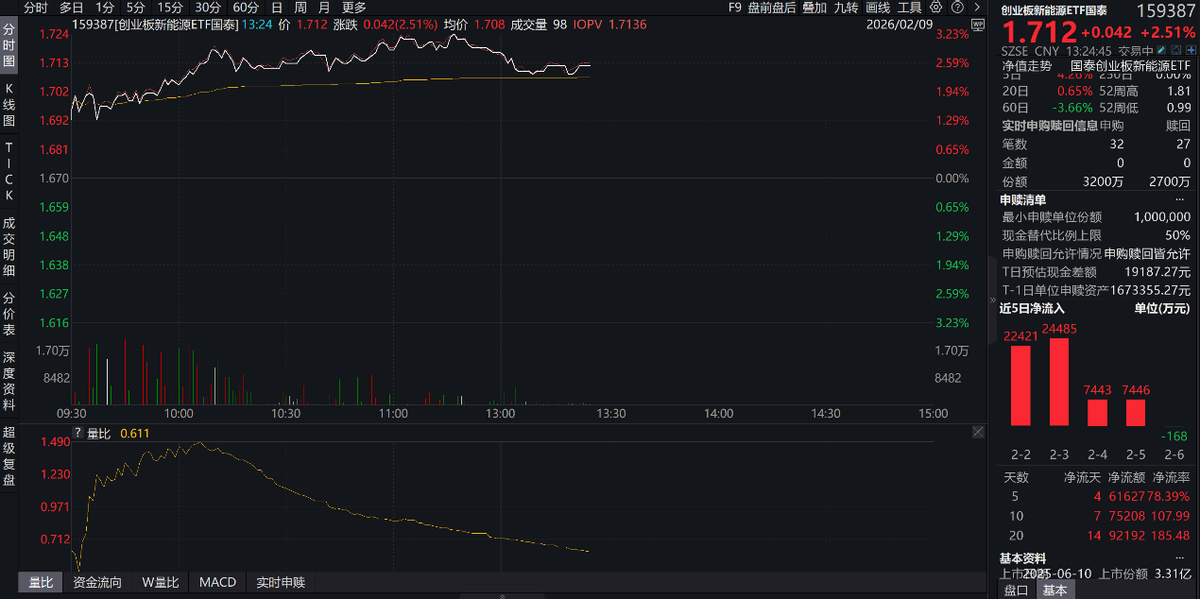
政策与产业共振驱动,创业板新能源ETF国泰(159387)大涨超3%
Mei Ri Jing Ji Xin Wen· 2026-02-09 05:45
Core Viewpoint - The recent performance of the new energy sector indicates a recovery phase, driven by supply-side adjustments, demand recovery, and technological upgrades, creating structural investment opportunities [3][6]. Group 1: Market Performance and Trends - The ChiNext New Energy ETF (159387) saw an intraday increase of over 3.2%, with a net inflow of over 600 million yuan in the past five trading days, indicating a clear sentiment recovery [1]. - The new energy sector is stabilizing after a period of volatility, with signs of bottoming out in the industry chain, particularly in solid-state batteries and space photovoltaic themes [3]. Group 2: Catalysts and Policy Support - Key catalysts for the renewed interest in the new energy sector include advancements in solid-state battery technology and increasing attention on themes like space photovoltaics and energy storage systems [4]. - The new energy sector remains a core focus of the "dual carbon" strategy and the construction of a new power system, with policies emphasizing electric equipment, grid transformation, and new energy storage [5]. Group 3: Supply Chain Adjustments and Profitability - The solar and lithium battery supply chains are showing signs of supply-side adjustments, with significant price corrections leading to a gradual stabilization of the industry [7]. - The lithium carbonate price has significantly dropped, and the profitability of battery manufacturers is recovering, while energy storage demand is emerging as a new growth driver [7]. Group 4: Investment Opportunities and Structural Changes - The current market offers three levels of investment logic: clear cyclical advantages, structural differentiation among companies, and the integration of new energy with AI, electrification, and digitalization [8]. - The new energy industry is expected to unlock new growth spaces due to technological breakthroughs, with the ChiNext New Energy ETF tracking companies involved in clean energy production, storage, and application [9].


一周一刻钟,大事快评(W143):再看东南亚,长城汽车业绩快报
Shenwan Hongyuan Securities· 2026-02-03 13:12
Investment Rating - The industry investment rating is "Overweight" indicating that the industry is expected to outperform the overall market [4]. Core Insights - The Southeast Asian electric vehicle (EV) market has shown significant changes, with sales and penetration rates of Chinese EV brands in Singapore, Malaysia, and Thailand exceeding expectations due to price reductions in 2025 [5][6]. - GWM's net profit for 2025 is reported at 9.9 billion yuan, a year-on-year decrease of 22%, attributed to various factors including policy changes in Russia and increased operational costs [7]. - The report emphasizes the strong growth potential for Chinese EV exports in 2026, driven by improved supply-demand dynamics and product iterations [6][7]. Summary by Sections Southeast Asia Market Analysis - The Southeast Asian EV market has improved significantly, with Chinese brands gaining market share due to competitive pricing strategies [5]. - The market is expected to see continued growth as local support policies evolve, leading to improved supply-demand relationships and increased pricing power for Chinese brands [5][6]. - Major Chinese EV manufacturers are expanding their presence in Southeast Asia, launching new models to enhance their product offerings [6]. GWM Performance Overview - GWM's net profit for 2025 is projected at 9.9 billion yuan, down 22% from the previous year, primarily due to increased costs and operational challenges [7]. - The company aims to achieve a sales target of 1.8 million vehicles in 2026, with significant contributions expected from new models and international markets [7]. - The introduction of new vehicles is anticipated to drive sales growth and improve profit margins, positioning GWM for a potential valuation increase [7].

周一刻钟,大事快评(W142):隆盛科技更新、四季报前瞻
Shenwan Hongyuan Securities· 2026-01-29 11:25
Investment Rating - The industry investment rating is "Overweight," indicating that the industry is expected to outperform the overall market [15]. Core Insights - The report highlights the growth potential of 隆盛科技 in the commercial aerospace sector, focusing on core component supply and deepening relationships with key customers, successfully entering the satellite constellation supply chain [2][3]. - The company is expanding its production capacity in the harmonic reducer sector, aiming for 200,000 units by 2026, while also exploring new applications in commercial aerospace [4]. - The automotive industry shows a positive trend, with domestic and international vehicle production and sales increasing, particularly in the new energy vehicle segment [6][7]. Summary by Sections 隆盛科技 Update - 隆盛科技 is focusing on core component supply in the commercial aerospace sector, with its subsidiary 微研中佳 providing key components for satellite energy and control modules, successfully integrating into the supply chains of major aerospace companies [3]. - The company is also advancing in the harmonic reducer market, with a planned production capacity of 200,000 units by 2026, and is developing customized solutions for humanoid and industrial robots [4]. - Other business segments, including drones and precision components, are showing positive growth, with significant advancements in the natural gas heavy-duty truck EGR valve market [5]. Quarterly Report Preview - According to data from 中汽协, the total vehicle production and sales for Q4 2025 reached 10.186 million and 10.023 million units, respectively, marking year-on-year increases of 3.9% and 1.7% [6]. - Domestic retail share for independent brands reached 66.9% in Q4 2025, with a year-on-year increase of 3.2 percentage points, while new energy vehicle wholesale reached 4.89 million units, up 13.2% year-on-year [7]. - The average industry discount rate decreased by 1.33 percentage points to 12.28% in Q4 2025, indicating reduced terminal discounts [8]. - Traditional raw material price indices saw a decline, while new energy raw material prices and shipping costs increased, impacting supply chain profitability [8].
汽车行业2025年四季报前瞻:行业盈利逐步回归中枢,看好出海+科技
Shenwan Hongyuan Securities· 2026-01-23 08:07
Investment Rating - The industry investment rating is "Overweight," indicating a positive outlook for the automotive sector compared to the overall market performance [12]. Core Insights - The automotive industry is gradually returning to its profit center, with a strong focus on overseas expansion [1]. - In Q4 2025, total vehicle production and sales reached 10.186 million and 10.023 million units, respectively, showing year-on-year increases of 3.9% and 1.7% [4]. - Domestic retail share of independent brands reached 66.9%, up 3.2 percentage points year-on-year, while wholesale of new energy passenger vehicles increased by 13.2% year-on-year [4]. - The average industry discount rate decreased by 1.33 percentage points to 12.28% in Q4 2025, indicating reduced terminal discounts [4]. - Traditional raw material prices saw a decline, while new energy raw material prices increased, impacting supply chain profitability [4]. Summary by Sections Vehicle Production and Sales - In Q4 2025, passenger vehicle production and sales were 9.018 million and 8.845 million units, with year-on-year changes of +2.2% and -0.3% respectively [4]. - Commercial vehicle production and sales reached 1.168 million and 1.178 million units, with year-on-year increases of +19.4% and +20.0% [4]. - Exports of vehicles in Q4 2025 totaled 2.147 million units, a significant year-on-year increase of 39.8%, with new energy vehicles showing remarkable growth [4]. Market Dynamics - The report highlights the leading position of independent brands in the market, with a notable increase in new energy vehicle sales [4]. - The report notes a divergence in profitability among automakers due to varying new vehicle release schedules and the suspension of trade-in subsidies [4]. Profit Forecasts - The report provides profit forecasts for key automotive companies, indicating significant growth for companies like Jifeng and Dongfang, while others like BYD and Li Auto are expected to see declines [6][8]. - Specific profit growth rates for Q4 2025 show a wide range, with some companies experiencing over 600% growth, while others face substantial losses [6]. Investment Recommendations - The report suggests focusing on companies benefiting from AI integration and overseas business support, such as BYD and Geely [4]. - It also emphasizes the importance of companies with strong performance in the supply chain, particularly in the context of rising raw material prices [4].




一周一刻钟 大事快评(W141):永达汽车、天准科技、隆盛、银轮、天成、福达
Xin Lang Cai Jing· 2026-01-21 10:30
Group 1 - Yongda Automotive shows strong recovery potential in luxury car dealership performance, supported by cash flow and dividend yield attractiveness [1] - The company benefits from BMW's support in new car gross profit, alongside the clearing of inefficient dealerships in the luxury car sector [1] - The new energy business is expected to contribute significantly, with a projected net cash flow exceeding 1.1 billion yuan in the first half of 2025 [1] Group 2 - Tianzhun Technology's core business is experiencing strong growth, but the industry faces cost pressures due to memory shortages [2] - The company focuses on intelligent driving and embodied intelligence, with significant growth momentum [2] - The shortage of high-end DDR5 memory and rising DRAM prices are impacting the cost structure for automotive manufacturers [2] Group 3 - Longsheng Technology has significant untapped potential in the commercial aerospace sector, with its subsidiary positioned in precision welding components [3] - The traditional business remains a core pillar of performance, while the robotics segment has clear long-term growth logic [3] - Yinxun shares are expected to see substantial market value elasticity due to the data center liquid cooling module as a core growth driver [3] Group 4 - Fuda shares have issued convertible bonds, signaling positive developments, with strong performance expected in 2026 due to scarce production capacity [3] - The company is involved in the drafting of national standards for robotic components, with overseas client validation progressing [3] - Tiancheng Self-Control is positioned as a key player in the low-altitude economy, with significant market share potential as the industry matures [3]


汽车周报:供应链涨价、购置税兜底驱缓,关注通胀环节投资机会-20260113
Shenwan Hongyuan Securities· 2026-01-13 04:13
Investment Rating - The report maintains a positive outlook on the automotive industry, indicating a favorable investment rating for the sector [2]. Core Insights - The report highlights the impact of rising prices for memory, copper, aluminum, and key components, which are expected to lead to an increase in consumer vehicle prices. It suggests focusing on supply chain companies with good supply-demand dynamics and price transmission capabilities, as well as mid-to-high-end vehicle manufacturers with model cycles [2]. - The report notes that the average daily retail sales of passenger vehicles in China reached 123,000 units in the last week of December, a year-on-year increase of 17% [2]. - The report emphasizes the importance of the recently implemented green consumption policies, which aim to support the purchase of new energy vehicles and enhance the automotive industry's supply chain [11][12]. Market Updates - The automotive industry recorded a total transaction value of 638.35 billion yuan, with a week-on-week increase of 11.27%. The automotive industry index rose by 2.53% during the week [2][13]. - The report indicates that the automotive industry index's growth was lower than that of the Shanghai and Shenzhen 300 index, which increased by 2.79% [13]. - The report lists significant stock movements, with 201 stocks rising and 68 falling, highlighting the top gainers and losers in the automotive sector [19]. Key Events - The Ministry of Industry and Information Technology released the 403rd batch of new vehicle approvals, featuring several notable models from various manufacturers [3][4]. - The report discusses the rising cost pressures in the automotive industry due to increasing memory prices, which are becoming a significant factor affecting profitability [6][8]. - The report mentions a strategic cooperation agreement between CATL and NIO, focusing on battery technology and market collaboration [36]. Financial Metrics - The automotive sector's price-to-earnings ratio stands at 30.20, ranking 18th among all primary industries, indicating a moderate valuation compared to the Shanghai and Shenzhen 300 index's 14.41 [16][18].



一周一刻钟,大事快评(W139):补贴政策受益分析;小鹏、零跑、长城销量解读
Shenwan Hongyuan Securities· 2026-01-07 10:29
Investment Rating - The report maintains an "Overweight" rating for the automotive industry, indicating a positive outlook compared to the overall market performance [10]. Core Insights - The 2026 new energy vehicle (NEV) purchase tax subsidy policy has shifted from a flat-rate model to a tiered proportional subsidy, resulting in a slight decrease in per-vehicle subsidy amounts. Companies with a higher proportion of low-end models, such as Geely and BYD, will experience a more significant subsidy reduction, while high-end brands will be less affected [2][3]. - The adjustment in subsidy policy is expected to reshape the sales structure of NEVs in 2026, with a decline in demand for low-end models and a relative advantage for mid-to-high-end models [2]. Summary by Relevant Sections Subsidy Policy Analysis - The new subsidy policy will lead to a 19% reduction for Geely and a 14% reduction for BYD, while companies like Xiaopeng, Great Wall, and Leap Motor will see a smaller impact of around 10% due to their higher proportion of mid-to-high-end models [2]. - The demand for A0 and A00 level low-end models, which previously relied heavily on subsidies, is expected to decrease significantly [2]. Sales Analysis of Key Companies - Xiaopeng Motors delivered nearly 430,000 vehicles in 2025, a 126% year-on-year increase. However, the average selling price (ASP) dropped from approximately 190,000 yuan in 2024 to 160,000 yuan in the first half of 2025 due to changes in product mix [3]. - Leap Motor achieved a delivery volume of 597,000 vehicles in 2025, doubling from 290,000 in 2024. The company plans to launch two high-end models in 2026 and aims for a sales target of 1 million vehicles [4]. - Great Wall Motors sold 1.32 million vehicles in 2025, with a 7% year-on-year growth. The company has set a sales target of 1.8 million vehicles for 2026, reflecting a 40% increase [5]. Investment Recommendations - The report suggests focusing on new energy vehicle companies with advantages in AI and robotics, such as Xiaopeng, NIO, and Li Auto, as well as component manufacturers like Yinchuan, Fuda, and Shuanghuan, which are expected to benefit from the new subsidy policies [6].
一周一刻钟,大事快评(W139):补贴政策受益分析,小鹏、零跑、长城销量解读
Shenwan Hongyuan Securities· 2026-01-07 09:13
Investment Rating - The industry investment rating is "Overweight" indicating that the industry is expected to outperform the overall market [12]. Core Insights - The 2026 new energy vehicle purchase tax subsidy policy has shifted from a "one-size-fits-all" model to a tiered proportional subsidy, resulting in a slight decrease in per-vehicle subsidy amounts. Companies with a higher proportion of low-end models, such as Geely and BYD, will experience a more significant subsidy reduction, while high-end brands are largely unaffected [2][3]. - The adjustment in subsidy policy is expected to significantly reshape the sales structure of new energy vehicles in 2026, with demand for low-end models likely to decline, benefiting mid-to-high-end models and companies with higher average selling prices (ASP) [3]. Summary by Sections Subsidy Policy Analysis - The 2026 subsidy policy will lead to a reduction in subsidies for companies with a higher share of low-end models, with Geely facing a 19% reduction and BYD a 14% reduction. In contrast, companies like Xiaopeng, Great Wall, and Leap Motor will see a reduction of around 10% due to their higher proportion of mid-to-high-end models [3][4]. Sales Analysis of Key Companies - **Xiaopeng Motors**: Projected delivery volume for 2025 is approximately 430,000 units, a 126% increase year-on-year. December deliveries were 37,500 units, showing a decline due to subsidy reductions. The ASP is expected to drop from nearly 190,000 yuan in 2024 to 160,000 yuan in the first half of 2025. Xiaopeng plans to launch seven dual-power models in 2026, which are expected to benefit from the policy changes [4][5]. - **Leap Motor**: Expected to deliver 597,000 units in 2025, doubling from 290,000 units in 2024. The growth is driven by new models and overseas market expansion. Despite the introduction of lower-priced models, Leap Motor has maintained its gross margin due to effective cost control. The 2026 sales target is set at 1 million units [5][6]. - **Great Wall Motors**: Anticipated sales for 2025 are 1.32 million units, a 7% increase. The company has optimized its internal structure, with new models compensating for declines in older models. The sales target for 2026 is set at 1.8 million units, reflecting a 40% year-on-year growth expectation [6]. Investment Recommendations - The report suggests focusing on new energy vehicle companies that have advantages in AI and robotics, such as Xiaopeng, NIO, and Li Auto, as well as key Tier 1 suppliers. It also recommends second-hand car companies and component manufacturers with low valuations and growth potential, such as Yinchuan, Fuda, and others [2][6].