救市

Search documents
救市必须大刀阔斧、雷厉风行、斩钉截铁、坚决果断、快刀斩乱麻
Xin Lang Cai Jing· 2026-02-24 05:59
Core Viewpoint - The article emphasizes the necessity for decisive and rapid measures to stabilize the market, advocating for bold and effective actions to address current challenges [1] Group 1 - The need for swift and resolute actions in market stabilization is highlighted, suggesting that a strong approach is essential to restore confidence [1] - The author calls for a comprehensive strategy that is both aggressive and efficient in tackling market issues [1] - The phrase "快刀斩乱麻" (cutting through the chaos with a swift knife) is used to illustrate the urgency and decisiveness required in the current situation [1]
印尼当局“紧急救市”:拟强制流通股翻倍 并安排主权基金入市稳信心
Xin Lang Cai Jing· 2026-01-29 08:28
Group 1 - Indonesian regulatory authorities plan to double the minimum free float requirement for listed companies from 7.5% to 15% starting next month [1] - The Danantara sovereign wealth fund may enter the market to enhance liquidity through its subsidiaries, which include state-owned banks with brokerage and asset management services [1] - Following these announcements, market sentiment stabilized, with the Jakarta Composite Index narrowing its decline to 0.3% after previously experiencing a 10% drop due to concerns over a potential downgrade by MSCI [1]
2026的第一天,用21个趋势关键词开启文娱行业新一年
3 6 Ke· 2026-01-04 01:30
Core Insights - The entertainment industry is on the brink of significant changes by 2026, driven by user insights, societal emotions, and the impact of new technologies like AI [1][2] Group 1: Family Entertainment - The concept of family entertainment is evolving, with a focus on creating universal emotional connections across generations, as evidenced by the success of films like "Ne Zha 2" which grossed 15.4 billion [3] - The new phase of family entertainment caters to diverse audience segments, exemplified by productions that attract both older and younger viewers [3] Group 2: Market Recovery - The industry is increasingly focused on practical solutions for market recovery, emphasizing the importance of blockbuster content to boost confidence and stabilize expectations [4] - Recovery strategies will involve a mix of releasing backlog projects and returning to strong genre content [4] Group 3: AI Production Capacity - AI has transitioned from experimental to a key driver of production capacity in the entertainment sector, with many companies integrating AI into traditional production processes [5][6] - The emergence of AI agents signifies a shift towards a more platform-oriented and streamlined production structure [6] Group 4: Electronic Actors - 2025 marks the emergence of electronic actors as professional artists, with AI-generated performers gaining traction in the entertainment industry [7] - AI actors are being utilized in short dramas, reducing production costs and enhancing engagement with overseas audiences [7] Group 5: Human-Machine Collaboration - Human-machine collaboration is redefining creative roles, allowing AI to assist in creative processes and decision-making, which lowers barriers to entry for creators [8] - This trend fosters diverse personal expressions but raises questions about copyright and originality [8] Group 6: Content Quality Concerns - The rise of AI-generated content has led to an influx of low-quality, homogeneous material, risking user engagement and attention [9] - Platforms face challenges in balancing content quality and quantity, necessitating new standards for content regulation [9] Group 7: Cyber Burnout - Users are experiencing fatigue from the overwhelming amount of fragmented content, leading to a shift towards more immersive long-form content and offline experiences [10][11] Group 8: Aesthetic Trends - The "rough aesthetic" trend in short videos emphasizes authenticity and rawness, contrasting with polished AI-generated content [12] Group 9: Individualized Content - The rise of video as a primary form of social expression among younger users reflects a shift towards personalized storytelling and documentation [13] Group 10: IP Development - The ByteDance ecosystem is fostering the incubation of various IPs, with short dramas increasingly recognized for their potential to carry IP value [14][15] Group 11: Music Industry Dynamics - The rapid growth of ByteDance's music platform, with a 90.7% increase in monthly active users, is reshaping the music market and challenging traditional platforms [15] Group 12: Short Drama Evolution - 2025 is a pivotal year for short dramas, with significant growth in viewership and the emergence of new stars, indicating a shift in the entertainment landscape [16] Group 13: Rural Market Expansion - The short drama market is expanding into rural areas, focusing on relatable themes for local audiences, supported by efficient production systems [17] Group 14: Vertical Distribution - Vertical distribution is gaining traction in the film market, allowing for more targeted audience engagement and steady revenue growth [18] Group 15: Niche Economy - The "cocoon economy" reflects the fragmentation of consumer interests, where niche communities thrive through tailored content and commerce [19][20] Group 16: Self-Identity in Consumption - Consumers are increasingly seeking to express their identities through participation in immersive experiences and community-driven events [21] Group 17: Decentralized Idol Culture - The idol industry is becoming decentralized, with new avenues for aspiring performers emerging through live streaming and interactive experiences [22] Group 18: Trendy Toys - The demand for trendy toys is surging, prompting brands to innovate in storytelling and marketing strategies to engage new consumer demographics [23][24] Group 19: IP Saturation - The IP market is becoming increasingly competitive, with a higher frequency of exposure leading to diminishing returns on IP collaborations [25] Group 20: Global Cultural Symbols - Chinese pop culture is beginning to establish its own global symbols, with brands like labubu gaining international recognition [26] Group 21: Event Experiences - Sports events are evolving into comprehensive experiences that blend entertainment, social interaction, and cultural engagement [27]
吴晓求:这一生大概只为中国资本市场而来|我们的四分之一世纪
Jing Ji Guan Cha Wang· 2025-12-27 01:26
Core Viewpoint - The article highlights the evolution and challenges of China's capital market through the insights of Wu Xiaoqiu, a prominent scholar and advocate for financial reform in China, emphasizing the need for continuous reform to achieve the goal of becoming a global financial center [4][20]. Group 1: Historical Context - The establishment of the Shanghai and Shenzhen Stock Exchanges in December 1990 marked the official birth of China's capital market [5]. - In the mid-1990s, there was skepticism in academia regarding the relevance of capital market research compared to macroeconomics, which led Wu Xiaoqiu to shift his focus from macroeconomic studies to securities investment [6][7]. Group 2: Key Contributions and Theories - Wu Xiaoqiu founded the Financial and Securities Research Institute at Renmin University in 1996 and initiated the China Capital Market Forum in 1997 to discuss long-term issues affecting capital market development [7]. - He proposed the "Capital Market Center Theory," arguing that the capital market is the core and foundation of the modern financial system, which was controversial at the time [8]. Group 3: Major Reforms and Developments - The stock market's value was equivalent to 50% of GDP by the end of 2000, with the Shanghai Composite Index rising significantly during that period [9]. - Wu Xiaoqiu identified the need for the split share structure reform, which addressed the liquidity barriers in China's capital market, leading to the publication of a foundational book on the subject in 2004 [12]. - The split share structure reform was initiated in 2005, marking a significant milestone in the development of China's capital market [14]. Group 4: Market Challenges and Responses - Following the completion of the split share reform, the Chinese stock market experienced a bull market from 2006 to 2007, with the Shanghai Composite Index increasing over 400% [15]. - The 2008 global financial crisis prompted Wu Xiaoqiu to advocate for reforms rather than short-term market interventions, emphasizing the importance of maintaining market transparency and fairness [16]. Group 5: Current Perspectives and Future Goals - Wu Xiaoqiu expressed concerns about the slow progress of reforms and the need for a dual-peak financial system, recognizing the significant role of commercial banks alongside the capital market [18]. - He highlighted the importance of continuous reforms in the legal and regulatory framework to combat issues like insider trading and fraud, which undermine market integrity [19]. - Wu Xiaoqiu's long-term vision includes the internationalization of the RMB and the establishment of China as a major global financial center by 2050, emphasizing the need for robust legal frameworks and market reforms [20].


直线拉升!刚刚:宣布救市!
中国基金报· 2025-12-15 13:39
Core Viewpoint - The South Korean National Pension Service (NPS) is implementing a more flexible approach to strategic foreign exchange hedging to support the weakening Korean won, which has depreciated over 8% against the US dollar in the second half of the year, making it the worst-performing currency in Asia [1]. Group 1 - The NPS has set a strategic hedging upper limit of 10% for its overseas investment portfolio, which manages approximately 136.1 trillion KRW (about 92.4 billion USD) [1]. - Following the announcement, the Korean won strengthened, with a 0.9% increase against the US dollar [2]. - The NPS has historically used hedging and foreign exchange operations to alleviate pressure on the won, including selling USD and buying KRW from January to May this year [4]. Group 2 - The NPS's governing body has decided to extend its foreign exchange swap agreement with the Bank of Korea (BOK) for another year, until the end of 2026 [4]. - The swap limit has been gradually increased from 10 billion USD in 2022 to 65 billion USD [5].

全方位“救市”!
格隆汇APP· 2025-11-22 08:53
Core Viewpoint - The article discusses the evolution of ETFs (Exchange-Traded Funds) and their role in stabilizing the market during turbulent times, highlighting their increasing popularity and adaptability in various market conditions [2] Group 1: ETF Market Dynamics - ETFs have seen significant growth, with assets under management reaching approximately $10 trillion, reflecting a year-on-year increase of 20% [2] - The article emphasizes the diversification benefits of ETFs, allowing investors to gain exposure to a wide range of assets with lower costs compared to traditional mutual funds [2] Group 2: Market Impact and Future Trends - The use of ETFs has been pivotal in providing liquidity during market downturns, acting as a buffer against volatility [2] - The article predicts that the trend of increasing ETF adoption will continue, driven by technological advancements and changing investor preferences towards passive investment strategies [2]

刚刚!美国宣布救市
Zhong Guo Ji Jin Bao· 2025-09-22 14:39
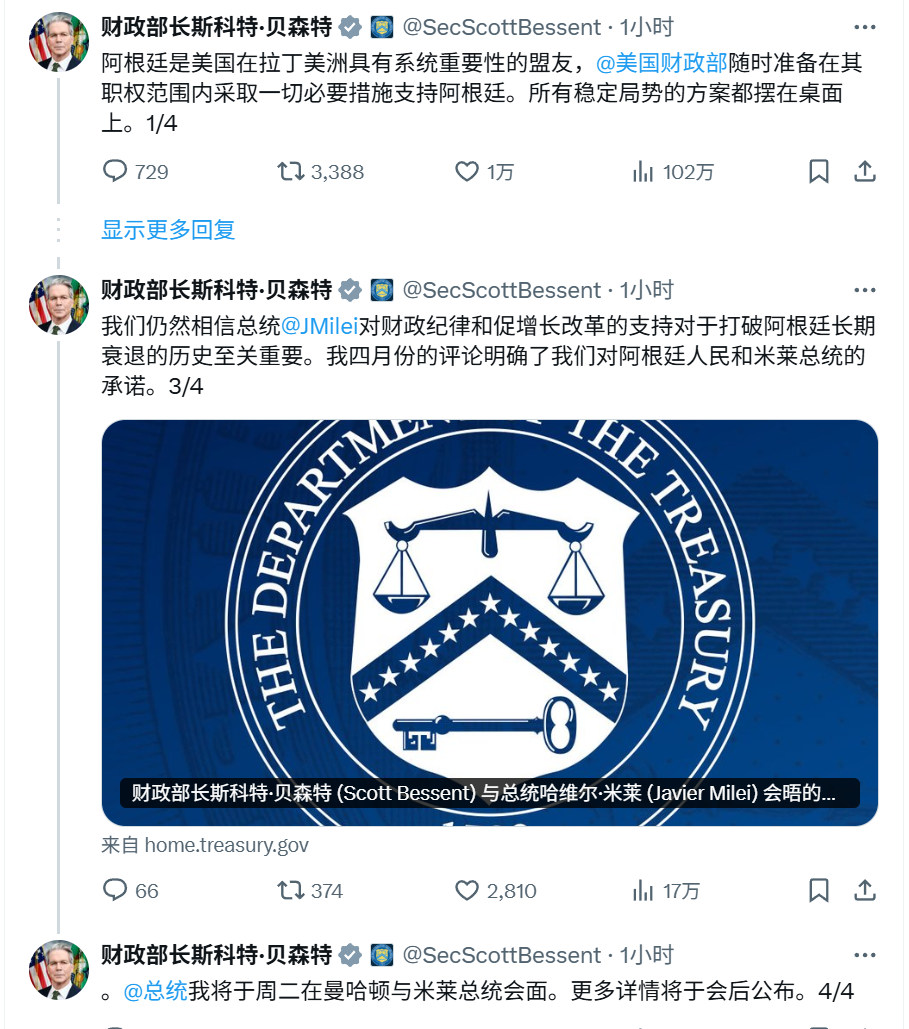
Group 1 - The Argentine stock market surged by 6% following U.S. Treasury Secretary Scott Bansen's supportive signals amid recent market sell-offs in Argentina [1][3] - Bansen committed to providing "all stabilization options" to Argentine President Javier Milei, including currency swap lines, direct repurchases of local currency, and utilizing the U.S. Treasury's Exchange Stabilization Fund (ESF) [1][6] - Following the announcement, the Argentine stock market experienced a peak increase of 7% during trading [3] Group 2 - U.S. support will complement a $20 billion program agreed upon with the International Monetary Fund (IMF), which was finalized by Milei in April [6] - The Argentine central bank sold $1.1 billion in three days to support the peso, while sovereign bonds faced significant pressure, marking the worst performance in emerging markets [6] - The Milei administration temporarily suspended export taxes on agricultural products to attract more U.S. dollars, indicating a strategy to reduce the depletion of international reserves [6] Group 3 - The upcoming midterm elections on October 26 represent a significant test for Milei, with rising disapproval ratings and a halved lead over the Peronist opposition party [6] - Concerns about Milei's governance have intensified due to bribery allegations, a recent electoral defeat, and challenges to his budget cuts in popular spending areas like education and healthcare [6][8] - Economic recovery under Milei has shown signs of weakness, with a slight contraction in Q2 and expectations of further decline in Q3, alongside high unemployment rates [8]
刚刚!美国宣布救市
中国基金报· 2025-09-22 14:33
Core Viewpoint - The article highlights the significant support from the U.S. government to stabilize the Argentine stock market amid recent turmoil, leading to a notable surge in stock prices and the exchange rate [2][3][6]. Group 1: U.S. Support and Market Reaction - On September 22, the Argentine stock market rose by 6% following U.S. Treasury Secretary Scott Bencet's commitment to provide "all stabilization options" to Argentine President Javier Milei [3]. - Following the announcement, the Argentine stock market experienced a peak increase of 7% during trading [4]. - The U.S. support is expected to complement a $20 billion program agreed upon with the International Monetary Fund (IMF) [7]. Group 2: Economic Measures and Challenges - The Milei government announced a temporary halt on export tariffs for agricultural products to attract more U.S. dollars, which analysts believe will reduce the depletion of international reserves [8]. - The upcoming midterm elections on October 26 pose a significant challenge for Milei, with rising disapproval ratings and a diminished lead over the Peronist opposition party [9]. - Economic recovery under Milei's administration has shown signs of weakness, with a slight contraction in output during the second quarter and expectations of further decline in the third quarter [9].

专家马光远称:救市,还有这些大招!
Sou Hu Cai Jing· 2025-09-10 10:19
Core Viewpoint - The article discusses various strategies proposed by economist Ma Guangyuan to rescue the real estate market in China, emphasizing that there are many potential solutions available. Group 1: Proposed Solutions - The first suggestion is to lower the down payment for home purchases to 10%. Concerns about increased risk to banks are noted, but Ma argues that the creditworthiness of Chinese citizens is relatively high, despite data showing a significant number of overdue credit card accounts and a rising risk of mortgage defaults among families [3][4]. - The second suggestion involves continuing to lower interest rates on mortgages. Ma believes that current mortgage rates are too high and suggests that they could be reduced to around 2%, which would still be relatively high given the current deflationary environment [4][6]. - The third proposal is to ensure that real estate developers do not face a liquidity crisis. Ma emphasizes the need for a public commitment to prevent project delays and to address regulatory failures that have led to issues like unfinished buildings [6][8]. Group 2: Additional Measures - Another idea presented is to offer a price guarantee for homebuyers. If the price of a purchased home decreases within six months, the developer would compensate the buyer for the difference, potentially through a financial product or insurance [8]. - The article critiques Ma's suggestions as lacking originality and practicality, suggesting that if these measures were effective, the current state of the real estate market would not be so dire [10].

A股救市大招频出!4月27日,凌晨的三大重要消息全面袭来!
Sou Hu Cai Jing· 2025-04-26 20:22
Group 1 - The China Securities Regulatory Commission (CSRC) has announced a market closure from May 1 to May 5, with trading resuming on May 6, which may impact investor sentiment negatively [1] - A meeting was held to discuss measures to support listed companies in enhancing their market value, which is beneficial for the A-share market, particularly for the 1,503 state-owned enterprises [1] Group 2 - The Nasdaq index rebounded by 10% over the week, but future movements may be uncertain due to inflation and tariff issues [3] - The Federal Reserve is considering a potential interest rate cut in June, which could influence market dynamics [3] Group 3 - Current market conditions indicate upward movement, but lack of trading volume poses significant pressure [5] - In an optimistic scenario, if trading volume exceeds 150 billion yuan, the Shanghai Composite Index could test 3,320 points [5] - In a neutral scenario, the market may maintain a trading volume of 1.1 to 1.2 trillion yuan, with the index fluctuating between 3,280 and 3,330 points [5] - In a pessimistic scenario, if trading volume falls below 1 trillion yuan, the index may retreat to 3,250 points, increasing risks for gold and consumer stocks [5] Group 4 - The Shanghai Composite Index closed down 0.07% at 3,295.06, while the Shenzhen Component Index and the ChiNext Index rose by 0.39% and 0.59%, respectively [7] - The market is currently in a consolidation phase around the 3,300-point mark, which is a critical level that requires further digestion [7] - A successful breakthrough above 3,300 points could lead to a more favorable upward trend in the market [7]