新能源车普及

Search documents
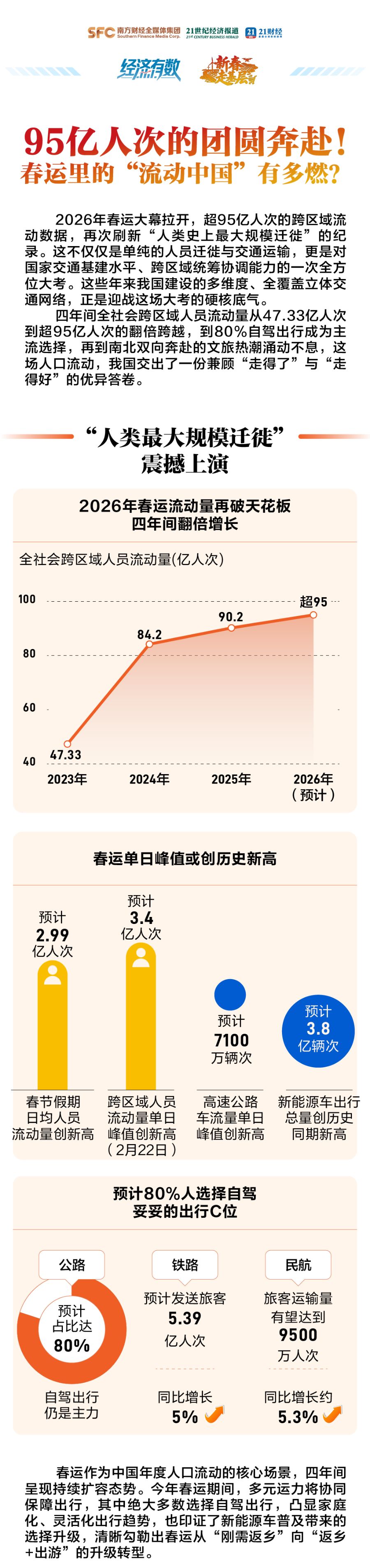
95亿人次的团圆奔赴!春运里的“流动中国”有多燃?
2 1 Shi Ji Jing Ji Bao Dao· 2026-02-06 11:48
Core Insights - The 2026 Spring Festival travel period is expected to witness over 950 million cross-regional movements, marking a significant increase from 473.3 million in 2022, showcasing the largest scale of human migration in history [3][4][5] - The trend indicates a shift towards self-driving travel, with approximately 80% of travelers opting for this mode, reflecting a growing preference for family-oriented and flexible travel options [12][13] - The transportation infrastructure has been significantly enhanced, with rail and air travel capacities increasing by over 5% year-on-year, and the expansion of electric vehicle charging facilities to support the rise in electric vehicle usage [19] Transportation Trends - The total cross-regional movement is projected to double over four years, highlighting the effectiveness of China's multi-dimensional transportation network [3][4] - Daily peak travel volumes are expected to reach historical highs, with significant increases in highway traffic and passenger transport [6][10][12] - The Spring Festival travel period is characterized by a blend of returning home and tourism, indicating a transformation in travel patterns from mere necessity to leisure [13][24] Infrastructure Development - The national transportation network has been continuously improved, addressing accessibility challenges for cross-regional travel [19] - The total length of highways has reached 5.49 million kilometers, with over 71,500 electric vehicle charging stations established to alleviate range anxiety for electric vehicle users [16][19] - The rail and air transport sectors are prepared to meet the increased demand, with a significant number of additional trains and flights scheduled during peak travel days [18][19] Tourism Dynamics - The domestic tourism market is experiencing a surge, with a notable increase in travel expenditures and visitor numbers during the Spring Festival [23] - The trend of reverse travel, where travelers from northern regions head south, is reshaping popular destinations and driving new patterns in tourism [24] - The overall travel expenditure is projected to grow significantly, with year-on-year increases of 23.1% to 47.3% anticipated in the coming years [23]

高盛:料内地车企今年本土业务利润承压 加速海外扩张 比亚迪股份及小鹏汽车-W具优势
Zhi Tong Cai Jing· 2026-01-09 02:40
Core Insights - Goldman Sachs held a series of management outlook meetings for the Chinese automotive industry, observing a generally conservative outlook on overall industry volume, with expectations of double-digit sales growth for individual companies and increased overseas expansion [1][2] - The anticipated retail sales growth for new energy vehicles in China for 2026 is approximately 10%, with significant variations in subsidy impacts across different price segments [2] - The competitive landscape in the high-end market is intensifying, with a projected launch of 119 new models in 2026, indicating a crowded high-end segment and a shift in competitive focus [3] Group 1 - The management teams of the participating companies expressed a cautious outlook for the overall industry, predicting a year-on-year retail sales growth for domestic passenger vehicles in 2026 to range from a decline of 5% to an increase of 1% [1] - The total subsidy amount for consumer goods in 2026 is estimated to be around 250 billion RMB, slightly lower than previous years, despite the continuation of the "trade-in" subsidy policy [1] - Six OEMs expect their sales growth in 2026 to range from 11% to 68%, while overseas sales growth is anticipated to be between 19% and 108% [2] Group 2 - Companies are planning to accelerate their overseas expansion in 2026, with a focus on launching more overseas versions of new models and establishing local sales and service channels [3] - The new model pipeline for this year is described as ambitious, with a significant increase in high-end models expected, particularly in the 250,000 to 300,000 RMB price range [3] - Goldman Sachs predicts a contraction in the domestic profit pool for the Chinese automotive industry in 2026, while the overseas market is expected to see accelerated adoption of new energy vehicles [3]

罗兰贝格戴璞称赞中国车企:厉害之处在于“从用户需求出发,把需求细分到极致”
Xin Lang Cai Jing· 2025-12-17 03:39
Core Insights - The conversation highlighted that the penetration rate of pure electric vehicles is expected to rise to 80% by 2030, with a model prediction of 78% [1][3] - Two main drivers for this growth were identified: technological maturity and product diversity in the Chinese electric vehicle market [1][3] Group 1: Technological and Market Drivers - The first driver is technology, as the maturity of new energy vehicle technology and the availability of diverse products have fostered competition and innovation [1][3] - The second driver is product diversity, where the Chinese electric vehicle market offers a wide range of choices that cater to specific user needs, leading to the concept of "supply creating demand" [1][3] Group 2: Competitive Advantages of Chinese Automakers - Chinese automakers excel in understanding user needs and segmenting them to an extreme degree, which supports a highly differentiated product strategy [2][4] - This approach allows products to stand out in the market, positioning Chinese companies as leaders in various industries [2][4] Group 3: Design Appreciation - The design of the ET9 was specifically praised for being elegant yet understated, showcasing a unique aesthetic that differentiates it from competitors [2][4]
罗兰贝格戴璞:激烈竞争促进新能源车普及
Xin Lang Cai Jing· 2025-12-17 03:39
Core Insights - The conversation highlighted that the penetration rate of pure electric vehicles is expected to rise to 80% by 2030, with a model prediction of 78% [1][3] - Two main drivers for this growth are identified: technological maturity and product diversity in the Chinese electric vehicle market [1][3] Group 1: Technological and Market Drivers - The first driver is technology, as the maturity of new energy vehicle technology and the availability of diverse products have fostered competition and innovation [1][3] - The second driver is product diversity, where the Chinese electric vehicle market offers a wide range of choices that stimulate market growth, emphasizing a user-centered approach [1][3] Group 2: Competitive Advantage of Chinese Automakers - Chinese automakers excel in segmenting user needs and organizing supply chain capabilities to support highly differentiated product strategies, which is a significant competitive advantage [2][4] - The approach of defining various usage scenarios for each vehicle contrasts with the more generalized product strategies of Western and Japanese automakers, which often leads to less effective outcomes [1][3]
驾校用特斯拉当教练车,教练:学费五千多 会关闭辅助驾驶
2 1 Shi Ji Jing Ji Bao Dao· 2025-12-14 02:52
Core Viewpoint - The introduction of Tesla vehicles as training cars in driving schools in Hangzhou aims to enhance the learning experience for students by adapting to the increasing prevalence of electric vehicles in the market [1] Group 1: Driving School Innovations - A driving school in Hangzhou has started using Tesla vehicles as training cars, which has garnered public attention [1] - The driving instructor, Li, mentioned that the Tesla is equipped with dual pedals and a "secondary brake" to meet vehicle inspection standards [1] - Students will initially practice with the Tesla for the driving test and will switch to gasoline cars to familiarize themselves with lighting and testing procedures [1] Group 2: Pricing and Market Strategy - The driving school has set the tuition fee for training with the Tesla at over 5000 yuan, positioning it as a standard price rather than a low-cost option [1] - The school aims to differentiate itself from competitors by offering training with electric vehicles, reflecting the growing trend of electric vehicle adoption among learners [1] - Li emphasized that practicing with electric vehicles helps students develop a better feel for the car, enabling them to adapt more quickly when driving their own electric vehicles in the future [1]

【乘联分会论坛】2025年8月乘用车区域市场流向分析
乘联分会· 2025-10-09 08:44
Core Viewpoint - The article discusses the evolving structure of the regional automotive market in China, highlighting the "strong North, weak South" trend, driven by government policies and changing consumer preferences, particularly in the context of electric vehicles and economic recovery in certain regions [2][5]. Regional Market Trends Analysis - The automotive market in China is characterized by a persistent "strong North, weak South" pattern, with the Northern market showing a 5.7% increase in market share from 2022 to 2025, despite a slight decline of 0.2% in August 2025 compared to the previous year [5]. - The Northeast region has shown consistent growth, maintaining a high market share of 6.8% in August 2025, while Southern regions like East China and South China have experienced significant declines [2][5]. - The Central region's market has improved, with a 1.5% increase in market share in August 2025 compared to the previous year, indicating a recovery trend [5]. Policy Impact on Regional Structure - Government subsidy policies have significantly influenced the market, particularly benefiting low-end and economic vehicles, with A00 and A0 class electric vehicles performing well in Northern regions [2][5]. - The article notes that the policy's fairness is evident as it encourages the development of small and micro electric vehicles, which is crucial for widespread adoption [2][5]. Market Structure Changes - The demand for SUVs is notably strong in the Central and Western regions, attributed to the geographical terrain, while the Eastern regions show a preference for electric vehicles, particularly in flat areas [7][8]. - The overall structure of the automotive market is shifting, with a notable increase in the share of electric vehicles, especially in regions like Hainan and Guangxi, where the penetration rate has reached around 60% [8][9]. New Energy Market Structure Analysis - The new energy vehicle market is performing well, with significant growth in both pure electric and plug-in hybrid vehicles, particularly in Northern regions where traditional fuel vehicles still dominate [8][9]. - The penetration rate of new energy vehicles in Eastern regions exceeds 50%, while the demand for traditional fuel vehicles remains high in the Central and Western regions, where they account for approximately 60% of the market [8][9].
合资车企逆风局
Di Yi Cai Jing· 2025-06-05 00:55
Group 1 - The core viewpoint of the articles highlights the significant decline of joint venture automotive companies in China, driven by the rise of domestic electric vehicle brands and changing consumer preferences [1][2][17] - Joint venture companies held over 60% market share in 2020, but this has dropped to 35% by 2024, indicating a major shift in the automotive landscape [2][21] - The decline in sales and profitability for joint venture companies has led to layoffs and operational challenges, with many companies struggling to adapt to the new market dynamics [2][8][12] Group 2 - The crisis for joint venture companies began around 2019, with a noticeable shift in financing practices as dealers sought better loan conditions from banks rather than automotive financial companies [7][8] - The pandemic exacerbated existing issues, as foreign executives were unable to gauge the rapidly changing Chinese market, leading to a lack of urgency in addressing the challenges [17][18] - The traditional decision-making structure of joint ventures, requiring consensus between foreign and local partners, has hindered their ability to respond quickly to market changes [18][19] Group 3 - The competitive landscape has shifted, with domestic brands like AITO and Li Auto gaining traction, prompting established brands to reconsider their strategies [1][27] - Joint venture companies are now exploring partnerships with local firms to leverage technology and adapt to the electric vehicle market, as seen with Audi and Toyota's recent collaborations [27][28] - The overall sentiment within the industry reflects a need for transformation, with some companies adopting a more aggressive and flexible approach to survive the current downturn [25][29]



今日新闻丨理想汽车发布2025年第一季度财报!极氪与蔚来在充电领域达成合作!马斯克从特朗普政府离职!
电动车公社· 2025-05-29 15:54
Group 1 - Li Auto reported Q1 2025 financial results, delivering 93,000 vehicles, a year-on-year increase of 15.5%, with quarterly revenue of 25.9 billion yuan and a net profit of 647 million yuan, marking a 9.4% year-on-year growth and achieving ten consecutive quarters of profitability [1][5] - The cash reserves of Li Auto reached 110.7 billion yuan, indicating strong financial health [1] - The company plans to launch the Li i8 and VLA driver model in July 2025, showcasing its commitment to innovation and product development [1] Group 2 - Elon Musk announced his departure from the Trump administration, stating he would initiate the resignation process, which was described as swift and low-key [9][10] - During his tenure, Musk aimed to implement reforms but faced challenges, including a significant drop in Tesla's stock price and declining sales [10] - Post-departure, Musk is expected to focus more on Tesla and SpaceX, potentially impacting the automotive and aerospace sectors [10] Group 3 - Zeekr and NIO have established a mutual charging network cooperation, allowing users from both brands to access charging stations through their apps or vehicle systems [11][12] - This collaboration aims to enhance user experience and improve the efficiency of charging infrastructure, benefiting the overall electric vehicle ecosystem [12]