时尚产业

Search documents
时尚产业撬动首都新消费
Bei Jing Shang Bao· 2026-01-26 14:12
Core Insights - The fashion consumption industry in Beijing is entering a new development stage driven by emotional consumption and the deep integration of culture and technology [1][4] - The younger generation's demand for personalized and emotional experiences is identified as a key driver for activating the fashion consumption market [4][5] - Policies aimed at expanding fashion consumption and promoting high-quality development in the fashion industry are set to be implemented by 2025 [1][5] Group 1: Fashion Consumption Trends - Emotional value is becoming a significant factor in consumer decision-making, with the concept of "heart price ratio" emerging among younger consumers [1][4] - The rise of new consumption models, such as trendy toys and performance economies, reflects a shift from traditional value-based consumption to experience-oriented spending [1][4] - The integration of fashion elements into various industries is essential for unlocking the consumption potential across different demographics [1][4][5] Group 2: Policy and Market Development - The implementation of the "Beijing Fashion Consumption Expansion Action Plan" and the "Beijing Fashion Industry High-Quality Development Implementation Plan (2025-2027)" aims to enrich the supply of fashion consumption [1][5] - There is a need for more tailored policies that effectively support businesses and enhance the consumer experience, particularly in areas like night services and refined offerings [5][11] - The establishment of a communication bridge between consumers and businesses is crucial for fostering a supportive policy environment [5][11] Group 3: Cultural Integration and IP Development - The future of Beijing's fashion industry is seen as reliant on cultural integration, with a focus on leveraging unique cultural assets to create meaningful connections with younger consumers [6][9] - The development of exclusive fashion IPs is essential for enhancing the emotional value of products and experiences, particularly in suburban tourism [7][9] - The integration of cultural, commercial, and tourism elements is vital for transforming short-distance travel into a comprehensive consumption experience [9][10] Group 4: Retail Innovation and Consumer Experience - Retail innovation is identified as a key strategy for unlocking consumption potential, with a focus on integrating fashion elements into retail environments [10][12] - The need for a diverse range of retail formats that cater to evolving consumer preferences is emphasized, particularly in the context of personalized and experiential shopping [10][11] - The promotion of smart retail solutions and the seamless integration of online and offline channels are critical for enhancing the consumer experience [11][12]

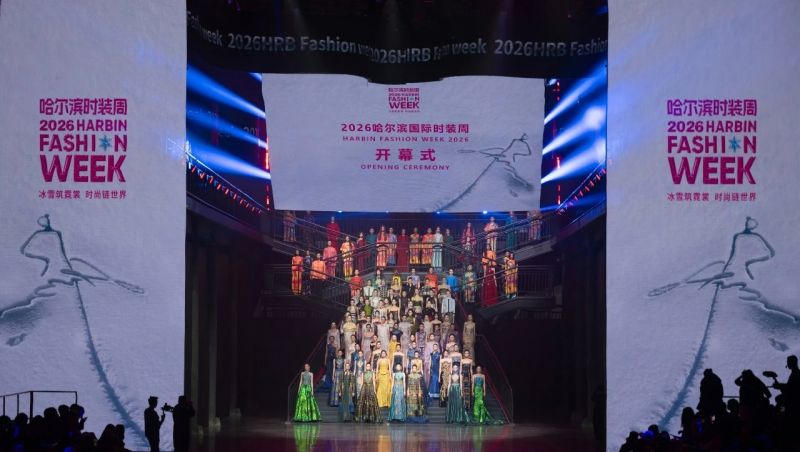
2026第十二届哈尔滨国际时装周盛装启幕
Zhong Guo Fa Zhan Wang· 2026-01-12 10:12
Core Viewpoint - The 12th Harbin International Fashion Week, themed "Ice and Snow Build Fashion, Fashion Links the World," aims to showcase Harbin's unique charm as a fashion city while promoting the integration of ice and snow culture with the fashion industry [3][9]. Group 1: Event Overview - The event features a comprehensive fashion system called "42211," which includes four major shows, two salons, two competitions, a city exploration tour, and a shopping festival [3]. - The opening ceremony was attended by key figures from the Chinese textile and fashion industry, highlighting the event's significance [1][4]. Group 2: Economic and Cultural Integration - Harbin is leveraging its reputation as an ice and snow city to enhance its cultural and economic integration, aiming to transform fashion concepts into actionable outcomes [4][6]. - The fashion week is seen as a platform to explore new models that combine ice and snow with fashion, technology, culture, and consumption, injecting new vitality into the fashion industry [6][7]. Group 3: International Participation and Innovation - The fashion week features global designers from 30 countries, showcasing their works and promoting the fusion of international fashion with local ice and snow tourism [7]. - The event includes various specialized shows, such as children's fashion and ready-to-wear collections, aimed at enhancing consumer engagement and promoting immediate purchases [8]. Group 4: Supporting Activities and Future Prospects - Additional activities include industry salons focusing on outdoor industry trends and new material applications, fostering connections between government, industry, academia, and research [8]. - The event aims to position Harbin as a creative design city with international recognition, enhancing its global fashion presence and promoting high-quality development in the ice and snow economy [4][9].
北京、上海人均服装消费占比全国倒数 居住消费全国最高
Zhong Guo Jing Ying Bao· 2025-11-25 04:29
Core Insights - The per capita clothing consumption expenditure in Beijing for 2024 is projected to be 2031 yuan, which is higher than the national average of 1521 yuan, but it only accounts for 4.08% of the total per capita consumption expenditure of 49748 yuan, ranking fifth lowest among 31 provinces [2] - In comparison, Shanghai's per capita clothing consumption expenditure is 1936 yuan, with a total per capita consumption expenditure of 52722 yuan, resulting in a clothing consumption share of 3.67%, which is lower than Beijing's [2] - The five regions with the lowest clothing consumption share are Beijing, Guangdong, Guangxi, Shanghai, and Hainan, with Beijing being the only northern city in this group [2] - In the housing consumption sector, Beijing and Shanghai rank highest in the country, with per capita housing consumption expenditures of 19232 yuan and 17867 yuan, respectively, and housing consumption shares of 38.66% and 33.89% [2][3] Consumption Analysis - Long-term market research indicates that Beijing's clothing consumption share is in the mid-to-lower range, reflecting the city's fundamental characteristics [3] - High housing prices in Beijing and Shanghai lead to a higher share of housing consumption, which in turn squeezes the consumption space for clothing and other sectors [3] - Chengdu, as an example, has a lower per capita housing consumption of 2191 yuan, which contributes to a more vibrant retail environment and a higher proportion of clothing stores [4] Industry Development Initiatives - The "Implementation Plan for High-Quality Development of the Fashion Industry in Beijing (2025-2027)" aims to promote high-quality development in the fashion industry by integrating technology and culture [5] - The plan encourages the combination of modern aesthetics with traditional cultural elements, the use of new materials and technologies, and the support of AI pattern-making and 3D printing for customized services [5] - It also emphasizes the importance of sustainable fashion, encouraging the development of functional and environmentally friendly materials [5]

登上户外运动产业高峰
Xin Hua Ri Bao· 2025-10-23 23:20
Core Insights - The outdoor industry in Changshu is experiencing significant growth, transitioning from basic camping to a focus on professional equipment and experiences [1][2] - The "Changshu Outdoor Sports Industry Development Three-Year Action Plan" aims to expand the outdoor business landscape, indicating a strategic shift towards outdoor sports [4][6] Industry Overview - The outdoor population in China is approximately 540 million, with a potential engagement of 230 million, highlighting a vast market opportunity [2] - The sports and outdoor apparel market in China is projected to reach 542.5 billion yuan in 2024, with a year-on-year growth of 10% [2] - Over 65% of consumers are adopting outdoor apparel for daily wear, indicating a trend towards functional everyday clothing [2] Local Industry Development - Changshu's textile and apparel industry has over 5,000 enterprises, producing more than 500 million garments annually, with a stable annual output value of 100 billion yuan [3] - The city is facing challenges such as brand premium insufficiency and design capability limitations, prompting a focus on intelligent manufacturing and brand building [3] - A dual market of over 100 billion yuan has emerged, with more than 700 companies completing digital transformation, leading to a 35% increase in labor productivity [3] Strategic Initiatives - The action plan emphasizes the development of outdoor sports clusters, focusing on apparel and equipment, to leverage existing advantages [4][5] - Changshu aims to attract at least 30 domestic and international outdoor brands and projects by 2027, with a manufacturing output target of 60 billion yuan [6] Technological Integration - The integration of AI and technology in the outdoor apparel sector is seen as a key driver for innovation and efficiency [7][8] - Companies are developing advanced materials that meet the functional and technological demands of outdoor products, enhancing competitiveness [5][6] Talent Development - A talent cultivation program in collaboration with Beijing Institute of Fashion Technology aims to nurture future leaders in the fashion industry, supporting the synergy between technology and fashion [9]
2025南京国际时尚周启幕
Nan Jing Ri Bao· 2025-09-17 02:43
Core Points - The third Nanjing International Fashion Week has commenced, themed "Six Tides of the Ancient Capital," aiming to promote the convergence and cooperation of international and domestic fashion resources in Nanjing [1] - The opening night featured five major brand debuts, showcasing diverse fashion styles and innovative designs, including a large-scale fashion show by designer Zhang Zhaoda and the launch of new collections by Bosideng and other brands [1] - The unveiling of the "Nanjing Eye International Fashion Center" marks a new fashion landmark in the city, set to host various high-end fashion events regularly, leveraging the scenic riverside location [2] Event Structure - This year's fashion week adopts an innovative format of "two main venues and two sub-venues, citywide interaction," with events scheduled at multiple locations, including the main venue at Nanjing Eye and two sub-venues focusing on different themes [3] - Key events include the 2025 Nanjing International Fashion Week at Wanxiang Tiandi, focusing on "trendy people, trendy clothing, and trendy art," and a themed event at Shazhong Outlet, emphasizing immersive experiences [3] - The closing ceremony will take place at the Nanjing Museum, featuring a high-end custom series inspired by Jinling's intangible cultural heritage, integrating light and shadow technology with live performances [3]
A股纺织龙头,能否走出营收利润双降困局
21世纪经济报道· 2025-09-02 09:37
Core Viewpoint - After consolidating the French high-end children's clothing brand BONPOINT, YOUNGOR is set to narrate a new story in the "fashion industry" amidst challenges in its real estate business and the transformation of its fashion segment [1]. Financial Performance - In the first half of 2025, YOUNGOR reported revenue of 5.11 billion yuan, a year-on-year decline of 10.50%, and a net profit attributable to shareholders of 1.72 billion yuan, down 8.04% [1]. - The fashion segment's revenue grew by 7.82% to 3.68 billion yuan, but the net profit attributable to shareholders fell by 39.28% to 238 million yuan due to increased costs and expenses [5]. - The investment segment contributed significantly to the overall profit, with a net profit of 1.39 billion yuan, accounting for over 80% of the total net profit [7]. Brand Strategy - YOUNGOR is implementing a multi-brand development strategy, holding eight brands including its main brand YOUNGOR, MAYOR, and HANP, as well as high-end sports and outdoor brands like HART MARX and HELLY HANSEN [3]. - The acquisition of BONPOINT, which generated revenue of 832 million yuan and accounted for 25.24% of the fashion segment's sales, marks a significant step in expanding its portfolio [5]. Market Positioning - BONPOINT targets new middle-class families in first- and second-tier cities, operating approximately 130 stores across 30 countries, with an annual revenue of about 1.5 billion euros (approximately 1.15 billion yuan) [5]. - The high-end children's clothing segment is seen as a potential growth area in a competitive apparel market, with BONPOINT expected to contribute to YOUNGOR's performance in the future [5]. Investment Adjustments - YOUNGOR has been adjusting its investment structure, selling off financial assets worth 4.175 billion yuan, which is about 10.13% of its audited net assets as of the end of 2024 [8]. - The company is focusing on enhancing cash flow management and strategically increasing stakes in key investments while reducing or exiting financial investment projects [8][9].


(活力中国调研行)汇聚产业与品牌动能 侨乡泉州铺就“时尚之路”
Zhong Guo Xin Wen Wang· 2025-08-21 03:48
Core Insights - Fujian Quanzhou is positioning itself as a "Fashion Capital" with a focus on its textile and footwear industry, boasting nine manufacturing clusters each exceeding 100 billion RMB and an annual output value of over 700 billion RMB in the textile and footwear sector [1][2] - The WhatsPOP Innovation Center, set to open in December 2024, will serve as a public service platform to enhance the development of the textile and footwear industry, offering over 140 services from design to market promotion [1][2] - The establishment of the Quanzhou Fashion Industry Alliance in October 2024, initiated by 23 leading brands, aims to unify over 700 textile and footwear companies and over 10,000 manufacturing supply chain enterprises to elevate Quanzhou's fashion industry on a global scale [3] Industry Development - The textile and footwear industry in Quanzhou is experiencing growth driven by young consumers' preference for designer brands and unique styles, creating new market opportunities [2] - Innovative materials and advanced technology are crucial for the fashion industry's evolution, with companies like Xintai Technology producing functional and aesthetically appealing textile materials [2][3] - Future initiatives include the "Global Quality Supplier Program" to attract top partners worldwide, enhancing Quanzhou's transition from a manufacturing hub to a standard-setting leader in the fashion industry [3] Events and Initiatives - The upcoming 2025 Quanzhou Fashion Week and the 8th China International Children's Fashion Week are expected to foster a vibrant fashion development atmosphere in the region [3] - The local government plans to extend its focus from being a manufacturing stronghold to becoming a fashion capital through various measures, including talent cultivation, international cooperation, and brand value enhancement [3]
“弄潮”三十二载 “中国皮革之都”锚定时尚新坐标
Zhong Guo Xin Wen Wang· 2025-07-14 20:39
Core Viewpoint - The 32nd Haining China Leather Expo highlights Haining's transformation from a traditional leather industry base to a comprehensive fashion hub, showcasing a diverse range of products and innovative designs [1][2][3] Industry Overview - Haining has evolved into Asia's largest and most comprehensive leather market, with approximately 3.7 million square meters of space, accounting for about 90% of China's leather jacket production and generating an annual output value exceeding 76 billion RMB [2] - The city is positioning itself as a benchmark for the fashion industry in China, integrating design and market dynamics to expand beyond leather into a full range of fashion categories [2] Innovations and Trends - The expo features innovative products such as leather combined with hemp and embroidery, as well as new styles like down jackets made from Xiangyun fabric and Songjin fur coats, reflecting a commitment to environmental aesthetics [3] - The integration of AI technology and rapid response systems allows for customized samples to be completed within 72 hours after selection, showcasing the industry's adaptability and innovation [2] Events and Activities - The expo includes various activities such as trend releases, brand showcases, and industry matchmaking, which aim to interlink the design, production, and sales value chains [3] - Haining is also focusing on online ecosystem development, with projected live-streaming sales in the leather industry reaching nearly 20 billion RMB by 2024, indicating a shift towards digital commerce [3] Future Plans - Haining is set to advance the transformation of the leather city, emphasizing space renovation, ecological restoration, and industrial upgrades, with the goal of creating an internet fashion industry platform named "Haisang Youpin" by 2025 [3]

北京日报社区小板报 | 北京非机动车管理条例今起征集意见
Bei Jing Ri Bao Ke Hu Duan· 2025-06-25 00:15
Group 1 - Beijing has launched a public consultation for the revised "Beijing Non-Motor Vehicle Management Regulations," focusing on enhancing the sales management of electric bicycles and encouraging the sale of smaller, lighter models [1] - The Beijing Municipal Science and Technology Association has initiated the 2025 Empowering Park Science and Technology Association High-Quality Development Project, aiming to support 20 parks to promote innovation in key industries [1] - The Beijing Municipal Bureau of Economy and Information Technology has released the first fashion industry development plan, aiming to establish Beijing as a global fashion innovation source and trendsetter [4] Group 2 - The Beijing government has introduced a loan risk compensation policy for technology innovation SMEs, providing 50% risk compensation for certain non-performing loan projects to encourage banks to lend [7] - The Beijing Health Insurance Bureau has added 12 new medical institutions to the health insurance designated list, with changes in service provision for some existing institutions [6]