
纺织鞋服

Search documents
越南油荒,储备撑不到2个月!原材料大涨价,当地中国商人:谁有货谁是甲方
21世纪经济报道· 2026-03-22 15:41
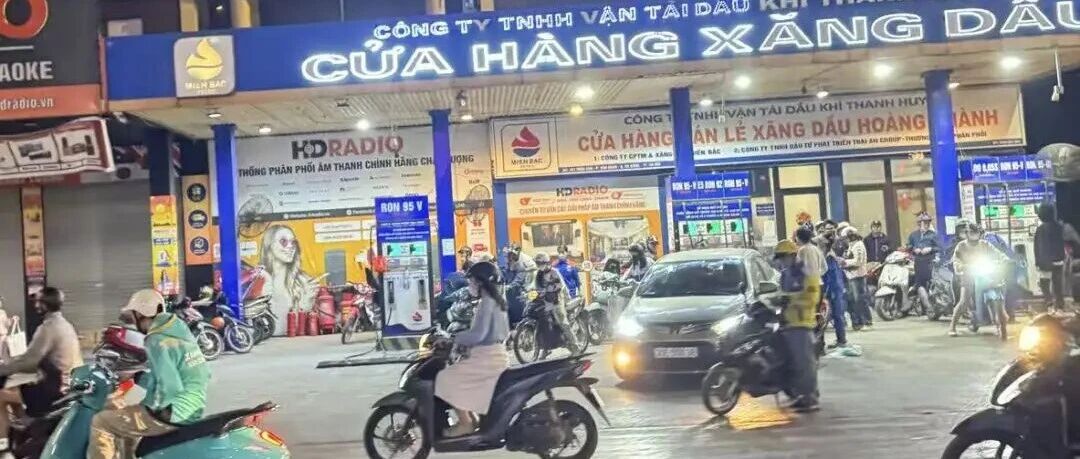
Core Viewpoint - The article discusses the significant rise in oil prices in Vietnam due to geopolitical tensions, particularly the situation in the Middle East, which has led to increased costs for various industries, particularly manufacturing and transportation [1][11]. Group 1: Oil Price Surge - Vietnam's oil prices have surged past 30,000 VND per liter, marking an increase of over 30% in just a few weeks, with the last time prices were this high being during the Russia-Ukraine conflict [1][11]. - The government has attempted to stabilize prices through measures such as reducing import taxes and utilizing a fuel price stabilization fund, but these efforts have had limited success [10][11]. Group 2: Impact on Industries - The tire manufacturing industry has seen raw material costs increase by 40% to 50%, leading to squeezed profit margins as companies struggle to pass on costs to customers [2][13]. - The construction materials sector has experienced price increases of 30% to 40% due to heightened demand from a surge in infrastructure projects, coupled with rising transportation costs [14][15]. Group 3: Supply Chain and Import Dependency - Vietnam's oil consumption is heavily reliant on imports, with nearly half of its needs met from foreign sources, primarily from the Middle East, making it vulnerable to supply disruptions [10][11]. - The country has initiated efforts to diversify its oil supply sources, seeking assistance from Japan and South Korea to mitigate the impact of the crisis [10][11]. Group 4: Foreign Investment Sentiment - The rising oil prices and raw material costs have led to a cooling sentiment among foreign investors, particularly Chinese companies, who are now more cautious about entering the Vietnamese market [17][19]. - Despite the challenges, companies in sectors like electric vehicles are seeing increased demand as consumers shift away from fuel-powered vehicles due to rising fuel costs [15][18].

谷爱凌穿上了!安踏巴黎首发!中国合成生物企业的菌丝皮革实现闭环!
合成生物学与绿色生物制造· 2026-02-05 11:58
Group 1 - Anta has launched a co-creation series with renowned fashion designer Kris Van Assche, named ANTAZEROXKRISVANASSCHE, which emphasizes sustainable innovation and merges high fashion aesthetics with Anta's sports DNA [3] - The collection was first released at the Dover Street Market flagship store in Paris, marking Anta's entry into the global fashion context with a sustainable approach [3] Group 2 - The vegan leather series, made from Mycelium mushroom leather (Mulkol@) by Yiru Biology, includes products such as parkas, sports jackets, and casual sports suits, showcasing low-carbon and sustainable material advantages [6] - Yiru Biology is the first company globally to achieve large-scale production of low-carbon bio-based leather, integrating the supply chain to drive innovation in the leather industry [8] - The company currently has an annual production capacity of 6 million meters for its bio-based leather products, with plans to increase this to 20 million meters by 2026 [8]


产业提质筋骨壮 乘势而上新局开
Xin Lang Cai Jing· 2026-01-28 23:06
Group 1 - The core viewpoint emphasizes that "优产业" (superior industry) has become the engine for high-quality economic development in Fujian, with a focus on digital transformation and modern industrial systems [1] - Fujian's manufacturing sector is identified as a key battleground for building a modern industrial system, with a shift from "manufacturing" to "creation" being necessary to maintain competitive advantages [2] - The government report highlights the importance of advanced manufacturing as a backbone and aims to accelerate the construction of a strong manufacturing province [2] Group 2 - The transformation of traditional industries through intelligent upgrades is crucial, with suggestions for a "graded pilot + classified transformation" model to reduce costs and risks for small and medium enterprises [3] - The development of new quality productivity is essential for high-quality growth, with calls for platforms and mechanisms to support technological innovation and seamless integration of innovation and industry chains [4] - The government aims to implement actions for innovative development of emerging industries and future industries, with a focus on artificial intelligence as a strategic technology [5][6] Group 3 - The report proposes actions to strengthen industrial chains by focusing on key industries, emphasizing the need for a comprehensive industry chain approach to overcome fragmentation and weakness [7] - The construction of future industrial ecological clusters is highlighted, with recommendations for provincial policies to support specific sectors like new batteries and green hydrogen [7][8] - Financial and tax support policies are suggested to enhance the capabilities of industrial clusters, alongside the establishment of new industrial parks and innovation laboratories [8]
时尚是城市骨子里的新锐气质
Xin Lang Cai Jing· 2026-01-17 23:55
Group 1 - VOGUE Business has included Quanzhou in its 2025 New Fashion Capital Index, ranking fifth in both cultural charm and development power, highlighting its deep cultural heritage and vibrant manufacturing clusters [1] - Quanzhou boasts 726 items of intangible cultural heritage, including unique Minnan craftsmanship and the historical Silk Road civilization, which are recognized as key cultural resources for engaging with fashion [1] - The city has been revitalizing traditional cultural symbols within modern fashion contexts through various initiatives, successfully integrating intangible cultural heritage techniques into contemporary fashion design [1] Group 2 - Quanzhou is home to over 13,000 textile and footwear enterprises, with a textile and apparel output value exceeding 700 billion, accounting for 10% of the national output and 40% of the national sports shoe production, as well as 20% globally [2] - The local brands are deeply exploring the cultural core, achieving a cross-border integration of traditional elements with modern fashion, transitioning from "Quanzhou manufacturing" to "Quanzhou design" and "Quanzhou fashion" [2] - The city's robust manufacturing strength and comprehensive industrial ecosystem, including nine major trillion-yuan manufacturing clusters, contribute to its ambition of becoming a fashion capital [2] Group 3 - The "Three-Year Action Plan for Building 'World Heritage Quanzhou Fashion Capital' (2025-2027)" aims to enhance the entire fashion industry chain through initiatives like intangible heritage revitalization, design empowerment, technological support, and brand upgrades, targeting an industry output value of over 800 billion by 2027 [3] - The plan emphasizes the need for collaboration among government, industry, academia, and research to identify breakthroughs and continuously drive efforts towards establishing Quanzhou as a leading fashion capital [3]


新华网财经观察丨爱拼、敢拼、善拼——从晋江看中国民营经济“会赢”的底气
Xin Hua Wang· 2025-12-25 02:11
Core Viewpoint - The article highlights the vibrant development of the private economy in Jinjiang, showcasing the entrepreneurial spirit of its people and the successful transformation of traditional industries into innovative enterprises [2][5][6]. Group 1: Overview of Jinjiang's Private Economy - Jinjiang, a county-level city with an area of 663 square kilometers, hosts over 110,000 private enterprises and 53 listed companies, reflecting its robust economic growth [5]. - The region has evolved from a poor county with a per capita GDP at only 40% of the national average to a thriving hub for private businesses, driven by grassroots entrepreneurship [5][6]. - Notable brands such as Anta, Xtep, and Hongxing Erke originated from small workshops, illustrating the journey of Jinjiang's private enterprises [6]. Group 2: Transformation and Innovation - Jinjiang's traditional manufacturing sector is undergoing proactive transformation to address challenges such as low industrial structure and small-scale high-tech industries [7]. - Companies like Fujian Xunxing Zipper Technology Co., Ltd. have evolved from small workshops to comprehensive tech firms through deep collaboration with research institutions [9]. - The region's GDP is projected to grow from 271.47 billion yuan in 2020 to 386 billion yuan by 2025, with an average annual growth rate of 6.6% [11]. Group 3: Future Development and Strategic Innovation - The upcoming "15th Five-Year Plan" period is expected to reshape the economic landscape of county-level economies, emphasizing the development of new productive forces based on local resources and industrial foundations [12][14]. - Jinjiang's approach to enhancing competitiveness involves strategic innovation and collaboration between entrepreneurs and scientists to drive technological advancements [14][15]. - Recent data shows that R&D investment in Jinjiang's enterprises increased from 4.46 billion yuan in 2020 to 8.429 billion yuan in 2024, marking an 88.15% growth [15].

县域活力足,经济韧性强
Xin Lang Cai Jing· 2025-12-22 23:27
Core Insights - The GDP of county-level regions in Fujian is projected to grow from 5.21 trillion yuan to 5.78 trillion yuan from 2022 to 2024, with an annual compound growth rate of 5.6% [1] - The number of billion-yuan counties in Fujian increased from 14 to 18, with Jinjiang and Gulou District surpassing 300 billion yuan in GDP, ranking in the top 1% among 2,846 county-level regions nationwide [1] Group 1: Development Index and Key Counties - The first Fujian County Key Industry Chain Development Index was released, identifying Jinjiang, Jimei, Nan'an, Xiang'an, Fuzhou, and others as top ten counties based on various metrics [2] - The top ten counties are primarily located in the Fuzhou and Xiamen-Zhangzhou-Quanzhou metropolitan areas, excelling in industrial scale, innovation resource aggregation, and collaborative development [2][3] Group 2: Industrial Growth and Innovation - Fujian's industrial strong counties have achieved simultaneous growth in scale and quality, with Jinjiang focusing on innovation and brand empowerment to transition from OEM to brand ownership [3] - The province's industrial output value increased by 7% from January to November 2025, outpacing the national average by 1 percentage point, with industrial investment growing by 7.9% [4] Group 3: Innovation and Digital Transformation - Innovation is identified as the primary driver of economic growth, with significant investments in R&D and the establishment of provincial-level technology centers [5] - Digital transformation initiatives have led to substantial efficiency improvements, with companies like Luojiang Iron Tuo Machinery achieving a 20% increase in production efficiency through digitalization [5] Group 4: Financial Support and Collaboration - Fujian is implementing targeted financial services for key industry chains, with significant financing events leading to over 177 billion yuan in intended financing [8] - Collaborative efforts among experts and local enterprises have resulted in the establishment of research projects and platforms, enhancing the innovation ecosystem [7]
最新GDP!我国20大地级市洗牌:泉州逆袭南通,盐城增速6%,临沂首破5000亿!
Sou Hu Cai Jing· 2025-12-01 08:51
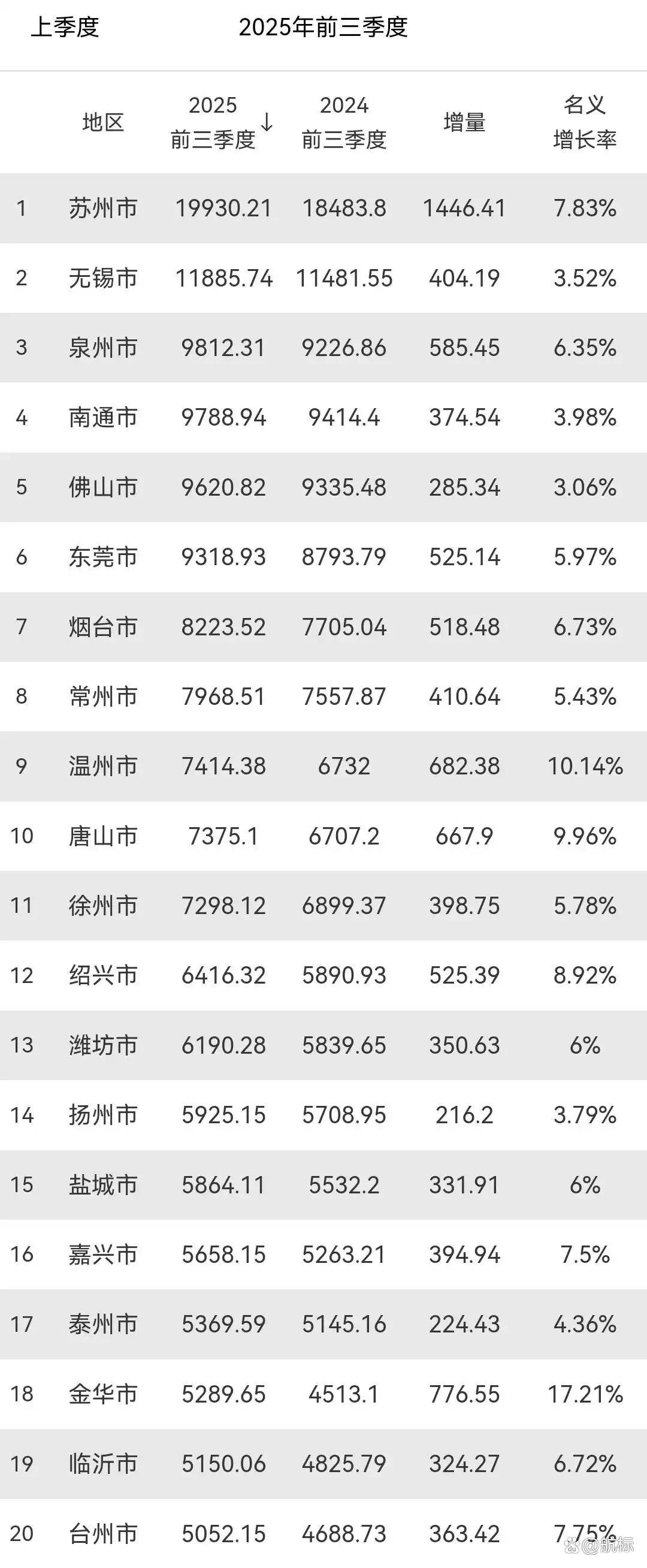
Core Insights - The economic landscape of China's prefecture-level cities is undergoing subtle adjustments, with notable changes in the GDP rankings for the first three quarters of 2025, driven by policies supporting regional coordination and new productivity cultivation [1][5] Group 1: GDP Rankings and Growth Rates - Suzhou remains the top city with a GDP of 19,930.21 billion, showing a growth rate of 7.83% compared to the previous year [3] - Quanzhou has surpassed Nantong to claim the third position with a GDP of 9,812.31 billion, achieving a growth rate of 6.35%, which is 2.37 percentage points higher than Nantong's 3.98% [4][5] - Linyi has reached a significant milestone by exceeding a GDP of 5,000 billion for the first time, recording 5,150.06 billion with a growth rate of 6.72% [5] Group 2: Key Drivers of Economic Growth - Quanzhou's growth is attributed to its strategic location as a core area of the Maritime Silk Road and advancements in the textile industry, including a project that improved order response speed by 40% [4] - Yancheng's 6% growth is driven by its position as the largest offshore wind power base in China, with a significant contribution from a local wind turbine manufacturer [5] - Linyi's economy is bolstered by a dual focus on commerce logistics and digital economy, with a robust online wholesale market and a comprehensive logistics network [5] Group 3: Other Notable Performers - Jinhua leads with a remarkable growth rate of 17.21%, fueled by the explosive growth of cross-border e-commerce in Yiwu [7] - Wenzhou and Tangshan also show double-digit growth, driven by innovation in the private sector and upgrades in traditional industries, respectively [7] - The rankings reflect the dynamic nature of local economies, emphasizing the importance of strategic positioning in terms of location, industry, and policy [7]
万亿城市大洗牌!泉州逆袭重返20强,南通佛山“掉队”,合肥烟台狂飙!
Sou Hu Cai Jing· 2025-11-20 09:16
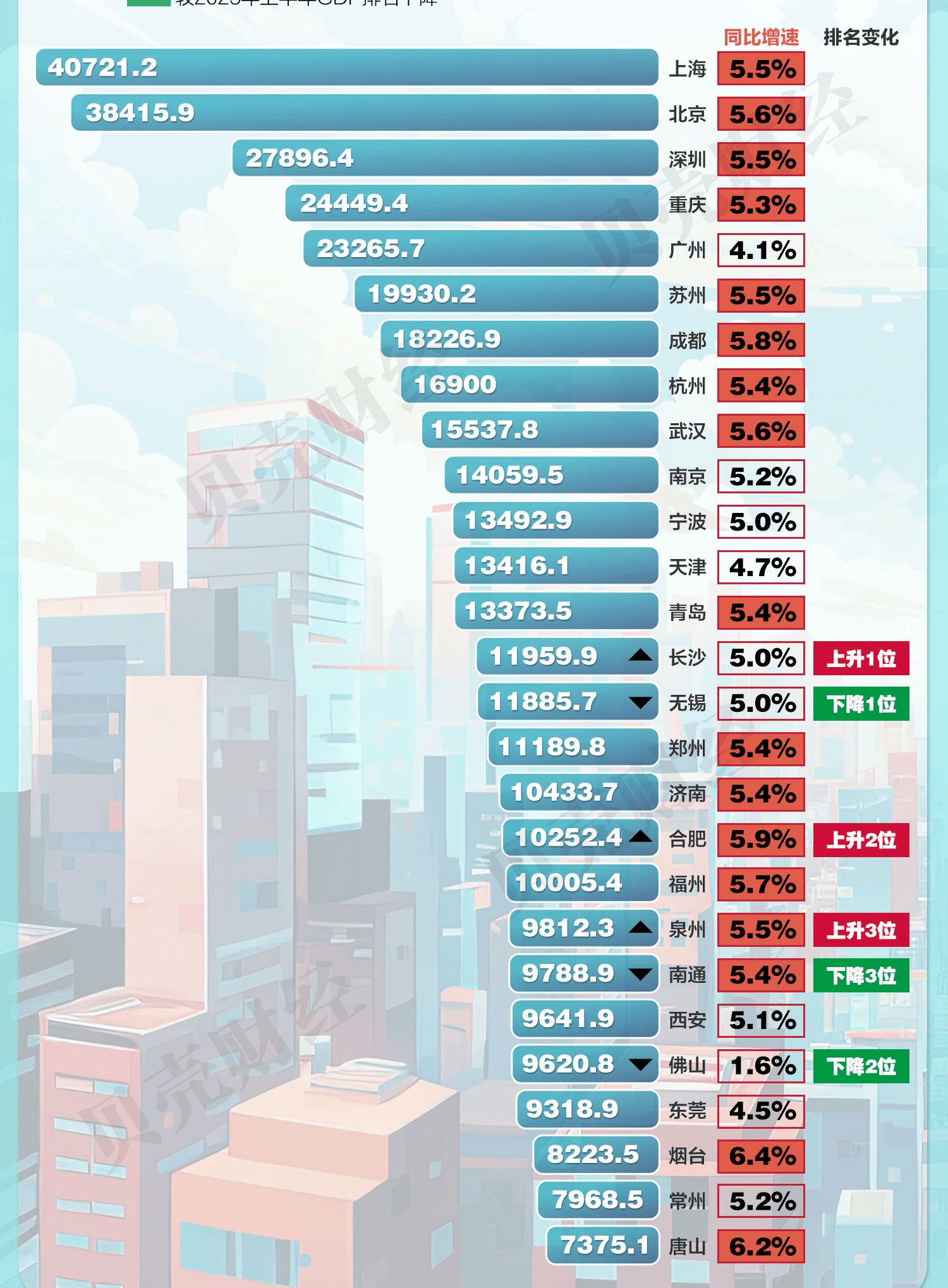
Core Insights - The economic performance of China's trillion-yuan cities has been revealed, with 27 cities reporting their GDP data for the first three quarters, showing a reshuffling in the economic landscape as 17 cities outpaced the national average growth rate [1] Economic Growth - Yantai leads with a GDP growth rate of 6.4%, followed closely by Tangshan at 6.2% and Hefei at 5.9%, indicating a trend where stronger cities continue to thrive [5] - Cities like Quanzhou, Jinan, and Dongguan also reported growth rates exceeding 5%, forming a "second tier" of economic performers [5] City Rankings - Quanzhou has made a significant comeback, re-entering the top 20 after surpassing Nantong, driven by a recovery in manufacturing and foreign trade [7] - Nantong has dropped out of the top 20 due to slowed growth, impacted by real estate and infrastructure investment challenges [7] - Hefei has risen to 18th place, benefiting from technological innovation and policy support, becoming a new growth engine in the Yangtze River Delta [7] Economic Scale - Shanghai has become the first city to exceed 4 trillion yuan in GDP, followed by Beijing with over 3.8 trillion yuan, while Shenzhen, Chongqing, and Guangzhou have surpassed 2 trillion yuan [8] - A total of 19 cities have now entered the "trillion-yuan club," indicating a strong economic foundation among these urban centers [8] Competitive Trends - The shifts in the rankings of trillion-yuan cities are attributed to technological empowerment and industrial upgrades, with Hefei excelling in integrated circuits and new energy sectors [9] - Yantai is transforming traditional industries like marine economy and green chemicals, while Quanzhou is leveraging its manufacturing strengths in textiles and home goods [9] - In contrast, Foshan is facing challenges due to a slowdown in traditional industries such as home appliances and ceramics, highlighting the need for new growth drivers [9] Conclusion - The competition among trillion-yuan cities is intensifying, with Shanghai and Beijing leading, while cities in the Yangtze River Delta and Pearl River Delta are in fierce competition [10] - The economic landscape is evolving, with cities needing to innovate and transform to avoid stagnation, as evidenced by the varying fortunes of Quanzhou, Nantong, and Hefei [10][11]
新需求叠加新供给,增品种还要创品牌 “四川织造”织出产业新面貌
Si Chuan Ri Bao· 2025-11-14 03:07
Core Viewpoint - The textile and apparel industry in Sichuan is a significant pillar of the province's light industry, showcasing a comprehensive supply chain and innovative product development during the recent supply-demand matching event held in Chengdu [1][3]. Industry Overview - Sichuan's textile and apparel industry ranks second in the western region and ninth nationally, with silk and satin production leading the country. The workwear market holds a one-third share of the national market, and the shoe manufacturing sector is one of the four major shoe production bases in China, primarily focusing on women's shoes and exports [1]. Product Innovation - Companies like Sichuan Liya E-commerce Co., Ltd. are expanding their product lines to include consumer-oriented items such as portable travel bags, leveraging materials like non-woven fabric. This shift allows them to better understand customer needs and drive production upgrades [3][4]. - Yixing Technology Co., Ltd. is also innovating with new products like functional shawls and knee pads, which incorporate odor removal, moisture-wicking, and antibacterial properties, reflecting a commitment to continuous improvement in the textile sector [5]. Brand Development - The integration of intangible cultural heritage elements into products, such as the "Chitu" leisure chair featuring Yi embroidery, has proven successful, with significant sales figures reported shortly after its launch. This approach enhances product value and addresses industry challenges [6]. - The establishment of the "Chuan Gong Shu Yi" public brand aims to empower high-quality development within the textile and apparel industry, showcasing the potential of cultural elements in product design [6]. Collaborative Efforts - The China Western High-end Custom Center is facilitating collaboration among over 40 registered companies and more than 100 signed designers, providing a platform for material information and design solutions [7]. - The provincial government emphasizes the importance of strengthening collaboration across the supply chain, enhancing design innovation, and leveraging local cultural assets to create high-quality textile and apparel products that meet modern consumer demands [7].
光明乳业,如何保卫上海市场?丨消费参考
2 1 Shi Ji Jing Ji Bao Dao· 2025-09-26 05:05
Core Viewpoint - Bright Dairy is experiencing a decline in revenue and profit, particularly in its home market of Shanghai, amid a broader contraction in the dairy industry [1][2][3]. Financial Performance - In the first half of 2025, Bright Dairy's revenue decreased by 1.9% year-on-year to 12.47 billion yuan, while net profit attributable to shareholders fell by 22.5% to 220 million yuan [1]. - Revenue from liquid milk, other dairy products, and livestock products was 6.61 billion yuan, 4.45 billion yuan, and 520 million yuan, with year-on-year growth rates of -8.6%, +8.8%, and -13.8% respectively [1]. - Regionally, revenue in Shanghai, other regions, and overseas was 3.49 billion yuan, 4.99 billion yuan, and 3.94 billion yuan, with year-on-year growth rates of -6.9%, -1.5%, and +1.9% respectively [1]. Industry Context - The overall demand for dairy products is shrinking, with Nielsen IQ reporting a 9.6% year-on-year decline in dairy sales across all channels as of June 2025 [3]. - Competitors like Mengniu and Yili also reported revenue declines, with Mengniu's revenue down 6.9% to 41.57 billion yuan and Yili's liquid milk revenue down 2.1% to 36.13 billion yuan in the first half of 2025 [3]. Competitive Landscape - Bright Dairy is intensifying efforts to defend its market share in Shanghai by launching new products and enhancing its distribution channels [5][6]. - New Dairy, a competitor, reported a revenue increase of 3.01% to 5.526 billion yuan in the first half of 2025, indicating a more proactive approach in its core markets [4].
