欧元升值

Search documents
欧洲央行管委Demarco称欧元若达到1.25美元 “也并非世界末日”
Xin Lang Cai Jing· 2026-02-19 15:06
Core Viewpoint - The European Central Bank (ECB) does not need to be overly concerned if the euro appreciates beyond 1.20 USD, as historical research suggests an equilibrium exchange rate between 1.20 and 1.25 USD, with the current rate still having room to move before reaching that level [1][2] Group 1 - ECB Governing Council member Alexander Demarco stated that even if the euro reaches 1.20 USD, it is not a catastrophic scenario [1] - Demarco noted that investors may be adjusting their portfolios to reduce dollar exposure due to recent events in the U.S., suggesting that a certain degree of euro appreciation is likely if it is to play a stronger role internationally [1] - Most ECB officials have downplayed the potential inflationary pressures from the recent euro appreciation [2] Group 2 - ECB Vice President Luis de Guindos mentioned that a 1.20 USD exchange rate is "completely acceptable," but higher levels would complicate matters significantly [2]
欧洲央行管委:欧元升值对经济影响仍有待观察 当前无需采取行动
智通财经网· 2026-02-13 09:00
Group 1 - The European Central Bank (ECB) is monitoring the impact of the euro's appreciation starting in 2025, with a projected 14% increase due to global uncertainties and a weakening dollar [1][2] - The ECB's latest forecasts reflect the effects of the euro's appreciation, predicting continued economic growth and inflation stabilizing at the 2% target [1] - ECB officials, including President Lagarde, remain vigilant and ready to respond, although current conditions do not necessitate immediate action [1][2] Group 2 - The low competitiveness of Europe compared to the US and China is a significant issue, and addressing this could improve the economy's tolerance for currency strength [2] - The ECB's current monetary policy is deemed appropriate, with balanced risks to the inflation outlook, and no immediate changes to the deposit rate are expected [2]
欧元走强 欧央行维持利率不变
Jin Tou Wang· 2026-02-09 13:23
Group 1 - The euro has appreciated significantly against both the Chinese yuan and the US dollar, reaching multi-year highs, driven by a combination of internal and external factors affecting its short-term and long-term outlook [1] - The European Central Bank (ECB) decided to maintain key interest rates unchanged, reflecting a balance between ongoing inflation decline and economic resilience, with the current inflation rate in the eurozone at low levels [1] - ECB President Lagarde emphasized the need to monitor wage pressures that could delay the decline in inflation, indicating that the current monetary policy is suitable for the existing economic conditions [1] Group 2 - The appreciation of the euro has negatively impacted eurozone exports and economic growth, particularly affecting core countries where manufacturing export competitiveness has declined [2] - Despite some resilience in the eurozone economy, challenges remain due to the euro's appreciation, geopolitical tensions, and trade uncertainties, with the EU predicting moderate growth and downward pressure in the next two years [2] - Strong domestic demand in the eurozone, including increased consumption and improved employment, has partially offset export drag, supported by fiscal expansion and increased defense spending [2]
欧元走强与关税阴影下,欧洲央行连续第五次按兵不动
Sou Hu Cai Jing· 2026-02-05 13:50
Group 1 - The European Central Bank (ECB) decided to maintain the deposit rate at 2%, marking the fifth consecutive pause in rate cuts since June of the previous year, as policymakers assess the economic impact of the euro's significant appreciation and renewed tariff threats from the Trump administration [1] - The ECB's deposit facility rate is currently at 2%, the marginal lending rate at 2.4%, and the main refinancing rate at 2.15%, all in line with expectations and previous values [1] - The ECB did not provide guidance on future policy actions, emphasizing that decisions will be based on forthcoming data, while acknowledging the eurozone's economic resilience amid a challenging global environment [1] Group 2 - Eurozone inflation fell to 1.7% in January, below the ECB's target of 2%, primarily due to declining energy costs and a stronger euro, with core inflation dropping from 2.3% to 2.2%, the lowest level since October 2021 [2] - The ECB projects an average inflation rate of 1.9% for 2026 and 2.1% for 2025, indicating that the current low inflation is considered temporary [2] - Analysts expect the ECB's next move to be an interest rate hike rather than a cut, despite rates remaining unchanged in the foreseeable future, with predictions of further declines in the unemployment rate leading to increased wage growth and inflation pressure [2] Group 3 - The significant appreciation of the euro is identified as a major risk for the ECB, as it could suppress exports or prolong declines in consumer prices, with the euro briefly surpassing the key threshold of 1.20 USD [2] - The ECB is closely monitoring the euro's value, although no specific exchange rate targets are set, as the euro's movement will guide decision-making [3] - Uncertainty surrounding tariffs is another risk factor, with ECB officials warning that this could hinder investment and slow growth, highlighting the need for policymakers to have the flexibility to respond quickly when necessary [3] Group 4 - The eurozone economy is unexpectedly strong as of the end of 2025, benefiting from increased spending in Germany and a regional military buildup [4] - Other major central banks, including the Bank of England and the Federal Reserve, have also maintained their policies, with expectations of further rate cuts in the coming months [4] - The Bank of England's decision to keep rates unchanged was narrowly decided by a 5-4 vote, with indications that there may be room for further rate cuts later in the year [5]
欧洲央行利率决议今晚来袭!料连续第五次按兵不动 地缘局势动荡及强势欧元成最大烦恼
Zhi Tong Cai Jing· 2026-02-05 06:53
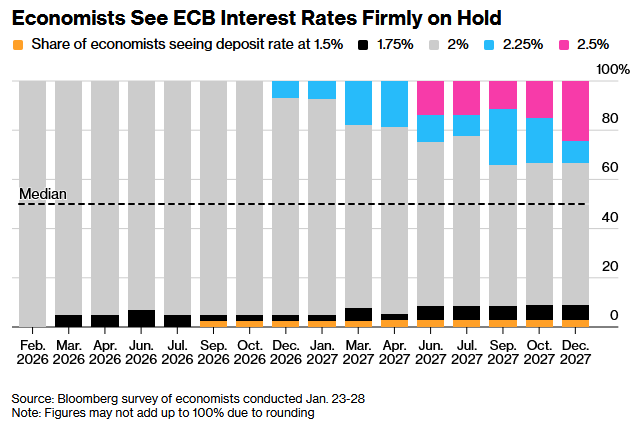
Core Viewpoint - The European Central Bank (ECB) is expected to maintain interest rates unchanged for the fifth consecutive time, with the deposit facility rate likely to remain at 2% until the end of next year, and the possibility of rate hikes in 2026 diminishing [1][4][6]. Interest Rates - ECB policymakers show little willingness to adjust borrowing costs, with the chief economist indicating no recent discussions on interest rates [4][6]. - Analysts predict a higher likelihood of rate cuts later this year, while the market anticipates a longer timeline for potential rate increases [6] Economic Outlook - The ECB is facing complex geopolitical events, including threats to the independence of the Federal Reserve and trade disputes, which have led to a weaker dollar and a stronger euro, potentially impacting European exporters and inflation rates [4][5]. - The euro's recent strength poses a risk to the ECB's economic outlook, with inflation expected to fall below the 2% target in the coming years [7][9]. Inflation Dynamics - Eurozone inflation has dropped below the ECB's target, with January's rate at 1.7%, despite persistent core price growth [10][12]. - The ECB is closely monitoring the situation, as the strength of the euro and inflation trends will guide future monetary policy decisions [9][10].

通胀降温趋势确立 欧洲央行观望立场强化
Xin Hua Cai Jing· 2026-02-04 14:03
Group 1 - Eurozone inflation has decreased to its lowest level in over a year, with January's rate at 1.7%, indicating a trend of cooling inflation [1] - Core inflation, excluding volatile items like energy and food, has dropped to 2.2%, suggesting persistent weakness in inflation [1] - France's inflation rate fell to a five-year low of 0.4%, while Italy's rate decreased to 1.0%, indicating a general reduction in price pressures across the Eurozone [1] Group 2 - The European Central Bank (ECB) is expected to maintain interest rates unchanged in its upcoming meeting, with no immediate action anticipated due to the current inflation data [1][2] - Analysts suggest that the ECB may express concerns about the recent strength of the euro, which could impact inflation expectations [2][3] - The euro's appreciation against the dollar is partly attributed to uncertainties surrounding U.S. policies and concerns over the independence of the Federal Reserve [2]
美元走弱推升欧元 欧洲经济复苏承压
Xin Lang Cai Jing· 2026-02-01 10:02
Core Viewpoint - The recent depreciation of the US dollar has led to significant concerns among European economies, with the euro appreciating approximately 14.4% over the past year, reaching a high of 1.20 against the dollar, the highest level since June 2021 [1] Group 1: Impact on Eurozone Economy - The euro's appreciation has resulted in a tangible impact on European exports and economic growth, with Eurozone exports projected to decline by 3.4% year-on-year to approximately €240.2 billion by November 2025, and trade surplus shrinking from €15.4 billion in November 2024 to €9.9 billion [2] - The Eurozone inflation rate fell to 1.9% in December 2025, below the European Central Bank's (ECB) target of 2%, indicating that the euro's appreciation is increasing cost pressures on export businesses and potentially hindering economic recovery [2] - The euro's strength is particularly affecting export-dependent countries like Germany, where the weakening dollar has significantly pressured product exports, diminishing international price competitiveness [2] Group 2: Financial Market Implications - The weak dollar may create potential pressures on the Eurozone economy through financial channels, with concerns that the dollar's status as a global reserve currency could be questioned, leading to liquidity bottlenecks for European banks reliant on dollar refinancing [3] - The ECB's monetary policy faces new challenges, as higher long-term interest rates in Europe compared to nominal economic growth rates may lead to increased capital inflows into the Eurozone, further exacerbating euro appreciation [3] - If the euro reaches 1.21 against the dollar, it could lower inflation and real GDP growth by approximately 0.1 percentage points in 2026, with the ECB closely monitoring exchange rate changes for potential economic and financial system impacts [3] Group 3: Future Outlook - The euro is expected to face upward pressure, with Morgan Stanley predicting that the euro could reach 1.23 against the dollar by the second quarter of 2026, indicating ongoing challenges for European export businesses and the overall economy [4] - A 5% increase in the euro against the dollar could reduce the annual returns of the MSCI Europe Index by approximately 1.5% to 2%, and on a trade-weighted basis, a 5% appreciation could decrease Eurozone exports by about 1.5% and economic growth by 0.3% [4]
综述丨美元走弱推升欧元 欧洲经济复苏承压
Sou Hu Cai Jing· 2026-02-01 08:10
Group 1 - The recent depreciation of the US dollar has led to a significant appreciation of the euro, with the exchange rate reaching 1.19 against the dollar as of January 31, 2023, and briefly surpassing 1.20, the highest level since June 2021. The euro has appreciated approximately 14.4% over the past year, driven by uncertainties in US economic policy and investor risk aversion [1][2] - European Central Bank (ECB) policymakers have expressed concerns regarding the rapid appreciation of the euro, indicating that further increases in the exchange rate could complicate policy operations. The ECB's Vice President highlighted that a stronger euro could further suppress price growth, which is already below the ECB's 2% inflation target [1][2] - The appreciation of the euro has had a tangible impact on European exports and economic growth, with Eurostat reporting a 3.4% year-on-year decline in eurozone exports to other countries, amounting to approximately €240.2 billion in November 2025. The trade surplus has also decreased from €15.4 billion in November 2024 to €9.9 billion [2] Group 2 - The euro's appreciation is particularly detrimental to export-dependent European countries, such as Germany, where the manufacturing sector plays a crucial role in economic growth. The German government has noted significant pressure on exports due to the weaker dollar, which has diminished the price competitiveness of German products in international markets [2] - The euro's strength is expected to exert downward pressure on inflation and economic growth, with predictions that if the euro reaches 1.21 against the dollar, it could lower inflation and real GDP growth by approximately 0.1 percentage points in 2026 [3] - Future projections indicate that the euro may continue to face upward pressure, with Morgan Stanley forecasting an exchange rate of 1.23 against the dollar by the second quarter of 2026. An increase of 5% in the euro's value could reduce the MSCI Europe Index's annual returns by 1.5% to 2% and decrease eurozone exports by about 1.5%, potentially cutting economic growth by 0.3% [4]
美元走弱推升欧元 欧洲经济复苏承压
Xin Hua She· 2026-02-01 05:34
Group 1 - The recent depreciation of the US dollar has led to a significant appreciation of the euro, with the exchange rate reaching 1.19 against the dollar as of January 31, 2023, and briefly surpassing 1.20, the highest level since June 2021. Over the past year, the euro has appreciated approximately 14.4% [1] - European Central Bank (ECB) officials have expressed concerns regarding the rapid appreciation of the euro, indicating that further increases in the exchange rate could complicate policy operations. The ECB's inflation target of 2% is already under pressure due to low inflation levels, which could be exacerbated by the euro's strength [1][2] - The euro's appreciation has had a tangible impact on European exports and economic growth, with Eurostat reporting a 3.4% year-on-year decline in eurozone exports to other countries, resulting in a reduction of the trade surplus from €15.4 billion in November 2024 to €9.9 billion in November 2025 [2] Group 2 - The euro's strength is directly undermining the competitiveness of European manufacturing exports, which is a critical factor affecting the current economic recovery in Europe. Countries with high export dependence, such as Germany, are experiencing significant pressure on their export markets due to the euro's appreciation [2] - The financial channels are also under potential pressure due to the weak dollar, with concerns that the dollar's status as a global reserve currency may be questioned. This could lead to liquidity bottlenecks for European banks that rely on dollar refinancing [3] - The ECB is facing new challenges as long-term interest rates in Europe exceed nominal economic growth rates, leading to increased capital inflows into the eurozone and further euro appreciation. If the euro reaches 1.21 against the dollar, it could lower inflation and GDP growth by approximately 0.1 percentage points in 2026 [3] Group 3 - Looking ahead, the euro is expected to face upward pressure, with Morgan Stanley predicting that the euro could reach 1.23 against the dollar by the second quarter of 2026. An increase of 5% in the euro's value could reduce the MSCI Europe index's annual returns by about 1.5% to 2% and decrease eurozone exports by approximately 1.5%, impacting economic growth by 0.3 percentage points [4]
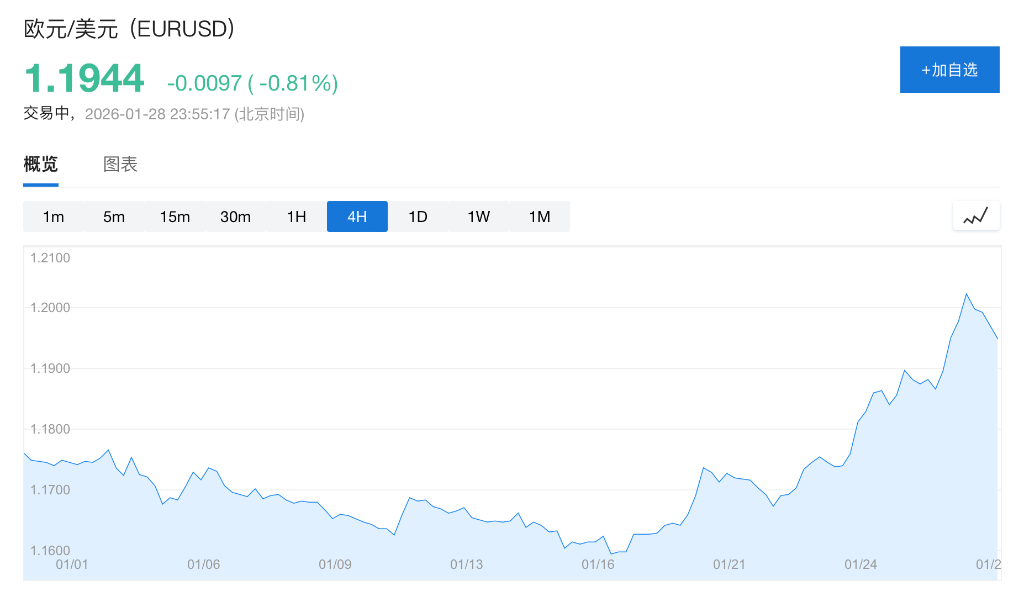
欧元升破1.20关口创五年新高,看涨狂潮令欧央行“左右为难”
Hua Er Jie Jian Wen· 2026-01-28 17:03
Core Viewpoint - The euro has strengthened significantly, surpassing the psychological threshold of 1.20 USD, reaching its highest level since 2021, primarily driven by a weakening dollar, which presents a policy dilemma for the European Central Bank (ECB) [1][4]. Group 1: Euro Strength and Market Sentiment - The rapid appreciation of the euro is expected to lower import costs, potentially suppressing inflation, which challenges the ECB's core mission of price stability [1]. - Market sentiment is leaning towards a bullish outlook for the euro, with options market activity at a multi-month high, and some long-term contracts betting on the euro reaching 1.25 USD by the end of June [1][4]. - Macro investors and hedge funds have significantly increased their bullish positions on euro options, with about 10% of recent trades betting on the euro surpassing 1.25 USD by June [4]. Group 2: ECB's Policy Considerations - ECB officials are closely monitoring the euro's exchange rate, with members indicating that while there is no specific exchange rate target, the impact of euro appreciation will be assessed in policy formulation [5]. - The ECB's Vice President previously noted that a euro exchange rate above 1.20 USD could pose challenges to monetary policy, indicating heightened awareness among decision-makers [5]. - The future trajectory of the euro's strength will depend on the underlying drivers of its appreciation, with concerns that if not supported by sustained capital inflows into European markets, it could be viewed as a risk [5]. Group 3: Divergent Views on Policy Impact - Some market observers believe that while ECB officials may express concerns about the euro's rapid appreciation, translating this into actual policy changes will be challenging if domestic economic fundamentals support a stronger currency [7]. - The speed and magnitude of exchange rate fluctuations are critical factors in how the ECB evaluates potential policy responses, with some analysts suggesting that a stronger euro may not trigger significant dovish policy reactions unless volatility becomes disorderly [6][7].