汽车电动化智能化

Search documents
上海半导体龙头,2025年预亏近2亿元
Xin Lang Cai Jing· 2026-02-02 12:27
Core Viewpoint - Dongxin Co., Ltd. forecasts a revenue of approximately 921 million yuan for 2025, representing a year-on-year increase of 43.75%, while net profit attributable to shareholders is expected to be between -214 million yuan and -174 million yuan, indicating a loss increase of 4.1% to 28.03% compared to the previous year [1][4]. Group 1: Revenue and Profit Forecast - The company anticipates a revenue of about 921 million yuan for 2025, with a year-on-year growth of 43.75% [1][4]. - The expected net profit attributable to shareholders is projected to be between -214 million yuan and -174 million yuan, reflecting a loss increase of 4.1% to 28.03% compared to the previous year [1][4]. - The net profit after excluding non-recurring gains and losses is expected to be between -241 million yuan and -201 million yuan, with a loss increase of 0.15% to 20.09% [1][4]. Group 2: Market Drivers and Business Performance - The small-capacity storage chip market is benefiting from an AI-driven industry upcycle, with an optimized supply-demand structure and steady recovery in product sales prices [2][5]. - The demand in downstream sectors is recovering and showing structural growth due to advancements in 5G base station construction, smart city security upgrades, innovations in wearable devices, and the electrification and intelligence of automobiles [2][5]. - The company has successfully achieved profitability in its storage segment, with quarterly gross margins showing sequential growth [2][5]. Group 3: Technological Development and Product Offerings - Dongxin Co., Ltd. is deepening its technological layout in the "storage, computing, and connectivity" integration field while maintaining high levels of R&D investment [6]. - The company has consolidated its leading position in SLC NAND Flash technology, with 1xnm flash products already in mass production [6]. - The company is expanding its Nor Flash product series and enhancing its DRAM product lines, including DDR3 and LPDDR4 [6]. Group 4: Investment Strategy - In 2024, the company made a strategic investment of 200 million yuan in Lishan Technology (Shanghai) Co., Ltd., with an additional investment of approximately 211 million yuan planned for 2025, focusing on the high-performance GPU sector [7]. - Lishan Technology specializes in the R&D and design of multi-layer graphic rendering GPU chips, with its first self-developed GPU chip "7G100" successfully completing its first tape-out in 2025 [7]. - The company is expected to recognize an investment loss of approximately 166 million yuan for 2025, which is a significant factor contributing to the overall increase in losses [7].
获三星、SK 海力士投资,服务比亚迪、特斯拉!国产快充芯片突围!
是说芯语· 2025-12-30 09:23
Core Viewpoint - The domestic power management chip sector is experiencing a significant opportunity for growth as the semiconductor industry emerges from a cyclical downturn, highlighted by the recent IPO progress of Voda Semiconductor [1][6]. Group 1: Company Overview - Voda Semiconductor, established in 2014, has become a leading supplier of power chips and solutions, recognized as a "little giant" enterprise by the Ministry of Industry and Information Technology, showcasing its strength in niche markets [3]. - The company focuses on four high-growth areas: consumer electronics, mobile accessories, automotive electronics, and industrial applications, creating a diversified product matrix that includes wireless charging chips, battery management chips, and automotive electronic chips [5]. - Voda Semiconductor has achieved five industry records in fast charging technology, which serves as a key differentiator and has enabled the company to enter the global supply chain, serving major clients such as Samsung, Xiaomi, and Tesla [5]. Group 2: Market Context - The global semiconductor industry is experiencing a mild recovery, with the market size expected to grow by 3.3% year-on-year by 2025, particularly in high-end sectors like automotive electronics where domestic replacement opportunities remain vast [6]. - In 2024, 84.3% of the top ten automotive analog chip manufacturers in China are expected to be foreign companies, indicating significant room for domestic players like Voda Semiconductor to expand their market share [6]. Group 3: Financial and Capital Support - Voda Semiconductor has established a global presence with offices in multiple cities, including Hefei, Shanghai, and Seoul, and has a workforce of approximately 300 employees, providing robust support for its global customer base [5]. - The company completed a multi-hundred million yuan D-round financing in 2020 and another E-round financing in 2022, with investments from notable firms such as SK Hynix and Samsung, which have fueled its technological development and market expansion [5].


从“代步工具”到“智能空间”电动化智能化驱动汽车产业转型升级
Xin Lang Cai Jing· 2025-11-06 00:08
Core Insights - The total number of new energy vehicles in China is projected to reach 36.89 million by the end of June 2025, according to data from the Ministry of Public Security [1] - The emergence of intelligent connected vehicles is creating new possibilities for work and life, necessitating new answers to automotive-related topics [1] - The degree of automobile penetration is considered a hallmark of a country's industrialization level, with traditional fuel vehicles having established R&D and manufacturing systems [1] - Initially, new car manufacturers were not well-received, but the market dynamics have shifted, with new energy vehicles achieving performance levels comparable to or better than traditional fuel vehicles in terms of acceleration [1] - New energy vehicles are increasingly equipped with intelligent assistance features, altering consumer perceptions of automobiles and generating new demand points, particularly in areas such as intelligent driving assistance, interactive cockpit experiences, and lifestyle service functions [1]
豪掷24亿收购汽车资产,领益智造多元化布局再落重子
Huan Qiu Lao Hu Cai Jing· 2025-10-31 11:35
Core Viewpoint - Linyang Intelligent Manufacturing is strategically expanding its automotive business by acquiring a 96.15% stake in Zhejiang Xianglong for 2.404 billion yuan, indicating a shift towards becoming a Tier 1 supplier in the automotive sector [1][2][3] Group 1: Acquisition Details - The acquisition involves Linyang Technology, a wholly-owned subsidiary, purchasing the stake for 2.404 billion yuan, which represents 12.09% of the company's audited net assets from the previous year [2] - Post-transaction, Zhejiang Xianglong will be included in Linyang's consolidated financial statements, with an assessed value of 2.51 billion yuan, reflecting a 203.55% increase in equity value [2] - Zhejiang Xianglong specializes in automotive components, serving major clients like Volkswagen, Toyota, BYD, and NIO, with projected revenues of 1.994 billion yuan and net profits of 127 million yuan for 2024 [2] Group 2: Strategic Intent - The transaction aims to deepen Linyang's presence in the automotive industry, enhancing its product matrix to align with trends in electrification and intelligence in vehicles [3] - The acquisition is part of a broader strategy to transition from a Tier 2 to a Tier 1 supplier, leveraging synergies with other recent acquisitions like Jiangsu Kedas [3] - Linyang has previously entered the automotive sector through acquisitions, including Zhejiang Jintai in 2021, indicating a long-term commitment to this market [3] Group 3: Diversification Efforts - Linyang has been diversifying its business beyond automotive, with significant investments in photovoltaic energy storage, thermal management, and robotics [5][6] - The company has established partnerships in the robotics sector, including collaborations with Hanson and Zhiyuan Innovation, aiming to become a key player in robot assembly [6] - Linyang's revenue from AI terminals constitutes about 90% of its income, while automotive and low-altitude economy sectors are emerging growth areas, contributing only 4.79% of total revenue in 2024 [10] Group 4: Financial Performance - Linyang reported a revenue of 37.59 billion yuan in the first three quarters of 2025, marking a 19.25% year-on-year increase, with a net profit of 1.941 billion yuan, up 37.66% [9] - Despite revenue growth, net profits have shown fluctuations from 2019 to 2024, indicating potential challenges in maintaining profitability amidst expanding operations [9][10] - The company’s reliance on a few major clients has increased, with sales to the top five clients rising from 36.62% in 2018 to 56.04% in 2024, highlighting a risk in customer concentration [8]

【行业政策】一周要闻回顾(2025年9月15日-9月21日)
乘联分会· 2025-09-22 08:40
Core Viewpoint - The article discusses the public consultation for the mandatory national standard on "Safety Requirements for Integrated Driving Assistance Systems in Intelligent Connected Vehicles," initiated by the Ministry of Industry and Information Technology, aiming to enhance safety and standardization in the automotive industry [3][4]. Group 1: Standard Overview - The draft standard includes twelve chapters covering scope, normative references, terminology, safety requirements for various driving assistance systems, testing methods, user notifications, and implementation dates [4]. - Six appendices provide detailed safety requirements, simulation testing credibility assessments, functional safety requirements, and data recording requirements [4]. Group 2: Industry Context - The penetration rate of Level 2 driving assistance systems in new energy vehicles exceeds 50%, with expectations for continued growth, improving driving experience but also raising safety concerns due to system limitations and user errors [5][6]. - Existing national standards related to driving assistance systems include GB/T 44461.1-2024 and GB/T 44461.2-2024, focusing on single-lane and multi-lane driving control, respectively [7]. Group 3: Implementation Timeline - The proposed implementation date for the new standard is January 1, 2027, with specific compliance timelines for new and existing vehicle models [9][10][11].
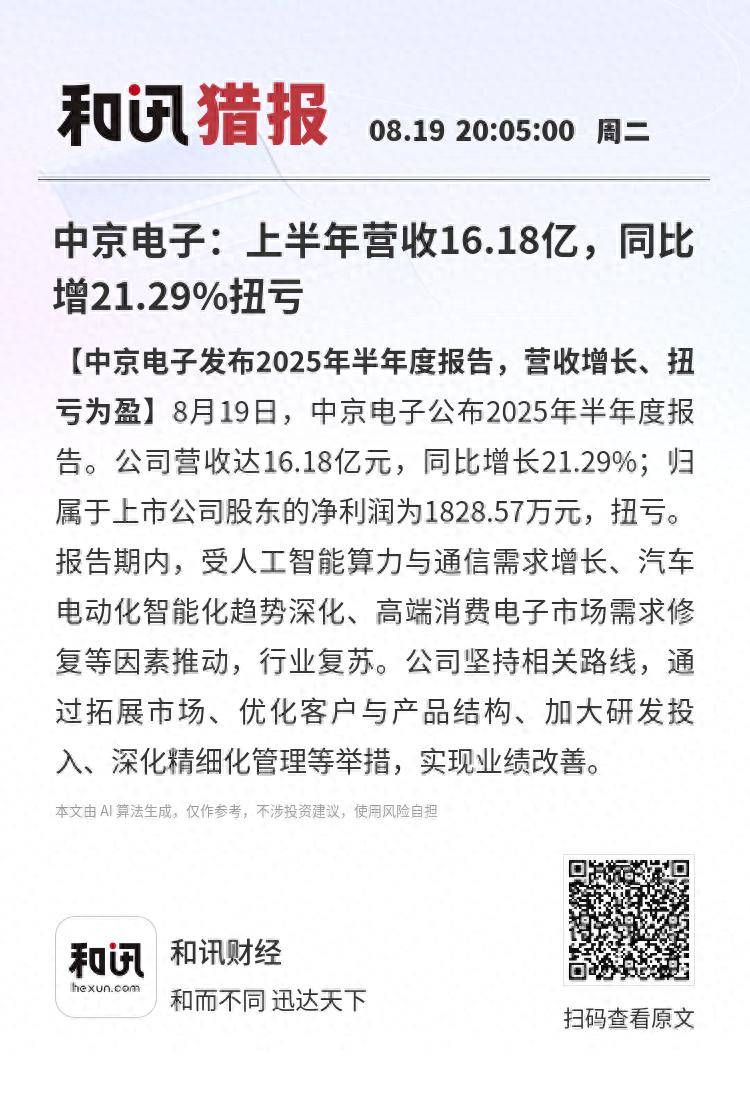
中京电子:上半年营收16.18亿,同比增21.29%扭亏
Sou Hu Cai Jing· 2025-08-19 12:42
Core Insights - The company reported a revenue of 1.618 billion yuan for the first half of 2025, representing a year-on-year growth of 21.29% [1] - The net profit attributable to shareholders was 18.2857 million yuan, indicating a turnaround from losses [1] - The industry is experiencing a recovery driven by increased demand for artificial intelligence computing power, communication needs, the deepening trend of automotive electrification and intelligence, and the restoration of high-end consumer electronics market demand [1] Company Strategies - The company is expanding its market presence and optimizing customer and product structures [1] - Increased investment in research and development is a key focus for the company [1] - The company is implementing refined management practices to improve performance [1]

华夏创业板新能源ETF发起式联接基金将于7月28日发行
Zheng Quan Ri Bao Wang· 2025-07-25 09:12
Group 1 - The new product, Huaxia ChiNext New Energy ETF Initiated Link (Class A: 024419; Class C: 024420), will be officially launched on July 28, 2025, managed by experienced fund manager Dan Kuan Zhi, aiming to provide investors with efficient and convenient investment tools in the new energy sector [1] - The fund primarily invests in the Huaxia ChiNext New Energy ETF (159368), closely tracking the ChiNext New Energy Index (399266.SZ), which focuses on the new energy and new energy vehicle industries, gathering multiple industry leaders [1] - The top three sub-industries by weight in the index are batteries (48.04%), photovoltaic equipment (21.23%), and automation equipment (16.10%), collectively accounting for 85.37% of the index [1] Group 2 - The current ChiNext index constituent stocks have certain allocation value, with increasing sales and penetration rates in the new energy vehicle sector, suggesting potential growth for related companies [2] - The trend of electrification and intelligentization in global automobiles is expected to open up additional growth opportunities for domestic auto parts companies as they expand overseas [2] - The lithium battery and photovoltaic industries are anticipated to experience positive development, with the lithium battery sector expected to enter an upward cycle by 2025, and photovoltaic component efficiency likely to improve due to industry policies and technological innovations [2]

福耀玻璃(600660):经营质量稳步提升 费用率控制有效
Xin Lang Cai Jing· 2025-04-18 10:25
Core Viewpoint - The company reported a steady increase in revenue and net profit for Q1 2025, indicating improved operational quality and effective cost control [1][3]. Financial Performance - Q1 2025 revenue reached 9.91 billion yuan, a year-on-year increase of 12.2% but a quarter-on-quarter decrease of 9.4% [1] - Net profit attributable to shareholders was 2.03 billion yuan, up 46.3% year-on-year and up 0.5% quarter-on-quarter [1] - Gross margin was 35.4%, down 1.4 percentage points year-on-year but up 3.3 percentage points quarter-on-quarter [1] - Net margin was 20.5%, an increase of 4.8 percentage points year-on-year and 2 percentage points quarter-on-quarter [1] Cost Management - The decline in gross margin year-on-year was primarily due to changes in accounting standards, which reclassified packaging costs from selling expenses to operating costs [1] - The significant increase in net margin was attributed to higher foreign exchange gains, a substantial decrease in financial expense ratio, and increased investment income [1] - The expense ratio for Q1 2025 was 10.6%, down 5.3 percentage points year-on-year and up 1.2 percentage points quarter-on-quarter [1] Product Development and Market Trends - The proportion of high-value-added products is increasing, with the average selling price (ASP) of automotive glass in 2024 reaching 229.11 yuan per square meter, a year-on-year increase of 7.5% [2] - The penetration of high-value-added products such as smart panoramic glass and lightweight ultra-thin glass is driving ASP and gross margin growth [2] - The company’s automotive glass sales volume in 2024 was 15.58 million square meters, a year-on-year increase of 11.2% [2] Capacity Expansion and Profitability - The company is expanding its production capacity, with capital expenditures of 5.481 billion yuan in 2024 [2] - The U.S. subsidiary achieved revenue of 6.312 billion yuan in 2024, a year-on-year increase of 13.3%, with a net profit of 627 million yuan, up 26.9% year-on-year [2] - The company is expected to continue gaining market share due to its focus on business, profitability, cost control, and R&D investment [2] Earnings Forecast - The company’s EPS is projected to be 3.46 yuan, 3.92 yuan, and 4.40 yuan for 2025, 2026, and 2027 respectively, with corresponding PE ratios of 16, 14, and 12 times [3] - The compound annual growth rate (CAGR) of net profit attributable to shareholders is estimated at 15.3% [3]