油粕市场

Search documents
油粕日报:震荡上涨-20260311
Guan Tong Qi Huo· 2026-03-11 11:15
Group 1: Report Investment Rating - No information provided on the industry investment rating Group 2: Core Viewpoints - The soybean market is influenced by factors such as production adjustments in South America, Chinese procurement, and domestic policies. The oil market is supported by the Middle - East situation and Indian procurement, showing a short - term upward trend but with risks from market sentiment fluctuations [1][2][3] Group 3: Summary by Related Content 1. Soybean and Bean Meal - The US Department of Agriculture lowered Argentina's 2025/2026 soybean production forecast from 48.5 million tons to 48 million tons, while keeping Brazil's at 180 million tons. US 2025/26 soybean imports and crush volumes are expected to increase, with unchanged ending stocks [1] - Brazil's February soybean shipments to China were revised down to 9.1 million tons, with 6.5 million tons in February and 13 million tons scheduled for March. US Gulf and West Coast shipments to China in February were 2.4 million tons, and in March, they are expected to increase to 1.7 million tons [1] - The US Department of Agriculture made few data adjustments, and the driving force for US soybeans is China's future procurement. There may be an order signed during Trump's visit to China from March 31 to April 2. Before the domestic soybean reserve release is confirmed, the market is full of speculations [2] 2. Oil - International oil prices have risen too fast, and buyers prefer to purchase from local sellers. The CIF price of imported crude palm oil in February was about $100/ton lower than that of crude soybean oil, and now the prices are almost the same. If India reduces long - term purchases, it may limit the further rise of vegetable oil prices but may also lead to a tight domestic supply in April [2] - According to ITS data, Malaysia's palm oil exports from March 1 - 10 were 622,445 tons, a 37.9% increase compared to the same period last month [2] - Due to the unclear Middle - East situation, the oil sector is supported. India's increased procurement has led to a significant increase in Malaysia's palm oil exports in the first ten days. The oil sector is expected to be volatile and strong in the short term [3]
油粕日报:区间震荡-20260206
Guan Tong Qi Huo· 2026-02-06 09:54
1. Report Industry Investment Rating - The investment rating for the oil and meal industry is "Range-bound oscillation" [1] 2. Core View of the Report - For soymeal, although the market's consistent expectation of a bountiful harvest and ample supply in South America is being further strengthened, due to uncertainties in post - holiday soybean auctions and arrivals, as well as weather issues in Argentina, it's unadvisable to be overly bearish. It is conservatively recommended to take partial basis at low points, and the futures market should be regarded as a wide - range oscillation [2]. - For oils, although the US 45Z policy strongly supports US soybean oil, its restrictions on raw material imports prevent the benefits from reaching the domestic market. The market is in a moderately bullish oscillation pattern with limited downside and weak upward momentum [3]. 3. Summary by Related Catalogs Soymeal - As of January 29, 2026, in the 2025/26 season, the US soybean exports to China (Mainland) were 432.4 million tons, lower than 1812 million tons in the same period last year. The US shipped 80.9 million tons of soybeans to China that week. The unshipped but sold soybeans to China in the 2025/26 season so far are 556.3 million tons, compared with 230.5 million tons in the same period last year [2]. - The drought problem in Argentina is worsening, especially in the central and southern regions. A cold front brought some showers, and the weather pattern in February seems more active, which may help depending on rainfall. Otherwise, the crop conditions will continue to deteriorate, and late - sown crops will face more pressure [2]. - Institutions significantly raised the production estimate of Brazil in the 2025/26 season, and the harvest progress is better than last year. Although there are still local weather uncertainties, the market's consistent expectation of a bountiful harvest and ample supply in South America is being further strengthened [2]. Oils - Indonesia plans to set the mandatory ethanol blending ratio in gasoline at 10% in 2028 to reduce gasoline imports and improve energy self - sufficiency. However, due to limited ethanol supply, the plan to increase the mandatory blending has been postponed [3]. - In the 2025/26 season, India's sunflower oil imports will drop by about 10% to a four - year low as the price premium of sunflower oil over other edible oils grows, prompting buyers to switch to cheaper alternatives like palm oil, which may help reduce inventories in Indonesia and Malaysia and support Malaysian palm oil futures prices [3].
格林大华期货早盘提示:三油-20251027
Ge Lin Qi Huo· 2025-10-27 02:21
1. Report Industry Investment Rating - No information provided in the report 2. Core Viewpoints of the Report - For vegetable oils, with a warming macro - environment and stronger external vegetable oils, domestic vegetable oils are expected to rise. It is recommended to close previous short positions and enter long positions [1][2] - For two types of meal (bean meal and rapeseed meal), macro - conditions are improving and the rise of US soybeans will drive the domestic double - meal to rebound, but the medium - long - term supply pressure increases, so the rebound space is limited, and wait for short - selling opportunities in the medium - long term [3] 3. Summary by Relevant Catalogs 3.1 Vegetable Oils 3.1.1 Market Review - On October 23, domestic vegetable oils were pressured by sufficient supply fundamentals, but showed resistance on the technical side. The closing prices and daily position changes of Y2601, Y2605, P2601, P2605, OI2601, and OI2605 contracts of soybeans, palm oil, and rapeseed oil are provided, along with price changes [1] 3.1.2 Important Information - On October 27, Sino - US economic and trade teams had their fifth face - to - face negotiation since May this year, reaching a "very substantial framework agreement", and the US "no longer considers" imposing a 100% tariff on China - NYMEX crude oil futures fell on October 24, but the weekly increase was the largest since mid - June - Brazil may not be able to increase the biodiesel blending ratio from 15% to 16% before March 2026, which may reduce the industrial demand for international soybean oil and drag down CBOT soybean oil - If Indonesia implements the B50 policy, the palm oil used for blending will reach about 17 million tons, 3 million tons more than the current B40 policy, accounting for about 35% of Indonesia's palm oil production - From October 1 - 25, Malaysia's palm oil exports decreased by 0.4% compared to September 1 - 25 - From October 1 - 20, Malaysia's palm oil production increased by 2.71% month - on - month - As of the 42nd week of 2025, the total inventory of the three major domestic edible oils decreased by 1.45% week - on - week and increased by 14.13% year - on - year [1] 3.1.3 Market Logic - Externally, the continuous sharp rise of international crude oil last week and the Sino - US phased easing are expected to boost vegetable oils. The Sino - US negotiation result made US soybeans jump, driving up US soybean oil. However, Malaysia's palm oil is pressured by increased production and decreased exports. Domestically, the supply of oilseeds in the fourth quarter is sufficient, the oil mill operating rate rises, and consumption enters a seasonal off - season. The main influencing factor at this stage is macro - factors. Macro conditions are warming, and the strength of external vegetable oils will drive up domestic vegetable oils [2] 3.1.4 Trading Strategy - Unilateral: Enter new long positions. Provide pressure and support levels for Y2601, Y2605, P2601, P2605, OI2601, and OI2605 contracts [2] - Arbitrage: No strategy provided 3.2 Two Types of Meal (Bean Meal and Rapeseed Meal) 3.2.1 Market Review - On October 23, domestic oils fell sharply, and the "buy oil and sell meal" arbitrage was decoded, supporting the double - meal. The closing prices, daily position changes, and price changes of M2601, M2605, RM2601, and RM2605 contracts of bean meal and rapeseed meal are provided [2] 3.2.2 Important Information - On October 27, Sino - US economic and trade teams had their fifth face - to - face negotiation since May this year, reaching a "very substantial framework agreement", and the US "no longer considers" imposing a 100% tariff on China - As of October 20, 2025, the soybean sowing progress in Paraná, Brazil was 52%, and the excellent - good rate was 98% - In September, China's soybean imports reached 12.869 million tons, a record high for the month - The Trump administration may announce a plan to rescue American farmers affected by the trade war and price drops, with preliminary expenditures up to $15 billion - As of the end of October, Brazil's soybean exports are expected to reach 102.2 million tons, exceeding the full - year totals of 2024 and 2023 - As of the 42nd week of 2025, the domestic imported soybean inventory increased, while the domestic bean meal inventory and contract volume decreased. The domestic imported rapeseed inventory, imported and pressed rapeseed meal inventory, and contract volume all decreased [2][3] 3.2.3 Market Logic - Externally, Sino - US reached a good agreement, and the market expects an increase in US soybean exports, causing US soybeans to jump. The market is in a wait - and - see mood on Friday, and both long and short positions reduced. The short - term main contract of Dalian meal is consolidating around 2950 yuan. Domestically, the oil mill's one - price increases slightly with the market, the near - month basis weakens locally, and the domestic bean meal inventory continues to decline. Due to poor压榨 profits, oil mills have weak willingness to purchase in the long - term. Feed enterprises adopt a strategy of replenishing inventory at low prices and giving priority to digesting existing inventory; traders face double pressures of cost inversion and slow sales, and the actual transactions are mainly negotiated, with weak willingness to chase the rise. Macro conditions are warming, and the rise of US soybeans will drive the domestic double - meal to rebound, but the medium - long - term supply pressure increases, so the rebound space is limited [3] 3.2.4 Trading Strategy - Unilateral: Cautiously participate in short - term long positions, the rebound space is limited, and wait for short - selling opportunities on rebounds in the medium - long term. Provide pressure and support levels for M2601, M2605, RM2601, and RM2605 contracts [3] - Arbitrage: No strategy provided
商品日报(4月28日):聚酯链集体领涨 油粕金属大面积下跌
Xin Hua Cai Jing· 2025-04-28 16:05
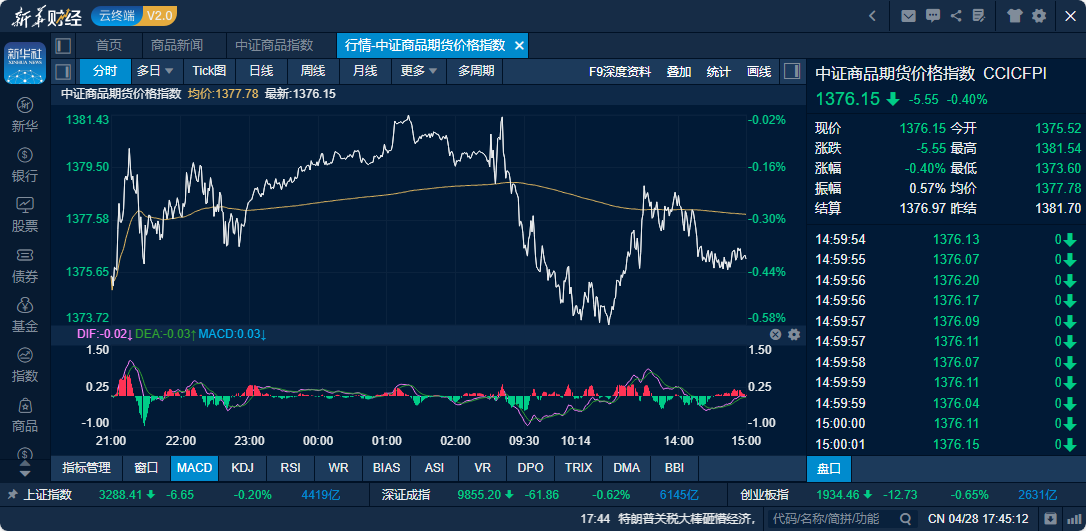
Group 1: Commodity Market Overview - The domestic commodity futures market experienced a weak trend on April 28, with the China Securities Commodity Futures Price Index closing at 1376.15 points, down 5.55 points or 0.40% from the previous trading day [1] - The energy and chemical sector showed strength, particularly in the polyester chain, with short fibers, low-sulfur fuel oil, and PTA recording approximately 2% gains [1][3] - In contrast, the metal sector continued to adjust, with polysilicon leading the decline, dropping over 3%, while gold and silver fell more than 1% [1][4] Group 2: Polyester Chain Performance - The polyester industry chain maintained a strong performance, with short fiber futures leading the market with a 2.08% increase, while PTA and bottle chips also rose over 1% [3] - Global trade tensions have lessened their impact on market sentiment, and the recovery of international oil prices has supported the stabilization of energy and chemical products [3] - However, there are concerns regarding weak demand in both domestic and foreign trade, leading to increased inventory levels in short fiber factories [3] Group 3: Metal Sector Weakness - The metal sector, including energy metals, faced a collective downturn, with polysilicon dropping 3.05%, and lithium carbonate and industrial silicon also declining [4] - Despite a previous rebound due to production control rumors, the demand for photovoltaic installations has cooled, exacerbating supply-demand imbalances for silicon materials [4] - The overall sentiment in the metal market remains bearish, with expectations of continued pressure on polysilicon prices due to weak future demand and slow inventory depletion [4] Group 4: Oilseed and Oil Market Trends - The oilseed and oil market also saw a collective decline, with soybean meal, palm oil, and No. 2 yellow soybeans all dropping over 2% [5] - The market sentiment turned negative due to downstream resistance to high-priced soybean meal, alongside a retreat in U.S. soybean prices and expectations of increased domestic oilseed supply [5] - In the absence of substantial positive fundamentals, the oilseed market is likely to maintain a weak and volatile trend [5]