
流感治疗

Search documents
罗氏速福达®正式在华获批扩龄至1岁及以上 守护儿童流感健康
Jing Ji Guan Cha Wang· 2026-03-12 10:03
Core Insights - Roche's antiviral treatment for influenza, Marbofloxacin, has received approval in China for expanded indications, allowing treatment for children aged 1 to 5 years with uncomplicated influenza, thus broadening its age coverage from previously 5 years and above [2][3] Group 1: Product Approval and Indications - Marbofloxacin oral suspension has been approved for children aged 1 to 5 years, including those at high risk for complications [2] - The tablet form of Marbofloxacin has been approved for adults and children aged 5 years and above, also including those at high risk for complications [2] - The new approvals provide a comprehensive treatment option for infants, children, and adults, enhancing the influenza prevention and control system in China [2] Group 2: Clinical Significance and Research - Influenza poses a significant public health threat, with seasonal influenza causing 3 to 5 million severe cases and 290,000 to 650,000 deaths globally each year [4] - Children are particularly vulnerable, with an annual infection rate of approximately 20%-30%, which can rise to 50% during peak seasons [4] - The new indications are based on two clinical studies conducted in children aged 1 to under 12 years, demonstrating the efficacy of Marbofloxacin compared to other treatments [5] Group 3: Expert Opinions - Experts emphasize the need for innovative treatments for young children, who are at high risk for severe complications from influenza [5] - The new formulations address challenges such as difficulty in swallowing and dosing accuracy for young patients [5] - The approval of Marbofloxacin for younger age groups is seen as a significant advancement in pediatric influenza treatment [5] Group 4: Company Statements and Future Directions - Roche's leadership highlights the ongoing public health challenge posed by influenza and the urgent need for innovative treatment options for high-risk children [6] - The company aims to enhance the accessibility of innovative drugs and contribute to the improvement of public health in China [6] - Marbofloxacin has shown effectiveness against various strains of influenza, including those resistant to other treatments, and is expected to significantly reduce the duration of symptoms [6][7]


罗氏速福达扩龄获批,适用于1岁及以上流感患者
Xin Lang Cai Jing· 2026-03-06 06:50
Core Insights - Roche Pharmaceuticals China announced the approval of its antiviral treatment, Xofluza® (generic name: baloxavir marboxil), by the National Medical Products Administration of China on March 3, 2026, for treating uncomplicated influenza A and B in children aged 1 to under 5 years, including both previously healthy patients and those at high risk for influenza complications [1] Group 1: Product Approvals - On February 13, 2026, Xofluza® tablets were approved for use in adults and children aged 5 and above for uncomplicated influenza A and B, expanding the treatment age range from previously 5 years and older to 1 year and older, thus providing comprehensive coverage for infants, children, and adults [2] - The approval of these new indications is based on results from two studies conducted in children aged 1 to under 12 years, demonstrating the drug's efficacy and safety [2] Group 2: Clinical Research Findings - The MINISTONE-2 study, a global Phase III, randomized, double-blind clinical trial, showed that baloxavir marboxil had good tolerability and efficacy in children aged 1 to 12 years, significantly reducing the time to viral clearance by more than two days compared to the neuraminidase inhibitor oseltamivir (24.2 hours vs. 75.8 hours) with a lower incidence of adverse events [2] - The DRAGONSTONE study, conducted in Chinese patients aged 1 to under 12 years, compared baloxavir marboxil with oseltamivir, showing similar rates of adverse events and no new safety signals [3] Group 3: Influenza Impact - According to the World Health Organization, seasonal influenza can lead to 3 to 5 million cases of severe illness and 290,000 to 650,000 respiratory disease-related deaths globally each year, with children being particularly susceptible, having an infection rate of approximately 20% to 30%, which can rise to about 50% during peak seasons [3]

流感药扎堆的时代,人们为什么首选奥司他韦
经济观察报· 2025-12-31 09:41
Core Viewpoint - Oseltamivir remains the preferred choice among various new antiviral drugs for influenza in the 2025 flu season due to its affordability, broad applicability, authoritative recommendations, and strong supply availability [1]. Group 1: Market Position and Demand - In December 2025, pediatric clinics experienced long queues of parents seeking treatment for their children, with many doctors prescribing Oseltamivir [2]. - Despite the emergence of several new antiviral drugs, Oseltamivir continues to be the most commonly used medication for influenza treatment, thanks to its solid efficacy, low price, and wide accessibility [4]. - The demand for Oseltamivir surges every winter during flu season, as families face significant financial considerations when choosing medications [8]. Group 2: Economic and Accessibility Advantages - Oseltamivir is significantly cheaper than newer antiviral drugs, with a typical box costing only a few dozen yuan, while newer drugs can cost hundreds of yuan per treatment course [9]. - The economic efficiency of Oseltamivir is particularly beneficial during influenza pandemics, as it allows for broader treatment coverage without overwhelming healthcare budgets [9]. - Oseltamivir is a staple in major hospitals and is also available in county-level hospitals and community health centers, ensuring timely access for patients across different regions [9]. Group 3: Safety and Efficacy - Since its launch in 1999, Oseltamivir has demonstrated safety and efficacy through various influenza outbreaks, making it a reliable option for vulnerable populations [11]. - Oseltamivir is suitable for a wide range of patients, including children as young as two weeks old, pregnant women, and those with underlying health conditions, which enhances its appeal as a family treatment option [12]. - The drug's long-term safety data is particularly important for high-risk groups, as it has been shown to be effective and safe for use in these populations [12]. Group 4: Guidelines and Recommendations - Multiple expert consensus guidelines in China recommend Oseltamivir as a first-line treatment for influenza, especially for high-risk groups [14]. - The latest clinical practice guidelines emphasize Oseltamivir's role as the preferred medication for severe cases, children, and pregnant women, based on substantial clinical evidence [15][16]. Group 5: Brand Trust and Market Leadership - Eastsun Pharmaceutical is the largest global producer of Oseltamivir, with its products being widely recognized and trusted by both doctors and patients [21]. - The company has invested significantly in the quality management of Oseltamivir production, ensuring that its products meet high standards and are readily available across various distribution channels [22]. - Eastsun's commitment to quality and accessibility has established "Kewai" as a household name, making it a key player in ensuring sufficient supply during flu outbreaks [22].

流感用药别任性 这些细节要注意
Yang Shi Wang· 2025-12-22 20:14
Group 1 - The article discusses the increase in flu cases during the winter season and the appropriate medication for treatment [1] - It questions the effectiveness of combining cold medicine and fever reducers for a quicker recovery from the flu [1] - The article aims to clarify misconceptions regarding flu treatment measures [1]
感冒药、退烧药不能同时吃!这些用药方式很危险,还有很多人不知道
Xin Lang Cai Jing· 2025-12-22 15:14
Group 1 - The article emphasizes that combining cold medicine and antipyretics is not advisable as it can lead to increased drug dosage and potential liver and kidney damage [1][2] - Experts warn that some traditional Chinese medicines may contain Western drug components, which can also lead to overdosing and harm to liver and kidneys [2] - It is crucial for patients experiencing flu symptoms to avoid self-medication and seek medical attention promptly [3] Group 2 - For children with flu, it is important not to use fever reduction as a criterion for stopping medication, as this could lead to a relapse or other serious conditions like myocarditis or pneumonia [4] - Parents can assess the severity of their child's flu using the ABC method, which includes checking the child's vitality, breathing condition, and skin color [5] - The article highlights the recent surge in flu cases and advises against blind medication use, stressing the importance of timely medical consultation [6]
石药集团:SYH2085片在中国获临床试验批准
Zhi Tong Cai Jing· 2025-12-19 13:23
Core Viewpoint - The approval of SYH2085 by the National Medical Products Administration of China marks a significant advancement for the company in the development of innovative antiviral treatments for influenza [1] Group 1: Product Development - SYH2085 is a novel oral small molecule candidate drug developed by the company, designed to inhibit the RNA polymerase acidic protein (PA) endonuclease activity of influenza viruses [1] - The clinical indication approved is for the treatment of uncomplicated influenza A and B in adults and adolescents aged 12 and older [1] - Preclinical studies have demonstrated that SYH2085 exhibits clear, broad-spectrum, and excellent inhibitory effects against both influenza A and B viruses, effectively reducing viral load and flu-like symptoms in animal models [1] Group 2: Clinical and Market Potential - The drug shows promising pharmacokinetic properties and safety, indicating a high clinical development value [1] - The introduction of SYH2085 is expected to enhance the company's product pipeline in the field of anti-infective treatments [1]
流感高发,请收好这份防护指南
Ren Min Ri Bao· 2025-12-12 03:01
Core Viewpoint - The current flu season in China is experiencing a high prevalence, with a positive detection rate of 54.2% for flu viruses in outpatient and emergency departments from December 1 to 7, indicating an upward trend in flu virus detection, although the rate of increase is slowing down [1] Group 1: Flu Characteristics and Treatment - Flu symptoms are more severe than those of a common cold, including sudden high fever (over 39 degrees Celsius), chills, headaches, muscle aches, and fatigue, which can lead to serious complications in vulnerable populations such as the elderly and those with underlying health conditions [2] - Flu is generally self-limiting, with mild cases recovering at home through rest and proper nutrition; however, severe cases may require antiviral treatment and management of complications [2][3] Group 2: Vaccination Recommendations - Vaccination is the most effective and economical means of preventing infectious diseases; individuals, especially children, the elderly, and those with underlying conditions, are encouraged to get vaccinated as flu activity increases [4] - Vaccination guidelines specify that children aged 6 months to 8 years require two doses of inactivated vaccine for their first vaccination, while those aged 9 and above need only one dose annually, regardless of previous vaccinations [5] Group 3: Post-Recovery Guidelines - After recovering from flu, individuals should maintain good hygiene practices, such as wearing masks, frequent handwashing, and ensuring proper ventilation to prevent reinfection [6][7] - Vulnerable groups should take extra precautions in crowded places, and schools should monitor health conditions to prevent the spread of illness [7]
门急诊流感病毒检出阳性率为54.2% 流感高发,请收好这份防护指南(服务窗)
Ren Min Ri Bao· 2025-12-11 22:05
Core Viewpoint - The current flu season in China is experiencing a high prevalence, with a positive detection rate of 54.2% for flu viruses in outpatient and emergency departments from December 1 to 7, indicating an upward trend in flu virus detection, although the rate of increase is slowing down [1] Group 1: Flu vs. Common Cold - The pathogens detected in China are common known pathogens, with no new infectious diseases reported [2] - Flu symptoms are more severe, characterized by sudden high fever (over 39 degrees Celsius), chills, headaches, muscle aches, and fatigue, potentially leading to serious complications in vulnerable populations [2] - Common colds are generally caused by rhinoviruses and parainfluenza viruses, with milder symptoms and typically self-resolving within a week [2] Group 2: Treatment and Prevention - Flu is generally self-limiting, with mild cases recovering at home; however, severe cases may require antiviral treatment as per the national guidelines [2][3] - Vaccination is the most effective and economical means of preventing infectious diseases, especially for high-risk groups such as children, the elderly, and those with underlying health conditions [4] - Vaccination can significantly reduce the risk of contracting flu and developing severe cases, even if some vaccinated individuals still contract the virus [4] Group 3: Vaccination Guidelines - Children aged 6 months to 8 years require two doses of inactivated vaccine for their first vaccination, while those previously vaccinated need only one dose [5] - For individuals aged 9 and above, only one dose is required annually, regardless of previous vaccinations [5] - Vaccination is necessary each flu season due to the virus's tendency to mutate and the waning immunity from previous vaccinations [5] Group 4: Post-Recovery Care - After recovery, individuals should maintain good hygiene practices, such as wearing masks, frequent handwashing, and ensuring proper ventilation [6][7] - It is advised that flu patients stay in separate rooms to minimize contact with others, and common surfaces should be disinfected regularly [7] - Vulnerable populations should take extra precautions in crowded places, and schools should monitor health conditions to prevent disease spread [7]
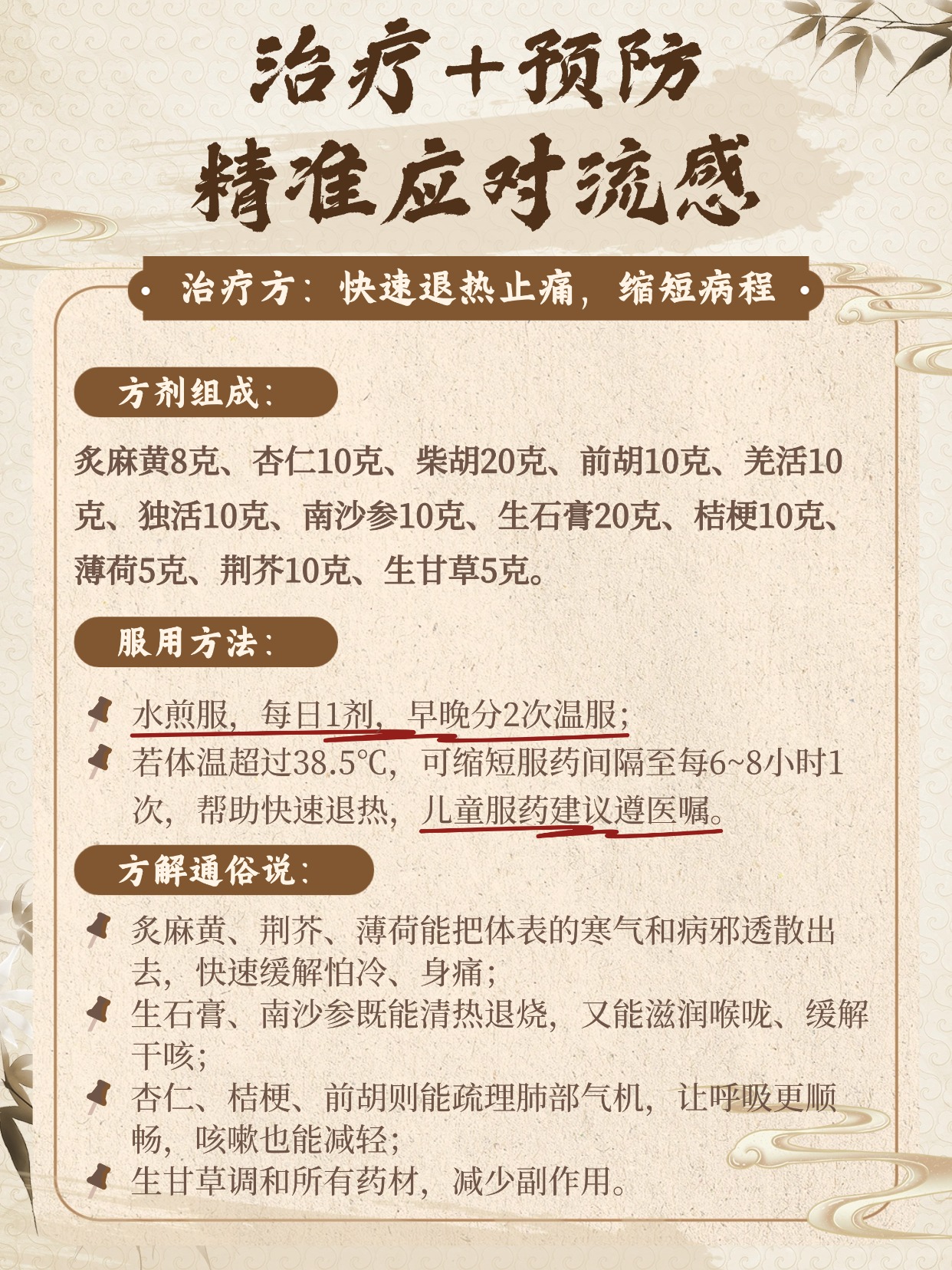
流感季别慌!这份居家中医方快收藏
Ren Min Wang· 2025-12-08 05:51
Core Viewpoint - The article provides recommendations for traditional Chinese medicine (TCM) methods to help alleviate flu symptoms and reduce infection risks during the flu season. Treatment and Prevention - A preventive formula is suggested for high-risk groups, focusing on enhancing immunity and preemptively combating the flu virus. The formula includes 10 grams each of raw astragalus, daqingye, and eleutherococcus, to be taken as a decoction twice daily [3]. - The components of the formula are explained: raw astragalus boosts immunity, daqingye has heat-clearing and detoxifying properties, and eleutherococcus strengthens energy and supports the body's defenses [3]. External Treatment Methods - External treatment methods are recommended for symptom relief, especially for those who find it difficult to take medicine or have mild symptoms. Techniques include guasha along the "governing vessel" on the back and cupping therapy [4]. - Specific scenarios for these methods include high fever (above 38.5°C) and severe throat pain, with instructions on how to perform these techniques safely [4][5]. Pediatric Care - Gentle external treatment methods are highlighted for children, emphasizing safety and effectiveness. Techniques include pediatric massage to reduce fever, clear phlegm, and relieve nasal congestion [6]. - Specific massage techniques are outlined, such as pushing from the center of the forehead to the hairline and massaging around the ears and temples [6][7]. Expert Contributions - The article features insights from experts in traditional Chinese medicine, including directors from affiliated hospitals, emphasizing the safety and efficacy of these methods for flu management [8].
流感已对奥司他韦耐药了吗?探访首儿所
Xin Jing Bao· 2025-12-04 10:40
Core Insights - Beijing has entered the influenza epidemic period earlier than usual, with the peak possibly already reached, as respiratory diseases account for 35%-40% of total daily consultations at the Capital Institute of Pediatrics [1][3][4] Group 1: Current Situation - The flu activity in Beijing has been increasing since late October, entering the epidemic phase by mid-November, approximately four weeks earlier than last year [3] - The daily consultation volume for respiratory diseases at the Capital Institute of Pediatrics reached this year's peak in the last two weeks, although it is slightly lower than previous years' peaks [4] Group 2: Measures Taken - To manage the winter surge in patient visits, the institute has increased personnel and appointment availability in respiratory, internal medicine, and fever clinics [4] - New online services have been introduced, including "external hospital follow-up" and dual appointment options for online and offline consultations, allowing for more efficient patient management [5] Group 3: Expert Insights - The resistance rate to Oseltamivir (Tamiflu) is currently between 1% and 2%, indicating that it remains effective against influenza [7] - It is crucial for children showing symptoms of influenza to receive antiviral treatment within 48 hours of onset to reduce the risk of severe illness [8]