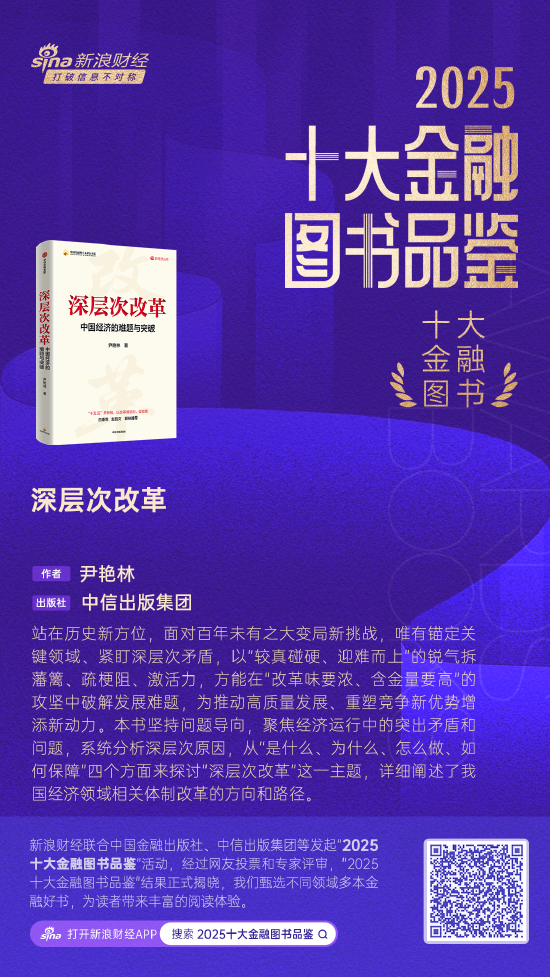
深层次改革

Search documents
尹艳林《深层次改革》获评2025十大金融图书
Xin Lang Cai Jing· 2026-02-05 11:18
Core Viewpoint - The book "Deep Reform" by Yin Yanlin has been recognized as one of the "Top Ten Financial Books of 2025" following a competitive selection process involving expert reviews [1][2]. Group 1: Book Overview - "Deep Reform" is published by CITIC Publishing Group and addresses the significant challenges posed by unprecedented changes in the current historical context [4][8]. - The book emphasizes the need to focus on key areas and deep-seated contradictions, advocating for a proactive approach to dismantle barriers and stimulate vitality in order to solve development issues [4][8]. - It adopts a problem-oriented approach, analyzing prominent issues in economic operations and exploring the deep-rooted causes [4][8]. Group 2: Themes and Analysis - The book discusses the theme of "deep reform" through four key aspects: what it is, why it matters, how to implement it, and how to ensure its success [4][8]. - It provides a detailed exposition of the directions and pathways for systemic reforms in China's economic sector [4][8].

住苏州省政协委员参加小组讨论
Su Zhou Ri Bao· 2026-02-03 00:26
Group 1 - The Jiangsu Provincial Political Consultative Conference highlighted the importance of "high-quality development" and "taking on major responsibilities" as key themes for the province's future growth [1] - Jiangsu's total import and export value reached a record high of 5.95 trillion yuan, and actual foreign investment has ranked first in the country for eight consecutive years, showcasing the province's economic resilience and vitality [1] - The chairman of Suzhou Changguanghua Optoelectronics Technology Co., Ltd. emphasized the need for technological and industrial innovation to contribute to the development of new productive forces in Jiangsu [1] Group 2 - The conference conveyed optimistic signals regarding education, with a goal to achieve a new high in the admission ratio for ordinary high schools by 2025, reflecting a commitment to providing quality education [2] - Environmental improvements were noted, including good water quality in Taihu Lake and an air quality rate of 83.8% for good days, indicating progress in creating a livable environment [2] - The conference participants expressed a strong desire to leverage the advantages of Jiangsu's free trade zone to create a more competitive business environment and attract global high-end resources [1]
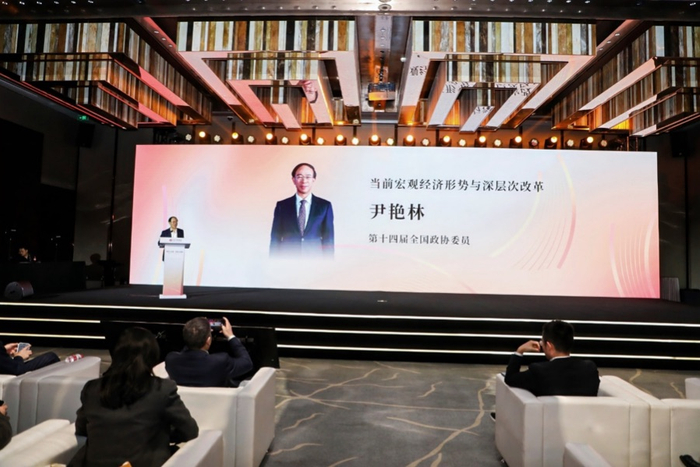
尹艳林:当前的经济形势与深层次改革
Xin Lang Cai Jing· 2026-01-12 12:33
Core Viewpoint - The current macroeconomic situation in China is characterized by both achievements and challenges, necessitating deep reforms alongside supportive policies to ensure stable growth and address existing issues [4][5][6]. Economic Performance - In 2025, China's GDP growth reached 5.2% in the first three quarters, an increase of 0.4 percentage points compared to the previous year, with an expected annual growth rate of around 5% and a total economic output projected to reach 140 trillion yuan [4][14]. - The consumer goods market saw significant activity, with sales from the "old-for-new" policy exceeding 2.5 trillion yuan, including over 11.2 million vehicle upgrades and more than 120 million home appliance upgrades [4][14]. - Industrial profits for large-scale enterprises increased by 1.9% from January to October, indicating improved corporate performance [5][14]. Challenges in the Economy - There are notable issues such as insufficient effective demand, with recent months witnessing negative growth in investment and overall weak consumption [6][15]. - Price levels remain low, with the Consumer Price Index (CPI) fluctuating around zero for two consecutive years and the Producer Price Index (PPI) experiencing three years of negative growth [6][15]. - Employment and income growth pressures are significant, as highlighted in the "15th Five-Year Plan," indicating a need for focused strategies to enhance job creation and income distribution [6][15]. Policy Recommendations - The Central Economic Work Conference emphasized the need for more proactive macroeconomic policies, including maintaining necessary fiscal deficits and increasing central budget investments to support key projects [7][17]. - A flexible monetary policy is recommended to promote stable economic growth and reasonable price recovery, utilizing tools like reserve requirement ratio cuts and interest rate reductions [8][17]. - The government is urged to implement reforms in income distribution, enhance support for low-income groups, and improve the overall income structure to stimulate domestic demand [9][18]. Reform Initiatives - The focus on deep reforms includes addressing barriers in talent mobility between public institutions and enterprises, enhancing the role of innovation in driving economic growth, and improving the financial system to better support technological advancements [10][19]. - The government aims to enhance the synergy between policy support and reform innovation to foster a favorable economic environment and improve market expectations [10][19].
尹艳林:制定实施城乡居民增收计划,需配套推进收入分配改革
2 1 Shi Ji Jing Ji Bao Dao· 2026-01-12 09:27
Economic Overview - The GDP growth for the first three quarters of 2025 is 5.2%, an increase of 0.4 percentage points compared to the same period last year, with an expected annual growth rate of around 5% and a total economic output projected to reach 140 trillion yuan [3][5][6] - The industrial structure is continuously optimizing, with emerging industries such as artificial intelligence, biomedicine, and robotics flourishing and ranking among the world's leaders [6][8] Challenges in the Economy - There are significant issues such as insufficient effective demand, low price levels, difficulties faced by some enterprises, pressure on employment and resident income growth, and low growth rates in fiscal revenue and expenditure [7][8] - Investment has shown negative growth for several months, and overall consumption remains weak [7] - The Consumer Price Index (CPI) has fluctuated around 0 for two consecutive years, while the Producer Price Index (PPI) has experienced negative growth for three years [7] Policy Recommendations - The government is urged to implement more proactive macroeconomic policies, including maintaining necessary fiscal deficits and total debt levels, and increasing central budget investments to support infrastructure projects [9][10] - A focus on income distribution reform is necessary, including increasing basic pensions for urban and rural residents, optimizing personal income tax policies, and improving the salaries of public sector employees to boost overall income [10][11] Financial Sector Reforms - Enhancing the vitality of the capital market requires reforms, including the establishment of a financial system that aligns with technological innovation [4][11] - Commercial banks are encouraged to better serve innovation by exploring pilot programs for investment and loan linkage, which involves deep adjustments to the financial system [4][11]
高标准建设海南自由贸易港更需弘扬特区精神
Hai Nan Ri Bao· 2025-12-20 23:14
Core Viewpoint - The construction of Hainan Free Trade Port is driven by high-level openness that necessitates deep reforms, which in turn promote high-quality development. The emphasis is on innovation and a pioneering spirit to address new challenges post-closure [1] Group 1: Role as a "Test Field" - The "test field" function is to explore and prioritize reforms, which entails both potential benefits and risks. The greatest risk lies in not reforming at all, and the only way forward is to utilize reform priorities effectively [2] Group 2: Role as an "Important Gateway" - As an "important gateway," Hainan must take on the role of a leader in China's new era of openness, focusing on national needs and local capabilities. This involves venturing into uncharted territories and actively participating in established areas [3] Group 3: Role as a "Shining Business Card" - The "shining business card" function is to showcase tangible results, which require significant effort. Hainan aims to demonstrate that China's doors to openness will continue to expand, and that balanced development and common prosperity are achievable [4] Group 4: High Standards in Construction - High standards in construction involve achieving a high level of openness, aligning with international trade rules, and ensuring high-quality development supported by a strong industrial foundation. This includes safeguarding safety, ecology, and public welfare [5][6] Group 5: Reform and Innovation - High-level openness and quality development require high starting point reforms that focus on integrated institutional innovation. This approach should be tailored to China's unique context and Hainan's development goals, avoiding superficial or reckless actions [6][7]
《求是》杂志发表韩文秀的重要文章《深刻领会因地制宜发展新质生产力的重要论述和决策部署》|宏观经济
清华金融评论· 2025-11-17 10:38
Core Viewpoint - The article emphasizes the importance of understanding and implementing Xi Jinping's discourse on developing new quality productivity in accordance with local conditions, which is crucial for establishing a solid material and technological foundation for Chinese-style modernization [3][4]. Summary by Sections Understanding New Quality Productivity - New quality productivity is characterized by innovation, moving away from traditional economic growth models, and is defined by high technology, high efficiency, and high quality, aligning with advanced production quality [5][6]. - Innovation is the core element of new quality productivity, encompassing technological, business model, management, and institutional innovations [6][7]. Key Characteristics - The focus is on quality improvement rather than just quantitative growth, with an emphasis on optimizing the combination of production factors to enhance overall productivity [7][8]. - New quality productivity signifies advanced productivity, which includes higher-skilled labor, advanced technological tools, and a broader range of labor objects, reflecting the evolution of production factors [8]. Basic Requirements for Development - The development of new quality productivity must respect and understand development laws, including the integration of market and government roles, and the importance of both basic and applied research [10][11]. - Regions should leverage their unique resources and industrial foundations to promote new industries and models, ensuring that traditional industries are not neglected but rather enhanced through new technologies [12][13]. Core Drivers and Systemic Support - Strengthening independent innovation is crucial, focusing on original and disruptive technological advancements, and fostering a robust innovation ecosystem [14][15]. - Building a modern industrial system is essential, balancing the upgrade of traditional industries with the development of strategic emerging industries [15][16]. Market and Reform Initiatives - Establishing a strong domestic market is vital for the growth of new quality productivity, emphasizing the role of consumption and investment in driving economic activity [16][17]. - Deepening reforms to create a supportive environment for innovation and productivity development is necessary, including optimizing the allocation of production factors and enhancing the financial system [17][18]. International Cooperation - Expanding high-level openness is important for integrating into the global economy, facilitating the flow of advanced production factors, and enhancing international collaboration [18].

好书推荐·赠书 |《匹配》《深层次改革》
清华金融评论· 2025-11-14 09:09
Group 1 - The core viewpoint of the article emphasizes the importance of understanding the underlying rules and mechanisms in resource allocation, as highlighted by Nobel laureate Alvin E. Roth in his book "Matching" [3][4][5] - Roth's work illustrates that resource distribution is not solely determined by price but also by a comprehensive set of rules and institutions, which can transform passive participants into informed players [4][5] - The book serves as a guide to understanding the hidden rules that govern various aspects of life, from education to job selection, and encourages readers to recognize and seize genuine opportunities [4][5] Group 2 - The article introduces another book titled "Deep Reforms" by Yin Yanlin, which focuses on the deep-seated issues within China's economic system and proposes reform directions [8][9] - The book is structured into four parts, addressing the meaning of deep reforms, analyzing current economic challenges, suggesting specific reform directions, and providing recommendations for ensuring the smooth implementation of reforms [8][9] - Yin Yanlin's expertise in macroeconomic policy and economic system reform is highlighted, showcasing his influence in both policy-making and academic circles [9]

张玉卓:持续推动央企与各类企业共享机遇、共谋发展、共创未来
Zheng Quan Shi Bao Wang· 2025-11-03 12:18
Core Viewpoint - The eighth China Enterprise Forum emphasizes the importance of strategic determination and innovation enhancement for Chinese enterprises in the context of the 14th Five-Year Plan and the broader goal of achieving socialist modernization [1][3]. Group 1: Industry Development - Enterprises are encouraged to enhance quality and upgrade industries by focusing on intelligent, green, and integrated development, optimizing traditional industries, and nurturing emerging sectors to create a "second curve" of growth [1][2]. - The establishment of a modern industrial system centered on advanced manufacturing is crucial for strengthening the foundation of the real economy and ensuring sustainable economic development [1]. Group 2: Technological Innovation - There is a call for promoting self-reliance in technology by increasing research and development investments, focusing on original innovations, and accelerating the application of major technological achievements [2]. - The integration of technological and industrial innovation is essential for significantly improving self-reliance in technology and developing new productive forces [2]. Group 3: Corporate Governance - The need for deep reforms in corporate governance is highlighted, advocating for a shift from experience-based decision-making to data-driven insights, and from control-oriented structures to empowering economic organizations [2]. - Enhancing the modern enterprise system and promoting entrepreneurial spirit are vital for improving overall productivity and establishing a high-level socialist market economy [2]. Group 4: Cooperation and Development - The forum stresses the importance of mutual cooperation and win-win development, encouraging enterprises to focus on their strengths, avoid internal competition, and engage in practical collaborations in technology, industry, and talent [2]. - A commitment to open development and growth through competition is essential for sustaining a favorable environment for various business entities [2][3].
和中财办原副主任尹艳林聊了两小时:房价、股市、“十五五”和改革
经济观察报· 2025-10-10 11:56
Group 1 - The current economic situation in China is characterized by insufficient demand, necessitating new incremental policies to stimulate growth [3][20][32] - The real estate market is identified as a crucial area for implementing incremental policies due to its strong impact on the economy [5][18][28] - The need for deep reforms in three key areas: income distribution reform, fiscal and tax system reform, and investment system reform to encourage private sector investment [7][43][45] Group 2 - The "anti-involution" policy is aimed at addressing excessive competition in certain industries, particularly in emerging sectors like renewable energy and technology [3][10][12] - The importance of preventing the misinterpretation of "anti-involution" as a move against platform economies or private enterprises [3][12][16] - The necessity for a balanced approach to market competition, emphasizing legal frameworks to guide behavior rather than administrative controls [11][12][14] Group 3 - The need for macroeconomic policies to focus on stimulating demand, with suggestions for lowering interest rates and potentially implementing a form of quantitative easing [8][45] - The role of local governments in maintaining redundant capacities and the challenges they pose to market dynamics [16][17] - The potential for urbanization to drive economic growth, with a focus on improving public services and reducing administrative barriers [29][30]
和中财办原副主任尹艳林聊了两小时:反内卷、房价、股市、“十五五”和改革
Jing Ji Guan Cha Wang· 2025-10-10 08:58
Economic Policy and Market Stability - The core issue in the current Chinese economy is insufficient demand, necessitating new incremental policies to stimulate growth [3][16] - Real estate should be a breakthrough point for these policies, as it has a stronger driving effect compared to the capital market [3][26] - The "9.24" policy aimed to stabilize the real estate market, but its effects are becoming localized rather than comprehensive [18][26] Reform Initiatives - Three key areas for reform include income distribution reform, fiscal and tax system reform, and investment system reform [5][44] - Income distribution reform should focus on adjusting personal income tax rates and lowering social security contribution rates to increase disposable income [35][36] - The fiscal system needs to clarify the relationship between central and local governments to enhance local financial autonomy [44] Real Estate Market Dynamics - The real estate market is transitioning from a phase of "demand overheating" to "demand insufficiency," requiring a shift in policy tools from suppressing price increases to supporting price growth [19][20] - Current housing policies are more focused on restrictions rather than support, which could reinforce negative price expectations [20][27] - The market's financial attributes should not be overlooked, as real estate remains a crucial asset for households [21][22] Investment and Consumption - A new round of large-scale investment plans is necessary to stimulate the economy, particularly in real estate, which can drive both investment and consumption [17][26] - Urbanization is still a significant driver of economic growth, with potential for further development in cities [28][29] - The relationship between investment and consumption needs to be improved, with a focus on stabilizing the real estate market to enhance consumer confidence [17][26] Market Competition and "Involution" - The concept of "involution" is being misapplied across various industries, and not all sectors require a response to it [6][7] - Legal frameworks should guide market competition to avoid administrative overreach that could stifle innovation and competition [9][10] - The focus should be on maintaining healthy market competition rather than imposing blanket restrictions that could harm smaller enterprises [9][10] Future Economic Growth - The potential for GDP growth during the "15th Five-Year Plan" period is projected to exceed 5% if demand issues are addressed [30][31] - The upcoming period is seen as critical for foundational development and comprehensive efforts to achieve modernization goals [31][44]