港股市场投资

Search documents
集体拉升!刚刚,港股市场突传大消息!
天天基金网· 2026-03-16 05:15
Core Viewpoint - The Hong Kong stock market is showing resilience and strength compared to other global markets, with significant interest from Middle Eastern investors looking to reallocate assets to Hong Kong amid ongoing geopolitical tensions in the Middle East [2][4][7]. Group 1: Market Performance - The Hang Seng Technology Index rose over 1%, while the Hang Seng Index and the National Enterprises Index also saw collective gains, contrasting sharply with declines in indices like Japan's Nikkei and South Korea's KOSPI [2][4]. - Michael Burry, a prominent investor known for short-selling, stated that the decline in the Hang Seng Technology Index is primarily due to multiple compressions, indicating that the index is undervalued despite being in a bear market [4]. Group 2: Middle Eastern Investment Interest - There has been a noticeable increase in inquiries from Middle Eastern clients regarding investment opportunities in Hong Kong, including the establishment of family offices [7][8]. - High-net-worth families from the Middle East, some of whom had previously relocated to Singapore or Dubai, are considering reallocating part of their assets back to Hong Kong [7]. - The Hong Kong Financial Secretary noted that the current geopolitical situation presents both risks and opportunities for Hong Kong, highlighting its safety and stability compared to other regions [8]. Group 3: Family Office Trends - A recent report indicated that 91% of surveyed family offices have established a presence in Hong Kong, with plans to increase their investment in risk products from 54% to 78% over the next three years [8]. - Hong Kong has successfully attracted a target of 200 family offices within three years, achieving this goal ahead of schedule, and ranks second globally in terms of the number of ultra-high-net-worth individuals [8].


恒生指数创新高,金融股发力、科技股落后
Di Yi Cai Jing· 2026-01-28 06:00
Core Viewpoint - The Hong Kong stock market, led by financial stocks like HSBC and AIA, has reached new highs, but trading volumes remain lower compared to previous peaks, indicating a potential for a volatile market ahead [1][4]. Group 1: Market Performance - The Hang Seng Index opened high on January 28, reaching a midday close of 27,725 points, surpassing the previous high of 27,381 points from October 2, 2025 [1]. - Daily trading volumes have been around HKD 3 billion, with January 27's volume at HKD 257.3 billion, significantly lower than the peak of over HKD 410 billion in September 2025 [1][4]. - Financial stocks have driven the recent market rally, contrasting with the tech-led growth seen four months prior, where tech stocks like Tencent and Alibaba had much higher trading volumes [1][3]. Group 2: Stock Performance and Weighting - On January 27, HSBC traded HKD 2.73 billion, up 2.67%, while AIA traded HKD 2.715 billion, up 4.09% [2]. - In contrast, tech stocks like Tencent had trading volumes exceeding HKD 20 billion in September 2025, while recent volumes for Alibaba have dropped from over HKD 40 billion to just above HKD 10 billion [2][3]. - As of December 31, 2025, HSBC held an index weight of 8.98%, AIA at 5.24%, Tencent at 7.91%, and Alibaba at 7.41%, indicating a significant presence of financial stocks in the index despite lower trading volumes [2]. Group 3: Market Outlook - Analysts suggest that the current market lacks significant new capital inflows, with southbound capital flows showing signs of decline [4]. - The market sentiment remains cautious, with expectations for continued volatility and a focus on stock selection rather than broad index movements [4][5]. - There is an emphasis on identifying structural opportunities in sectors like advanced manufacturing and semiconductors, as well as in financially stable industries [5][6].




公募加大布局港股力度 首只千亿级份额港股主题ETF诞生
Shang Hai Zheng Quan Bao· 2026-01-27 18:36
Group 1 - The Hong Kong stock market has become a significant focus for public funds, with a notable increase in the number of new Hong Kong-themed funds reported since 2026, totaling 26 new products [1] - The new funds primarily target sectors such as technology, pharmaceuticals, and cyclical industries, indicating a broadening investment strategy [2][1] - The net inflow into Hong Kong-themed ETFs has reached nearly 30 billion yuan, with the first Hong Kong-themed ETF surpassing 100 billion yuan in shares [1][3] Group 2 - The pharmaceutical sector in Hong Kong is attracting institutional interest, with a shift in focus from just innovative drugs to the entire pharmaceutical field, as evidenced by multiple new fund reports [2] - The cyclical sector is also gaining attention due to rising resource prices, with several funds targeting this area being reported [2] - The total net inflow into Hong Kong-themed ETFs was 3,673.54 billion yuan in 2025, with a significant increase to 811.94 billion yuan by January 26, 2026 [3] Group 3 - The ongoing volatility in the Hong Kong market has not deterred investment enthusiasm, with expectations of growth driven by global capital inflows and steady recovery in the Chinese economy [4] - Policy support for technology innovation and consumption upgrades is expected to benefit growth sectors within the Hong Kong market [4] - Potential interest rate cuts by the Federal Reserve may lower corporate financing costs, further enhancing the valuation recovery of growth stocks [4]
机构称一季度港股风险偏好有望提高,持续关注恒生中国企业ETF易方达(510900)等产品投资机会
Mei Ri Jing Ji Xin Wen· 2026-01-08 10:17
Group 1 - The Hang Seng Index closed down by 1.2%, the Hang Seng China Enterprises Index fell by 1.1%, and the CSI Hong Kong Stock Connect China 100 Index decreased by 0.9% [1] - According to Industrial Securities, in the medium term, by 2026, the profitability and liquidity of Hong Kong stocks are expected to drive market trends in tandem, with changes in risk appetite likely to show a pattern of "initial rise, followed by decline, then rise again and decline" [1] Group 2 - The Hang Seng ETF managed by E Fund tracks the Hang Seng Index, which consists of large-cap, actively traded stocks with strong industry representation, covering sectors such as finance, consumer discretionary, and information technology, which together account for nearly 80% of the index [2] - The Hang Seng China Enterprises ETF also managed by E Fund tracks the Hang Seng China Enterprises Index, composed of 50 large-cap, actively traded stocks listed in Hong Kong, with consumer discretionary, information technology, finance, and energy sectors making up nearly 85% of the index [2] - The Hong Kong Stock Connect 100 ETF, also managed by E Fund, tracks the CSI Hong Kong Stock Connect China 100 Index, which includes 100 large-cap, actively traded companies within the Hong Kong Stock Connect scope, with consumer discretionary, finance, and information technology sectors exceeding 70% of the index [2]

翻1倍!翻2倍!2025年A股基金前20强,交卷!
券商中国· 2025-12-29 07:01
Core Viewpoint - In the context of the investment wave towards Hong Kong stocks in 2025, a group of fund managers focusing on core technology assets in the A-share market have achieved impressive performance by deeply cultivating their areas of expertise [1] Group 1: Performance of A-share Funds - The top 20 A-share fund products in terms of performance this year have returns ranging from 125% to 236% [2] - These top-performing funds have generally maintained low exposure to Hong Kong stocks, with most having less than 10% allocation or zero holdings, ensuring a high concentration of core A-share assets [2][3] - The strategy of focusing on A-shares rather than diversifying into Hong Kong stocks reflects a rational assessment of market pricing efficiency and the fund managers' comparative advantages [3] Group 2: Investment Strategy and Market Dynamics - A-share market pricing reacts more directly and fully to local hot sectors, allowing for better capture of market opportunities by maintaining high positions in core A-share assets [4] - The low allocation to Hong Kong stocks among top-performing A-share funds indicates the importance of adapting investment strategies to different market characteristics [5] - Funds that heavily invested in Hong Kong stocks without adjusting their strategies often underperformed, highlighting the need for a deep understanding of market rules [6] Group 3: Differences in Investment Logic - A-share fund managers tend to focus on growth potential and sector performance, while professional Hong Kong fund managers prioritize financial quality, cash flow, and dividend potential [7] - The contrasting investment logic between A-share and Hong Kong funds is evident, as some high-growth stocks favored by A-share managers may not align with the preferences of Hong Kong investors [7][9] Group 4: Insights from Professional Fund Managers - Professional Hong Kong fund managers emphasize the importance of understanding liquidity risks and the unique pricing mechanisms of the Hong Kong market [8] - They suggest that A-share fund managers need to invest additional effort to learn and adapt to the characteristics of the Hong Kong market [8] - The focus on high dividend potential and quality growth in Hong Kong stocks offers A-share fund managers alternative strategies for expanding their investment capabilities [9]

港股宽基指数延续调整,关注恒生中国企业ETF (510900)等产品投资价值
Mei Ri Jing Ji Xin Wen· 2025-12-11 05:08
Core Viewpoint - The Hang Seng Index fell by 1.3%, the Hang Seng China Enterprises Index decreased by 1.6%, and the CSI Hong Kong Stock Connect China 100 Index dropped by 1.5% [1] Group 1: Market Outlook - China Galaxy Securities' report indicates that the upcoming important domestic meetings in December, along with the Federal Reserve's interest rate meeting, are expected to provide medium to long-term policy direction and short-term liquidity signals for the Hong Kong stock market [1] Group 2: Investment Recommendations - The report suggests focusing on sectors such as precious metals, domestic consumption, and technology growth for investment opportunities [1]

申万宏源王胜:在本轮牛市巅峰,中国股市可能会出现全球市值最大的公司
Xin Lang Zheng Quan· 2025-11-26 02:42
Group 1 - The core viewpoint is that during the peak of the current bull market, China is likely to see the emergence of the largest company by market capitalization globally, which could be listed in either the A-share or Hong Kong stock market [1][2]. Group 2 - The company emphasizes the importance of categorizing all companies under the Hong Kong Stock Connect according to a unified standard for horizontal industry comparison, which is crucial for investment decision-making [2]. - Due to the absence of a price limit mechanism in the Hong Kong market, it exhibits greater volatility than the A-share market, making it more challenging for individual investors to participate [2]. - For ordinary investors, it is recommended to adopt a diversified investment approach, utilizing professional institutions or products with a high proportion of southbound capital, or through ETFs and other professional tools for more stable allocation [2].

跨境投资洞察系列之一:港股基金找不同
Ping An Securities· 2025-09-19 09:17
Market Overview - Since 2010, the Hong Kong stock market has experienced four major uptrends, driven by factors such as liquidity easing and fundamental improvements, particularly in technology stocks[3] - The market has seen a narrowing of style differentiation since 2022, indicating increased difficulty in rotation strategies and shrinking profit margins[3] Investment Trends - Passive funds dominate the Hong Kong market, accounting for over 80% of funds focused on this market, with approximately 80% of these being industry-themed funds, primarily in technology[3] - Active funds are predominantly all-market funds, with 91% of them focusing on balanced allocations to adapt to market changes[3] Fund Performance - Active Hong Kong funds have shown significant excess returns during growth-dominant markets, particularly in technology and healthcare sectors, outperforming passive funds[3] - The average allocation of private equity funds to Hong Kong stocks has increased to 41.21% as of July 2025, reflecting a growing interest in undervalued opportunities[22] Risk Factors - Past performance of funds does not guarantee future results, and regulatory changes may impact the validity of research conclusions[3] Valuation Insights - As of August 22, 2025, the valuation percentile for the Hang Seng Technology Index is at 37%, significantly lower than the A-share technology sector, which is at 100%[21] - The premium of AH shares has decreased, with the Hang Seng-Hushen Connect AH premium at 125, indicating a relative premium for A-shares[21]
中国人寿:新获批QDII额度在配置上会非常关注港股市场
Zheng Quan Shi Bao Wang· 2025-08-28 03:54
Group 1 - The core viewpoint of the article highlights that China Life Insurance is focusing on the Hong Kong stock market for its investment strategy, particularly in the context of newly approved QDII quotas [1] - The Hong Kong stock market has shown significant valuation recovery in the first half of the year, outperforming major global equity indices, making it an attractive option for investment [1] - China Life Insurance has maintained a balanced and stable equity allocation, achieving good returns from its investments in the Hong Kong market during the first half of the year [1] Group 2 - The company plans to continue its investment operations in the Hong Kong stock market in the second half of the year, indicating a sustained interest in this region [1] - The focus on high-dividend and new economy assets in the Hong Kong market is seen as having substantial investment value amid global capital rebalancing [1]

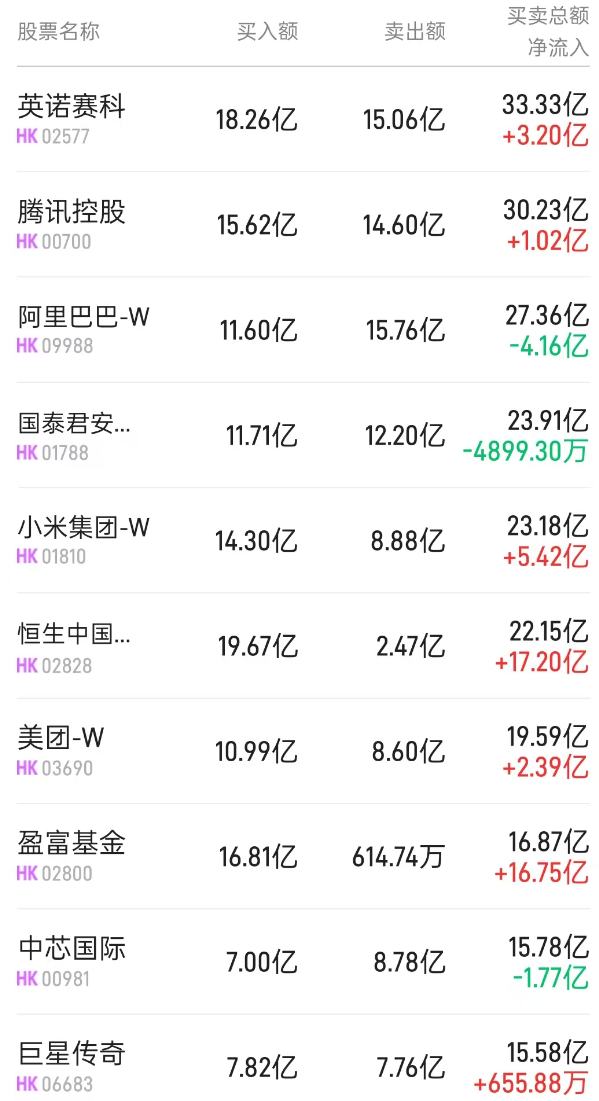
北水成交净买入122.07亿 内资继续加仓港股ETF 抢筹盈富基金超37亿港元
Zhi Tong Cai Jing· 2025-08-01 19:25
Group 1 - On August 1, the Hong Kong stock market saw a net inflow of 12.207 billion HKD from northbound trading, with 5.575 billion HKD from the Shanghai Stock Connect and 6.632 billion HKD from the Shenzhen Stock Connect [2] - The most bought stocks included the Tracker Fund of Hong Kong (02800), Hang Seng China Enterprises (02828), and Xiaomi Group-W (01810), while the most sold stocks were Innovent Biologics (01801), Alibaba-W (09988), and SMIC (00981) [2][8] - Xiaomi Group-W reported over 30,000 vehicle deliveries in July, attributed to increased production capacity, with expectations of 400,000 to 500,000 vehicle sales by 2025 [6] Group 2 - In the technology sector, Tencent (00700), Meituan-W (03690), and Kuaishou-W (01024) saw net inflows of 8.36 billion, 7.66 billion, and 2.02 billion HKD respectively, while Alibaba-W faced a net outflow of 2.02 billion HKD [7] - InnoCare Pharma (02577) received a net inflow of 3.63 billion HKD after being listed as a partner by NVIDIA for its 800V DC power architecture, which is designed for AI data centers [7] - The overall sentiment in the Hong Kong market remains positive, with expectations of a structural uptrend driven by improving fundamentals and policy outlook [6][7]