美国关税政策变动

Search documents
铜:高位拉锯,等待节后破局信号
Ning Zheng Qi Huo· 2026-02-24 10:32
1. Report Industry Investment Rating - No relevant content provided 2. Core Viewpoints - During the Spring Festival holiday, the domestic copper market was closed, while the overseas copper market saw slight increases, with LME copper rising 0.33% and COMEX copper rising 1.29% [1]. - Market sentiment is affected by multiple factors, including geopolitical risks from the repeated Iran - US negotiations, the US plan to impose a 15% general tariff on the world after the Supreme Court's ruling, and the uncertainty of the Fed's policy path, which intensify the market's wait - and - see attitude [1]. - On the supply side, the long - term narrative of tight mine supply provides bottom support, and domestic refined copper production in December increased 11.9% year - on - year, with overall stable supply [1]. - On the demand side, post - holiday spot demand is expected to gradually improve as downstream processing enterprises resume work, but the actual demand recovery intensity needs time to be verified [1]. - Domestic social inventories increased significantly before the holiday, and LME copper inventories also rose sharply after the holiday, with continuous accumulation in COMEX copper inventories, increasing the pressure of visible inventories [1]. - In the short term, copper prices are expected to maintain a volatile pattern, and the substantial recovery of post - holiday peak - season demand will be the key driving variable in the next stage, with attention needed on domestic inventory destocking rhythm and downstream resumption of work [1]. 3. Summary by Relevant Catalogs 3.1 Market Review and Outlook - During the Spring Festival, domestic copper market was closed, and overseas copper prices rose slightly (LME copper +0.33%, COMEX copper +1.29%). Market sentiment is affected by geopolitical risks, US tariff policy, and Fed policy uncertainty. Supply is stable with long - term mine supply tightness, and December refined copper production increased 11.9% year - on - year. Post - holiday demand is expected to improve, but actual recovery needs verification. Visible inventories have increased, and short - term copper prices are expected to be volatile, with post - holiday demand recovery as a key factor [1]. 3.2 Factors to Watch - US tariff policy changes and post - holiday demand recovery are important factors. Weekly data shows that the price of electrolytic copper in Shanghai increased 0.65% (from 99,625 to 100,275 yuan/ton), the electrolytic copper premium in Shanghai decreased 120% (from 25 to - 5 yuan/ton), the clean copper concentrate forward spot comprehensive index (TC) decreased 0.08% (- 0.04 to - 51.17 dollars/dry ton), the oxygen - free copper rod price increased 0.03% (from 101,240 to 101,270 yuan/ton), LME copper inventories increased 31.95% (from 183,275 to 241,825 tons), SHFE copper inventories increased 9.47% (from 248,911 to 272,475 tons), and COMEX copper inventories increased 1.93% (from 589,081 to 600,436 short tons) [1][2]. 3.3 This Week's Fundamental Data Weekly Changes - No detailed content provided other than the title [3] 3.4 Futures Market Review - Figures of the Shanghai copper market trend, London copper market trend, and the Shanghai - London ratio (without excluding exchange rate) are provided, but no specific analysis content [4][5][7] 3.5 Supply Situation Analysis - Figures related to copper concentrate forward spot prices, rough copper spot processing average prices, copper concentrate port inventories, domestic electrolytic copper production, electrolytic copper and scrap copper price change trends, and main market refined - scrap price differences are presented, but no specific analysis [11][13] 3.6 Demand Situation Analysis - Figures of 1 electrolytic copper premium in Shanghai, copper product prices, copper product capacity utilization rates, refined copper rod trading volumes, Yangshan copper bonded premiums, and electrolytic copper warehouse receipt bill of lading premiums are provided, but no specific analysis [14][15][17] 3.7 Inventory Situation Analysis - Figures of electrolytic copper spot inventories and inventories of three major futures exchanges are presented, but no specific analysis [22][23]
中国中免跌停 公司回应
Xin Lang Cai Jing· 2026-02-24 02:19
Core Viewpoint - The duty-free retail sector has experienced a significant decline, with China Duty Free Group hitting its daily limit down, alongside other companies such as Hainan Airlines Group, Caesar Travel, Hainan Development, and Zhuhai Duty Free Group following suit [1][2]. Company Summary - China Duty Free Group's spokesperson stated that the company has no undisclosed information that should have been revealed, suggesting that the stock price fluctuations may be related to changes in U.S. tariff policies [1][2].

银价狂飙为哪般
Qi Lu Wan Bao· 2025-12-11 01:51
Core Viewpoint - Silver prices have surged to historic highs, driven by multiple factors including a weakening dollar, changes in U.S. tariff policies, and supply shortages, with expectations of further interest rate cuts by the Federal Reserve [2][3]. Group 1: Price Movements - On December 10, spot silver prices reached $60 per ounce, marking a historic high, with London silver peaking at $61.607 per ounce, up over 110% from the year's low [2]. - The main contract for silver in China also hit a record high of 14,420 yuan per kilogram [2]. - Year-to-date, silver prices have outperformed gold, which is currently around $4,200 per ounce with a 60% increase this year [2]. Group 2: Supply and Demand Dynamics - The World Silver Association reported that industrial silver demand has increased by approximately 18% over the past four years, with industrial uses accounting for about 50% of total silver demand [3]. - Global silver production is expected to be around 813 million ounces this year, slightly lower than in 2021, with limited new mining capacity contributing to supply constraints [4]. - The rising demand for silver in industries such as electric vehicles and solar panels is a significant driver of this increased industrial demand [3]. Group 3: Market Sentiment and Investment Trends - There has been a notable increase in demand for physical silver in markets like Shenzhen, with reports of a surge in purchases of silver bars and jewelry [6]. - Investors are shifting from gold to silver due to the latter's lower price point and perceived greater upside potential [6]. - Analysts have mixed views on silver's future, with some predicting further price increases while others caution about potential corrections [7][9]. Group 4: Risks and Volatility - Silver is characterized by higher volatility compared to gold, with significant price fluctuations observed, including a notable drop of over 8.7% in late October [8][9]. - The price spread between buying and selling silver is larger than that of gold, making it more challenging for investors to realize gains [7]. - Experts warn that if silver prices continue to rise, alternative materials may be adopted in industries like photovoltaics, potentially reducing future demand [8].


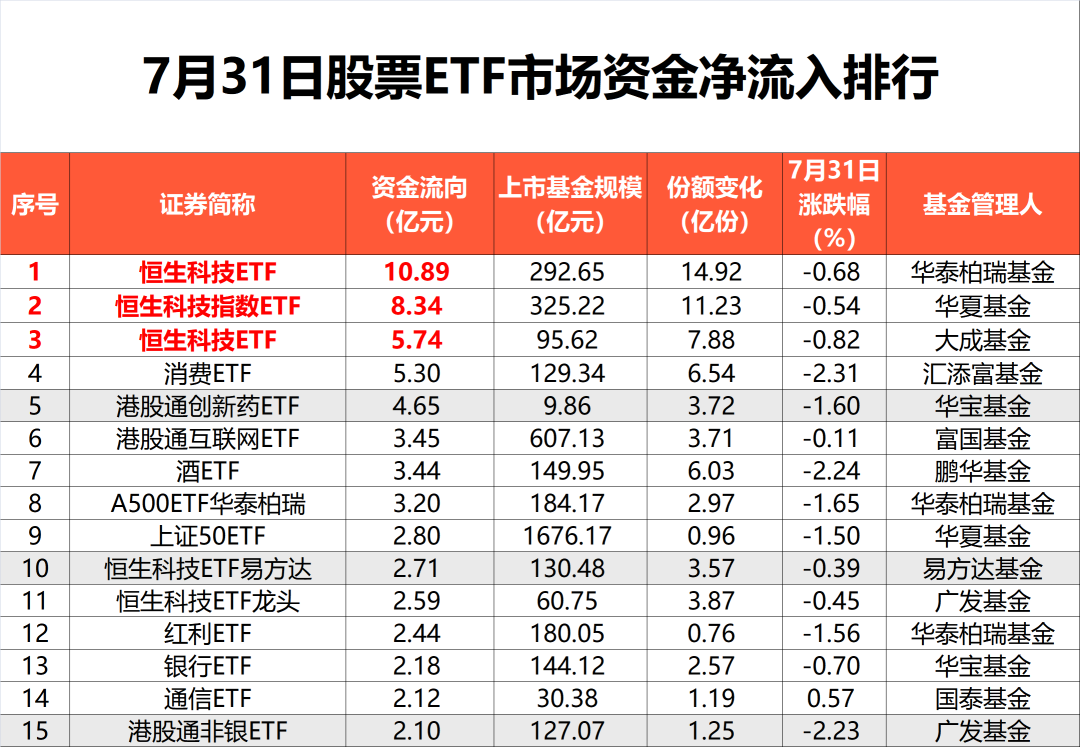
突然!超100亿,“跑了”
Zhong Guo Ji Jin Bao· 2025-08-01 05:33
Group 1 - The core point of the article highlights a significant net outflow of over 10 billion yuan from the stock ETF market on the last trading day of July, coinciding with a drop in the A-share market where all three major indices fell by more than 1% [1][2][3] - In July, the stock market experienced substantial gains, leading to profit-taking by investors, which contributed to the net outflow from stock ETFs [2][8] - The total scale of the stock ETF market reached 3.77 trillion yuan, with a reduction of 6.628 billion units in total shares on the day of the market decline [3][4] Group 2 - The net inflow of funds was observed in the Hang Seng Technology Index, which saw a net inflow of 3.305 billion yuan, indicating a preference for this index amidst the overall market downturn [4][5] - Major fund companies, such as E Fund and Huaxia Fund, reported significant net inflows in their ETFs, particularly in the Hang Seng Technology ETFs, despite the overall market decline [7][8] - The outflow of funds was predominantly from broad-based ETFs, with the ChiNext ETF and the Sci-Tech 50 ETF experiencing the largest net outflows of 1.956 billion yuan and 1.765 billion yuan, respectively [9][10] Group 3 - Looking ahead to August, several institutions express optimism for continued upward movement in the A-share market, supported by improving fundamentals and liquidity conditions [12] - The upcoming earnings reports are expected to show marginal improvements in sectors such as technology, consumption, and midstream manufacturing, which may further support market performance [12]
高频数据跟踪:物价边际回暖,航运指数上行
China Post Securities· 2025-06-09 10:01
Group 1: Report Information - The report is a fixed - income report released on June 9, 2025 [1] - Analysts are Liang Weichao (SAC registration number: S1340523070001) and Cui Chao (SAC registration number: S1340523120001) [2] Group 2: Core Viewpoints - High - frequency economic data focuses on four aspects: production is stable with a slight decline, real estate shows continuous marginal improvement, prices have a marginal recovery, and shipping indices continue to rise significantly. Short - term attention should be paid to the implementation of new growth - stabilizing stimulus policies, the recovery of the real estate market, and changes in US tariff policies [2][31] Group 3: Production - In the week of June 6, the capacity utilization rate of coke ovens decreased by 0.15 pct, the blast furnace operating rate decreased by 0.31 pct, and the output of rebar decreased by 7.05 tons. The operating rate of petroleum asphalt increased by 3.6 pct, the PX operating rate increased by 4.91 pct, and the PTA operating rate increased by 6.1 pct. The operating rate of all - steel tires decreased by 1.33 pct, and the operating rate of semi - steel tires decreased by 4.39 pct [3][10][11] Group 4: Demand - In the week of June 1, the real estate market continued to improve, with the transaction area of commercial housing rising and the inventory - to - sales ratio falling. The land transaction area increased, and the premium rate of residential land transactions decreased. The movie box office increased by 235 million yuan compared with the previous week. In the week of May 31, the daily average retail sales of automobile manufacturers increased by 34,500 vehicles, and the daily average wholesale sales increased by 80,700 vehicles. In the week of June 6, the shipping index SCFI rose 8.09%, CCFI rose 3.34%, and BDI rose 15.16% [3][14][20] Group 5: Prices - In the week of June 6, Brent crude oil prices rose 4.02% to $66.47 per barrel, coking coal futures prices rose 5.06% to 779 yuan per ton. The LME copper, aluminum, and zinc futures prices changed by +1.83%, +0.12%, and +1.25% respectively, and the domestic rebar futures prices rose 0.64%. The overall price of agricultural products decreased, with the prices of pork, eggs, vegetables, and fruits changing by - 0.97%, - 2.96%, +0.46%, and - 0.64% respectively compared with the previous week [3][22][24] Group 6: Logistics - In the week of June 7, the subway passenger volume in Beijing and Shanghai decreased, and the peak congestion index in first - tier cities continued to decline. In the week of May 28, the number of domestic and international flights decreased [4][27][29]
关税风暴中的外贸厂商:准备两年不赚钱,但大限来临前狠赚了一把
3 6 Ke· 2025-04-24 10:32
Core Insights - The article highlights the significant impact of the U.S. government's tariffs on Chinese imports, particularly a 125% tariff that has led to a drastic reduction in orders and warehouse activity for businesses involved in importing goods from China [1][2][10]. Group 1: Impact of Tariffs - The imposition of high tariffs has caused many importers to either clear their inventory or shift their supply chains to countries like Mexico and Southeast Asia, leading to a significant decline in warehouse activity [2][3]. - Businesses that previously thrived under more favorable conditions are now struggling, with reports of order reductions of up to 30% and significant financial losses due to canceled orders and increased logistics costs [6][11]. - The uncertainty surrounding tariff policies has made it difficult for companies to plan, with some logistics providers increasing their rates significantly in anticipation of further changes [3][20]. Group 2: Business Adaptations - Companies are exploring alternative supply chains, such as relocating production to Vietnam or Mexico, but face challenges including rising tariffs and logistical issues [6][8]. - Some businesses are considering innovative strategies to mitigate costs, such as breaking down products into components to reduce tariff burdens, although this adds complexity and risk to their operations [19][20]. - Despite the challenges, there remains a demand for products in the U.S. market, prompting companies to adapt their strategies to maintain sales and customer relationships [21]. Group 3: Market Dynamics - The article notes that while the U.S. market has become more challenging due to tariffs, there are still opportunities for businesses that can navigate the complexities of the current environment [16][21]. - The ongoing changes in tariff policies and logistics costs are forcing companies to remain agile and responsive to market demands, with some even reporting increased sales as consumers rush to purchase before potential price hikes [14][21]. - The competitive landscape is evolving, with businesses needing to find new ways to sustain operations and profitability amid rising costs and shifting consumer behavior [15][21].